Bhagavad Gita 5.26: meaning and translation
Chapter 5: Karma Sannyasa Yoga. Krishna says
Krishna says that for the renunciates (yatis) who are free from desire and anger, who have mastered their minds and know the self, the peace of Brahman is close at hand.
Click or tap a word for its meaning and its dictionary page.
Text and layers
Text and layers
These choices stay in this browser.
Bhagavad Gita 5.26
कामक्रोधवियुक्तानां यतीनां यतचेतसाम् ।अभितो ब्रह्मनिर्वाणं वर्तते विदितात्मनाम् ॥
Kamakrodhaviyuktanam yatinam yatachetasamAbhito brahmanirvanam vartate viditatmanam
kāmakrodhaviyuktānāṃ yatīnāṃ yatacetasām |abhito brahmanirvāṇaṃ vartate viditātmanām ||
Our explanation Krishna says that for the renunciates (yatis) who are free from desire and anger, who have mastered their minds and know the self, the peace of Brahman is close at hand. The old translations read abhitaḥ in two ways: “near” (Besant) and “on both sides of death” (Telang).
हिंदी अर्थ कृष्ण कहते हैं कि जो यति काम और क्रोध से मुक्त हैं, जिन्होंने अपने चित्त को वश में कर लिया है और आत्मा को जान लिया है, उनके लिए ब्रह्मनिर्वाण पास ही है। पुराने अनुवाद “अभितः” को दो तरह पढ़ते हैं: “निकट” (बेसेंट) और “मृत्यु के दोनों ओर” (तेलंग)।
Word by word
Every word, with its dictionary page
Word by word
- कामक्रोधवियुक्तानाम् kāmakrodhaviyuktānām · free from desire and anger (compound, genitive plural) Dictionary: kāma, Monier-Williams 1899, p. 271, col. 3 “wish, desire, longing”; krodha, Monier-Williams 1899, p. 322, col. 1 “anger, wrath, passion”; vi-yukta, Monier-Williams 1899, p. 981, col. 3 “disjoined, detached, separated or delivered from”
- यतीनाम् yatīnām · for the renunciates (genitive plural) Dictionary: 1. yati, Monier-Williams 1899, p. 841, col. 1 “an ascetic, devotee”
- यतचेतसाम् yatacetasām · who have mastered their minds (compound, genitive plural) Dictionary: yata, Monier-Williams 1899, p. 845, col. 2 “restrained, held in”; cetas, Monier-Williams 1899, p. 398, col. 1 “consciousness, intelligence, thinking soul, heart, mind”
- अभितः abhitaḥ · near, on both sides (indeclinable) Dictionary: abhi-tas, Monier-Williams 1899, p. 61, col. 1 “near to, towards”
- ब्रह्मनिर्वाणम् brahmanirvāṇam · the peace of Brahman (compound, nominative singular) Dictionary: brahma-nirvāṇa, Monier-Williams 1899, p. 739, col. 1 “extinction in Brahmă, absorption into the one self-existent Spirit”
- वर्तते vartate · is (there) (present, 3rd person singular) Dictionary: 1. vṛt, Monier-Williams 1899, p. 1009, col. 1 “to be, live, exist, be found, remain, stay, abide, dwell”
- विदितात्मनाम् viditātmanām · who know the self (compound, genitive plural) Dictionary: vidita, Monier-Williams 1899, p. 963, col. 3 “known, understood”; ātman, Monier-Williams 1899, p. 135, col. 1 “the individual soul, self”
Old translations
Kashinath Trimbak Telang, 1882. Public domain. Page 66.
To the ascetics, who are free from desire and wrath1, and whose minds are restrained, and who have knowledge of the self, the Brahmic bliss is on both sides (of death).
Footnotes (the translator’s own) - Cf. Sutta Nipâta, p. 3. ↩
Compare 3 translations
Kashinath Trimbak Telang, 1882. Public domain. Page 66.
To the ascetics, who are free from desire and wrath1, and whose minds are restrained, and who have knowledge of the self, the Brahmic bliss is on both sides (of death).
Footnotes (the translator’s own) - Cf. Sutta Nipâta, p. 3. ↩
You are reading this one
Annie Besant, 1895. Public domain. Page 63.
Near to the Nirvâna of Brahman approach those who know themselves, who are disjoined from desire and passion, subdued in nature, of subdued thoughts.
You are reading this one
Swami Swarupananda, 1909 (first printed 1907). Public domain. Page 118.
Released from lust and anger, the heart controlled, the Self realised, absolute freedom is for such Sannyasis, both here and hereafter.
You are reading this one
Cite this verse
The translation: K. T. Telang, The Bhagavadgîtâ (The Sacred Books of the East, vol. VIII, Oxford: Clarendon Press, 1882), p. 66. Bhagavad Gita 5.26.
The translation: Annie Besant, The Bhagavad Gîtâ, or The Lord's Song (London: Theosophical Publishing Society, 1895), p. 63. Bhagavad Gita 5.26.
The translation: Swami Swarupananda, Srimad-Bhagavad-Gita (Mayavati: Prabuddha Bharata Press, 1909; first printed in Prabuddha Bharata, 1907–1909), p. 118. Bhagavad Gita 5.26.
Our explanation: “Bhagavad Gita 5.26: meaning and translation.” Pujadeep. Updated October 25, 2026. https://pujadeep.com/bhagavad-gita/5/26/
Pujadeep’s explanations are free to quote with credit: name Pujadeep and link to the page. How to credit
Classical readings, by school
No readings by school on this verse yet.
Share
Show the ways to share
Send one picture or the text to one chat. The picture names its source and the address of this page.
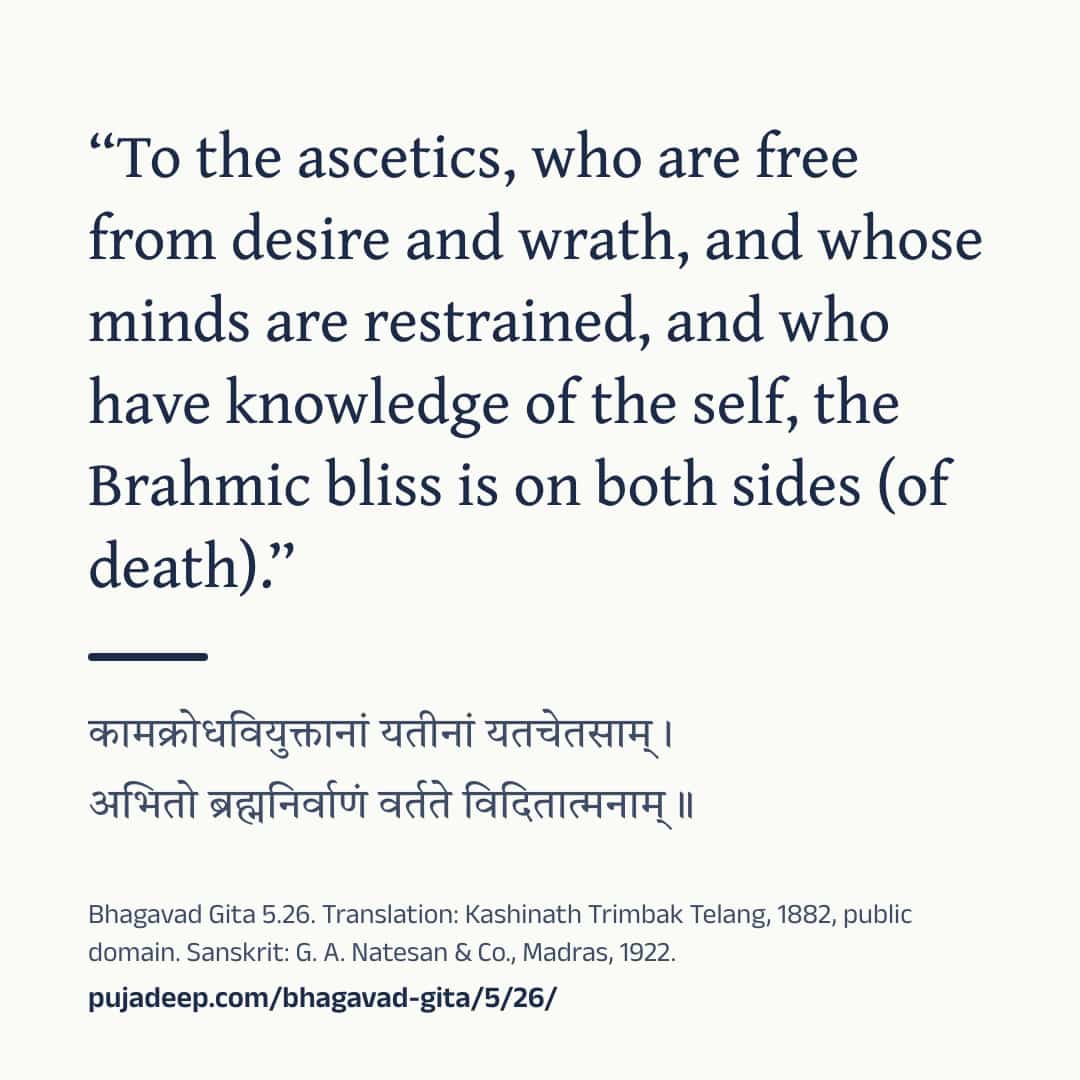
Drawing the picture
See the words
Bhagavad Gita 5.26

कामक्रोधवियुक्तानां यतीनां यतचेतसाम् ।
अभितो ब्रह्मनिर्वाणं वर्तते विदितात्मनाम् ॥

“To the ascetics, who are free from desire and wrath, and whose minds are restrained, and who have knowledge of the self, the Brahmic bliss is on both sides (of death).”
(K. T. Telang, The Bhagavadgîtâ (The Sacred Books of the East, vol. VIII, Oxford: Clarendon Press, 1882), p. 66, public domain)

“Near to the Nirvâna of Brahman approach those who know themselves, who are disjoined from desire and passion, subdued in nature, of subdued thoughts.”
(Annie Besant, The Bhagavad Gîtâ, or The Lord's Song (London: Theosophical Publishing Society, 1895), p. 63, public domain)

“Released from lust and anger, the heart controlled, the Self realised, absolute freedom is for such Sannyasis, both here and hereafter.”
(Swami Swarupananda, Srimad-Bhagavad-Gita (Mayavati: Prabuddha Bharata Press, 1909; first printed in Prabuddha Bharata, 1907–1909), p. 118, public domain)

Sanskrit: G. A. Natesan & Co., Madras, 1922.
https://pujadeep.com/bhagavad-gita/5/26/ Nothing is sent from this site. Your own app sends it, to the chat you choose. The picture quotes the translation you chose on this page, with its name and year.
Sanskrit text: The Bhagavad-Gita, or The Lord's Song, with the text in Devanagari and an English translation, 1922. Meanings: written for Pujadeep and checked against the cited edition. Source and changes
Questions families ask
Who speaks Bhagavad Gita 5.26?
Krishna speaks this verse, in chapter 5 (Karma Sannyasa Yoga).
Where does the Sanskrit text come from?
Sanskrit text: The Bhagavad-Gita, or The Lord's Song, with the text in Devanagari and an English translation, 1922. Meanings: written for Pujadeep and checked against the cited edition. See the source
Is the meaning on this page a translation?
Explanation written for this site from the sources listed here, and checked against the cited edition. It is not a translation and not the only way to read the text. Free to quote with credit.
Source and licence
- Sanskrit text
- The Bhagavad-Gita, or The Lord's Song, with the text in Devanagari and an English translation (Annie Besant, G. A. Natesan & Co., Madras, 1922). Public domain. The Sanskrit on these pages was read from this printing’s page images.
- Translation
- The Bhagavadgîtâ with the Sanatsugâtîya and the Anugîtâ, translated by Kâshinâth Trimbak Telang (The Sacred Books of the East, vol. VIII, ed. F. Max Müller) (Kashinath Trimbak Telang, F. Max Müller, Clarendon Press, Oxford, 1882). Public domain. Shown verbatim, as printed.
- Translation
- The Bhagavad Gîtâ, or The Lord's Song, translated by Annie Besant (Annie Besant, Theosophical Publishing Society, London, 1895). Public domain. Shown verbatim, as printed.
- Translation
- Srimad-Bhagavad-Gita, with Sanskrit Text; Paraphrase with Word-by-word Literal Translation; English Rendering and Comments, Index, &c., by the Swami Swarupananda (Himalayan Series, No. XX) (Swami Swarupananda, The Editors and Publishers, Advaita Ashrama, Mayavati, Prabuddha Bharata Press, Mayavati, Almora, Himalayas, 1909). Public domain. Shown verbatim, as printed.
- Common wording
- In this text, 32 words follow today's common wording, checked against sanskritdocuments.org; Sanskrit Wikisource; Gita Press, Gorakhpur; GRETIL, Göttingen and Bhaktivedanta Book Trust.
- Our explanation
- Explanation written for this site from the sources listed here, and checked against the cited edition. It is not a translation and not the only way to read the text. Free to quote with credit.
- Checked
- Checked against the cited edition, October 15, 2026.
- Updated
- October 25, 2026