Bhagavad Gita 5.16: meaning and translation
Chapter 5: Karma Sannyasa Yoga. Krishna says
Krishna says that in those whose ignorance has been destroyed by knowledge of the self, that knowledge, like the sun, lights up the Supreme.
Click or tap a word for its meaning and its dictionary page.
Text and layers
Text and layers
These choices stay in this browser.
Bhagavad Gita 5.16
ज्ञानेन तु तदज्ञानं येषां नाशितमात्मनः ।तेषामादित्यवज्ज्ञानं प्रकाशयति तत्परम् ॥
Jnanena tu tadajnanam yesham nashitamatmanahTeshamadityavajjnanam prakashayati tatparam
jñānena tu tadajñānaṃ yeṣāṃ nāśitamātmanaḥ |teṣāmādityavajjñānaṃ prakāśayati tatparam ||
Our explanation Krishna says that in those whose ignorance has been destroyed by knowledge of the self, that knowledge, like the sun, lights up the Supreme.
हिंदी अर्थ कृष्ण कहते हैं कि जिनका वह अज्ञान आत्मा के ज्ञान से नष्ट हो गया है, उनका ज्ञान सूर्य की तरह उस परम तत्त्व को प्रकाशित कर देता है।
Word by word
Every word, with its dictionary page
Word by word
- ज्ञानेन jñānena · by knowledge (instrumental singular) Dictionary: jñāna, Monier-Williams 1899, p. 426, col. 1 “knowing, becoming acquainted with, knowledge”
- तु tu · but (indeclinable) Dictionary: 2. tu, Monier-Williams 1899, p. 449, col. 3 “but”
- तत् tat · that (pronoun, nominative singular (neuter)) Dictionary: tad, Monier-Williams 1899, p. 434, col. 1 “that, this”
- अज्ञानम् ajñānam · ignorance (nominative singular (neuter)) Dictionary: a-jñāna, Monier-Williams 1899, p. 10, col. 3 “ignorance”
- येषाम् yeṣām · whose (relative pronoun, genitive plural) Dictionary: yad, Monier-Williams 1899, p. 844, col. 2 “who, which, what, whichever, whatever, that”
- नाशितम् nāśitam · destroyed (past participle, nominative singular (neuter)) Dictionary: nāśita, Monier-Williams 1899, p. 538, col. 1 “destroyed, ruined”
- आत्मनः ātmanaḥ · of the self (genitive singular) Dictionary: ātman, Monier-Williams 1899, p. 135, col. 1 “the individual soul, self”
- तेषाम् teṣām · of them (pronoun, genitive plural) Dictionary: tad, Monier-Williams 1899, p. 434, col. 1 “that, this”
- आदित्यवत् ādityavat · like the sun (indeclinable) Dictionary: āditya, Monier-Williams 1899, p. 137, col. 2 “N. of a god in general, especially of Sūrya (the sun), RV.”; 1. vat, Monier-Williams 1899, p. 915, col. 2 “added to words to imply likeness or resemblance”
- ज्ञानम् jñānam · knowledge (nominative singular (neuter)) Dictionary: jñāna, Monier-Williams 1899, p. 426, col. 1 “knowing, becoming acquainted with, knowledge”
- प्रकाशयति prakāśayati · lights up (causative, present, 3rd person singular) Dictionary: pra-kāś, Monier-Williams 1899, p. 653, col. 1 “to become visible, appear, shine, become evident or manifest”
- तत् tat · that (pronoun, accusative singular (neuter)) Dictionary: tad, Monier-Williams 1899, p. 434, col. 1 “that, this”
- परम् param · the Supreme (accusative singular (neuter)) Dictionary: 1. para, Monier-Williams 1899, p. 586, col. 1 “better or worse than, superior or inferior to, best or worst, highest, supreme, chief”
Old translations
Kashinath Trimbak Telang, 1882. Public domain. Page 65.
But to those who have destroyed that ignorance by knowledge of the self, (such) knowledge, like the sun, shows forth that supreme (principle).
Compare 3 translations
Kashinath Trimbak Telang, 1882. Public domain. Page 65.
But to those who have destroyed that ignorance by knowledge of the self, (such) knowledge, like the sun, shows forth that supreme (principle).
You are reading this one
Annie Besant, 1895. Public domain. Page 61.
Verily, in whom unwisdom is destroyed by the wisdom of the SELF, in them wisdom irradiates that Highest, shining as the Sun.
You are reading this one
Swami Swarupananda, 1909 (first printed 1907). Public domain. Page 113.
But whose ignorance is destroyed by the knowledge of Self,—that knowledge of theirs like the sun, reveals the Supreme (Brahman).
You are reading this one
Cite this verse
The translation: K. T. Telang, The Bhagavadgîtâ (The Sacred Books of the East, vol. VIII, Oxford: Clarendon Press, 1882), p. 65. Bhagavad Gita 5.16.
The translation: Annie Besant, The Bhagavad Gîtâ, or The Lord's Song (London: Theosophical Publishing Society, 1895), p. 61. Bhagavad Gita 5.16.
The translation: Swami Swarupananda, Srimad-Bhagavad-Gita (Mayavati: Prabuddha Bharata Press, 1909; first printed in Prabuddha Bharata, 1907–1909), p. 113. Bhagavad Gita 5.16.
Our explanation: “Bhagavad Gita 5.16: meaning and translation.” Pujadeep. Updated October 25, 2026. https://pujadeep.com/bhagavad-gita/5/16/
Pujadeep’s explanations are free to quote with credit: name Pujadeep and link to the page. How to credit
Classical readings, by school
No readings by school on this verse yet.
Share
Show the ways to share
Send one picture or the text to one chat. The picture names its source and the address of this page.
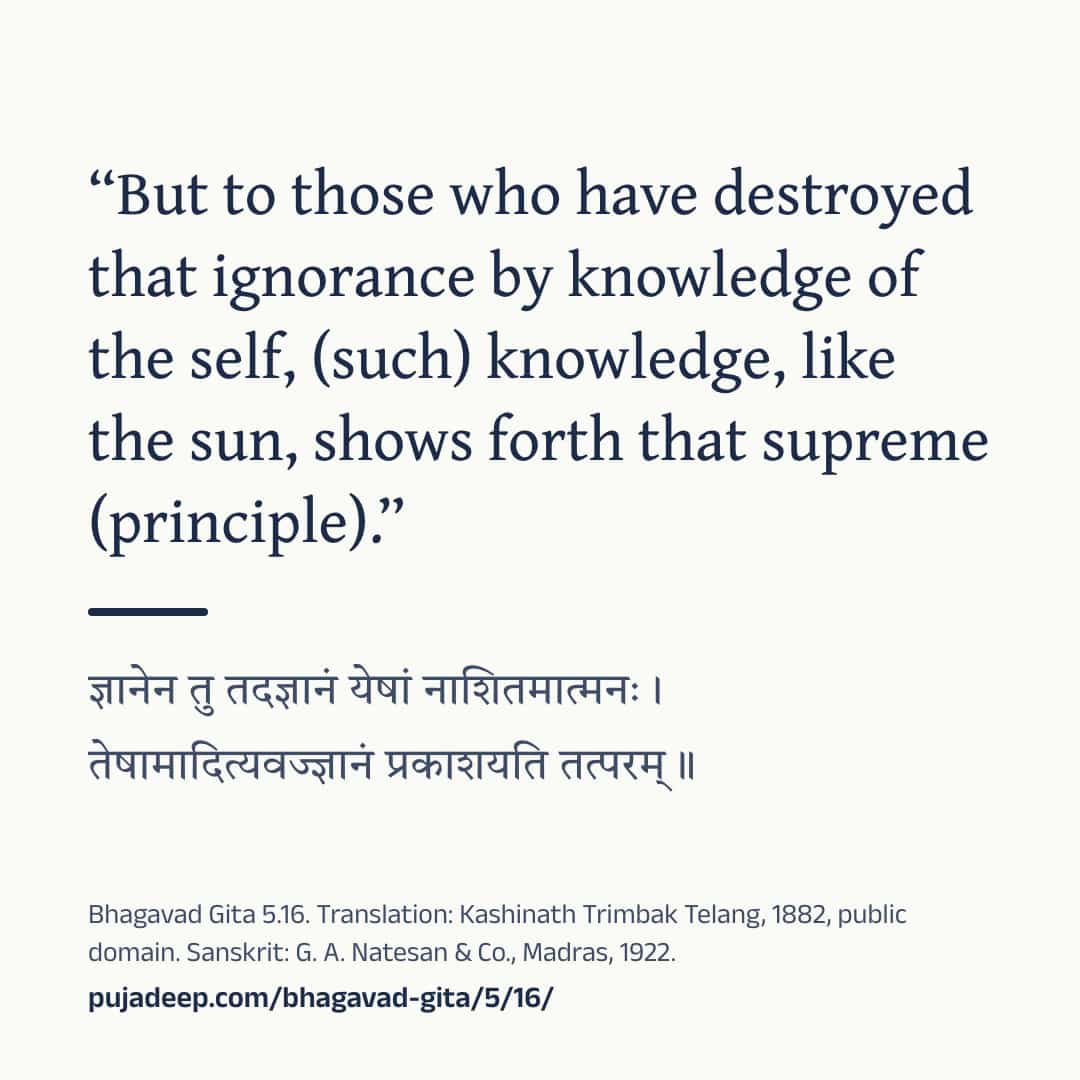
Drawing the picture
See the words
Bhagavad Gita 5.16

ज्ञानेन तु तदज्ञानं येषां नाशितमात्मनः ।
तेषामादित्यवज्ज्ञानं प्रकाशयति तत्परम् ॥

“But to those who have destroyed that ignorance by knowledge of the self, (such) knowledge, like the sun, shows forth that supreme (principle).”
(K. T. Telang, The Bhagavadgîtâ (The Sacred Books of the East, vol. VIII, Oxford: Clarendon Press, 1882), p. 65, public domain)

“Verily, in whom unwisdom is destroyed by the wisdom of the SELF, in them wisdom irradiates that Highest, shining as the Sun.”
(Annie Besant, The Bhagavad Gîtâ, or The Lord's Song (London: Theosophical Publishing Society, 1895), p. 61, public domain)

“But whose ignorance is destroyed by the knowledge of Self,—that knowledge of theirs like the sun, reveals the Supreme (Brahman).”
(Swami Swarupananda, Srimad-Bhagavad-Gita (Mayavati: Prabuddha Bharata Press, 1909; first printed in Prabuddha Bharata, 1907–1909), p. 113, public domain)

Sanskrit: G. A. Natesan & Co., Madras, 1922.
https://pujadeep.com/bhagavad-gita/5/16/ Nothing is sent from this site. Your own app sends it, to the chat you choose. The picture quotes the translation you chose on this page, with its name and year.
Sanskrit text: The Bhagavad-Gita, or The Lord's Song, with the text in Devanagari and an English translation, 1922. Meanings: written for Pujadeep and checked against the cited edition. Source and changes
Questions families ask
Who speaks Bhagavad Gita 5.16?
Krishna speaks this verse, in chapter 5 (Karma Sannyasa Yoga).
Where does the Sanskrit text come from?
Sanskrit text: The Bhagavad-Gita, or The Lord's Song, with the text in Devanagari and an English translation, 1922. Meanings: written for Pujadeep and checked against the cited edition. See the source
Is the meaning on this page a translation?
Explanation written for this site from the sources listed here, and checked against the cited edition. It is not a translation and not the only way to read the text. Free to quote with credit.
Source and licence
- Sanskrit text
- The Bhagavad-Gita, or The Lord's Song, with the text in Devanagari and an English translation (Annie Besant, G. A. Natesan & Co., Madras, 1922). Public domain. The Sanskrit on these pages was read from this printing’s page images.
- Translation
- The Bhagavadgîtâ with the Sanatsugâtîya and the Anugîtâ, translated by Kâshinâth Trimbak Telang (The Sacred Books of the East, vol. VIII, ed. F. Max Müller) (Kashinath Trimbak Telang, F. Max Müller, Clarendon Press, Oxford, 1882). Public domain. Shown verbatim, as printed.
- Translation
- The Bhagavad Gîtâ, or The Lord's Song, translated by Annie Besant (Annie Besant, Theosophical Publishing Society, London, 1895). Public domain. Shown verbatim, as printed.
- Translation
- Srimad-Bhagavad-Gita, with Sanskrit Text; Paraphrase with Word-by-word Literal Translation; English Rendering and Comments, Index, &c., by the Swami Swarupananda (Himalayan Series, No. XX) (Swami Swarupananda, The Editors and Publishers, Advaita Ashrama, Mayavati, Prabuddha Bharata Press, Mayavati, Almora, Himalayas, 1909). Public domain. Shown verbatim, as printed.
- Common wording
- In this text, 32 words follow today's common wording, checked against sanskritdocuments.org; Sanskrit Wikisource; Gita Press, Gorakhpur; GRETIL, Göttingen and Bhaktivedanta Book Trust.
- Our explanation
- Explanation written for this site from the sources listed here, and checked against the cited edition. It is not a translation and not the only way to read the text. Free to quote with credit.
- Checked
- Checked against the cited edition, October 15, 2026.
- Updated
- October 25, 2026