Bhagavad Gita 5.17: meaning and translation
Chapter 5: Karma Sannyasa Yoga. Krishna says
Krishna says that those whose understanding rests on That, whose self is That, who are devoted to That and hold That as their highest goal, go to the state from which there is no return, their faults washed away by knowledge.
Click or tap a word for its meaning and its dictionary page.
Text and layers
Text and layers
These choices stay in this browser.
Bhagavad Gita 5.17
तद्बुद्धयस्तदात्मानस्तन्निष्ठास्तत्परायणाः ।गच्छन्त्यपुनरावृत्तिं ज्ञाननिर्धूतकल्मषाः ॥
TadbuddhayastadatmanastannishthastatparayanahGachchhantyapunaravrittim jnananirdhutakalmashah
tadbuddhayastadātmānastanniṣṭhāstatparāyaṇāḥ |gacchantyapunarāvṛttiṃ jñānanirdhūtakalmaṣāḥ ||
Our explanation Krishna says that those whose understanding rests on That, whose self is That, who are devoted to That and hold That as their highest goal, go to the state from which there is no return, their faults washed away by knowledge.
हिंदी अर्थ कृष्ण कहते हैं कि जिनकी बुद्धि उसी (परम तत्त्व) में लगी है, जिनकी आत्मा वही है, जो उसी में निष्ठा रखते हैं और उसी को परम लक्ष्य मानते हैं, वे ज्ञान से अपने दोष धोकर उस अवस्था को पाते हैं जहाँ से लौटना नहीं होता।
Word by word
Every word, with its dictionary page
Word by word
- तद्बुद्धयः tadbuddhayaḥ · whose understanding rests on That (compound, nominative plural) Dictionary: tad, Monier-Williams 1899, p. 434, col. 1 “that, this”; buddhi, Monier-Williams 1899, p. 733, col. 3 “intelligence, reason, intellect, mind”
- तदात्मानः tadātmānaḥ · whose self is That (compound, nominative plural) Dictionary: tad, Monier-Williams 1899, p. 434, col. 1 “that, this”; ātman, Monier-Williams 1899, p. 135, col. 1 “the individual soul, self”
- तन्निष्ठाः tanniṣṭhāḥ · devoted to That (compound, nominative plural) Dictionary: tad, Monier-Williams 1899, p. 434, col. 1 “that, this”; ni-ṣṭha, Monier-Williams 1899, p. 563, col. 1 “intent on, devoted to”
- तत्परायणाः tatparāyaṇāḥ · holding That as the highest goal (compound, nominative plural) Dictionary: tad, Monier-Williams 1899, p. 434, col. 1 “that, this”; 1. parāyaṇa, Monier-Williams 1899, p. 587, col. 3 “final end or aim, last resort or refuge, principal object”
- गच्छन्ति gacchanti · go (present, 3rd person plural) Dictionary: 1. gam, Monier-Williams 1899, p. 347, col. 1 “to go, move, go away, set out, come”
- अपुनरावृत्तिम् apunarāvṛttim · no return (compound, accusative singular) Dictionary: a-punar-āvṛtti, Monier-Williams 1899, p. 56, col. 1 “final exemption”
- ज्ञाननिर्धूतकल्मषाः jñānanirdhūtakalmaṣāḥ · whose faults are washed away by knowledge (compound, nominative plural) Dictionary: jñāna, Monier-Williams 1899, p. 426, col. 1 “knowing, becoming acquainted with, knowledge”; nir-dhūta, Monier-Williams 1899, p. 555, col. 2 “shaken, agitated”; kalmaṣa, Monier-Williams 1899, p. 263, col. 1 “moral stain, sin”
Old translations
Kashinath Trimbak Telang, 1882. Public domain. Page 65.
And those whose mind is (centred) on it, whose (very) self it is, who are thoroughly devoted to it, and whose final goal it is, go never to return, having their sins destroyed by knowledge.
Compare 3 translations
Kashinath Trimbak Telang, 1882. Public domain. Page 65.
And those whose mind is (centred) on it, whose (very) self it is, who are thoroughly devoted to it, and whose final goal it is, go never to return, having their sins destroyed by knowledge.
You are reading this one
Annie Besant, 1895. Public domain. Page 61.
Thinking on THAT, the SELF THAT, believing in THAT, solely devoted to THAT, they go whence there is no return, their sins dispelled by wisdom.
You are reading this one
Swami Swarupananda, 1909 (first printed 1907). Public domain. Page 114.
Those who have their intellect absorbed in That, whose Self is That, whose steadfastness is in That, whose consummation is That, their impurities cleansed by knowledge, they attain to Non-return (Moksha).
You are reading this one
Cite this verse
The translation: K. T. Telang, The Bhagavadgîtâ (The Sacred Books of the East, vol. VIII, Oxford: Clarendon Press, 1882), p. 65. Bhagavad Gita 5.17.
The translation: Annie Besant, The Bhagavad Gîtâ, or The Lord's Song (London: Theosophical Publishing Society, 1895), p. 61. Bhagavad Gita 5.17.
The translation: Swami Swarupananda, Srimad-Bhagavad-Gita (Mayavati: Prabuddha Bharata Press, 1909; first printed in Prabuddha Bharata, 1907–1909), p. 114. Bhagavad Gita 5.17.
Our explanation: “Bhagavad Gita 5.17: meaning and translation.” Pujadeep. Updated October 25, 2026. https://pujadeep.com/bhagavad-gita/5/17/
Pujadeep’s explanations are free to quote with credit: name Pujadeep and link to the page. How to credit
Classical readings, by school
No readings by school on this verse yet.
Share
Show the ways to share
Send one picture or the text to one chat. The picture names its source and the address of this page.
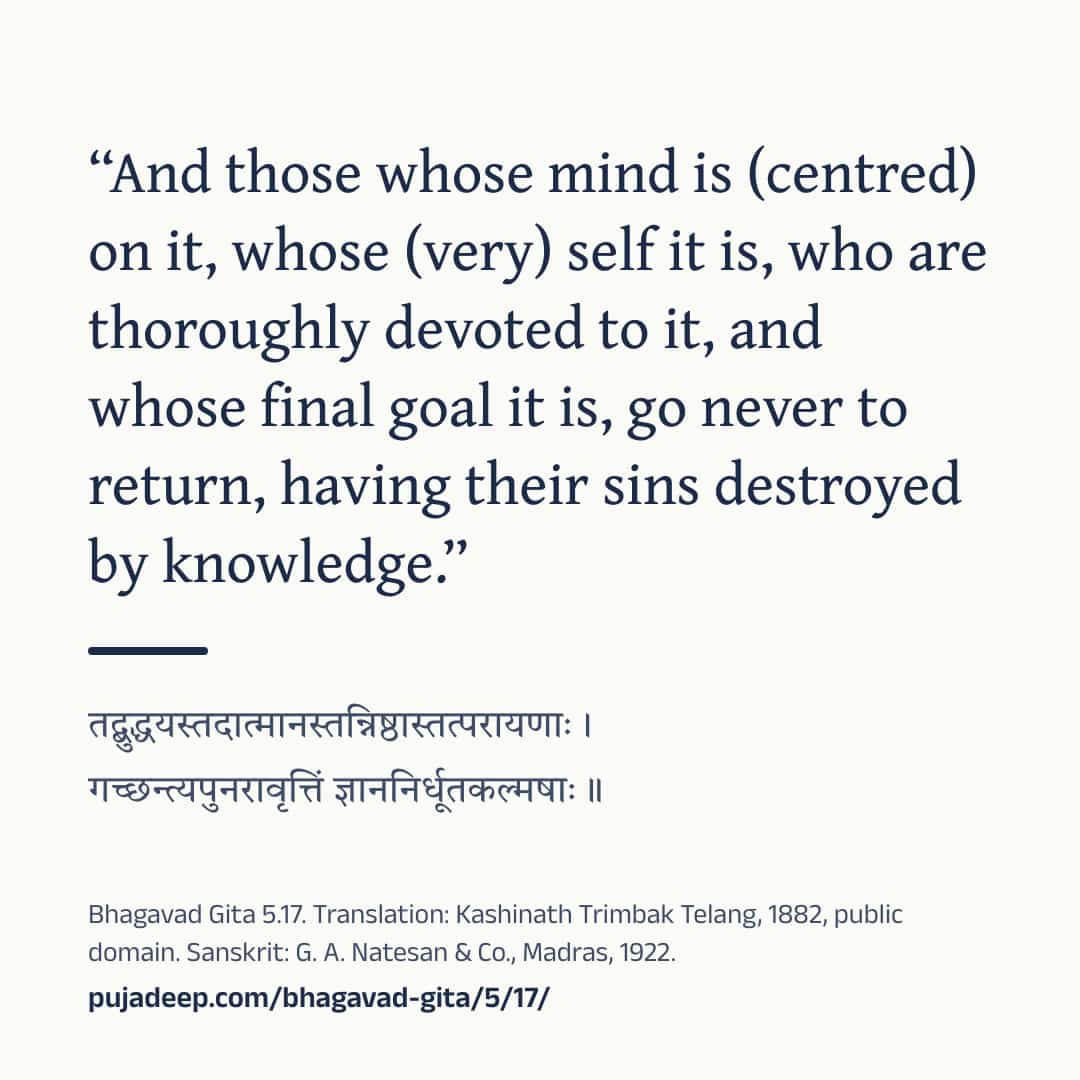
Drawing the picture
See the words
Bhagavad Gita 5.17

तद्बुद्धयस्तदात्मानस्तन्निष्ठास्तत्परायणाः ।
गच्छन्त्यपुनरावृत्तिं ज्ञाननिर्धूतकल्मषाः ॥

“And those whose mind is (centred) on it, whose (very) self it is, who are thoroughly devoted to it, and whose final goal it is, go never to return, having their sins destroyed by knowledge.”
(K. T. Telang, The Bhagavadgîtâ (The Sacred Books of the East, vol. VIII, Oxford: Clarendon Press, 1882), p. 65, public domain)

“Thinking on THAT, the SELF THAT, believing in THAT, solely devoted to THAT, they go whence there is no return, their sins dispelled by wisdom.”
(Annie Besant, The Bhagavad Gîtâ, or The Lord's Song (London: Theosophical Publishing Society, 1895), p. 61, public domain)

“Those who have their intellect absorbed in That, whose Self is That, whose steadfastness is in That, whose consummation is That, their impurities cleansed by knowledge, they attain to Non-return (Moksha).”
(Swami Swarupananda, Srimad-Bhagavad-Gita (Mayavati: Prabuddha Bharata Press, 1909; first printed in Prabuddha Bharata, 1907–1909), p. 114, public domain)

Sanskrit: G. A. Natesan & Co., Madras, 1922.
https://pujadeep.com/bhagavad-gita/5/17/ Nothing is sent from this site. Your own app sends it, to the chat you choose. The picture quotes the translation you chose on this page, with its name and year.
Sanskrit text: The Bhagavad-Gita, or The Lord's Song, with the text in Devanagari and an English translation, 1922. Meanings: written for Pujadeep and checked against the cited edition. Source and changes
Questions families ask
Who speaks Bhagavad Gita 5.17?
Krishna speaks this verse, in chapter 5 (Karma Sannyasa Yoga).
Where does the Sanskrit text come from?
Sanskrit text: The Bhagavad-Gita, or The Lord's Song, with the text in Devanagari and an English translation, 1922. Meanings: written for Pujadeep and checked against the cited edition. See the source
Is the meaning on this page a translation?
Explanation written for this site from the sources listed here, and checked against the cited edition. It is not a translation and not the only way to read the text. Free to quote with credit.
Source and licence
- Sanskrit text
- The Bhagavad-Gita, or The Lord's Song, with the text in Devanagari and an English translation (Annie Besant, G. A. Natesan & Co., Madras, 1922). Public domain. The Sanskrit on these pages was read from this printing’s page images.
- Translation
- The Bhagavadgîtâ with the Sanatsugâtîya and the Anugîtâ, translated by Kâshinâth Trimbak Telang (The Sacred Books of the East, vol. VIII, ed. F. Max Müller) (Kashinath Trimbak Telang, F. Max Müller, Clarendon Press, Oxford, 1882). Public domain. Shown verbatim, as printed.
- Translation
- The Bhagavad Gîtâ, or The Lord's Song, translated by Annie Besant (Annie Besant, Theosophical Publishing Society, London, 1895). Public domain. Shown verbatim, as printed.
- Translation
- Srimad-Bhagavad-Gita, with Sanskrit Text; Paraphrase with Word-by-word Literal Translation; English Rendering and Comments, Index, &c., by the Swami Swarupananda (Himalayan Series, No. XX) (Swami Swarupananda, The Editors and Publishers, Advaita Ashrama, Mayavati, Prabuddha Bharata Press, Mayavati, Almora, Himalayas, 1909). Public domain. Shown verbatim, as printed.
- Common wording
- In this text, 32 words follow today's common wording, checked against sanskritdocuments.org; Sanskrit Wikisource; Gita Press, Gorakhpur; GRETIL, Göttingen and Bhaktivedanta Book Trust.
- Our explanation
- Explanation written for this site from the sources listed here, and checked against the cited edition. It is not a translation and not the only way to read the text. Free to quote with credit.
- Checked
- Checked against the cited edition, October 15, 2026.
- Updated
- October 25, 2026