Bhagavad Gita 5.21: meaning and translation
Chapter 5: Karma Sannyasa Yoga. Krishna says
Krishna says that one whose mind is not attached to outer contacts finds the happiness that is within the self.
Click or tap a word for its meaning and its dictionary page.
Text and layers
Text and layers
These choices stay in this browser.
Bhagavad Gita 5.21
बाह्यस्पर्शेष्वसक्तात्मा विन्दत्यात्मनि यत्सुखम् ।स ब्रह्मयोगयुक्तात्मा सुखमक्षयमश्नुते ॥
Bahyasparsheshvasaktatma vindatyatmani yatsukhamSa brahmayogayuktatma sukhamakshayamashnute
bāhyasparśeṣvasaktātmā vindatyātmani yatsukham |sa brahmayogayuktātmā sukhamakṣayamaśnute ||
Our explanation Krishna says that one whose mind is not attached to outer contacts finds the happiness that is within the self. Joined to Brahman in yoga, he says, such a person enjoys a happiness that does not decay.
हिंदी अर्थ कृष्ण कहते हैं कि जिसका मन बाहरी विषयों के स्पर्श में आसक्त नहीं, वह आत्मा में ही सुख पाता है। वे कहते हैं कि ब्रह्म से योग में जुड़ा ऐसा व्यक्ति अक्षय (कभी न घटने वाला) सुख भोगता है।
Word by word
Every word, with its dictionary page
Word by word
- बाह्यस्पर्शेषु bāhyasparśeṣu · to outer contacts (compound, locative plural) Dictionary: bāhya, Monier-Williams 1899, p. 730, col. 3 “being outside”; sparśa, Monier-Williams 1899, p. 1269, col. 1 “touch, sense of touch”
- असक्तात्मा asaktātmā · whose mind is unattached (compound, nominative singular) Dictionary: a-sakta, Monier-Williams 1899, p. 118, col. 1 “free from ties”; ātman, Monier-Williams 1899, p. 135, col. 1 “the individual soul, self”
- विन्दति vindati · finds (present, 3rd person singular) Dictionary: 3. vid, Monier-Williams 1899, p. 964, col. 3 “to find, discover, meet or fall in with, obtain, get, acquire”
- आत्मनि ātmani · in the self (locative singular) Dictionary: ātman, Monier-Williams 1899, p. 135, col. 1 “the individual soul, self”
- यत् yat · the (happiness) that (relative pronoun, accusative singular (neuter)) Dictionary: yad, Monier-Williams 1899, p. 844, col. 2 “who, which, what, whichever, whatever, that”
- सुखम् sukham · happiness (accusative singular (neuter)) Dictionary: sukha, Monier-Williams 1899, p. 1221, col. 1 “ease, easiness, comfort, prosperity, pleasure, happiness”
- सः saḥ · he (pronoun, nominative singular) Dictionary: tad, Monier-Williams 1899, p. 434, col. 1 “that, this”
- ब्रह्मयोगयुक्तात्मा brahmayogayuktātmā · whose self is joined to Brahman in yoga (compound, nominative singular) Dictionary: brahman, Monier-Williams 1899, p. 738, col. 1 “one self-existent impersonal Spirit, the one universal Soul”; yoga-yukta, Monier-Williams 1899, p. 857, col. 1 “immersed in deep meditation, absorbed in Yoga”; ātman, Monier-Williams 1899, p. 135, col. 1 “the individual soul, self”
- सुखम् sukham · happiness (accusative singular (neuter)) Dictionary: sukha, Monier-Williams 1899, p. 1221, col. 1 “ease, easiness, comfort, prosperity, pleasure, happiness”
- अक्षयम् akṣayam · that does not decay (accusative singular (neuter)) Dictionary: a-kṣaya, Monier-Williams 1899, p. 3, col. 2 “exempt from decay, undecaying”
- अश्नुते aśnute · gains, enjoys (present, 3rd person singular) Dictionary: 1. aś, Monier-Williams 1899, p. 112, col. 2 “to reach, come to, arrive at, get, gain, obtain”
2 printings differ
Edition differences. Another printing or text reads this place differently.
- The printed edition reads: बाह्यस्पर्शेष्वसक्तात्मा विन्दत्यात्मनि यत्सुखम् ।
स ब्रह्मयोगयुक्तात्मा सुखमक्षय्यमश्नुते ॥ - Word The 1922 Madras printing reads: स ब्रह्मयोगयुक्तात्मा सुखमक्षय्यमश्नुते The 1922 base printing (leaf n91) reads अक्षय्यम्, a by-form with the same sense (the doubled य्य checked at high zoom). Under decision 14 the display follows the common wording अक्षयम्, printed by Gita Press (p. 92) and read in sanskritdocuments.org, GRETIL and Sanskrit Wikisource.
Old translations
Kashinath Trimbak Telang, 1882. Public domain. Page 66.
One whose self is not attached to external objects, obtains the happiness that is in (one's) self; and by means of concentration of mind, joining one's self (with the Brahman), one obtains indestructible happiness.
Compare 3 translations
Kashinath Trimbak Telang, 1882. Public domain. Page 66.
One whose self is not attached to external objects, obtains the happiness that is in (one's) self; and by means of concentration of mind, joining one's self (with the Brahman), one obtains indestructible happiness.
You are reading this one
Annie Besant, 1895. Public domain. Page 62.
He whose self is unattached to external contacts finds joy in the SELF; and he, having the self harmonised with Brahman by Yoga, enjoys happiness exempt from decay.
You are reading this one
Swami Swarupananda, 1909 (first printed 1907). Public domain. Page 116.
With the heart unattached to external objects, he realises the joy that is in the Self. With the heart devoted to meditation of Brahman, he attains undecaying happiness.
You are reading this one
Cite this verse
The translation: K. T. Telang, The Bhagavadgîtâ (The Sacred Books of the East, vol. VIII, Oxford: Clarendon Press, 1882), p. 66. Bhagavad Gita 5.21.
The translation: Annie Besant, The Bhagavad Gîtâ, or The Lord's Song (London: Theosophical Publishing Society, 1895), p. 62. Bhagavad Gita 5.21.
The translation: Swami Swarupananda, Srimad-Bhagavad-Gita (Mayavati: Prabuddha Bharata Press, 1909; first printed in Prabuddha Bharata, 1907–1909), p. 116. Bhagavad Gita 5.21.
Our explanation: “Bhagavad Gita 5.21: meaning and translation.” Pujadeep. Updated October 25, 2026. https://pujadeep.com/bhagavad-gita/5/21/
Pujadeep’s explanations are free to quote with credit: name Pujadeep and link to the page. How to credit
Classical readings, by school
No readings by school on this verse yet.
Share
Show the ways to share
Send one picture or the text to one chat. The picture names its source and the address of this page.
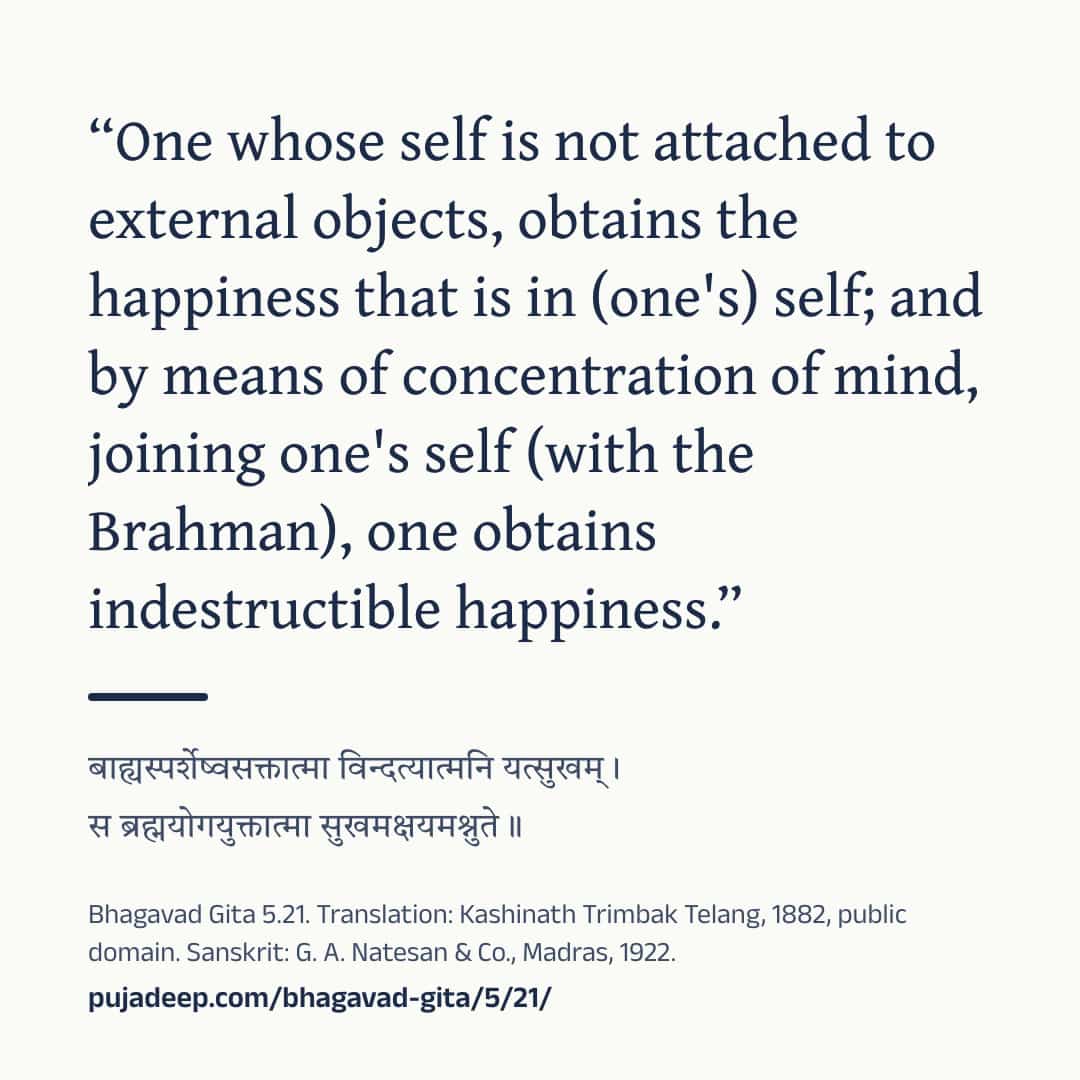
Drawing the picture
See the words
Bhagavad Gita 5.21

बाह्यस्पर्शेष्वसक्तात्मा विन्दत्यात्मनि यत्सुखम् ।
स ब्रह्मयोगयुक्तात्मा सुखमक्षयमश्नुते ॥

“One whose self is not attached to external objects, obtains the happiness that is in (one's) self; and by means of concentration of mind, joining one's self (with the Brahman), one obtains indestructible happiness.”
(K. T. Telang, The Bhagavadgîtâ (The Sacred Books of the East, vol. VIII, Oxford: Clarendon Press, 1882), p. 66, public domain)

“He whose self is unattached to external contacts finds joy in the SELF; and he, having the self harmonised with Brahman by Yoga, enjoys happiness exempt from decay.”
(Annie Besant, The Bhagavad Gîtâ, or The Lord's Song (London: Theosophical Publishing Society, 1895), p. 62, public domain)

“With the heart unattached to external objects, he realises the joy that is in the Self. With the heart devoted to meditation of Brahman, he attains undecaying happiness.”
(Swami Swarupananda, Srimad-Bhagavad-Gita (Mayavati: Prabuddha Bharata Press, 1909; first printed in Prabuddha Bharata, 1907–1909), p. 116, public domain)

Sanskrit: G. A. Natesan & Co., Madras, 1922.
https://pujadeep.com/bhagavad-gita/5/21/ Nothing is sent from this site. Your own app sends it, to the chat you choose. The picture quotes the translation you chose on this page, with its name and year.
Sanskrit text: The Bhagavad-Gita, or The Lord's Song, with the text in Devanagari and an English translation, 1922. Meanings: written for Pujadeep and checked against the cited edition. Source and changes
Questions families ask
Who speaks Bhagavad Gita 5.21?
Krishna speaks this verse, in chapter 5 (Karma Sannyasa Yoga).
Where does the Sanskrit text come from?
Sanskrit text: The Bhagavad-Gita, or The Lord's Song, with the text in Devanagari and an English translation, 1922. Meanings: written for Pujadeep and checked against the cited edition. See the source
Is the meaning on this page a translation?
Explanation written for this site from the sources listed here, and checked against the cited edition. It is not a translation and not the only way to read the text. Free to quote with credit.
Source and licence
- Sanskrit text
- The Bhagavad-Gita, or The Lord's Song, with the text in Devanagari and an English translation (Annie Besant, G. A. Natesan & Co., Madras, 1922). Public domain. The Sanskrit on these pages was read from this printing’s page images.
- Translation
- The Bhagavadgîtâ with the Sanatsugâtîya and the Anugîtâ, translated by Kâshinâth Trimbak Telang (The Sacred Books of the East, vol. VIII, ed. F. Max Müller) (Kashinath Trimbak Telang, F. Max Müller, Clarendon Press, Oxford, 1882). Public domain. Shown verbatim, as printed.
- Translation
- The Bhagavad Gîtâ, or The Lord's Song, translated by Annie Besant (Annie Besant, Theosophical Publishing Society, London, 1895). Public domain. Shown verbatim, as printed.
- Translation
- Srimad-Bhagavad-Gita, with Sanskrit Text; Paraphrase with Word-by-word Literal Translation; English Rendering and Comments, Index, &c., by the Swami Swarupananda (Himalayan Series, No. XX) (Swami Swarupananda, The Editors and Publishers, Advaita Ashrama, Mayavati, Prabuddha Bharata Press, Mayavati, Almora, Himalayas, 1909). Public domain. Shown verbatim, as printed.
- Common wording
- In this text, 32 words follow today's common wording, checked against sanskritdocuments.org; Sanskrit Wikisource; Gita Press, Gorakhpur; GRETIL, Göttingen and Bhaktivedanta Book Trust.
- Our explanation
- Explanation written for this site from the sources listed here, and checked against the cited edition. It is not a translation and not the only way to read the text. Free to quote with credit.
- Checked
- Checked against the cited edition, October 15, 2026.
- Updated
- October 25, 2026