Bhagavad Gita 5.12: meaning and translation
Chapter 5: Karma Sannyasa Yoga. Krishna says
Krishna says that the person steady in yoga, who gives up the fruit of action, reaches a lasting peace.
Click or tap a word for its meaning and its dictionary page.
Text and layers
Text and layers
These choices stay in this browser.
Bhagavad Gita 5.12
युक्तः कर्मफलं त्यक्त्वा शान्तिमाप्नोति नैष्ठिकीम् ।अयुक्तः कामकारेण फले सक्तो निबध्यते ॥
Yuktah karmaphalam tyaktva shantimapnoti naishthikimAyuktah kamakarena phale sakto nibadhyate
yuktaḥ karmaphalaṃ tyaktvā śāntimāpnoti naiṣṭhikīm |ayuktaḥ kāmakāreṇa phale sakto nibadhyate ||
Our explanation Krishna says that the person steady in yoga, who gives up the fruit of action, reaches a lasting peace. The one who is not steady, he says, driven by desire and attached to the fruit, is bound.
हिंदी अर्थ कृष्ण कहते हैं कि योग में स्थिर व्यक्ति कर्मफल का त्याग करके स्थायी (नैष्ठिकी) शांति पाता है। वे कहते हैं कि जो स्थिर नहीं है, वह कामना से प्रेरित होकर फल में आसक्त रहता है और बँध जाता है।
Word by word
Every word, with its dictionary page
Word by word
- युक्तः yuktaḥ · one steady in yoga (past participle, nominative singular) Dictionary: yukta, Monier-Williams 1899, p. 853, col. 2 “absorbed in abstract meditation, concentrated, attentive”
- कर्मफलम् karmaphalam · the fruit of action (compound, accusative singular) Dictionary: karma-phala, Monier-Williams 1899, p. 259, col. 1 “the fruit or recompense of actions”
- त्यक्त्वा tyaktvā · giving up (absolutive ('having done')) Dictionary: 1. tyaj, Monier-Williams 1899, p. 456, col. 3 “to leave, abandon, quit”
- शान्तिम् śāntim · peace (accusative singular (feminine)) Dictionary: śānti, Monier-Williams 1899, p. 1064, col. 3 “tranquillity, peace, quiet, peace or calmness of mind”
- आप्नोति āpnoti · attains (present, 3rd person singular) Dictionary: 1. āp, Monier-Williams 1899, p. 142, col. 1 “to reach, overtake, meet with, fall upon”
- नैष्ठिकीम् naiṣṭhikīm · lasting, final (accusative singular (feminine)) Dictionary: naiṣṭhika, Monier-Williams 1899, p. 570, col. 1 “final, last”
- अयुक्तः ayuktaḥ · one not steady (nominative singular) Dictionary: a-yukta, Monier-Williams 1899, p. 85, col. 3 “not attentive, not devout”
- कामकारेण kāmakāreṇa · driven by desire (compound, instrumental singular) Dictionary: kāma-kāra, Monier-Williams 1899, p. 272, col. 1 “following one's own inclinations”
- फले phale · to the fruit (locative singular) Dictionary: phala, Monier-Williams 1899, p. 716, col. 2 “fruit (met.), consequence, effect, result”
- सक्तः saktaḥ · attached (past participle, nominative singular) Dictionary: sakta, Monier-Williams 1899, p. 1132, col. 3 “clinging or adhering”
- निबध्यते nibadhyate · is bound (passive, present, 3rd person singular) Dictionary: ni-bandh, Monier-Williams 1899, p. 550, col. 1 “to bind on”
Old translations
Kashinath Trimbak Telang, 1882. Public domain. Page 65.
He who is possessed of devotion, abandoning the fruit of actions, attains the highest tranquillity. He who is without devotion, and attached to the fruit (of action), is tied down by (reason of his) acting in consequence of (some) desire.
Compare 3 translations
Kashinath Trimbak Telang, 1882. Public domain. Page 65.
He who is possessed of devotion, abandoning the fruit of actions, attains the highest tranquillity. He who is without devotion, and attached to the fruit (of action), is tied down by (reason of his) acting in consequence of (some) desire.
You are reading this one
Annie Besant, 1895. Public domain. Page 60.
The harmonised man, having abandoned the fruit of action, attaineth to everlasting Peace; the non-harmonised, impelled by desire, attached to fruit, are bound.
You are reading this one
Swami Swarupananda, 1909 (first printed 1907). Public domain. Page 111.
The well-poised, forsaking the fruit of action, attains peace, born of steadfastness; the unbalanced one, led by desire, is bound by being attached to fruit (of action).
You are reading this one
Cite this verse
The translation: K. T. Telang, The Bhagavadgîtâ (The Sacred Books of the East, vol. VIII, Oxford: Clarendon Press, 1882), p. 65. Bhagavad Gita 5.12.
The translation: Annie Besant, The Bhagavad Gîtâ, or The Lord's Song (London: Theosophical Publishing Society, 1895), p. 60. Bhagavad Gita 5.12.
The translation: Swami Swarupananda, Srimad-Bhagavad-Gita (Mayavati: Prabuddha Bharata Press, 1909; first printed in Prabuddha Bharata, 1907–1909), p. 111. Bhagavad Gita 5.12.
Our explanation: “Bhagavad Gita 5.12: meaning and translation.” Pujadeep. Updated October 25, 2026. https://pujadeep.com/bhagavad-gita/5/12/
Pujadeep’s explanations are free to quote with credit: name Pujadeep and link to the page. How to credit
Classical readings, by school
No readings by school on this verse yet.
Share
Show the ways to share
Send one picture or the text to one chat. The picture names its source and the address of this page.
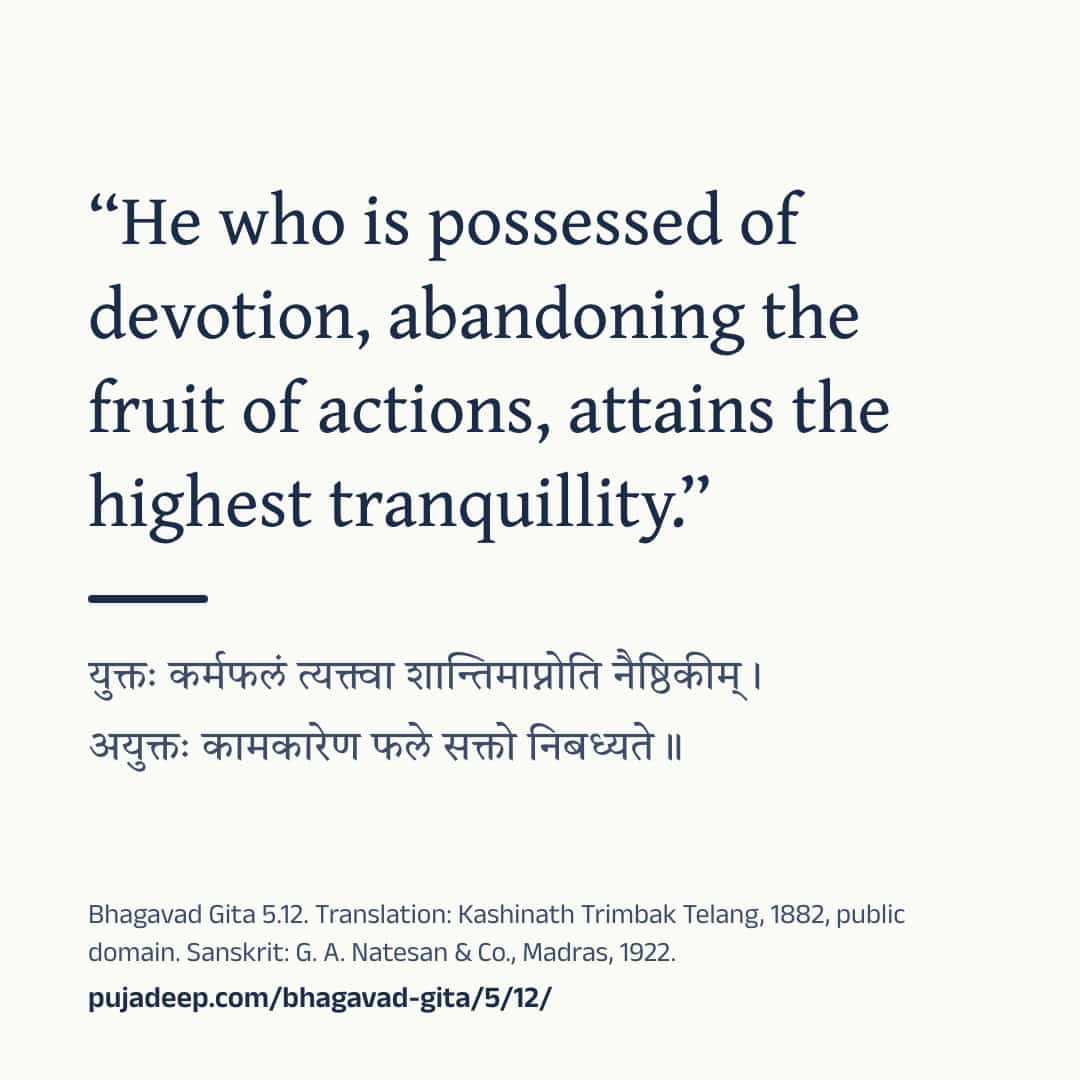
Drawing the picture
See the words
Bhagavad Gita 5.12

युक्तः कर्मफलं त्यक्त्वा शान्तिमाप्नोति नैष्ठिकीम् ।
अयुक्तः कामकारेण फले सक्तो निबध्यते ॥

“He who is possessed of devotion, abandoning the fruit of actions, attains the highest tranquillity. He who is without devotion, and attached to the fruit (of action), is tied down by (reason of his) acting in consequence of (some) desire.”
(K. T. Telang, The Bhagavadgîtâ (The Sacred Books of the East, vol. VIII, Oxford: Clarendon Press, 1882), p. 65, public domain)

“The harmonised man, having abandoned the fruit of action, attaineth to everlasting Peace; the non-harmonised, impelled by desire, attached to fruit, are bound.”
(Annie Besant, The Bhagavad Gîtâ, or The Lord's Song (London: Theosophical Publishing Society, 1895), p. 60, public domain)

“The well-poised, forsaking the fruit of action, attains peace, born of steadfastness; the unbalanced one, led by desire, is bound by being attached to fruit (of action).”
(Swami Swarupananda, Srimad-Bhagavad-Gita (Mayavati: Prabuddha Bharata Press, 1909; first printed in Prabuddha Bharata, 1907–1909), p. 111, public domain)

Sanskrit: G. A. Natesan & Co., Madras, 1922.
https://pujadeep.com/bhagavad-gita/5/12/ Nothing is sent from this site. Your own app sends it, to the chat you choose. The picture quotes the translation you chose on this page, with its name and year.
Sanskrit text: The Bhagavad-Gita, or The Lord's Song, with the text in Devanagari and an English translation, 1922. Meanings: written for Pujadeep and checked against the cited edition. Source and changes
Questions families ask
Who speaks Bhagavad Gita 5.12?
Krishna speaks this verse, in chapter 5 (Karma Sannyasa Yoga).
Where does the Sanskrit text come from?
Sanskrit text: The Bhagavad-Gita, or The Lord's Song, with the text in Devanagari and an English translation, 1922. Meanings: written for Pujadeep and checked against the cited edition. See the source
Is the meaning on this page a translation?
Explanation written for this site from the sources listed here, and checked against the cited edition. It is not a translation and not the only way to read the text. Free to quote with credit.
Source and licence
- Sanskrit text
- The Bhagavad-Gita, or The Lord's Song, with the text in Devanagari and an English translation (Annie Besant, G. A. Natesan & Co., Madras, 1922). Public domain. The Sanskrit on these pages was read from this printing’s page images.
- Translation
- The Bhagavadgîtâ with the Sanatsugâtîya and the Anugîtâ, translated by Kâshinâth Trimbak Telang (The Sacred Books of the East, vol. VIII, ed. F. Max Müller) (Kashinath Trimbak Telang, F. Max Müller, Clarendon Press, Oxford, 1882). Public domain. Shown verbatim, as printed.
- Translation
- The Bhagavad Gîtâ, or The Lord's Song, translated by Annie Besant (Annie Besant, Theosophical Publishing Society, London, 1895). Public domain. Shown verbatim, as printed.
- Translation
- Srimad-Bhagavad-Gita, with Sanskrit Text; Paraphrase with Word-by-word Literal Translation; English Rendering and Comments, Index, &c., by the Swami Swarupananda (Himalayan Series, No. XX) (Swami Swarupananda, The Editors and Publishers, Advaita Ashrama, Mayavati, Prabuddha Bharata Press, Mayavati, Almora, Himalayas, 1909). Public domain. Shown verbatim, as printed.
- Common wording
- In this text, 32 words follow today's common wording, checked against sanskritdocuments.org; Sanskrit Wikisource; Gita Press, Gorakhpur; GRETIL, Göttingen and Bhaktivedanta Book Trust.
- Our explanation
- Explanation written for this site from the sources listed here, and checked against the cited edition. It is not a translation and not the only way to read the text. Free to quote with credit.
- Checked
- Checked against the cited edition, October 15, 2026.
- Updated
- October 25, 2026