Bhagavad Gita 5.3: meaning and translation
Chapter 5: Karma Sannyasa Yoga. Krishna says
Krishna says that a person who neither hates nor craves should be known as one who always renounces (nitya-saṃnyāsī), even while acting.
Click or tap a word for its meaning and its dictionary page.
Text and layers
Text and layers
These choices stay in this browser.
Bhagavad Gita 5.3
ज्ञेयः स नित्यसंन्यासी यो न द्वेष्टि न काङ्क्षति ।निर्द्वन्द्वो हि महाबाहो सुखं बन्धात्प्रमुच्यते ॥
Jneyah sa nityasannyasi yo na dveshti na kankshatiNirdvandvo hi mahabaho sukham bandhatpramuchyate
jñeyaḥ sa nityasaṃnyāsī yo na dveṣṭi na kāṅkṣati |nirdvandvo hi mahābāho sukhaṃ bandhātpramucyate ||
Our explanation Krishna says that a person who neither hates nor craves should be known as one who always renounces (nitya-saṃnyāsī), even while acting. Free from the pairs of opposites, such as pleasure and pain, he says, such a person is easily freed from bondage. He calls Arjuna Mahabaho, mighty-armed.
हिंदी अर्थ कृष्ण कहते हैं कि जो न द्वेष करता है, न कामना करता है, उसे नित्य संन्यासी समझना चाहिए, भले वह कर्म करता हो। वे कहते हैं कि सुख-दुःख जैसे द्वंद्वों से मुक्त ऐसा व्यक्ति सहज ही बंधन से छूट जाता है। वे अर्जुन को महाबाहो (बलवान भुजाओं वाले) कहकर पुकारते हैं।
Word by word
Every word, with its dictionary page
Word by word
- ज्ञेयः jñeyaḥ · should be known (gerundive ("to be done"), nominative singular) Dictionary: jñeya, Monier-Williams 1899, p. 426, col. 2 “to be known”
- सः saḥ · he (pronoun, nominative singular) Dictionary: tad, Monier-Williams 1899, p. 434, col. 1 “that, this”
- नित्यसंन्यासी nityasaṃnyāsī · one who always renounces (compound, nominative singular) Dictionary: nitya, Monier-Williams 1899, p. 547, col. 2 “continual, perpetual, eternal”; saṃ-nyāsin, Monier-Williams 1899, p. 1148, col. 1 “one who abandons”
- यः yaḥ · who (relative pronoun, nominative singular) Dictionary: yad, Monier-Williams 1899, p. 844, col. 2 “who, which, what, whichever, whatever, that”
- न na · not (indeclinable) Dictionary: 2. na, Monier-Williams 1899, p. 523, col. 1 “not, no, nor, neither”
- द्वेष्टि dveṣṭi · hates (present, 3rd person singular) Dictionary: 2. dviṣ, Monier-Williams 1899, p. 506, col. 3 “to hate, show hatred against”
- न na · nor (indeclinable) Dictionary: 2. na, Monier-Williams 1899, p. 523, col. 1 “not, no, nor, neither”
- काङ्क्षति kāṅkṣati · craves (present, 3rd person singular) Dictionary: kāṅkṣ, Monier-Williams 1899, p. 268, col. 1 “to wish, desire, long for, hope for”
- निर्द्वन्द्वः nirdvandvaḥ · free from the pairs of opposites (nominative singular) Dictionary: nir-dvaṃdva, Monier-Williams 1899, p. 541, col. 2 “indifferent to the alternatives”
- हि hi · for, indeed (indeclinable) Dictionary: 2. hi, Monier-Williams 1899, p. 1297, col. 3 “for, because, on account of”
- महाबाहो mahābāho · O mighty-armed (vocative singular) Dictionary: mahā-bāhu, Monier-Williams 1899, p. 798, col. 1 “long-armed”
- सुखम् sukham · easily (adverb) Dictionary: sukha, Monier-Williams 1899, p. 1221, col. 1 “easily, comfortably, pleasantly, joyfully, willingly”
- बन्धात् bandhāt · from bondage (ablative singular) Dictionary: bandha, Monier-Williams 1899, p. 720, col. 3 “binding, tying, a bond, tie, chain, fetter”
- प्रमुच्यते pramucyate · is set free (passive, present, 3rd person singular) Dictionary: pra-muc, Monier-Williams 1899, p. 686, col. 3 “to free one's self from (abl. or instr.)”
Old translations
Kashinath Trimbak Telang, 1882. Public domain. Page 63.
He should be understood to be always an ascetic1, who has no aversion and no desire. For, O you of mighty arms! he who is free from the pairs of opposites is easily released from (all) bonds.
Footnotes (the translator’s own) - I. e. one who has performed 'renunciation.' ↩
Compare 3 translations
Kashinath Trimbak Telang, 1882. Public domain. Page 63.
He should be understood to be always an ascetic1, who has no aversion and no desire. For, O you of mighty arms! he who is free from the pairs of opposites is easily released from (all) bonds.
Footnotes (the translator’s own) - I. e. one who has performed 'renunciation.' ↩
You are reading this one
Annie Besant, 1895. Public domain. Page 58.
He should be known as a perpetual Sannyâsî,1 who neither hateth nor desireth; free from the pairs of opposites, O mighty-armed, he is easily set free from bondage.
Footnotes (the translator’s own) - An ascetic who renounces all. ↩
You are reading this one
Swami Swarupananda, 1909 (first printed 1907). Public domain. Page 107.
He should be known a constant Sannyasi, who neither likes nor dislikes: for, free from the pairs of opposites, O mighty-armed, he is easily set free from bondage.
You are reading this one
Cite this verse
The translation: K. T. Telang, The Bhagavadgîtâ (The Sacred Books of the East, vol. VIII, Oxford: Clarendon Press, 1882), p. 63. Bhagavad Gita 5.3.
The translation: Annie Besant, The Bhagavad Gîtâ, or The Lord's Song (London: Theosophical Publishing Society, 1895), p. 58. Bhagavad Gita 5.3.
The translation: Swami Swarupananda, Srimad-Bhagavad-Gita (Mayavati: Prabuddha Bharata Press, 1909; first printed in Prabuddha Bharata, 1907–1909), p. 107. Bhagavad Gita 5.3.
Our explanation: “Bhagavad Gita 5.3: meaning and translation.” Pujadeep. Updated October 25, 2026. https://pujadeep.com/bhagavad-gita/5/3/
Pujadeep’s explanations are free to quote with credit: name Pujadeep and link to the page. How to credit
Classical readings, by school
Each reading is named by its school. None is presented as the only meaning.
What Advaita, Vishishtadvaita and Dvaita teach, in short
Shankara Advaita
Shankara says this verse gives the reason why the yoga of action is praised: the person who works without hating pain or desiring pleasure is a true renouncer, even though he is engaged in action.
Source: The Bhagavad-Gita, with the commentary of Sri Sankaracharya, translated by A. Mahadeva Sastri (2nd ed., Mysore: G. T. A. Printing Works, 1901), commentary on 5.3, pp. 145–146. Summarised in our own words; none of its text is reproduced.
Ramanuja Vishishtadvaita
Ramanuja says the worker who has tasted the bliss of the self wants nothing else, and so has nothing to hate. He bears the pairs of opposites, and is to be known as a constant renouncer, that is, one who constantly practises knowledge.
Source: Sri Bhagavad-Gita with Sri Ramanujacharya's Visishtadvaita commentary, translated by A. Govindacharya (Madras, 1898), commentary on 5.3, p. 173. Summarised in our own words; none of its text is reproduced.
Share
Show the ways to share
Send one picture or the text to one chat. The picture names its source and the address of this page.
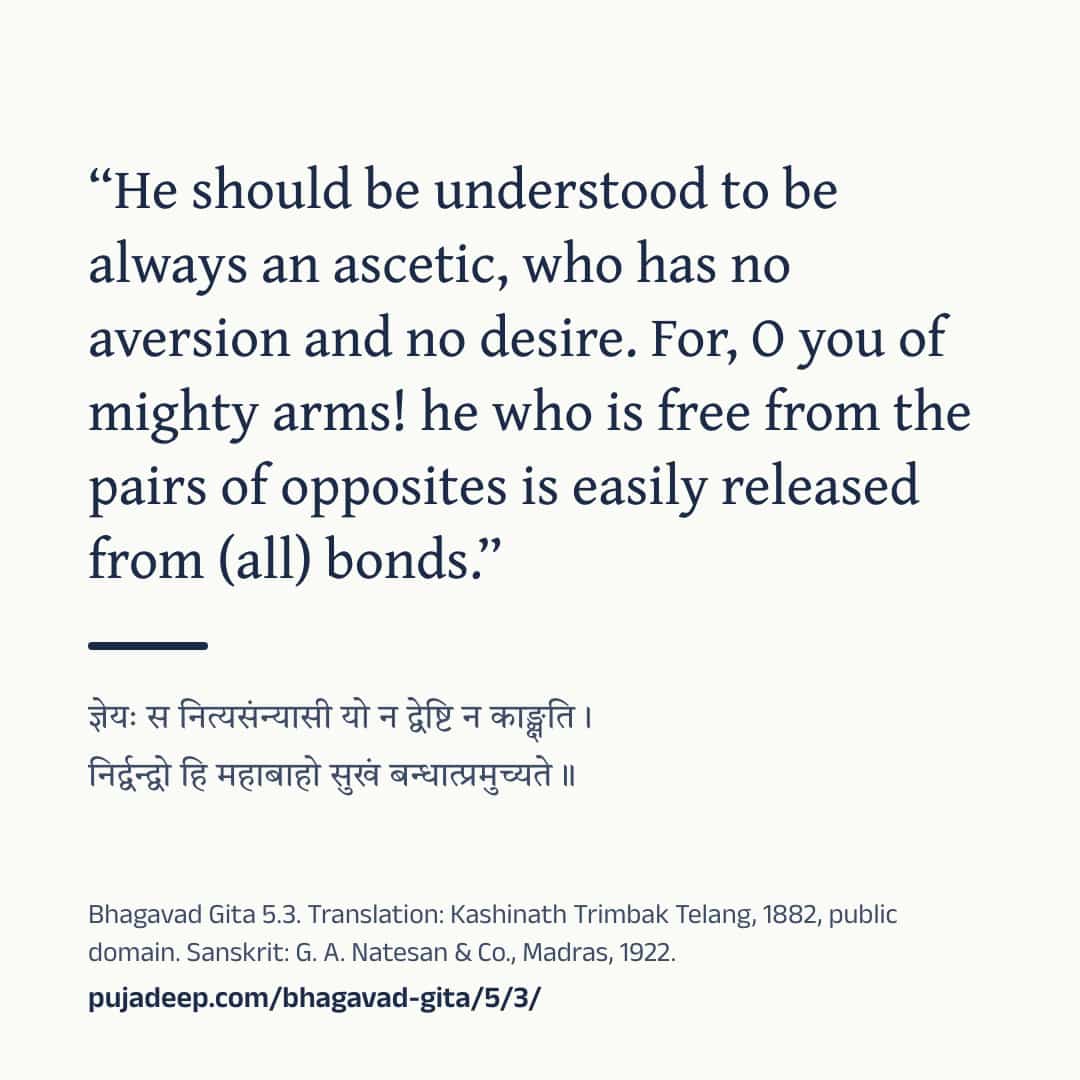
Drawing the picture
See the words
Bhagavad Gita 5.3

ज्ञेयः स नित्यसंन्यासी यो न द्वेष्टि न काङ्क्षति ।
निर्द्वन्द्वो हि महाबाहो सुखं बन्धात्प्रमुच्यते ॥

“He should be understood to be always an ascetic, who has no aversion and no desire. For, O you of mighty arms! he who is free from the pairs of opposites is easily released from (all) bonds.”
(K. T. Telang, The Bhagavadgîtâ (The Sacred Books of the East, vol. VIII, Oxford: Clarendon Press, 1882), p. 63, public domain)

“He should be known as a perpetual Sannyâsî, who neither hateth nor desireth; free from the pairs of opposites, O mighty-armed, he is easily set free from bondage.”
(Annie Besant, The Bhagavad Gîtâ, or The Lord's Song (London: Theosophical Publishing Society, 1895), p. 58, public domain)

“He should be known a constant Sannyasi, who neither likes nor dislikes: for, free from the pairs of opposites, O mighty-armed, he is easily set free from bondage.”
(Swami Swarupananda, Srimad-Bhagavad-Gita (Mayavati: Prabuddha Bharata Press, 1909; first printed in Prabuddha Bharata, 1907–1909), p. 107, public domain)

Sanskrit: G. A. Natesan & Co., Madras, 1922.
https://pujadeep.com/bhagavad-gita/5/3/ Nothing is sent from this site. Your own app sends it, to the chat you choose. The picture quotes the translation you chose on this page, with its name and year.
Sanskrit text: The Bhagavad-Gita, or The Lord's Song, with the text in Devanagari and an English translation, 1922. Meanings: written for Pujadeep and checked against the cited edition. Source and changes
Questions families ask
Who speaks Bhagavad Gita 5.3?
Krishna speaks this verse, in chapter 5 (Karma Sannyasa Yoga).
Where does the Sanskrit text come from?
Sanskrit text: The Bhagavad-Gita, or The Lord's Song, with the text in Devanagari and an English translation, 1922. Meanings: written for Pujadeep and checked against the cited edition. See the source
Is the meaning on this page a translation?
Explanation written for this site from the sources listed here, and checked against the cited edition. It is not a translation and not the only way to read the text. Free to quote with credit.
Source and licence
- Sanskrit text
- The Bhagavad-Gita, or The Lord's Song, with the text in Devanagari and an English translation (Annie Besant, G. A. Natesan & Co., Madras, 1922). Public domain. The Sanskrit on these pages was read from this printing’s page images.
- Translation
- The Bhagavadgîtâ with the Sanatsugâtîya and the Anugîtâ, translated by Kâshinâth Trimbak Telang (The Sacred Books of the East, vol. VIII, ed. F. Max Müller) (Kashinath Trimbak Telang, F. Max Müller, Clarendon Press, Oxford, 1882). Public domain. Shown verbatim, as printed.
- Translation
- The Bhagavad Gîtâ, or The Lord's Song, translated by Annie Besant (Annie Besant, Theosophical Publishing Society, London, 1895). Public domain. Shown verbatim, as printed.
- Translation
- Srimad-Bhagavad-Gita, with Sanskrit Text; Paraphrase with Word-by-word Literal Translation; English Rendering and Comments, Index, &c., by the Swami Swarupananda (Himalayan Series, No. XX) (Swami Swarupananda, The Editors and Publishers, Advaita Ashrama, Mayavati, Prabuddha Bharata Press, Mayavati, Almora, Himalayas, 1909). Public domain. Shown verbatim, as printed.
- Commentary
- The Bhagavad-Gita, with the commentary of Sri Sankaracharya, translated by A. Mahadeva Sastri (2nd ed., Mysore: G. T. A. Printing Works, 1901) (Public-domain scan, University of California Libraries). Summarised in our own words; none of its text is reproduced.
- Commentary
- Sri Bhagavad-Gita with Sri Ramanujacharya's Visishtadvaita commentary, translated by A. Govindacharya (Madras, 1898) (Scan uploaded to archive.org (folkscanomy collection)). Summarised in our own words; none of its text is reproduced.
- Common wording
- In this text, 32 words follow today's common wording, checked against sanskritdocuments.org; Sanskrit Wikisource; Gita Press, Gorakhpur; GRETIL, Göttingen and Bhaktivedanta Book Trust.
- Our explanation
- Explanation written for this site from the sources listed here, and checked against the cited edition. It is not a translation and not the only way to read the text. Free to quote with credit.
- Checked
- Checked against the cited edition, October 15, 2026.
- Updated
- October 25, 2026