Bhagavad Gita 5.2: meaning and translation
Chapter 5: Karma Sannyasa Yoga. Krishna says
Krishna answers.
Click or tap a word for its meaning and its dictionary page.
Text and layers
Text and layers
These choices stay in this browser.
Bhagavad Gita 5.2
श्रीभगवानुवाच ।
संन्यासः कर्मयोगश्च निःश्रेयसकरावुभौ ।तयोस्तु कर्मसंन्यासात्कर्मयोगो विशिष्यते ॥
Sannyasah karmayogashcha nihshreyasakaravubhauTayostu karmasannyasatkarmayogo vishishyate
saṃnyāsaḥ karmayogaśca niḥśreyasakarāvubhau |tayostu karmasaṃnyāsātkarmayogo viśiṣyate ||
Our explanation Krishna answers. Both renunciation (saṃnyāsa) and the yoga of action (karma-yoga) lead to the highest good (niḥśreyasa). But of the two, he says, the yoga of action is better than giving up action. The schools differ on why (see the views).
हिंदी अर्थ कृष्ण उत्तर देते हैं। संन्यास और कर्मयोग, दोनों परम कल्याण (निःश्रेयस) की ओर ले जाते हैं। पर वे कहते हैं कि इन दोनों में कर्मों के संन्यास से कर्मयोग श्रेष्ठ है। परंपराएँ इसका कारण अलग-अलग बताती हैं।
Word by word
Every word, with its dictionary page
Word by word
- संन्यासः saṃnyāsaḥ · renunciation (nominative singular) Dictionary: saṃ-nyāsa, Monier-Williams 1899, p. 1148, col. 1 “laying aside, resignation, abandonment of (gen. or comp.)”
- कर्मयोगः karmayogaḥ · the yoga of action (compound, nominative singular) Dictionary: karma-yoga, Monier-Williams 1899, p. 259, col. 1 “performance of a work”
- च ca · and (indeclinable) Dictionary: 2. ca, Monier-Williams 1899, p. 380, col. 1 “and, both, also, moreover, as well as”
- निःश्रेयसकरौ niḥśreyasakarau · leading to the highest good (compound, nominative dual) Dictionary: niḥ-śreyasa, Monier-Williams 1899, p. 538, col. 3 “ultimate bliss”; 1. kara, Monier-Williams 1899, p. 253, col. 1 “a doer, maker, causer, doing, making, causing, producing”
- उभौ ubhau · both (nominative dual) Dictionary: ubha, Monier-Williams 1899, p. 216, col. 2 “both”
- तयोः tayoḥ · of the two (pronoun, genitive dual) Dictionary: tad, Monier-Williams 1899, p. 434, col. 1 “that, this”
- तु tu · but (indeclinable) Dictionary: 2. tu, Monier-Williams 1899, p. 449, col. 3 “but”
- कर्मसंन्यासात् karmasaṃnyāsāt · than giving up action (compound, ablative singular) Dictionary: karman, Monier-Williams 1899, p. 258, col. 2 “act, action, performance, business”; saṃ-nyāsa, Monier-Williams 1899, p. 1148, col. 1 “laying aside, resignation, abandonment of (gen. or comp.)”
- कर्मयोगः karmayogaḥ · the yoga of action (compound, nominative singular) Dictionary: karma-yoga, Monier-Williams 1899, p. 259, col. 1 “performance of a work”
- विशिष्यते viśiṣyate · is better (passive, present, 3rd person singular) Dictionary: vi-śiṣ, Monier-Williams 1899, p. 990, col. 2 “to be pre-eminent, excel, be better than”
Old translations
Kashinath Trimbak Telang, 1882. Public domain. Page 63.
The Deity said:
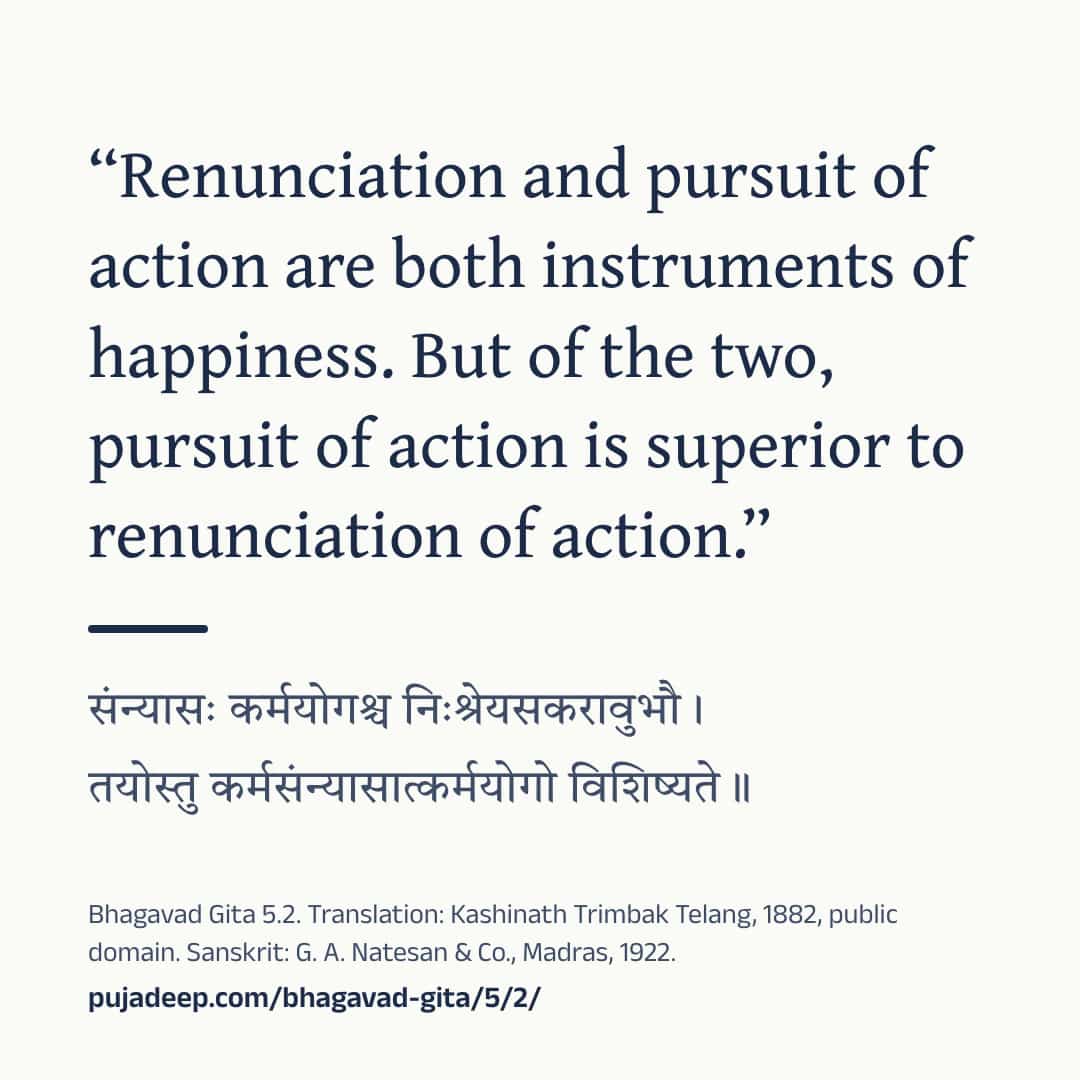
Renunciation and pursuit of action are both instruments of happiness. But of the two, pursuit of action is superior to renunciation of action.
Compare 3 translations
Kashinath Trimbak Telang, 1882. Public domain. Page 63.
The Deity said:
Renunciation and pursuit of action are both instruments of happiness. But of the two, pursuit of action is superior to renunciation of action.
You are reading this one
Annie Besant, 1895. Public domain. Page 58.
The Blessed Lord said:
Renunciation and Yoga by action both lead to the highest bliss; of the two, Yoga by action is verily better than renunciation of action.
You are reading this one
Swami Swarupananda, 1909 (first printed 1907). Public domain. Page 106.
The Blessed Lord said:
Both renunciation and performance of action lead to freedom: of these, performance of action is superior to the renunciation of action.
You are reading this one
Cite this verse
The translation: K. T. Telang, The Bhagavadgîtâ (The Sacred Books of the East, vol. VIII, Oxford: Clarendon Press, 1882), p. 63. Bhagavad Gita 5.2.
The translation: Annie Besant, The Bhagavad Gîtâ, or The Lord's Song (London: Theosophical Publishing Society, 1895), p. 58. Bhagavad Gita 5.2.
The translation: Swami Swarupananda, Srimad-Bhagavad-Gita (Mayavati: Prabuddha Bharata Press, 1909; first printed in Prabuddha Bharata, 1907–1909), p. 106. Bhagavad Gita 5.2.
Our explanation: “Bhagavad Gita 5.2: meaning and translation.” Pujadeep. Updated October 25, 2026. https://pujadeep.com/bhagavad-gita/5/2/
Pujadeep’s explanations are free to quote with credit: name Pujadeep and link to the page. How to credit
Classical readings, by school
Each reading is named by its school. None is presented as the only meaning.
What Advaita, Vishishtadvaita and Dvaita teach, in short
Shankara Advaita
Shankara says both lead to liberation (mokṣa) because both give rise to knowledge. For a person without knowledge, the yoga of action is better than a renunciation that is not yet joined with knowledge, because it is easier. The translator's note adds that renunciation joined with knowledge is still the higher path.
Source: The Bhagavad-Gita, with the commentary of Sri Sankaracharya, translated by A. Mahadeva Sastri (2nd ed., Mysore: G. T. A. Printing Works, 1901), commentary on 5.2, p. 145. Summarised in our own words; none of its text is reproduced.
Ramanuja Vishishtadvaita
Ramanuja says the path of knowledge and the path of works can each, on its own, lead to the bliss of the self. Of the two, the path of works is better.
Source: Sri Bhagavad-Gita with Sri Ramanujacharya's Visishtadvaita commentary, translated by A. Govindacharya (Madras, 1898), commentary on 5.2, p. 173. Summarised in our own words; none of its text is reproduced.
Share
Show the ways to share
Send one picture or the text to one chat. The picture names its source and the address of this page.
Drawing the picture
See the words
Bhagavad Gita 5.2

संन्यासः कर्मयोगश्च निःश्रेयसकरावुभौ ।
तयोस्तु कर्मसंन्यासात्कर्मयोगो विशिष्यते ॥

“Renunciation and pursuit of action are both instruments of happiness. But of the two, pursuit of action is superior to renunciation of action.”
(K. T. Telang, The Bhagavadgîtâ (The Sacred Books of the East, vol. VIII, Oxford: Clarendon Press, 1882), p. 63, public domain)

“Renunciation and Yoga by action both lead to the highest bliss; of the two, Yoga by action is verily better than renunciation of action.”
(Annie Besant, The Bhagavad Gîtâ, or The Lord's Song (London: Theosophical Publishing Society, 1895), p. 58, public domain)

“Both renunciation and performance of action lead to freedom: of these, performance of action is superior to the renunciation of action.”
(Swami Swarupananda, Srimad-Bhagavad-Gita (Mayavati: Prabuddha Bharata Press, 1909; first printed in Prabuddha Bharata, 1907–1909), p. 106, public domain)

Sanskrit: G. A. Natesan & Co., Madras, 1922.
https://pujadeep.com/bhagavad-gita/5/2/ Nothing is sent from this site. Your own app sends it, to the chat you choose. The picture quotes the translation you chose on this page, with its name and year.
Sanskrit text: The Bhagavad-Gita, or The Lord's Song, with the text in Devanagari and an English translation, 1922. Meanings: written for Pujadeep and checked against the cited edition. Source and changes
Questions families ask
Who speaks Bhagavad Gita 5.2?
Krishna speaks this verse, in chapter 5 (Karma Sannyasa Yoga).
Where does the Sanskrit text come from?
Sanskrit text: The Bhagavad-Gita, or The Lord's Song, with the text in Devanagari and an English translation, 1922. Meanings: written for Pujadeep and checked against the cited edition. See the source
Is the meaning on this page a translation?
Explanation written for this site from the sources listed here, and checked against the cited edition. It is not a translation and not the only way to read the text. Free to quote with credit.
Source and licence
- Sanskrit text
- The Bhagavad-Gita, or The Lord's Song, with the text in Devanagari and an English translation (Annie Besant, G. A. Natesan & Co., Madras, 1922). Public domain. The Sanskrit on these pages was read from this printing’s page images.
- Translation
- The Bhagavadgîtâ with the Sanatsugâtîya and the Anugîtâ, translated by Kâshinâth Trimbak Telang (The Sacred Books of the East, vol. VIII, ed. F. Max Müller) (Kashinath Trimbak Telang, F. Max Müller, Clarendon Press, Oxford, 1882). Public domain. Shown verbatim, as printed.
- Translation
- The Bhagavad Gîtâ, or The Lord's Song, translated by Annie Besant (Annie Besant, Theosophical Publishing Society, London, 1895). Public domain. Shown verbatim, as printed.
- Translation
- Srimad-Bhagavad-Gita, with Sanskrit Text; Paraphrase with Word-by-word Literal Translation; English Rendering and Comments, Index, &c., by the Swami Swarupananda (Himalayan Series, No. XX) (Swami Swarupananda, The Editors and Publishers, Advaita Ashrama, Mayavati, Prabuddha Bharata Press, Mayavati, Almora, Himalayas, 1909). Public domain. Shown verbatim, as printed.
- Commentary
- The Bhagavad-Gita, with the commentary of Sri Sankaracharya, translated by A. Mahadeva Sastri (2nd ed., Mysore: G. T. A. Printing Works, 1901) (Public-domain scan, University of California Libraries). Summarised in our own words; none of its text is reproduced.
- Commentary
- Sri Bhagavad-Gita with Sri Ramanujacharya's Visishtadvaita commentary, translated by A. Govindacharya (Madras, 1898) (Scan uploaded to archive.org (folkscanomy collection)). Summarised in our own words; none of its text is reproduced.
- Common wording
- In this text, 32 words follow today's common wording, checked against sanskritdocuments.org; Sanskrit Wikisource; Gita Press, Gorakhpur; GRETIL, Göttingen and Bhaktivedanta Book Trust.
- Our explanation
- Explanation written for this site from the sources listed here, and checked against the cited edition. It is not a translation and not the only way to read the text. Free to quote with credit.
- Checked
- Checked against the cited edition, October 15, 2026.
- Updated
- October 25, 2026