Bhagavad Gita 5.6: meaning and translation
Chapter 5: Karma Sannyasa Yoga. Krishna says
Krishna says that renunciation is hard to reach without yoga.
Click or tap a word for its meaning and its dictionary page.
Text and layers
Text and layers
These choices stay in this browser.
Bhagavad Gita 5.6
संन्यासस्तु महाबाहो दुःखमाप्तुमयोगतः ।योगयुक्तो मुनिर्ब्रह्म न चिरेणाधिगच्छति ॥
Sannyasastu mahabaho duhkhamaptumayogatahYogayukto munirbrahma na chirenadhigachchhati
saṃnyāsastu mahābāho duḥkhamāptumayogataḥ |yogayukto munirbrahma na cireṇādhigacchati ||
Our explanation Krishna says that renunciation is hard to reach without yoga. The sage (muni) who is joined in yoga, he says, reaches Brahman before long. The schools read “Brahman” here differently (see the views).
हिंदी अर्थ कृष्ण कहते हैं कि योग के बिना संन्यास पाना कठिन है। वे कहते हैं कि योग से युक्त मुनि शीघ्र ही ब्रह्म को पा लेता है। परंपराएँ यहाँ “ब्रह्म” शब्द का अर्थ अलग-अलग लेती हैं।
Word by word
Every word, with its dictionary page
Word by word
- संन्यासः saṃnyāsaḥ · renunciation (nominative singular) Dictionary: saṃ-nyāsa, Monier-Williams 1899, p. 1148, col. 1 “laying aside, resignation, abandonment of (gen. or comp.)”
- तु tu · but (indeclinable) Dictionary: 2. tu, Monier-Williams 1899, p. 449, col. 3 “but”
- महाबाहो mahābāho · O mighty-armed (vocative singular) Dictionary: mahā-bāhu, Monier-Williams 1899, p. 798, col. 1 “long-armed”
- दुःखम् duḥkham · hard, with difficulty (adverb) Dictionary: 1. duḥkha, Monier-Williams 1899, p. 483, col. 2 “uneasiness, pain, sorrow, trouble, difficulty”
- आप्तुम् āptum · to attain (infinitive ('to do')) Dictionary: 1. āp, Monier-Williams 1899, p. 142, col. 1 “to reach, overtake, meet with, fall upon”
- अयोगतः ayogataḥ · without yoga (ablative sense (-tas)) Dictionary: 1. a-yoga, Monier-Williams 1899, p. 85, col. 3 “separation, disjunction”
- योगयुक्तः yogayuktaḥ · joined in yoga (compound, nominative singular) Dictionary: yoga-yukta, Monier-Williams 1899, p. 857, col. 1 “immersed in deep meditation, absorbed in Yoga”
- मुनिः muniḥ · the sage (nominative singular) Dictionary: muni, Monier-Williams 1899, p. 823, col. 1 “a saint, sage, seer, ascetic, monk, devotee, hermit”
- ब्रह्म brahma · Brahman (accusative singular (neuter)) Dictionary: brahman, Monier-Williams 1899, p. 738, col. 1 “one self-existent impersonal Spirit, the one universal Soul”
- न na · not (indeclinable) Dictionary: 2. na, Monier-Williams 1899, p. 523, col. 1 “not, no, nor, neither”
- चिरेण cireṇa · after long (instrumental singular) Dictionary: cira, Monier-Williams 1899, p. 398, col. 2 “long, lasting a long time”
- अधिगच्छति adhigacchati · reaches (present, 3rd person singular) Dictionary: adhi-gam, Monier-Williams 1899, p. 20, col. 3 “to meet, find, discover, obtain”
2 printings differ
Edition differences. Another printing or text reads this place differently.
- Spelling A digital text reads Same letters. The e-text joins नचिरेण ('soon') into one word; the 1922 edition prints न चिरेण as two words, as it prints न चिरात् in 12.7.
- Spelling A digital text reads Same letters, joined as nacireṇa, like another digital text.
Old translations
Kashinath Trimbak Telang, 1882. Public domain. Page 64.
Renunciation, O you of mighty arms! is difficult to reach without devotion; the sage possessed of devotion attains Brahman1 without delay.
Footnotes (the translator’s own) - I. e. 'attains true renunciation,' says Saṅkara; Srîdhara says, 'attains Brahman, after becoming a "renouncer."' ↩
Compare 3 translations
Kashinath Trimbak Telang, 1882. Public domain. Page 64.
Renunciation, O you of mighty arms! is difficult to reach without devotion; the sage possessed of devotion attains Brahman1 without delay.
Footnotes (the translator’s own) - I. e. 'attains true renunciation,' says Saṅkara; Srîdhara says, 'attains Brahman, after becoming a "renouncer."' ↩
You are reading this one
Annie Besant, 1895. Public domain. Page 59.
But for him without Yoga, O mighty-armed, renunciation is hard to attain to; the Yoga-harmonised Muni1 swiftly goeth to Brahman.
Footnotes (the translator’s own) - A saint; in its original meaning one who observed the vow of silence. ↩
You are reading this one
Swami Swarupananda, 1909 (first printed 1907). Public domain. Page 108.
Renunciation of action, O mighty-armed, is hard to attain to without performance of action; the man of meditation purified by devotion to action, quickly goes to Brahman.
You are reading this one
Cite this verse
The translation: K. T. Telang, The Bhagavadgîtâ (The Sacred Books of the East, vol. VIII, Oxford: Clarendon Press, 1882), p. 64. Bhagavad Gita 5.6.
The translation: Annie Besant, The Bhagavad Gîtâ, or The Lord's Song (London: Theosophical Publishing Society, 1895), p. 59. Bhagavad Gita 5.6.
The translation: Swami Swarupananda, Srimad-Bhagavad-Gita (Mayavati: Prabuddha Bharata Press, 1909; first printed in Prabuddha Bharata, 1907–1909), p. 108. Bhagavad Gita 5.6.
Our explanation: “Bhagavad Gita 5.6: meaning and translation.” Pujadeep. Updated October 25, 2026. https://pujadeep.com/bhagavad-gita/5/6/
Pujadeep’s explanations are free to quote with credit: name Pujadeep and link to the page. How to credit
Classical readings, by school
Each reading is named by its school. None is presented as the only meaning.
What Advaita, Vishishtadvaita and Dvaita teach, in short
Shankara Advaita
Shankara says the renunciation meant here is true renunciation, which rests on knowledge, and “yoga” is the performance of prescribed duties offered to the Lord without selfish motive. “Brahman” here means that true renunciation; he cites a Taittiriya passage that calls renunciation (nyāsa) Brahman.
Source: The Bhagavad-Gita, with the commentary of Sri Sankaracharya, translated by A. Mahadeva Sastri (2nd ed., Mysore: G. T. A. Printing Works, 1901), commentary on 5.6, p. 148. Summarised in our own words; none of its text is reproduced.
Ramanuja Vishishtadvaita
Ramanuja says the path of knowledge is hard to achieve without the help of the path of works. The sage who follows the path of works soon reaches “Brahman”, which here means the self (ātman); the path of knowledge alone takes a long time.
Source: Sri Bhagavad-Gita with Sri Ramanujacharya's Visishtadvaita commentary, translated by A. Govindacharya (Madras, 1898), commentary on 5.6, p. 175. Summarised in our own words; none of its text is reproduced.
Share
Show the ways to share
Send one picture or the text to one chat. The picture names its source and the address of this page.
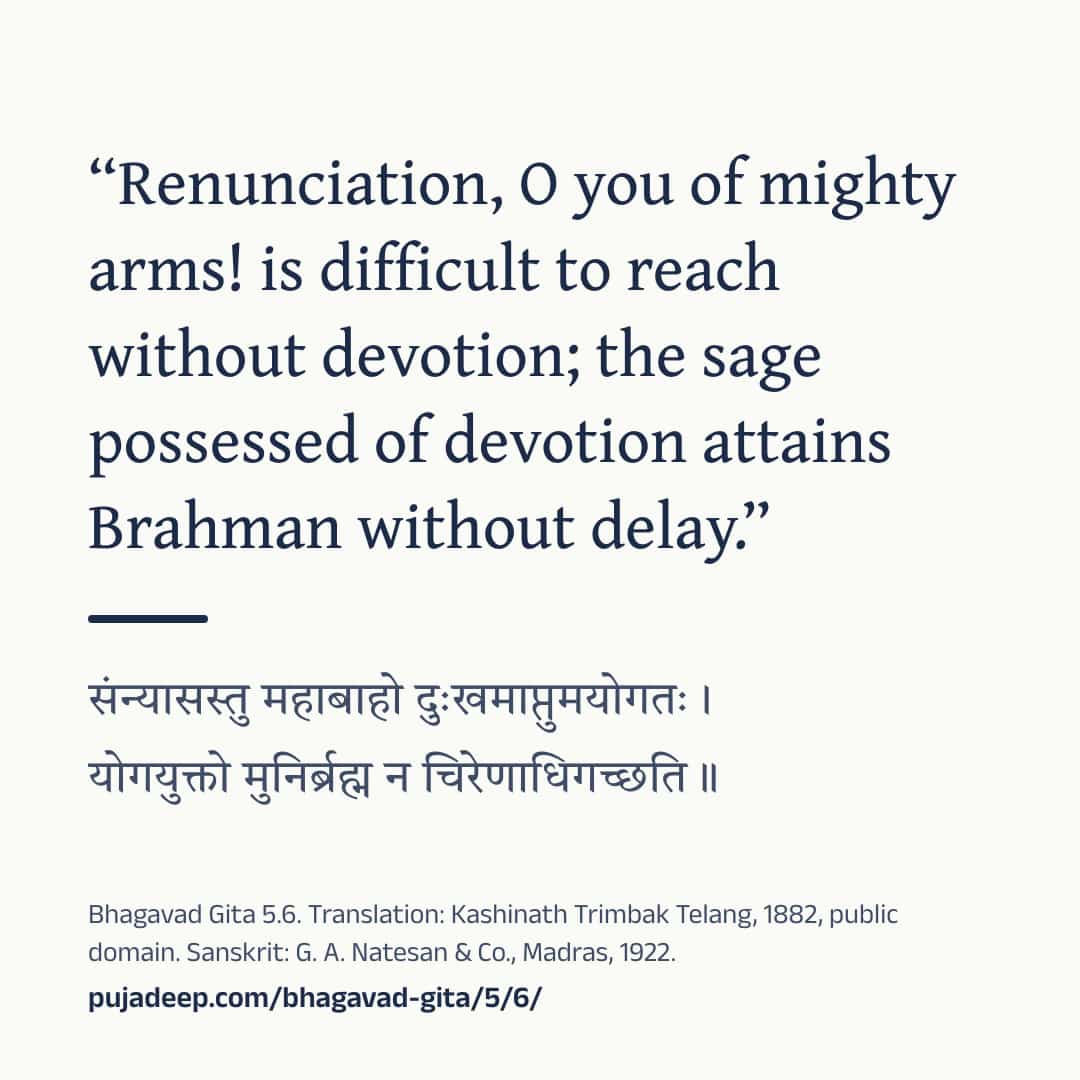
Drawing the picture
See the words
Bhagavad Gita 5.6

संन्यासस्तु महाबाहो दुःखमाप्तुमयोगतः ।
योगयुक्तो मुनिर्ब्रह्म न चिरेणाधिगच्छति ॥

“Renunciation, O you of mighty arms! is difficult to reach without devotion; the sage possessed of devotion attains Brahman without delay.”
(K. T. Telang, The Bhagavadgîtâ (The Sacred Books of the East, vol. VIII, Oxford: Clarendon Press, 1882), p. 64, public domain)

“But for him without Yoga, O mighty-armed, renunciation is hard to attain to; the Yoga-harmonised Muni swiftly goeth to Brahman.”
(Annie Besant, The Bhagavad Gîtâ, or The Lord's Song (London: Theosophical Publishing Society, 1895), p. 59, public domain)

“Renunciation of action, O mighty-armed, is hard to attain to without performance of action; the man of meditation purified by devotion to action, quickly goes to Brahman.”
(Swami Swarupananda, Srimad-Bhagavad-Gita (Mayavati: Prabuddha Bharata Press, 1909; first printed in Prabuddha Bharata, 1907–1909), p. 108, public domain)

Sanskrit: G. A. Natesan & Co., Madras, 1922.
https://pujadeep.com/bhagavad-gita/5/6/ Nothing is sent from this site. Your own app sends it, to the chat you choose. The picture quotes the translation you chose on this page, with its name and year.
Sanskrit text: The Bhagavad-Gita, or The Lord's Song, with the text in Devanagari and an English translation, 1922. Meanings: written for Pujadeep and checked against the cited edition. Source and changes
Questions families ask
Who speaks Bhagavad Gita 5.6?
Krishna speaks this verse, in chapter 5 (Karma Sannyasa Yoga).
Where does the Sanskrit text come from?
Sanskrit text: The Bhagavad-Gita, or The Lord's Song, with the text in Devanagari and an English translation, 1922. Meanings: written for Pujadeep and checked against the cited edition. See the source
Is the meaning on this page a translation?
Explanation written for this site from the sources listed here, and checked against the cited edition. It is not a translation and not the only way to read the text. Free to quote with credit.
Source and licence
- Sanskrit text
- The Bhagavad-Gita, or The Lord's Song, with the text in Devanagari and an English translation (Annie Besant, G. A. Natesan & Co., Madras, 1922). Public domain. The Sanskrit on these pages was read from this printing’s page images.
- Translation
- The Bhagavadgîtâ with the Sanatsugâtîya and the Anugîtâ, translated by Kâshinâth Trimbak Telang (The Sacred Books of the East, vol. VIII, ed. F. Max Müller) (Kashinath Trimbak Telang, F. Max Müller, Clarendon Press, Oxford, 1882). Public domain. Shown verbatim, as printed.
- Translation
- The Bhagavad Gîtâ, or The Lord's Song, translated by Annie Besant (Annie Besant, Theosophical Publishing Society, London, 1895). Public domain. Shown verbatim, as printed.
- Translation
- Srimad-Bhagavad-Gita, with Sanskrit Text; Paraphrase with Word-by-word Literal Translation; English Rendering and Comments, Index, &c., by the Swami Swarupananda (Himalayan Series, No. XX) (Swami Swarupananda, The Editors and Publishers, Advaita Ashrama, Mayavati, Prabuddha Bharata Press, Mayavati, Almora, Himalayas, 1909). Public domain. Shown verbatim, as printed.
- Commentary
- The Bhagavad-Gita, with the commentary of Sri Sankaracharya, translated by A. Mahadeva Sastri (2nd ed., Mysore: G. T. A. Printing Works, 1901) (Public-domain scan, University of California Libraries). Summarised in our own words; none of its text is reproduced.
- Commentary
- Sri Bhagavad-Gita with Sri Ramanujacharya's Visishtadvaita commentary, translated by A. Govindacharya (Madras, 1898) (Scan uploaded to archive.org (folkscanomy collection)). Summarised in our own words; none of its text is reproduced.
- Common wording
- In this text, 32 words follow today's common wording, checked against sanskritdocuments.org; Sanskrit Wikisource; Gita Press, Gorakhpur; GRETIL, Göttingen and Bhaktivedanta Book Trust.
- Our explanation
- Explanation written for this site from the sources listed here, and checked against the cited edition. It is not a translation and not the only way to read the text. Free to quote with credit.
- Checked
- Checked against the cited edition, October 15, 2026.
- Updated
- October 25, 2026