Bhagavad Gita 5.8: meaning and translation
Chapter 5: Karma Sannyasa Yoga. Krishna says
Krishna says that the person joined in yoga, who knows the truth (tattva), should think “I do nothing at all”, even while seeing, hearing, touching, smelling, eating, walking, sleeping and breathing.
Click or tap a word for its meaning and its dictionary page.
Text and layers
Text and layers
These choices stay in this browser.
Bhagavad Gita 5.8
नैव किञ्चित्करोमीति युक्तो मन्येत तत्त्ववित् ।पश्यन्शृण्वन्स्पृशञ्जिघ्रन्नश्नन्गच्छन्स्वपन्श्वसन् ॥
Naiva kinchitkaromiti yukto manyeta tattvavitPashyanshrinvansprishanjighrannashnangachchhansvapanshvasan
naiva kiñcitkaromīti yukto manyeta tattvavit |paśyanśṛṇvanspṛśañjighrannaśnangacchansvapanśvasan ||
Our explanation Krishna says that the person joined in yoga, who knows the truth (tattva), should think “I do nothing at all”, even while seeing, hearing, touching, smelling, eating, walking, sleeping and breathing. The sentence continues in the next verse.
हिंदी अर्थ कृष्ण कहते हैं कि योग से युक्त, तत्त्व को जानने वाला व्यक्ति देखते, सुनते, छूते, सूँघते, खाते, चलते, सोते और साँस लेते हुए भी यह माने कि “मैं कुछ भी नहीं करता”। यह वाक्य अगले श्लोक में पूरा होता है।
Word by word
Every word, with its dictionary page
Word by word
- न na · not (indeclinable) Dictionary: 2. na, Monier-Williams 1899, p. 523, col. 1 “not, no, nor, neither”
- एव eva · at all (indeclinable) Dictionary: 1. eva, Monier-Williams 1899, p. 232, col. 2 “just, exactly, very, same, only, even, alone, merely”
- किञ्चित् kiñcit · anything (indeclinable) Dictionary: kiṃ-cid, Monier-Williams 1899, p. 283, col. 1 “something”
- करोमि karomi · "I do" (present, 1st person singular) Dictionary: 1. kṛ, Monier-Williams 1899, p. 301, col. 1 “to do, make, perform, accomplish, cause, effect”
- इति iti · thus (ends the thought) (indeclinable) Dictionary: 2. iti, Monier-Williams 1899, p. 165, col. 1 “in this manner, thus”
- युक्तः yuktaḥ · one joined in yoga (past participle, nominative singular) Dictionary: yukta, Monier-Williams 1899, p. 853, col. 2 “absorbed in abstract meditation, concentrated, attentive”
- मन्येत manyeta · should think (optative, 3rd person singular) Dictionary: man, Monier-Williams 1899, p. 783, col. 1 “to think, believe, imagine, suppose, conjecture”
- तत्त्ववित् tattvavit · knower of the truth (compound, nominative singular) Dictionary: tattva-vid, Monier-Williams 1899, p. 433, col. 1 “knowing the true nature of (gen.)”
- पश्यन् paśyan · seeing (present participle, nominative singular) Dictionary: 1. paś, Monier-Williams 1899, p. 611, col. 2 “behold, look at, observe, perceive, notice”
- शृण्वन् śṛṇvan · hearing (present participle, nominative singular) Dictionary: 1. śru, Monier-Williams 1899, p. 1100, col. 3 “to hear, listen or attend to anything”
- स्पृशन् spṛśan · touching (present participle, nominative singular) Dictionary: 1. spṛś, Monier-Williams 1899, p. 1268, col. 3 “to touch”
- जिघ्रन् jighran · smelling (present participle, nominative singular) Dictionary: ghrā, Monier-Williams 1899, p. 379, col. 3 “to smell”
- अश्नन् aśnan · eating (present participle, nominative singular) Dictionary: 2. aś, Monier-Williams 1899, p. 112, col. 2 “to eat, consume”
- गच्छन् gacchan · walking, going (present participle, nominative singular) Dictionary: 1. gam, Monier-Williams 1899, p. 347, col. 1 “to go, move, go away, set out, come”
- स्वपन् svapan · sleeping (present participle, nominative singular) Dictionary: 1. svap, Monier-Williams 1899, p. 1280, col. 2 “to sleep”
- श्वसन् śvasan · breathing (present participle, nominative singular) Dictionary: 1. śvas, Monier-Williams 1899, p. 1105, col. 3 “to breathe”
2 printings differ
Edition differences. Another printing or text reads this place differently.
- The printed edition reads: नैव किञ्चित्करोमीति युक्तो मन्येत तत्त्ववित् ।
पश्यन्शृण्वन्स्पृशञ्जिघ्रन्नश्नन्गच्छन्श्वसन्स्वपन् ॥ - Word The 1922 Madras printing reads: पश्यन्शृण्वन्स्पृशञ्जिघ्रन्नश्नन्गच्छन्श्वसन्स्वपन् The 1922 base printing (leaf n87) reads श्वसन्स्वपन् ('breathing, sleeping'). Under decision 14 the display follows the common order स्वपन् श्वसन् ('sleeping, breathing'), printed by Gita Press (p. 88) and read in sanskritdocuments.org, GRETIL and Sanskrit Wikisource; Telang and Besant also translate in that order. The sense is the same.
Old translations
Kashinath Trimbak Telang, 1882. Public domain. Page 64.
The man of devotion, who knows the truth, thinks he does nothing at all, when he sees1, hears, touches, smells, eats, moves, sleeps, breathes,
This sentence goes on in 5.9.
Footnotes (the translator’s own) - These are the various operations of the organs of perception, action, &c. ↩
Compare 3 translations
Kashinath Trimbak Telang, 1882. Public domain. Page 64.
The man of devotion, who knows the truth, thinks he does nothing at all, when he sees1, hears, touches, smells, eats, moves, sleeps, breathes,
This sentence goes on in 5.9.
Footnotes (the translator’s own) - These are the various operations of the organs of perception, action, &c. ↩
You are reading this one
Annie Besant, 1895. Public domain. Page 59–60.
"I do not anything," should think the harmonised one, who knoweth the Essence of things; in seeing, hearing, touching, smelling, eating, moving, sleeping, breathing,
This sentence goes on in 5.9.
You are reading this one
Swami Swarupananda, 1909 (first printed 1907). Public domain. Page 109–110.
The knower of Truth, (being) centred (in the Self) should think, "I do nothing at all"—though seeing, hearing, touching, smelling, eating, going, sleeping, breathing, speaking, letting-go, holding, opening and closing the eyes,—convinced that it is the senses that move among sense-objects.
This sentence covers verses 5.8 to 5.9.
You are reading this one
Cite this verse
The translation: K. T. Telang, The Bhagavadgîtâ (The Sacred Books of the East, vol. VIII, Oxford: Clarendon Press, 1882), p. 64. Bhagavad Gita 5.8.
The translation: Annie Besant, The Bhagavad Gîtâ, or The Lord's Song (London: Theosophical Publishing Society, 1895), pp. 59–60. Bhagavad Gita 5.8.
The translation: Swami Swarupananda, Srimad-Bhagavad-Gita (Mayavati: Prabuddha Bharata Press, 1909; first printed in Prabuddha Bharata, 1907–1909), pp. 109–110. Bhagavad Gita 5.8–9.
Our explanation: “Bhagavad Gita 5.8: meaning and translation.” Pujadeep. Updated October 25, 2026. https://pujadeep.com/bhagavad-gita/5/8/
Pujadeep’s explanations are free to quote with credit: name Pujadeep and link to the page. How to credit
Classical readings, by school
No readings by school on this verse yet.
Share
Show the ways to share
Send one picture or the text to one chat. The picture names its source and the address of this page.
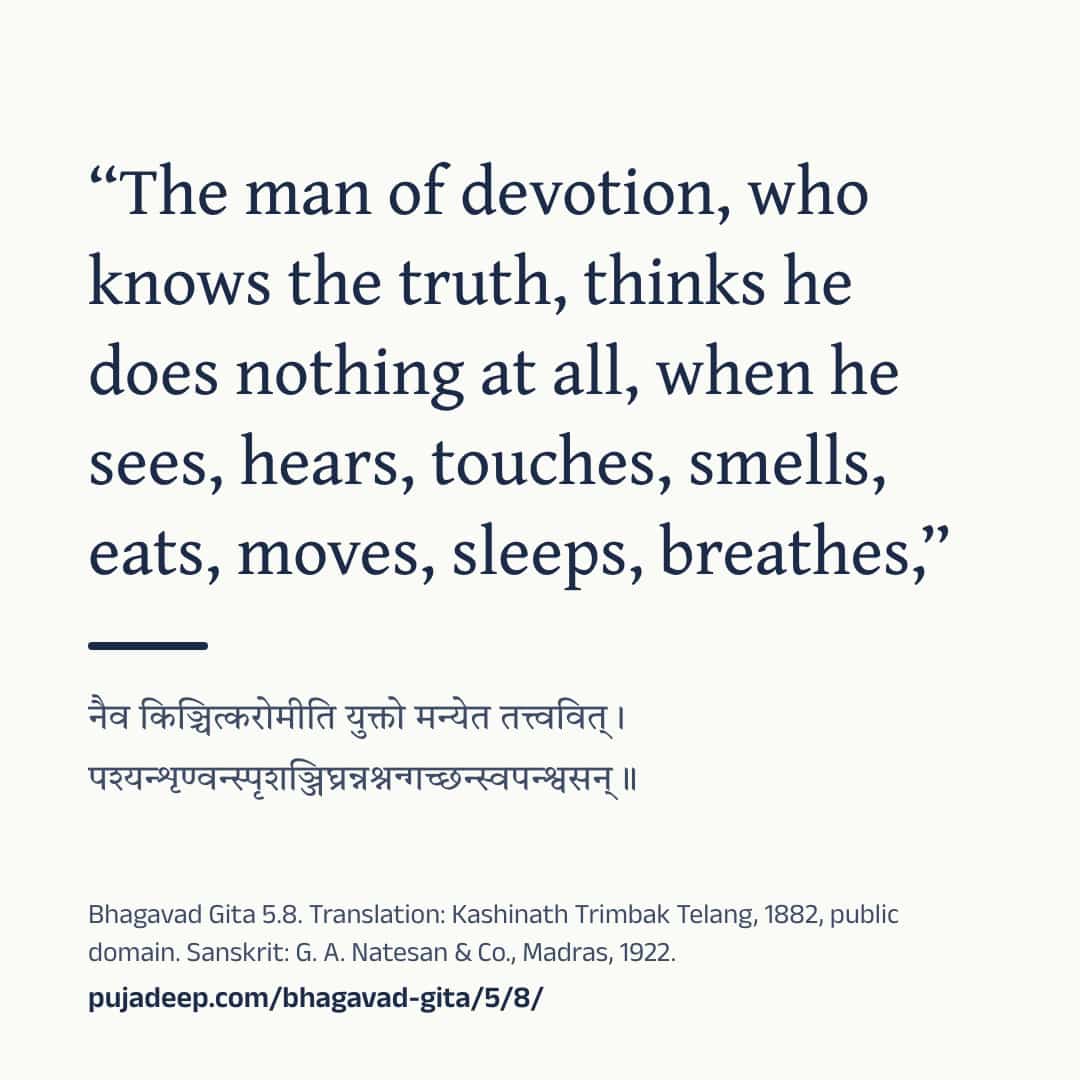
Drawing the picture
See the words
Bhagavad Gita 5.8

नैव किञ्चित्करोमीति युक्तो मन्येत तत्त्ववित् ।
पश्यन्शृण्वन्स्पृशञ्जिघ्रन्नश्नन्गच्छन्स्वपन्श्वसन् ॥

“The man of devotion, who knows the truth, thinks he does nothing at all, when he sees, hears, touches, smells, eats, moves, sleeps, breathes,”
(K. T. Telang, The Bhagavadgîtâ (The Sacred Books of the East, vol. VIII, Oxford: Clarendon Press, 1882), p. 64, public domain)
This sentence goes on in 5.9.

“"I do not anything," should think the harmonised one, who knoweth the Essence of things; in seeing, hearing, touching, smelling, eating, moving, sleeping, breathing,”
(Annie Besant, The Bhagavad Gîtâ, or The Lord's Song (London: Theosophical Publishing Society, 1895), pp. 59–60, public domain)
This sentence goes on in 5.9.

“The knower of Truth, (being) centred (in the Self) should think, "I do nothing at all"—though seeing, hearing, touching, smelling, eating, going, sleeping, breathing, speaking, letting-go, holding, opening and closing the eyes,—convinced that it is the senses that move among sense-objects.”
(Swami Swarupananda, Srimad-Bhagavad-Gita (Mayavati: Prabuddha Bharata Press, 1909; first printed in Prabuddha Bharata, 1907–1909), pp. 109–110, public domain)
This sentence covers verses 5.8 to 5.9.

Sanskrit: G. A. Natesan & Co., Madras, 1922.
https://pujadeep.com/bhagavad-gita/5/8/ Nothing is sent from this site. Your own app sends it, to the chat you choose. The picture quotes the translation you chose on this page, with its name and year.
Sanskrit text: The Bhagavad-Gita, or The Lord's Song, with the text in Devanagari and an English translation, 1922. Meanings: written for Pujadeep and checked against the cited edition. Source and changes
Questions families ask
Who speaks Bhagavad Gita 5.8?
Krishna speaks this verse, in chapter 5 (Karma Sannyasa Yoga).
Where does the Sanskrit text come from?
Sanskrit text: The Bhagavad-Gita, or The Lord's Song, with the text in Devanagari and an English translation, 1922. Meanings: written for Pujadeep and checked against the cited edition. See the source
Is the meaning on this page a translation?
Explanation written for this site from the sources listed here, and checked against the cited edition. It is not a translation and not the only way to read the text. Free to quote with credit.
Source and licence
- Sanskrit text
- The Bhagavad-Gita, or The Lord's Song, with the text in Devanagari and an English translation (Annie Besant, G. A. Natesan & Co., Madras, 1922). Public domain. The Sanskrit on these pages was read from this printing’s page images.
- Translation
- The Bhagavadgîtâ with the Sanatsugâtîya and the Anugîtâ, translated by Kâshinâth Trimbak Telang (The Sacred Books of the East, vol. VIII, ed. F. Max Müller) (Kashinath Trimbak Telang, F. Max Müller, Clarendon Press, Oxford, 1882). Public domain. Shown verbatim, as printed.
- Translation
- The Bhagavad Gîtâ, or The Lord's Song, translated by Annie Besant (Annie Besant, Theosophical Publishing Society, London, 1895). Public domain. Shown verbatim, as printed.
- Translation
- Srimad-Bhagavad-Gita, with Sanskrit Text; Paraphrase with Word-by-word Literal Translation; English Rendering and Comments, Index, &c., by the Swami Swarupananda (Himalayan Series, No. XX) (Swami Swarupananda, The Editors and Publishers, Advaita Ashrama, Mayavati, Prabuddha Bharata Press, Mayavati, Almora, Himalayas, 1909). Public domain. Shown verbatim, as printed.
- Common wording
- In this text, 32 words follow today's common wording, checked against sanskritdocuments.org; Sanskrit Wikisource; Gita Press, Gorakhpur; GRETIL, Göttingen and Bhaktivedanta Book Trust.
- Our explanation
- Explanation written for this site from the sources listed here, and checked against the cited edition. It is not a translation and not the only way to read the text. Free to quote with credit.
- Checked
- Checked against the cited edition, October 15, 2026.
- Updated
- October 25, 2026