Bhagavad Gita 5.9: meaning and translation
Chapter 5: Karma Sannyasa Yoga. Krishna says
Krishna: The list goes on: speaking, letting go, grasping, opening and closing the eyes.
Click or tap a word for its meaning and its dictionary page.
Text and layers
Text and layers
These choices stay in this browser.
Bhagavad Gita 5.9
प्रलपन्विसृजन्गृह्णन्नुन्मिषन्निमिषन्नपि ।इन्द्रियाणीन्द्रियार्थेषु वर्तन्त इति धारयन् ॥
PralapanvisrijangrihnannunmishannimishannapiIndriyanindriyartheshu vartanta iti dharayan
pralapanvisṛjangṛhṇannunmiṣannimiṣannapi |indriyāṇīndriyārtheṣu vartanta iti dhārayan ||
Our explanation The list goes on: speaking, letting go, grasping, opening and closing the eyes. In all of this, Krishna says, such a person holds that it is only the senses moving among their objects.
हिंदी अर्थ सूची आगे चलती है: बोलते, त्यागते, ग्रहण करते, आँखें खोलते और बंद करते हुए भी। कृष्ण कहते हैं कि इन सब में ऐसा व्यक्ति यही समझता है कि केवल इंद्रियाँ अपने विषयों में बरत रही हैं।
Word by word
Every word, with its dictionary page
Word by word
- प्रलपन् pralapan · speaking (present participle, nominative singular) Dictionary: pra-lap, Monier-Williams 1899, p. 689, col. 2 “to speak forth”
- विसृजन् visṛjan · letting go (present participle, nominative singular) Dictionary: vi-sṛj, Monier-Williams 1899, p. 1001, col. 1 “to send or pour forth”
- गृह्णन् gṛhṇan · grasping (present participle, nominative singular) Dictionary: grah, Monier-Williams 1899, p. 371, col. 3 “to seize, take”
- उन्मिषन् unmiṣan · opening the eyes (present participle, nominative singular) Dictionary: un-miṣ, Monier-Williams 1899, p. 194, col. 1 “to open the eyes”
- निमिषन् nimiṣan · closing the eyes (present participle, nominative singular) Dictionary: ni-miṣ, Monier-Williams 1899, p. 551, col. 2 “to shut the eyelids”
- अपि api · even (indeclinable) Dictionary: api, Monier-Williams 1899, p. 55, col. 1 “in the sense of even, also, very”
- इन्द्रियाणि indriyāṇi · the senses (nominative plural (neuter)) Dictionary: indriya, Monier-Williams 1899, p. 167, col. 2 “faculty of sense, sense, organ of sense”
- इन्द्रियार्थेषु indriyārtheṣu · among the objects of the senses (compound, locative plural) Dictionary: indriyārtha, Monier-Williams 1899, p. 167, col. 2 “an object of sense (as sound, smell, &c.)”
- वर्तन्ते vartante · move, are at work (present, 3rd person plural) Dictionary: 1. vṛt, Monier-Williams 1899, p. 1009, col. 1 “to move or go on, get along, advance, proceed”
- इति iti · thus (indeclinable) Dictionary: 2. iti, Monier-Williams 1899, p. 165, col. 1 “in this manner, thus”
- धारयन् dhārayan · holding (in mind) (present participle, causative, nominative singular) Dictionary: dhṛ, Monier-Williams 1899, p. 519, col. 1 “(with or scil. manasā) to bear in mind, recollect, remember”
Old translations
Kashinath Trimbak Telang, 1882. Public domain. Page 64.
talks, throws out1, takes, opens or closes the eyelids; he holds that the senses deal with the objects of the senses.
This sentence begins in 5.8.
Footnotes (the translator’s own) - Excretions, &c. ↩
Compare 3 translations
Kashinath Trimbak Telang, 1882. Public domain. Page 64.
talks, throws out1, takes, opens or closes the eyelids; he holds that the senses deal with the objects of the senses.
This sentence begins in 5.8.
Footnotes (the translator’s own) - Excretions, &c. ↩
You are reading this one
Annie Besant, 1895. Public domain. Page 60.
Speaking, letting go, grasping, opening and closing the eyes, he saith: "The senses move among the objects of sense."
This sentence begins in 5.8.
You are reading this one
Swami Swarupananda, 1909 (first printed 1907). Public domain.
Swarupananda renders verses 8–9 together; see 5.8. Read it at 5.8
You are reading this one
Cite this verse
The translation: K. T. Telang, The Bhagavadgîtâ (The Sacred Books of the East, vol. VIII, Oxford: Clarendon Press, 1882), p. 64. Bhagavad Gita 5.9.
The translation: Annie Besant, The Bhagavad Gîtâ, or The Lord's Song (London: Theosophical Publishing Society, 1895), p. 60. Bhagavad Gita 5.9.
The translation: Swami Swarupananda, Srimad-Bhagavad-Gita (Mayavati: Prabuddha Bharata Press, 1909; first printed in Prabuddha Bharata, 1907–1909), pp. 109–110. Bhagavad Gita 5.8–9.
Our explanation: “Bhagavad Gita 5.9: meaning and translation.” Pujadeep. Updated October 25, 2026. https://pujadeep.com/bhagavad-gita/5/9/
Pujadeep’s explanations are free to quote with credit: name Pujadeep and link to the page. How to credit
Classical readings, by school
No readings by school on this verse yet.
Share
Show the ways to share
Send one picture or the text to one chat. The picture names its source and the address of this page.
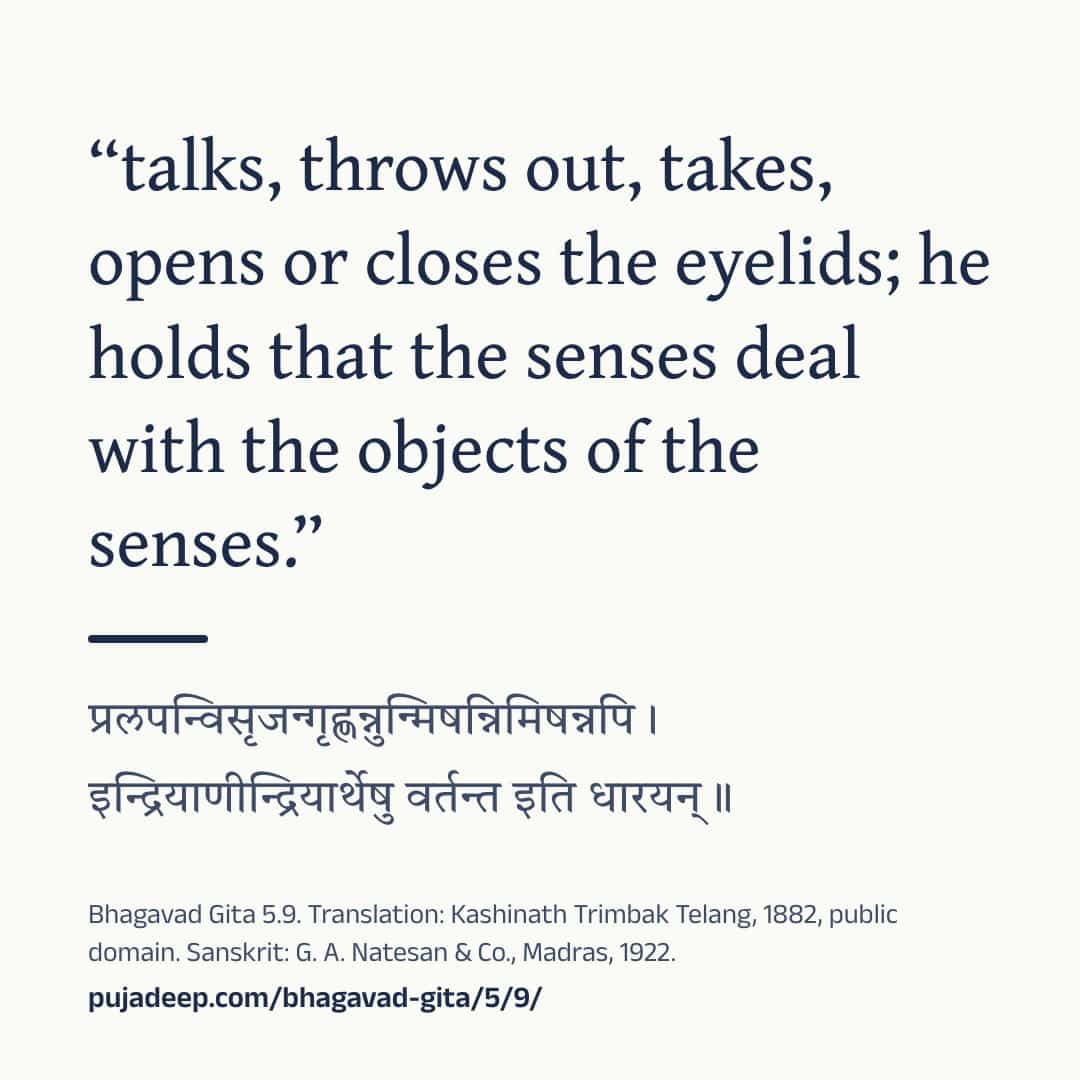
Drawing the picture
See the words
Bhagavad Gita 5.9

प्रलपन्विसृजन्गृह्णन्नुन्मिषन्निमिषन्नपि ।
इन्द्रियाणीन्द्रियार्थेषु वर्तन्त इति धारयन् ॥

“talks, throws out, takes, opens or closes the eyelids; he holds that the senses deal with the objects of the senses.”
(K. T. Telang, The Bhagavadgîtâ (The Sacred Books of the East, vol. VIII, Oxford: Clarendon Press, 1882), p. 64, public domain)
This sentence begins in 5.8.

“Speaking, letting go, grasping, opening and closing the eyes, he saith: "The senses move among the objects of sense."”
(Annie Besant, The Bhagavad Gîtâ, or The Lord's Song (London: Theosophical Publishing Society, 1895), p. 60, public domain)
This sentence begins in 5.8.

Sanskrit: G. A. Natesan & Co., Madras, 1922.
https://pujadeep.com/bhagavad-gita/5/9/ Nothing is sent from this site. Your own app sends it, to the chat you choose. The picture quotes the translation you chose on this page, with its name and year.
Sanskrit text: The Bhagavad-Gita, or The Lord's Song, with the text in Devanagari and an English translation, 1922. Meanings: written for Pujadeep and checked against the cited edition. Source and changes
Questions families ask
Who speaks Bhagavad Gita 5.9?
Krishna speaks this verse, in chapter 5 (Karma Sannyasa Yoga).
Where does the Sanskrit text come from?
Sanskrit text: The Bhagavad-Gita, or The Lord's Song, with the text in Devanagari and an English translation, 1922. Meanings: written for Pujadeep and checked against the cited edition. See the source
Is the meaning on this page a translation?
Explanation written for this site from the sources listed here, and checked against the cited edition. It is not a translation and not the only way to read the text. Free to quote with credit.
Source and licence
- Sanskrit text
- The Bhagavad-Gita, or The Lord's Song, with the text in Devanagari and an English translation (Annie Besant, G. A. Natesan & Co., Madras, 1922). Public domain. The Sanskrit on these pages was read from this printing’s page images.
- Translation
- The Bhagavadgîtâ with the Sanatsugâtîya and the Anugîtâ, translated by Kâshinâth Trimbak Telang (The Sacred Books of the East, vol. VIII, ed. F. Max Müller) (Kashinath Trimbak Telang, F. Max Müller, Clarendon Press, Oxford, 1882). Public domain. Shown verbatim, as printed.
- Translation
- The Bhagavad Gîtâ, or The Lord's Song, translated by Annie Besant (Annie Besant, Theosophical Publishing Society, London, 1895). Public domain. Shown verbatim, as printed.
- Translation
- Srimad-Bhagavad-Gita, with Sanskrit Text; Paraphrase with Word-by-word Literal Translation; English Rendering and Comments, Index, &c., by the Swami Swarupananda (Himalayan Series, No. XX) (Swami Swarupananda, The Editors and Publishers, Advaita Ashrama, Mayavati, Prabuddha Bharata Press, Mayavati, Almora, Himalayas, 1909). Public domain. Shown verbatim, as printed.
- Common wording
- In this text, 32 words follow today's common wording, checked against sanskritdocuments.org; Sanskrit Wikisource; Gita Press, Gorakhpur; GRETIL, Göttingen and Bhaktivedanta Book Trust.
- Our explanation
- Explanation written for this site from the sources listed here, and checked against the cited edition. It is not a translation and not the only way to read the text. Free to quote with credit.
- Checked
- Checked against the cited edition, October 15, 2026.
- Updated
- October 25, 2026