Bhagavad Gita 5.14: meaning and translation
Chapter 5: Karma Sannyasa Yoga. Krishna says
Krishna says that the lord (prabhu) does not create doership, or actions, for the world, nor the link between action and its fruit.
Click or tap a word for its meaning and its dictionary page.
Text and layers
Text and layers
These choices stay in this browser.
Bhagavad Gita 5.14
न कर्तृत्वं न कर्माणि लोकस्य सृजति प्रभुः ।न कर्मफलसंयोगं स्वभावस्तु प्रवर्तते ॥
Na kartritvam na karmani lokasya srijati prabhuhNa karmaphalasanyogam svabhavastu pravartate
na kartṛtvaṃ na karmāṇi lokasya sṛjati prabhuḥ |na karmaphalasaṃyogaṃ svabhāvastu pravartate ||
Our explanation Krishna says that the lord (prabhu) does not create doership, or actions, for the world, nor the link between action and its fruit. It is one's own nature (svabhāva), he says, that works. Commentators differ on who “the lord” is: Shankara takes it as the Self, lord of the body; Ramanuja as the individual self (ātman).
हिंदी अर्थ कृष्ण कहते हैं कि प्रभु संसार के लिए न कर्तापन रचता है, न कर्म, न कर्म और फल का संबंध। वे कहते हैं कि यह सब स्वभाव (प्रकृति) से चलता है। “प्रभु” कौन है, इस पर टीकाकार अलग राय रखते हैं: शंकराचार्य इसे शरीर की स्वामी आत्मा मानते हैं, रामानुजाचार्य जीवात्मा।
Word by word
Every word, with its dictionary page
Word by word
- न na · not (indeclinable) Dictionary: 2. na, Monier-Williams 1899, p. 523, col. 1 “not, no, nor, neither”
- कर्तृत्वम् kartṛtvam · doership (accusative singular (neuter)) Dictionary: kartṛ-tva, Monier-Williams 1899, p. 258, col. 1 “the state of being the performer”
- न na · nor (indeclinable) Dictionary: 2. na, Monier-Williams 1899, p. 523, col. 1 “not, no, nor, neither”
- कर्माणि karmāṇi · actions (accusative plural (neuter)) Dictionary: karman, Monier-Williams 1899, p. 258, col. 2 “act, action, performance, business”
- लोकस्य lokasya · of the world, of people (genitive singular) Dictionary: loka, Monier-Williams 1899, p. 906, col. 1 “the wide space or world”
- सृजति sṛjati · creates (present, 3rd person singular) Dictionary: 1. sṛj, Monier-Williams 1899, p. 1245, col. 2 “to emit from one's self, i.e. create, procreate, produce, beget”
- प्रभुः prabhuḥ · the lord (nominative singular) Dictionary: pra-bhu, Monier-Williams 1899, p. 684, col. 3 “a master, lord, king”
- न na · nor (indeclinable) Dictionary: 2. na, Monier-Williams 1899, p. 523, col. 1 “not, no, nor, neither”
- कर्मफलसंयोगम् karmaphalasaṃyogam · the link of action and fruit (compound, accusative singular) Dictionary: karma-phala, Monier-Williams 1899, p. 259, col. 1 “the fruit or recompense of actions”; saṃ-yoga, Monier-Williams 1899, p. 1112, col. 2 “conjunction, combination”
- स्वभावः svabhāvaḥ · one's own nature (nominative singular) Dictionary: sva-bhāva, Monier-Williams 1899, p. 1276, col. 1 “innate or inherent disposition, nature”
- तु tu · but (indeclinable) Dictionary: 2. tu, Monier-Williams 1899, p. 449, col. 3 “but”
- प्रवर्तते pravartate · works, goes on (present, 3rd person singular) Dictionary: pra-vṛt, Monier-Williams 1899, p. 693, col. 2 “to roll or go onwards”
Old translations
Kashinath Trimbak Telang, 1882. Public domain. Page 65.
The Lord is not the cause of actions, or of the capacity of performing actions amongst men, or of the connexion of action and fruit. But nature only works.
Compare 3 translations
Kashinath Trimbak Telang, 1882. Public domain. Page 65.
The Lord is not the cause of actions, or of the capacity of performing actions amongst men, or of the connexion of action and fruit. But nature only works.
You are reading this one
Annie Besant, 1895. Public domain. Page 61.
The Lord of the world produceth neither the faculty of acting, nor actions, nor the union together of action and its fruit; Nature, however, energiseth.
You are reading this one
Swami Swarupananda, 1909 (first printed 1907). Public domain. Page 112.
Neither agency, nor actions does the Lord create for the world, nor (does He bring about) the union with the fruit of action. It is the universal ignorance that does (it all).
You are reading this one
Cite this verse
The translation: K. T. Telang, The Bhagavadgîtâ (The Sacred Books of the East, vol. VIII, Oxford: Clarendon Press, 1882), p. 65. Bhagavad Gita 5.14.
The translation: Annie Besant, The Bhagavad Gîtâ, or The Lord's Song (London: Theosophical Publishing Society, 1895), p. 61. Bhagavad Gita 5.14.
The translation: Swami Swarupananda, Srimad-Bhagavad-Gita (Mayavati: Prabuddha Bharata Press, 1909; first printed in Prabuddha Bharata, 1907–1909), p. 112. Bhagavad Gita 5.14.
Our explanation: “Bhagavad Gita 5.14: meaning and translation.” Pujadeep. Updated October 25, 2026. https://pujadeep.com/bhagavad-gita/5/14/
Pujadeep’s explanations are free to quote with credit: name Pujadeep and link to the page. How to credit
Classical readings, by school
No readings by school on this verse yet.
Share
Show the ways to share
Send one picture or the text to one chat. The picture names its source and the address of this page.
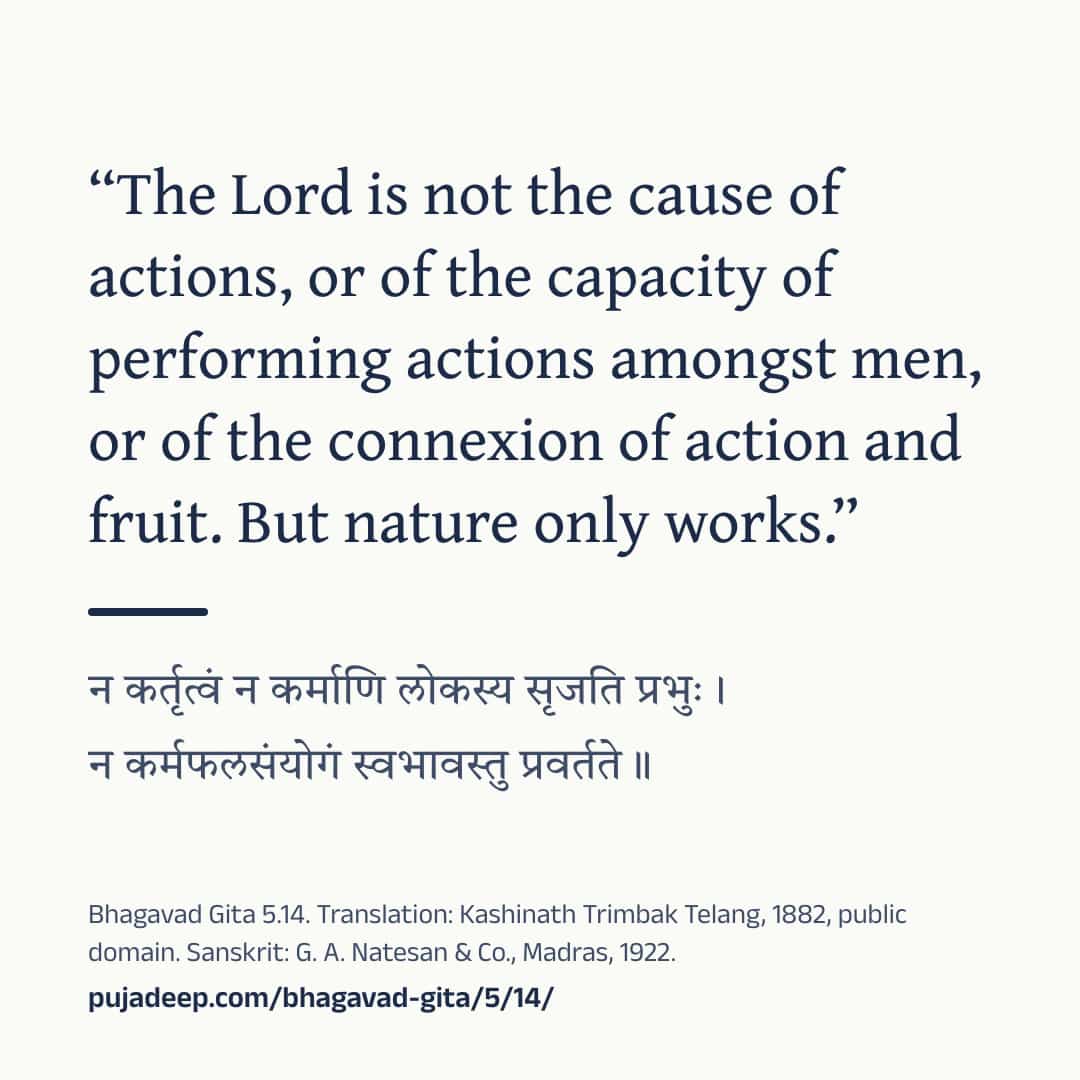
Drawing the picture
See the words
Bhagavad Gita 5.14

न कर्तृत्वं न कर्माणि लोकस्य सृजति प्रभुः ।
न कर्मफलसंयोगं स्वभावस्तु प्रवर्तते ॥

“The Lord is not the cause of actions, or of the capacity of performing actions amongst men, or of the connexion of action and fruit. But nature only works.”
(K. T. Telang, The Bhagavadgîtâ (The Sacred Books of the East, vol. VIII, Oxford: Clarendon Press, 1882), p. 65, public domain)

“The Lord of the world produceth neither the faculty of acting, nor actions, nor the union together of action and its fruit; Nature, however, energiseth.”
(Annie Besant, The Bhagavad Gîtâ, or The Lord's Song (London: Theosophical Publishing Society, 1895), p. 61, public domain)

“Neither agency, nor actions does the Lord create for the world, nor (does He bring about) the union with the fruit of action. It is the universal ignorance that does (it all).”
(Swami Swarupananda, Srimad-Bhagavad-Gita (Mayavati: Prabuddha Bharata Press, 1909; first printed in Prabuddha Bharata, 1907–1909), p. 112, public domain)

Sanskrit: G. A. Natesan & Co., Madras, 1922.
https://pujadeep.com/bhagavad-gita/5/14/ Nothing is sent from this site. Your own app sends it, to the chat you choose. The picture quotes the translation you chose on this page, with its name and year.
Sanskrit text: The Bhagavad-Gita, or The Lord's Song, with the text in Devanagari and an English translation, 1922. Meanings: written for Pujadeep and checked against the cited edition. Source and changes
Questions families ask
Who speaks Bhagavad Gita 5.14?
Krishna speaks this verse, in chapter 5 (Karma Sannyasa Yoga).
Where does the Sanskrit text come from?
Sanskrit text: The Bhagavad-Gita, or The Lord's Song, with the text in Devanagari and an English translation, 1922. Meanings: written for Pujadeep and checked against the cited edition. See the source
Is the meaning on this page a translation?
Explanation written for this site from the sources listed here, and checked against the cited edition. It is not a translation and not the only way to read the text. Free to quote with credit.
Source and licence
- Sanskrit text
- The Bhagavad-Gita, or The Lord's Song, with the text in Devanagari and an English translation (Annie Besant, G. A. Natesan & Co., Madras, 1922). Public domain. The Sanskrit on these pages was read from this printing’s page images.
- Translation
- The Bhagavadgîtâ with the Sanatsugâtîya and the Anugîtâ, translated by Kâshinâth Trimbak Telang (The Sacred Books of the East, vol. VIII, ed. F. Max Müller) (Kashinath Trimbak Telang, F. Max Müller, Clarendon Press, Oxford, 1882). Public domain. Shown verbatim, as printed.
- Translation
- The Bhagavad Gîtâ, or The Lord's Song, translated by Annie Besant (Annie Besant, Theosophical Publishing Society, London, 1895). Public domain. Shown verbatim, as printed.
- Translation
- Srimad-Bhagavad-Gita, with Sanskrit Text; Paraphrase with Word-by-word Literal Translation; English Rendering and Comments, Index, &c., by the Swami Swarupananda (Himalayan Series, No. XX) (Swami Swarupananda, The Editors and Publishers, Advaita Ashrama, Mayavati, Prabuddha Bharata Press, Mayavati, Almora, Himalayas, 1909). Public domain. Shown verbatim, as printed.
- Common wording
- In this text, 32 words follow today's common wording, checked against sanskritdocuments.org; Sanskrit Wikisource; Gita Press, Gorakhpur; GRETIL, Göttingen and Bhaktivedanta Book Trust.
- Our explanation
- Explanation written for this site from the sources listed here, and checked against the cited edition. It is not a translation and not the only way to read the text. Free to quote with credit.
- Checked
- Checked against the cited edition, October 15, 2026.
- Updated
- October 25, 2026