Bhagavad Gita 5.28: meaning and translation
Chapter 5: Karma Sannyasa Yoga. Krishna says
Krishna: Such a sage (muni) keeps senses, mind and understanding under control, holds liberation (mokṣa) as the highest goal, and has let go of desire, fear and anger.
Click or tap a word for its meaning and its dictionary page.
Text and layers
Text and layers
These choices stay in this browser.
Bhagavad Gita 5.28
यतेन्द्रियमनोबुद्धिर्मुनिर्मोक्षपरायणः ।विगतेच्छाभयक्रोधो यः सदा मुक्त एव सः ॥
YatendriyamanobuddhirmunirmokshaparayanahVigatechchhabhayakrodho yah sada mukta eva sah
yatendriyamanobuddhirmunirmokṣaparāyaṇaḥ |vigatecchābhayakrodho yaḥ sadā mukta eva saḥ ||
Our explanation Such a sage (muni) keeps senses, mind and understanding under control, holds liberation (mokṣa) as the highest goal, and has let go of desire, fear and anger. Krishna says that such a one is truly free, always.
हिंदी अर्थ ऐसा मुनि इंद्रियों, मन और बुद्धि को वश में रखता है, मोक्ष को परम लक्ष्य मानता है, और इच्छा, भय और क्रोध को छोड़ चुका है। कृष्ण कहते हैं कि ऐसा व्यक्ति सदा मुक्त ही है।
Word by word
Every word, with its dictionary page
Word by word
- यतेन्द्रियमनोबुद्धिः yatendriyamanobuddhiḥ · with senses, mind and understanding held in check (compound, nominative singular) Dictionary: yata, Monier-Williams 1899, p. 845, col. 2 “restrained, held in”; indriya, Monier-Williams 1899, p. 167, col. 2 “faculty of sense, sense, organ of sense”; manas, Monier-Williams 1899, p. 783, col. 3 “mind (in its widest sense as applied to all the mental powers)”; buddhi, Monier-Williams 1899, p. 733, col. 3 “intelligence, reason, intellect, mind”
- मुनिः muniḥ · the sage (nominative singular) Dictionary: muni, Monier-Williams 1899, p. 823, col. 1 “a saint, sage, seer, ascetic, monk, devotee, hermit”
- मोक्षपरायणः mokṣaparāyaṇaḥ · holding liberation as the highest goal (compound, nominative singular) Dictionary: mokṣa, Monier-Williams 1899, p. 835, col. 1 “emancipation, liberation”; 1. parāyaṇa, Monier-Williams 1899, p. 587, col. 3 “final end or aim, last resort or refuge, principal object”
- विगतेच्छाभयक्रोधः vigatecchābhayakrodhaḥ · free from desire, fear and anger (compound, nominative singular) Dictionary: 2. vi-gata, Monier-Williams 1899, p. 956, col. 3 “gone away, departed”; icchā, Monier-Williams 1899, p. 169, col. 1 “wish, desire”; bhaya, Monier-Williams 1899, p. 747, col. 1 “fear, alarm, dread, apprehension”; krodha, Monier-Williams 1899, p. 322, col. 1 “anger, wrath, passion”
- यः yaḥ · who (relative pronoun, nominative singular) Dictionary: yad, Monier-Williams 1899, p. 844, col. 2 “who, which, what, whichever, whatever, that”
- सदा sadā · always (indeclinable) Dictionary: sadā, Monier-Williams 1899, p. 1139, col. 2 “always, ever, every time, continually”
- मुक्तः muktaḥ · free (past participle, nominative singular) Dictionary: mukta, Monier-Williams 1899, p. 820, col. 3 “loosened, let loose, set free, relaxed”
- एव eva · truly (indeclinable) Dictionary: 1. eva, Monier-Williams 1899, p. 232, col. 2 “just, exactly, very, same, only, even, alone, merely”
- सः saḥ · he (pronoun, nominative singular) Dictionary: tad, Monier-Williams 1899, p. 434, col. 1 “that, this”
Old translations
Kashinath Trimbak Telang, 1882. Public domain.
Telang translates verses 27–28 as one sentence; see 5.27. Read it at 5.27
Compare 3 translations
Kashinath Trimbak Telang, 1882. Public domain.
Telang translates verses 27–28 as one sentence; see 5.27. Read it at 5.27
You are reading this one
Annie Besant, 1895. Public domain. Page 63.
With senses, Manas and Buddhi controlled, solely devoted to liberation, the Muni, having cast away hope, fear and passion, he verily is liberated for ever.
This sentence begins in 5.27.
You are reading this one
Swami Swarupananda, 1909 (first printed 1907). Public domain.
Swarupananda renders verses 27–28 together; see 5.27. Read it at 5.27
You are reading this one
Cite this verse
The translation: K. T. Telang, The Bhagavadgîtâ (The Sacred Books of the East, vol. VIII, Oxford: Clarendon Press, 1882), pp. 66–67. Bhagavad Gita 5.27–28.
The translation: Annie Besant, The Bhagavad Gîtâ, or The Lord's Song (London: Theosophical Publishing Society, 1895), p. 63. Bhagavad Gita 5.28.
The translation: Swami Swarupananda, Srimad-Bhagavad-Gita (Mayavati: Prabuddha Bharata Press, 1909; first printed in Prabuddha Bharata, 1907–1909), p. 119. Bhagavad Gita 5.27–28.
Our explanation: “Bhagavad Gita 5.28: meaning and translation.” Pujadeep. Updated October 25, 2026. https://pujadeep.com/bhagavad-gita/5/28/
Pujadeep’s explanations are free to quote with credit: name Pujadeep and link to the page. How to credit
Classical readings, by school
No readings by school on this verse yet.
Share
Show the ways to share
Send one picture or the text to one chat. The picture names its source and the address of this page.
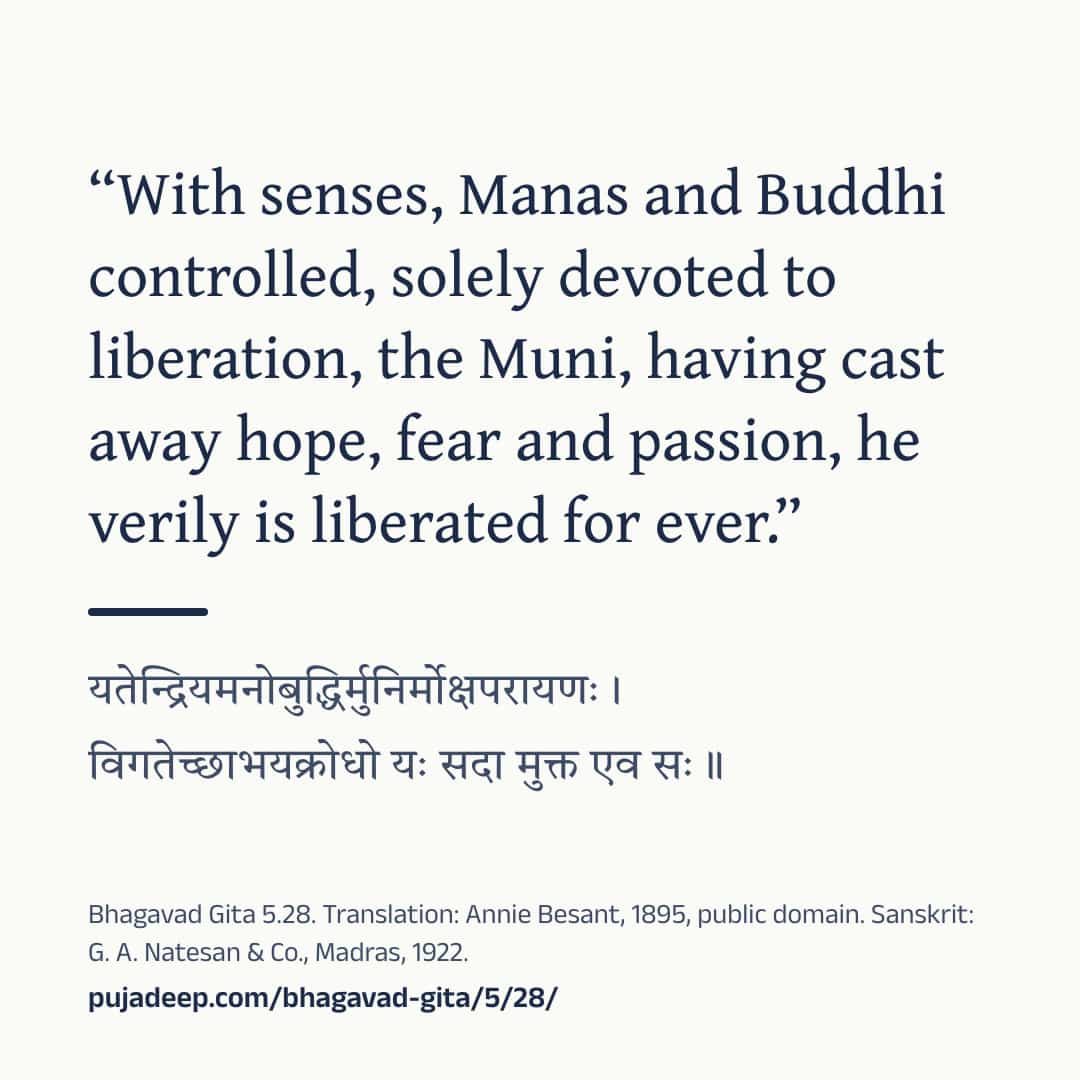
Drawing the picture
See the words
Bhagavad Gita 5.28

यतेन्द्रियमनोबुद्धिर्मुनिर्मोक्षपरायणः ।
विगतेच्छाभयक्रोधो यः सदा मुक्त एव सः ॥

“With senses, Manas and Buddhi controlled, solely devoted to liberation, the Muni, having cast away hope, fear and passion, he verily is liberated for ever.”
(Annie Besant, The Bhagavad Gîtâ, or The Lord's Song (London: Theosophical Publishing Society, 1895), p. 63, public domain)
This sentence begins in 5.27.

Sanskrit: G. A. Natesan & Co., Madras, 1922.
https://pujadeep.com/bhagavad-gita/5/28/ Nothing is sent from this site. Your own app sends it, to the chat you choose. The picture quotes the translation you chose on this page, with its name and year.
Sanskrit text: The Bhagavad-Gita, or The Lord's Song, with the text in Devanagari and an English translation, 1922. Meanings: written for Pujadeep and checked against the cited edition. Source and changes
Questions families ask
Who speaks Bhagavad Gita 5.28?
Krishna speaks this verse, in chapter 5 (Karma Sannyasa Yoga).
Where does the Sanskrit text come from?
Sanskrit text: The Bhagavad-Gita, or The Lord's Song, with the text in Devanagari and an English translation, 1922. Meanings: written for Pujadeep and checked against the cited edition. See the source
Is the meaning on this page a translation?
Explanation written for this site from the sources listed here, and checked against the cited edition. It is not a translation and not the only way to read the text. Free to quote with credit.
Source and licence
- Sanskrit text
- The Bhagavad-Gita, or The Lord's Song, with the text in Devanagari and an English translation (Annie Besant, G. A. Natesan & Co., Madras, 1922). Public domain. The Sanskrit on these pages was read from this printing’s page images.
- Translation
- The Bhagavadgîtâ with the Sanatsugâtîya and the Anugîtâ, translated by Kâshinâth Trimbak Telang (The Sacred Books of the East, vol. VIII, ed. F. Max Müller) (Kashinath Trimbak Telang, F. Max Müller, Clarendon Press, Oxford, 1882). Public domain. Shown verbatim, as printed.
- Translation
- The Bhagavad Gîtâ, or The Lord's Song, translated by Annie Besant (Annie Besant, Theosophical Publishing Society, London, 1895). Public domain. Shown verbatim, as printed.
- Translation
- Srimad-Bhagavad-Gita, with Sanskrit Text; Paraphrase with Word-by-word Literal Translation; English Rendering and Comments, Index, &c., by the Swami Swarupananda (Himalayan Series, No. XX) (Swami Swarupananda, The Editors and Publishers, Advaita Ashrama, Mayavati, Prabuddha Bharata Press, Mayavati, Almora, Himalayas, 1909). Public domain. Shown verbatim, as printed.
- Common wording
- In this text, 32 words follow today's common wording, checked against sanskritdocuments.org; Sanskrit Wikisource; Gita Press, Gorakhpur; GRETIL, Göttingen and Bhaktivedanta Book Trust.
- Our explanation
- Explanation written for this site from the sources listed here, and checked against the cited edition. It is not a translation and not the only way to read the text. Free to quote with credit.
- Checked
- Checked against the cited edition, October 15, 2026.
- Updated
- October 25, 2026