Bhagavad Gita 5.22: meaning and translation
Chapter 5: Karma Sannyasa Yoga. Krishna says
Krishna says that the pleasures born of contact between the senses and their objects are sources of sorrow, because they have a beginning and an end.
Click or tap a word for its meaning and its dictionary page.
Text and layers
Text and layers
These choices stay in this browser.
Bhagavad Gita 5.22
ये हि संस्पर्शजा भोगा दुःखयोनय एव ते ।आद्यन्तवन्तः कौन्तेय न तेषु रमते बुधः ॥
Ye hi sansparshaja bhoga duhkhayonaya eva teAdyantavantah kaunteya na teshu ramate budhah
ye hi saṃsparśajā bhogā duḥkhayonaya eva te |ādyantavantaḥ kaunteya na teṣu ramate budhaḥ ||
Our explanation Krishna says that the pleasures born of contact between the senses and their objects are sources of sorrow, because they have a beginning and an end. The wise person, he says, does not delight in them. He calls Arjuna Kaunteya, son of Kunti.
हिंदी अर्थ कृष्ण कहते हैं कि इंद्रियों और विषयों के स्पर्श से पैदा होने वाले भोग दुःख के कारण हैं, क्योंकि उनका आरंभ और अंत होता है। वे कहते हैं कि बुद्धिमान व्यक्ति उनमें रमता नहीं। वे अर्जुन को कौन्तेय (कुंती के पुत्र) कहकर पुकारते हैं।
Word by word
Every word, with its dictionary page
Word by word
- ये ye · those which (relative pronoun, nominative plural) Dictionary: yad, Monier-Williams 1899, p. 844, col. 2 “who, which, what, whichever, whatever, that”
- हि hi · indeed (indeclinable) Dictionary: 2. hi, Monier-Williams 1899, p. 1297, col. 3 “for, because, on account of”
- संस्पर्शजाः saṃsparśajāḥ · born of contact (compound, nominative plural) Dictionary: saṃ-sparśa-ja, Monier-Williams 1899, p. 1122, col. 1 “produced by contact or sensible perception”; saṃ-sparśa, Monier-Williams 1899, p. 1122, col. 1 “close or mutual contact”
- भोगाः bhogāḥ · pleasures (nominative plural) Dictionary: 2. bhoga, Monier-Williams 1899, p. 767, col. 2 “enjoyment, eating, feeding on”; 3. bhuj, Monier-Williams 1899, p. 759, col. 2 “to enjoy, use, possess”
- दुःखयोनयः duḥkhayonayaḥ · sources of sorrow (compound, nominative plural) Dictionary: 1. duḥkha, Monier-Williams 1899, p. 483, col. 2 “uneasiness, pain, sorrow, trouble, difficulty”; yoni, Monier-Williams 1899, p. 858, col. 2 “place of birth, source”
- एव eva · only (indeclinable) Dictionary: 1. eva, Monier-Williams 1899, p. 232, col. 2 “just, exactly, very, same, only, even, alone, merely”
- ते te · they (pronoun, nominative plural) Dictionary: tad, Monier-Williams 1899, p. 434, col. 1 “that, this”
- आद्यन्तवन्तः ādyantavantaḥ · having a beginning and an end (compound, nominative plural) Dictionary: ādy-anta-vat, Monier-Williams 1899, p. 137, col. 1 “having beginning and end”; ādy-anta, Monier-Williams 1899, p. 137, col. 1 “beginning and end”
- कौन्तेय kaunteya · O son of Kunti (vocative singular) Dictionary: kaunteya, Monier-Williams 1899, p. 316, col. 2 “metron. fr. Kuntī”
- न na · not (indeclinable) Dictionary: 2. na, Monier-Williams 1899, p. 523, col. 1 “not, no, nor, neither”
- तेषु teṣu · in them (pronoun, locative plural) Dictionary: tad, Monier-Williams 1899, p. 434, col. 1 “that, this”
- रमते ramate · delights (present, 3rd person singular) Dictionary: ram, Monier-Williams 1899, p. 867, col. 2 “to delight”
- बुधः budhaḥ · the wise one (nominative singular) Dictionary: budha, Monier-Williams 1899, p. 734, col. 1 “a wise or learned man”
Old translations
Kashinath Trimbak Telang, 1882. Public domain. Page 66.
For the enjoyments born of contact (between senses and their objects) are, indeed, sources of misery; they have a beginning as well as an end1. O son of Kuntî! a wise man feels no pleasure in them.
Footnotes (the translator’s own) - Cf. supra, p. 44. ↩
Compare 3 translations
Kashinath Trimbak Telang, 1882. Public domain. Page 66.
For the enjoyments born of contact (between senses and their objects) are, indeed, sources of misery; they have a beginning as well as an end1. O son of Kuntî! a wise man feels no pleasure in them.
Footnotes (the translator’s own) - Cf. supra, p. 44. ↩
You are reading this one
Annie Besant, 1895. Public domain. Page 62.
The delights that are contact-born they are verily wombs of pain, for they have beginning and ending, O Kaunteya; not in them may rejoice the spiritually wise.
You are reading this one
Swami Swarupananda, 1909 (first printed 1907). Public domain. Page 116.
Since enjoyments that are contact-born are parents of misery alone, and with beginning and end, O son of Kunti, a wise man does not seek pleasure in them.
You are reading this one
Cite this verse
The translation: K. T. Telang, The Bhagavadgîtâ (The Sacred Books of the East, vol. VIII, Oxford: Clarendon Press, 1882), p. 66. Bhagavad Gita 5.22.
The translation: Annie Besant, The Bhagavad Gîtâ, or The Lord's Song (London: Theosophical Publishing Society, 1895), p. 62. Bhagavad Gita 5.22.
The translation: Swami Swarupananda, Srimad-Bhagavad-Gita (Mayavati: Prabuddha Bharata Press, 1909; first printed in Prabuddha Bharata, 1907–1909), p. 116. Bhagavad Gita 5.22.
Our explanation: “Bhagavad Gita 5.22: meaning and translation.” Pujadeep. Updated October 25, 2026. https://pujadeep.com/bhagavad-gita/5/22/
Pujadeep’s explanations are free to quote with credit: name Pujadeep and link to the page. How to credit
Classical readings, by school
No readings by school on this verse yet.
Share
Show the ways to share
Send one picture or the text to one chat. The picture names its source and the address of this page.
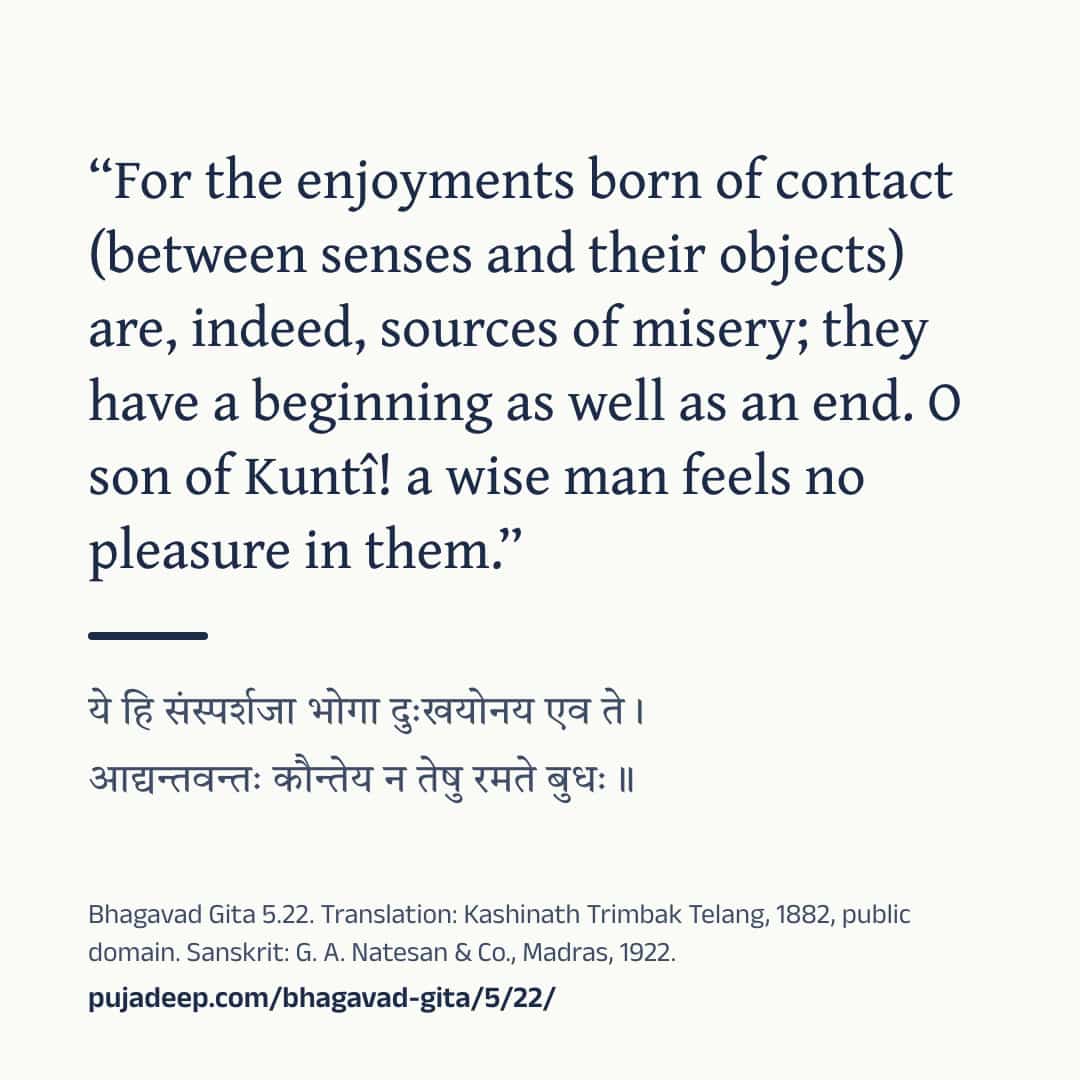
Drawing the picture
See the words
Bhagavad Gita 5.22

ये हि संस्पर्शजा भोगा दुःखयोनय एव ते ।
आद्यन्तवन्तः कौन्तेय न तेषु रमते बुधः ॥

“For the enjoyments born of contact (between senses and their objects) are, indeed, sources of misery; they have a beginning as well as an end. O son of Kuntî! a wise man feels no pleasure in them.”
(K. T. Telang, The Bhagavadgîtâ (The Sacred Books of the East, vol. VIII, Oxford: Clarendon Press, 1882), p. 66, public domain)

“The delights that are contact-born they are verily wombs of pain, for they have beginning and ending, O Kaunteya; not in them may rejoice the spiritually wise.”
(Annie Besant, The Bhagavad Gîtâ, or The Lord's Song (London: Theosophical Publishing Society, 1895), p. 62, public domain)

“Since enjoyments that are contact-born are parents of misery alone, and with beginning and end, O son of Kunti, a wise man does not seek pleasure in them.”
(Swami Swarupananda, Srimad-Bhagavad-Gita (Mayavati: Prabuddha Bharata Press, 1909; first printed in Prabuddha Bharata, 1907–1909), p. 116, public domain)

Sanskrit: G. A. Natesan & Co., Madras, 1922.
https://pujadeep.com/bhagavad-gita/5/22/ Nothing is sent from this site. Your own app sends it, to the chat you choose. The picture quotes the translation you chose on this page, with its name and year.
Sanskrit text: The Bhagavad-Gita, or The Lord's Song, with the text in Devanagari and an English translation, 1922. Meanings: written for Pujadeep and checked against the cited edition. Source and changes
Questions families ask
Who speaks Bhagavad Gita 5.22?
Krishna speaks this verse, in chapter 5 (Karma Sannyasa Yoga).
Where does the Sanskrit text come from?
Sanskrit text: The Bhagavad-Gita, or The Lord's Song, with the text in Devanagari and an English translation, 1922. Meanings: written for Pujadeep and checked against the cited edition. See the source
Is the meaning on this page a translation?
Explanation written for this site from the sources listed here, and checked against the cited edition. It is not a translation and not the only way to read the text. Free to quote with credit.
Source and licence
- Sanskrit text
- The Bhagavad-Gita, or The Lord's Song, with the text in Devanagari and an English translation (Annie Besant, G. A. Natesan & Co., Madras, 1922). Public domain. The Sanskrit on these pages was read from this printing’s page images.
- Translation
- The Bhagavadgîtâ with the Sanatsugâtîya and the Anugîtâ, translated by Kâshinâth Trimbak Telang (The Sacred Books of the East, vol. VIII, ed. F. Max Müller) (Kashinath Trimbak Telang, F. Max Müller, Clarendon Press, Oxford, 1882). Public domain. Shown verbatim, as printed.
- Translation
- The Bhagavad Gîtâ, or The Lord's Song, translated by Annie Besant (Annie Besant, Theosophical Publishing Society, London, 1895). Public domain. Shown verbatim, as printed.
- Translation
- Srimad-Bhagavad-Gita, with Sanskrit Text; Paraphrase with Word-by-word Literal Translation; English Rendering and Comments, Index, &c., by the Swami Swarupananda (Himalayan Series, No. XX) (Swami Swarupananda, The Editors and Publishers, Advaita Ashrama, Mayavati, Prabuddha Bharata Press, Mayavati, Almora, Himalayas, 1909). Public domain. Shown verbatim, as printed.
- Common wording
- In this text, 32 words follow today's common wording, checked against sanskritdocuments.org; Sanskrit Wikisource; Gita Press, Gorakhpur; GRETIL, Göttingen and Bhaktivedanta Book Trust.
- Our explanation
- Explanation written for this site from the sources listed here, and checked against the cited edition. It is not a translation and not the only way to read the text. Free to quote with credit.
- Checked
- Checked against the cited edition, October 15, 2026.
- Updated
- October 25, 2026