Bhagavad Gita 5.18: meaning and translation
Chapter 5: Karma Sannyasa Yoga. Krishna says
Krishna says that the wise see the same in a learned and humble brāhmaṇa, a cow, an elephant, a dog, and a śvapāka, a man of the group that society in that age held lowest.
Click or tap a word for its meaning and its dictionary page.
Text and layers
Text and layers
These choices stay in this browser.
Bhagavad Gita 5.18
विद्याविनयसम्पन्ने ब्राह्मणे गवि हस्तिनि ।शुनि चैव श्वपाके च पण्डिताः समदर्शिनः ॥
Vidyavinayasampanne brahmane gavi hastiniShuni chaiva shvapake cha panditah samadarshinah
vidyāvinayasampanne brāhmaṇe gavi hastini |śuni caiva śvapāke ca paṇḍitāḥ samadarśinaḥ ||
Our explanation Krishna says that the wise see the same in a learned and humble brāhmaṇa, a cow, an elephant, a dog, and a śvapāka, a man of the group that society in that age held lowest. The verse names the extremes of its own society to say that the wise make no such distinction in what they see. The schools differ on what “the same” is (see the views).
हिंदी अर्थ कृष्ण कहते हैं कि ज्ञानी विद्या और विनय से संपन्न ब्राह्मण में, गाय में, हाथी में, कुत्ते में और श्वपाक में, यानी उस समय के समाज में सबसे नीचा माने गए वर्ग के व्यक्ति में, एक ही तत्त्व देखते हैं। श्लोक अपने समय के समाज के दो छोर गिनाकर कहता है कि ज्ञानी की दृष्टि में यह भेद नहीं रहता। वह “एक ही तत्त्व” क्या है, इस पर परंपराएँ अलग राय रखती हैं।
Word by word
Every word, with its dictionary page
Word by word
- विद्याविनयसम्पन्ने vidyāvinayasampanne · rich in learning and humility (compound, locative singular) Dictionary: vidyā, Monier-Williams 1899, p. 963, col. 3 “knowledge”; vi-naya, Monier-Williams 1899, p. 971, col. 3 “good breeding, propriety of conduct, decency, modesty”; sam-panna, Monier-Williams 1899, p. 1172, col. 1 “endowed or furnished with”
- ब्राह्मणे brāhmaṇe · in a brāhmaṇa (locative singular) Dictionary: brāhmaṇa, Monier-Williams 1899, p. 741, col. 2 “one who has divine knowledge”
- गवि gavi · in a cow (locative singular) Dictionary: go, Monier-Williams 1899, p. 363, col. 3 “m. an ox, f. a cow”
- हस्तिनि hastini · in an elephant (locative singular) Dictionary: hastin, Monier-Williams 1899, p. 1295, col. 3 “an elephant”
- शुनि śuni · in a dog (locative singular) Dictionary: 1. śvan, Monier-Williams 1899, p. 1105, col. 1 “a dog”
- च ca · and (indeclinable) Dictionary: 2. ca, Monier-Williams 1899, p. 380, col. 1 “and, both, also, moreover, as well as”
- एव eva · even (indeclinable) Dictionary: 1. eva, Monier-Williams 1899, p. 232, col. 2 “just, exactly, very, same, only, even, alone, merely”
- श्वपाके śvapāke · in a śvapāka (locative singular) Dictionary: śva-pāka, Monier-Williams 1899, p. 1105, col. 1 “one who cooks dogs, a man of an outcaste tribe”
- च ca · and (indeclinable) Dictionary: 2. ca, Monier-Williams 1899, p. 380, col. 1 “and, both, also, moreover, as well as”
- पण्डिताः paṇḍitāḥ · the wise (nominative plural) Dictionary: paṇḍita, Monier-Williams 1899, p. 580, col. 3 “learned, wise, shrewd, clever”
- समदर्शिनः samadarśinaḥ · see the same (compound, nominative plural) Dictionary: sama-darśin, Monier-Williams 1899, p. 1152, col. 2 “looking impartially”
Old translations
Kashinath Trimbak Telang, 1882. Public domain. Page 65.
The wise look upon a Brâhmana possessed of learning and humility, on a cow, an elephant, a dog, and a Svapâka, as alike1.
Footnotes (the translator’s own) - As manifestations of Brahman, though of different qualities and classes. As to Svapâka, a very low caste, see Sutta Nipâta, p. 36. ↩
Compare 3 translations
Kashinath Trimbak Telang, 1882. Public domain. Page 65.
The wise look upon a Brâhmana possessed of learning and humility, on a cow, an elephant, a dog, and a Svapâka, as alike1.
Footnotes (the translator’s own) - As manifestations of Brahman, though of different qualities and classes. As to Svapâka, a very low caste, see Sutta Nipâta, p. 36. ↩
You are reading this one
Annie Besant, 1895. Public domain. Page 61.
The Sage looketh equally on a perfectly learned and humble Brâhman, a cow, an elephant, and even a dog, and a Svapâka.1
Footnotes (the translator’s own) - The lowest class of outcasts. ↩
You are reading this one
Swami Swarupananda, 1909 (first printed 1907). Public domain. Page 114.
The knowers of the Self look with an equal eye on a Bráhmana endowed with learning and humility, a cow, an elephant, a dog, and a pariah.
You are reading this one
Cite this verse
The translation: K. T. Telang, The Bhagavadgîtâ (The Sacred Books of the East, vol. VIII, Oxford: Clarendon Press, 1882), p. 65. Bhagavad Gita 5.18.
The translation: Annie Besant, The Bhagavad Gîtâ, or The Lord's Song (London: Theosophical Publishing Society, 1895), p. 61. Bhagavad Gita 5.18.
The translation: Swami Swarupananda, Srimad-Bhagavad-Gita (Mayavati: Prabuddha Bharata Press, 1909; first printed in Prabuddha Bharata, 1907–1909), p. 114. Bhagavad Gita 5.18.
Our explanation: “Bhagavad Gita 5.18: meaning and translation.” Pujadeep. Updated October 25, 2026. https://pujadeep.com/bhagavad-gita/5/18/
Pujadeep’s explanations are free to quote with credit: name Pujadeep and link to the page. How to credit
Classical readings, by school
Each reading is named by its school. None is presented as the only meaning.
What Advaita, Vishishtadvaita and Dvaita teach, in short
Shankara Advaita
Shankara says the wise see in all of them the one Brahman, which never changes and is untouched by the three qualities (guṇas) or their effects, even though the bodies differ: he calls the learned brāhmaṇa sāttvic, the cow rājasic, and the elephant and the rest tāmasic.
Source: The Bhagavad-Gita, with the commentary of Sri Sankaracharya, translated by A. Mahadeva Sastri (2nd ed., Mysore: G. T. A. Printing Works, 1901), commentary on 5.18, pp. 155–156. Summarised in our own words; none of its text is reproduced.
Ramanuja Vishishtadvaita
Ramanuja says the wise see all the selves (ātmans) living in these bodies as equal, because knowledge (jñāna) is the nature of every self. The great differences between a brāhmaṇa, a cow, an elephant, a dog and an outcaste belong to matter (prakṛti), not to the self.
Source: Sri Bhagavad-Gita with Sri Ramanujacharya's Visishtadvaita commentary, translated by A. Govindacharya (Madras, 1898), commentary on 5.18, p. 184. Summarised in our own words; none of its text is reproduced.
Share
Show the ways to share
Send one picture or the text to one chat. The picture names its source and the address of this page.
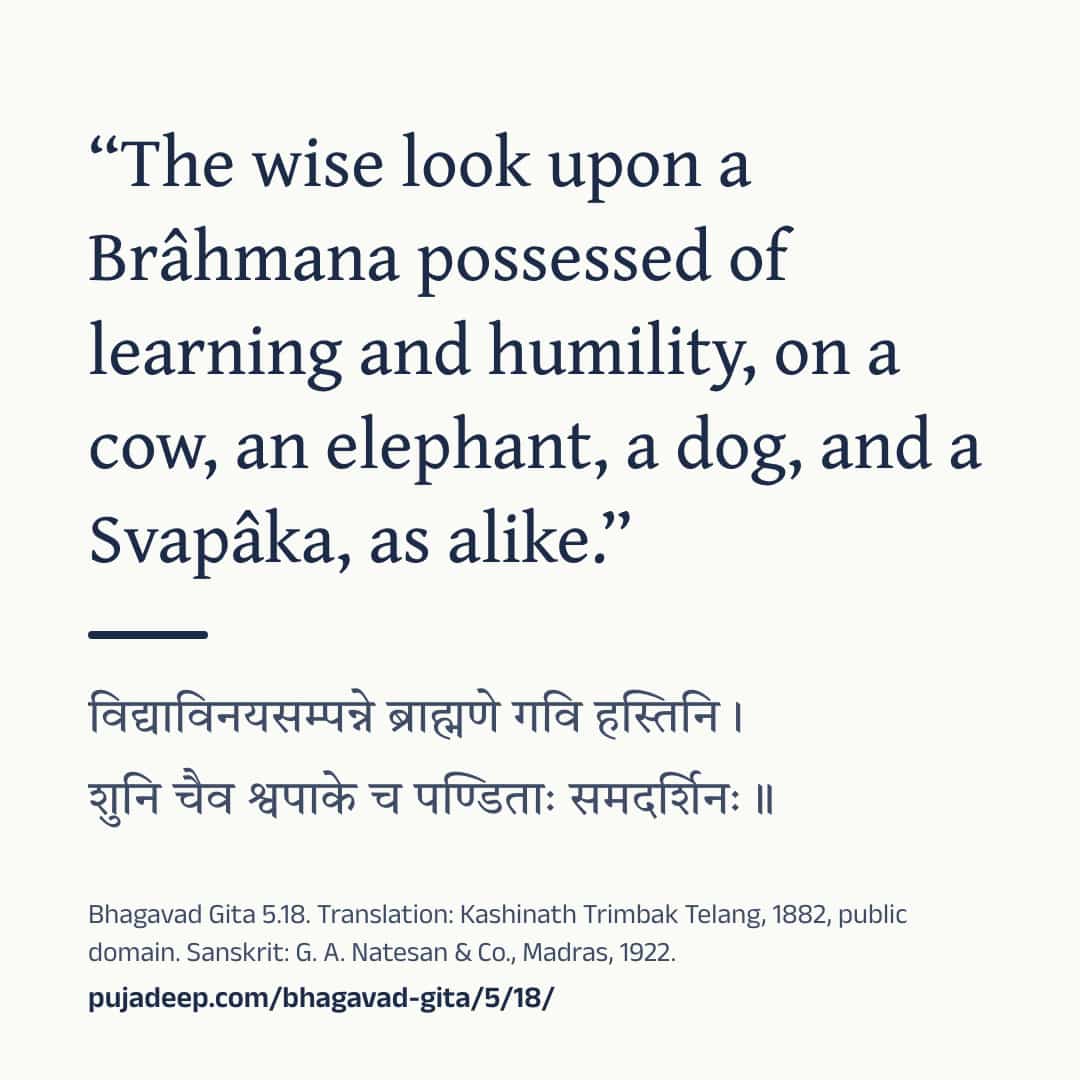
Drawing the picture
See the words
Bhagavad Gita 5.18

विद्याविनयसम्पन्ने ब्राह्मणे गवि हस्तिनि ।
शुनि चैव श्वपाके च पण्डिताः समदर्शिनः ॥

“The wise look upon a Brâhmana possessed of learning and humility, on a cow, an elephant, a dog, and a Svapâka, as alike.”
(K. T. Telang, The Bhagavadgîtâ (The Sacred Books of the East, vol. VIII, Oxford: Clarendon Press, 1882), p. 65, public domain)

“The Sage looketh equally on a perfectly learned and humble Brâhman, a cow, an elephant, and even a dog, and a Svapâka.”
(Annie Besant, The Bhagavad Gîtâ, or The Lord's Song (London: Theosophical Publishing Society, 1895), p. 61, public domain)

“The knowers of the Self look with an equal eye on a Bráhmana endowed with learning and humility, a cow, an elephant, a dog, and a pariah.”
(Swami Swarupananda, Srimad-Bhagavad-Gita (Mayavati: Prabuddha Bharata Press, 1909; first printed in Prabuddha Bharata, 1907–1909), p. 114, public domain)

Sanskrit: G. A. Natesan & Co., Madras, 1922.
https://pujadeep.com/bhagavad-gita/5/18/ Nothing is sent from this site. Your own app sends it, to the chat you choose. The picture quotes the translation you chose on this page, with its name and year.
Sanskrit text: The Bhagavad-Gita, or The Lord's Song, with the text in Devanagari and an English translation, 1922. Meanings: written for Pujadeep and checked against the cited edition. Source and changes
Questions families ask
Who speaks Bhagavad Gita 5.18?
Krishna speaks this verse, in chapter 5 (Karma Sannyasa Yoga).
Where does the Sanskrit text come from?
Sanskrit text: The Bhagavad-Gita, or The Lord's Song, with the text in Devanagari and an English translation, 1922. Meanings: written for Pujadeep and checked against the cited edition. See the source
Is the meaning on this page a translation?
Explanation written for this site from the sources listed here, and checked against the cited edition. It is not a translation and not the only way to read the text. Free to quote with credit.
Source and licence
- Sanskrit text
- The Bhagavad-Gita, or The Lord's Song, with the text in Devanagari and an English translation (Annie Besant, G. A. Natesan & Co., Madras, 1922). Public domain. The Sanskrit on these pages was read from this printing’s page images.
- Translation
- The Bhagavadgîtâ with the Sanatsugâtîya and the Anugîtâ, translated by Kâshinâth Trimbak Telang (The Sacred Books of the East, vol. VIII, ed. F. Max Müller) (Kashinath Trimbak Telang, F. Max Müller, Clarendon Press, Oxford, 1882). Public domain. Shown verbatim, as printed.
- Translation
- The Bhagavad Gîtâ, or The Lord's Song, translated by Annie Besant (Annie Besant, Theosophical Publishing Society, London, 1895). Public domain. Shown verbatim, as printed.
- Translation
- Srimad-Bhagavad-Gita, with Sanskrit Text; Paraphrase with Word-by-word Literal Translation; English Rendering and Comments, Index, &c., by the Swami Swarupananda (Himalayan Series, No. XX) (Swami Swarupananda, The Editors and Publishers, Advaita Ashrama, Mayavati, Prabuddha Bharata Press, Mayavati, Almora, Himalayas, 1909). Public domain. Shown verbatim, as printed.
- Commentary
- The Bhagavad-Gita, with the commentary of Sri Sankaracharya, translated by A. Mahadeva Sastri (2nd ed., Mysore: G. T. A. Printing Works, 1901) (Public-domain scan, University of California Libraries). Summarised in our own words; none of its text is reproduced.
- Commentary
- Sri Bhagavad-Gita with Sri Ramanujacharya's Visishtadvaita commentary, translated by A. Govindacharya (Madras, 1898) (Scan uploaded to archive.org (folkscanomy collection)). Summarised in our own words; none of its text is reproduced.
- Common wording
- In this text, 32 words follow today's common wording, checked against sanskritdocuments.org; Sanskrit Wikisource; Gita Press, Gorakhpur; GRETIL, Göttingen and Bhaktivedanta Book Trust.
- Our explanation
- Explanation written for this site from the sources listed here, and checked against the cited edition. It is not a translation and not the only way to read the text. Free to quote with credit.
- Checked
- Checked against the cited edition, October 15, 2026.
- Updated
- October 25, 2026