Bhagavad Gita 5.25: meaning and translation
Chapter 5: Karma Sannyasa Yoga. Krishna says
Krishna says that the sages (ṛṣis) whose faults are worn away, whose doubts are cut, who are self-controlled and who delight in the good of all beings, reach the peace of Brahman.
Click or tap a word for its meaning and its dictionary page.
Text and layers
Text and layers
These choices stay in this browser.
Bhagavad Gita 5.25
लभन्ते ब्रह्मनिर्वाणमृषयः क्षीणकल्मषाः ।छिन्नद्वैधा यतात्मानः सर्वभूतहिते रताः ॥
Labhante brahmanirvanamrishayah kshinakalmashahChhinnadvaidha yatatmanah sarvabhutahite ratah
labhante brahmanirvāṇamṛṣayaḥ kṣīṇakalmaṣāḥ |chinnadvaidhā yatātmānaḥ sarvabhūtahite ratāḥ ||
Our explanation Krishna says that the sages (ṛṣis) whose faults are worn away, whose doubts are cut, who are self-controlled and who delight in the good of all beings, reach the peace of Brahman.
हिंदी अर्थ कृष्ण कहते हैं कि जिनके दोष नष्ट हो गए हैं, जिनके संशय कट गए हैं, जो अपने मन को वश में रखते हैं और सब प्राणियों के हित में लगे रहते हैं, वे ऋषि ब्रह्मनिर्वाण को पाते हैं।
Word by word
Every word, with its dictionary page
Word by word
- लभन्ते labhante · gain (present, 3rd person plural) Dictionary: labh, Monier-Williams 1899, p. 896, col. 2 “to gain possession of, obtain, receive”
- ब्रह्मनिर्वाणम् brahmanirvāṇam · the peace of Brahman (compound, accusative singular) Dictionary: brahma-nirvāṇa, Monier-Williams 1899, p. 739, col. 1 “extinction in Brahmă, absorption into the one self-existent Spirit”
- ऋषयः ṛṣayaḥ · the sages (nominative plural) Dictionary: ṛṣi, Monier-Williams 1899, p. 226, col. 3 “a singer of sacred hymns, an inspired poet or sage”
- क्षीणकल्मषाः kṣīṇakalmaṣāḥ · whose faults are worn away (compound, nominative plural) Dictionary: kṣīṇa, Monier-Williams 1899, p. 328, col. 2 “diminished, wasted”; kalmaṣa, Monier-Williams 1899, p. 263, col. 1 “moral stain, sin”
- छिन्नद्वैधाः chinnadvaidhāḥ · whose doubts are cut (compound, nominative plural) Dictionary: chinna, Monier-Williams 1899, p. 406, col. 3 “cut off, cut”; dvaidha, Monier-Williams 1899, p. 507, col. 3 “duality, duplicity, division, separation into two parts, contest, dispute, doubt, uncertainty”
- यतात्मानः yatātmānaḥ · self-controlled (compound, nominative plural) Dictionary: yatātman, Monier-Williams 1899, p. 845, col. 3 “self-restrained”
- सर्वभूतहिते sarvabhūtahite · in the good of all beings (compound, locative singular) Dictionary: sarva-bhūta, Monier-Williams 1899, p. 1186, col. 2 “all beings”; hita, Monier-Williams 1899, p. 1298, col. 2 “beneficial, advantageous, salutary, wholesome, suitable”
- रताः ratāḥ · delighting (past participle, nominative plural) Dictionary: rata, Monier-Williams 1899, p. 867, col. 2 “delighting in, intent upon, fond or enamoured of, devoted or attached”
Old translations
Kashinath Trimbak Telang, 1882. Public domain. Page 66.
The sages whose sins have perished, whose misgivings are destroyed, who are self-restrained, and who are intent on the welfare of all beings1, obtain the Brahmic bliss.
Footnotes (the translator’s own) - Sutta Nipâta, p. 39; also Davids' Buddhism, p. 109. ↩
Compare 3 translations
Kashinath Trimbak Telang, 1882. Public domain. Page 66.
The sages whose sins have perished, whose misgivings are destroyed, who are self-restrained, and who are intent on the welfare of all beings1, obtain the Brahmic bliss.
Footnotes (the translator’s own) - Sutta Nipâta, p. 39; also Davids' Buddhism, p. 109. ↩
You are reading this one
Annie Besant, 1895. Public domain. Page 63.
The Rishis obtain the Nirvâna of Brahman, their sins destroyed, their duality removed, their selves controlled, intent upon the welfare of all beings.
You are reading this one
Swami Swarupananda, 1909 (first printed 1907). Public domain. Page 117–118.
With imperfections exhausted, doubts dispelled, senses controlled, engaged in the good of all beings, the Rishis obtain absolute freedom.
You are reading this one
Cite this verse
The translation: K. T. Telang, The Bhagavadgîtâ (The Sacred Books of the East, vol. VIII, Oxford: Clarendon Press, 1882), p. 66. Bhagavad Gita 5.25.
The translation: Annie Besant, The Bhagavad Gîtâ, or The Lord's Song (London: Theosophical Publishing Society, 1895), p. 63. Bhagavad Gita 5.25.
The translation: Swami Swarupananda, Srimad-Bhagavad-Gita (Mayavati: Prabuddha Bharata Press, 1909; first printed in Prabuddha Bharata, 1907–1909), pp. 117–118. Bhagavad Gita 5.25.
Our explanation: “Bhagavad Gita 5.25: meaning and translation.” Pujadeep. Updated October 25, 2026. https://pujadeep.com/bhagavad-gita/5/25/
Pujadeep’s explanations are free to quote with credit: name Pujadeep and link to the page. How to credit
Classical readings, by school
No readings by school on this verse yet.
Share
Show the ways to share
Send one picture or the text to one chat. The picture names its source and the address of this page.
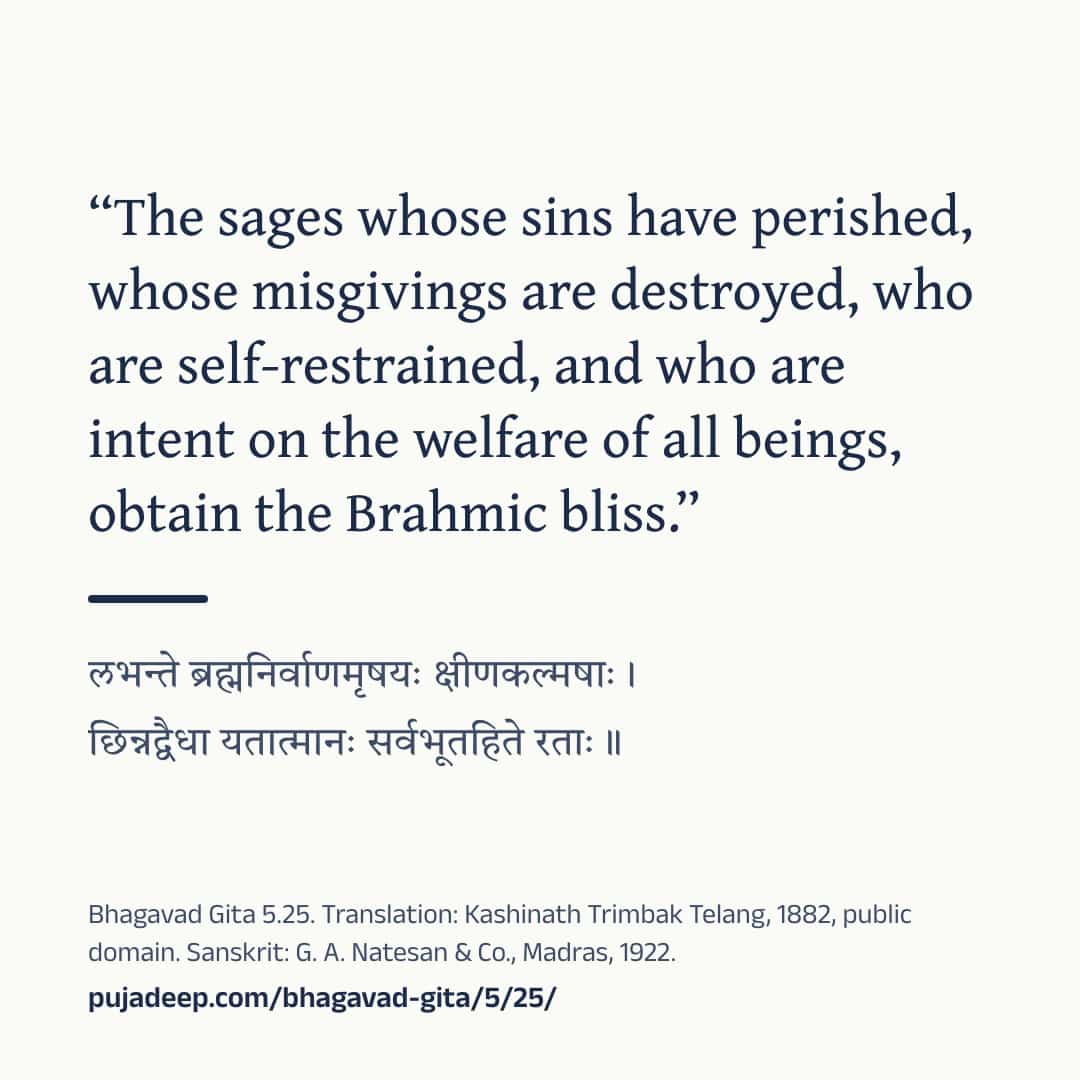
Drawing the picture
See the words
Bhagavad Gita 5.25

लभन्ते ब्रह्मनिर्वाणमृषयः क्षीणकल्मषाः ।
छिन्नद्वैधा यतात्मानः सर्वभूतहिते रताः ॥

“The sages whose sins have perished, whose misgivings are destroyed, who are self-restrained, and who are intent on the welfare of all beings, obtain the Brahmic bliss.”
(K. T. Telang, The Bhagavadgîtâ (The Sacred Books of the East, vol. VIII, Oxford: Clarendon Press, 1882), p. 66, public domain)

“The Rishis obtain the Nirvâna of Brahman, their sins destroyed, their duality removed, their selves controlled, intent upon the welfare of all beings.”
(Annie Besant, The Bhagavad Gîtâ, or The Lord's Song (London: Theosophical Publishing Society, 1895), p. 63, public domain)

“With imperfections exhausted, doubts dispelled, senses controlled, engaged in the good of all beings, the Rishis obtain absolute freedom.”
(Swami Swarupananda, Srimad-Bhagavad-Gita (Mayavati: Prabuddha Bharata Press, 1909; first printed in Prabuddha Bharata, 1907–1909), pp. 117–118, public domain)

Sanskrit: G. A. Natesan & Co., Madras, 1922.
https://pujadeep.com/bhagavad-gita/5/25/ Nothing is sent from this site. Your own app sends it, to the chat you choose. The picture quotes the translation you chose on this page, with its name and year.
Sanskrit text: The Bhagavad-Gita, or The Lord's Song, with the text in Devanagari and an English translation, 1922. Meanings: written for Pujadeep and checked against the cited edition. Source and changes
Questions families ask
Who speaks Bhagavad Gita 5.25?
Krishna speaks this verse, in chapter 5 (Karma Sannyasa Yoga).
Where does the Sanskrit text come from?
Sanskrit text: The Bhagavad-Gita, or The Lord's Song, with the text in Devanagari and an English translation, 1922. Meanings: written for Pujadeep and checked against the cited edition. See the source
Is the meaning on this page a translation?
Explanation written for this site from the sources listed here, and checked against the cited edition. It is not a translation and not the only way to read the text. Free to quote with credit.
Source and licence
- Sanskrit text
- The Bhagavad-Gita, or The Lord's Song, with the text in Devanagari and an English translation (Annie Besant, G. A. Natesan & Co., Madras, 1922). Public domain. The Sanskrit on these pages was read from this printing’s page images.
- Translation
- The Bhagavadgîtâ with the Sanatsugâtîya and the Anugîtâ, translated by Kâshinâth Trimbak Telang (The Sacred Books of the East, vol. VIII, ed. F. Max Müller) (Kashinath Trimbak Telang, F. Max Müller, Clarendon Press, Oxford, 1882). Public domain. Shown verbatim, as printed.
- Translation
- The Bhagavad Gîtâ, or The Lord's Song, translated by Annie Besant (Annie Besant, Theosophical Publishing Society, London, 1895). Public domain. Shown verbatim, as printed.
- Translation
- Srimad-Bhagavad-Gita, with Sanskrit Text; Paraphrase with Word-by-word Literal Translation; English Rendering and Comments, Index, &c., by the Swami Swarupananda (Himalayan Series, No. XX) (Swami Swarupananda, The Editors and Publishers, Advaita Ashrama, Mayavati, Prabuddha Bharata Press, Mayavati, Almora, Himalayas, 1909). Public domain. Shown verbatim, as printed.
- Common wording
- In this text, 32 words follow today's common wording, checked against sanskritdocuments.org; Sanskrit Wikisource; Gita Press, Gorakhpur; GRETIL, Göttingen and Bhaktivedanta Book Trust.
- Our explanation
- Explanation written for this site from the sources listed here, and checked against the cited edition. It is not a translation and not the only way to read the text. Free to quote with credit.
- Checked
- Checked against the cited edition, October 15, 2026.
- Updated
- October 25, 2026