Bhagavad Gita 5.15: meaning and translation
Chapter 5: Karma Sannyasa Yoga. Krishna says
Krishna says that the all-pervading one (vibhu) takes on no one's sin and no one's good deed.
Click or tap a word for its meaning and its dictionary page.
Text and layers
Text and layers
These choices stay in this browser.
Bhagavad Gita 5.15
नादत्ते कस्यचित्पापं न चैव सुकृतं विभुः ।अज्ञानेनावृतं ज्ञानं तेन मुह्यन्ति जन्तवः ॥
Nadatte kasyachitpapam na chaiva sukritam vibhuhAjnanenavritam jnanam tena muhyanti jantavah
nādatte kasyacitpāpaṃ na caiva sukṛtaṃ vibhuḥ |ajñānenāvṛtaṃ jñānaṃ tena muhyanti jantavaḥ ||
Our explanation Krishna says that the all-pervading one (vibhu) takes on no one's sin and no one's good deed. Knowledge, he says, is covered by ignorance, and that is why beings are deluded.
हिंदी अर्थ कृष्ण कहते हैं कि विभु (सर्वव्यापी) किसी का पाप नहीं लेता और किसी का पुण्य भी नहीं। वे कहते हैं कि अज्ञान से ज्ञान ढका हुआ है, इसी से प्राणी मोह में पड़ते हैं।
Word by word
Every word, with its dictionary page
Word by word
- न na · not (indeclinable) Dictionary: 2. na, Monier-Williams 1899, p. 523, col. 1 “not, no, nor, neither”
- आदत्ते ādatte · takes on (present, 3rd person singular) Dictionary: ā-dā, Monier-Williams 1899, p. 136, col. 3 “'to give to one's self,' take, accept, receive”
- कस्यचित् kasyacit · of anyone (pronoun, genitive singular) Dictionary: kim, Monier-Williams 1899, p. 282, col. 2 “what? how? whence? wherefore? why?”; 2. cid, Monier-Williams 1899, p. 398, col. 1 “even, indeed, also”
- पापम् pāpam · sin (accusative singular (neuter)) Dictionary: pāpa, Monier-Williams 1899, p. 618, col. 2 “sin, vice, crime, guilt”
- न na · nor (indeclinable) Dictionary: 2. na, Monier-Williams 1899, p. 523, col. 1 “not, no, nor, neither”
- च ca · and (indeclinable) Dictionary: 2. ca, Monier-Williams 1899, p. 380, col. 1 “and, both, also, moreover, as well as”
- एव eva · even (indeclinable) Dictionary: 1. eva, Monier-Williams 1899, p. 232, col. 2 “just, exactly, very, same, only, even, alone, merely”
- सुकृतम् sukṛtam · good deed (accusative singular (neuter)) Dictionary: su-kṛta, Monier-Williams 1899, p. 1220, col. 2 “a good or righteous deed, meritorious act, virtue, moral merit”
- विभुः vibhuḥ · the all-pervading one (nominative singular) Dictionary: vi-bhu, Monier-Williams 1899, p. 978, col. 3 “being everywhere, far-extending, all-pervading, omnipresent, eternal”
- अज्ञानेन ajñānena · by ignorance (instrumental singular) Dictionary: a-jñāna, Monier-Williams 1899, p. 10, col. 3 “ignorance”
- आवृतम् āvṛtam · covered (past participle, nominative singular (neuter)) Dictionary: ā-vṛta, Monier-Williams 1899, p. 156, col. 1 “covered, concealed, hid”
- ज्ञानम् jñānam · knowledge (nominative singular (neuter)) Dictionary: jñāna, Monier-Williams 1899, p. 426, col. 1 “knowing, becoming acquainted with, knowledge”
- तेन tena · by that, so (pronoun, instrumental singular) Dictionary: tad, Monier-Williams 1899, p. 434, col. 1 “that, this”
- मुह्यन्ति muhyanti · are deluded (present, 3rd person plural) Dictionary: 1. muh, Monier-Williams 1899, p. 825, col. 1 “to become stupefied or unconscious, be bewildered or perplexed”
- जन्तवः jantavaḥ · beings (nominative plural) Dictionary: jantu, Monier-Williams 1899, p. 411, col. 2 “a creature, living being”
Old translations
Kashinath Trimbak Telang, 1882. Public domain. Page 65.
The Lord receives no one's sin, nor merit either. Knowledge is enveloped by ignorance, hence all creatures are deluded1.
Footnotes (the translator’s own) - As regards the Lord's relation to man's merit or sin. ↩
Compare 3 translations
Kashinath Trimbak Telang, 1882. Public domain. Page 65.
The Lord receives no one's sin, nor merit either. Knowledge is enveloped by ignorance, hence all creatures are deluded1.
Footnotes (the translator’s own) - As regards the Lord's relation to man's merit or sin. ↩
You are reading this one
Annie Besant, 1895. Public domain. Page 61.
The Lord accepteth neither the evil nor yet the well-doing of any. Wisdom is enveloped by unwisdom; therewith mortals are deluded.
You are reading this one
Swami Swarupananda, 1909 (first printed 1907). Public domain. Page 112.
The Omnipresent takes note of the merit or demerit of none. Knowledge is enveloped in ignorance, hence do beings get deluded.
You are reading this one
Cite this verse
The translation: K. T. Telang, The Bhagavadgîtâ (The Sacred Books of the East, vol. VIII, Oxford: Clarendon Press, 1882), p. 65. Bhagavad Gita 5.15.
The translation: Annie Besant, The Bhagavad Gîtâ, or The Lord's Song (London: Theosophical Publishing Society, 1895), p. 61. Bhagavad Gita 5.15.
The translation: Swami Swarupananda, Srimad-Bhagavad-Gita (Mayavati: Prabuddha Bharata Press, 1909; first printed in Prabuddha Bharata, 1907–1909), p. 112. Bhagavad Gita 5.15.
Our explanation: “Bhagavad Gita 5.15: meaning and translation.” Pujadeep. Updated October 25, 2026. https://pujadeep.com/bhagavad-gita/5/15/
Pujadeep’s explanations are free to quote with credit: name Pujadeep and link to the page. How to credit
Classical readings, by school
No readings by school on this verse yet.
Share
Show the ways to share
Send one picture or the text to one chat. The picture names its source and the address of this page.
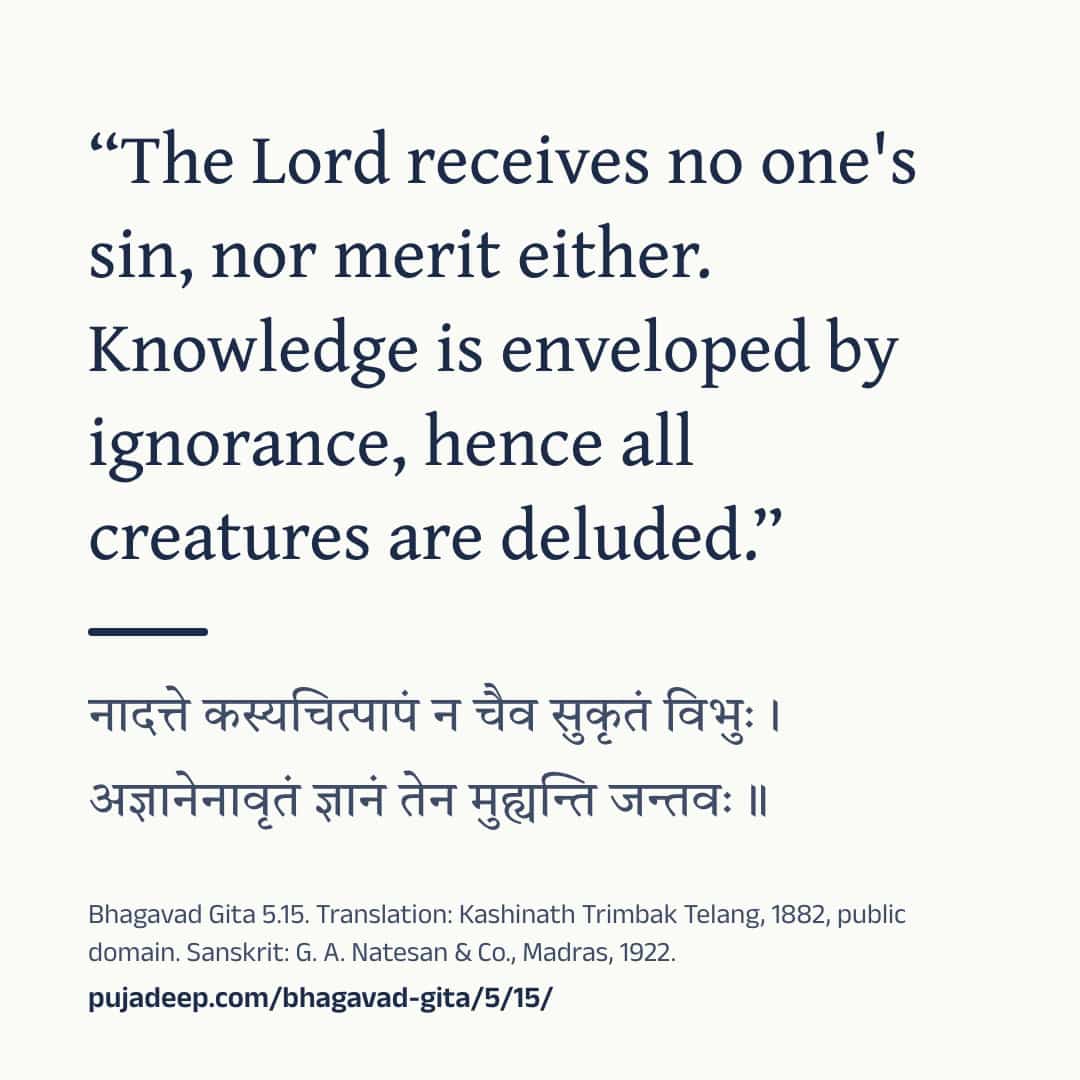
Drawing the picture
See the words
Bhagavad Gita 5.15

नादत्ते कस्यचित्पापं न चैव सुकृतं विभुः ।
अज्ञानेनावृतं ज्ञानं तेन मुह्यन्ति जन्तवः ॥

“The Lord receives no one's sin, nor merit either. Knowledge is enveloped by ignorance, hence all creatures are deluded.”
(K. T. Telang, The Bhagavadgîtâ (The Sacred Books of the East, vol. VIII, Oxford: Clarendon Press, 1882), p. 65, public domain)

“The Lord accepteth neither the evil nor yet the well-doing of any. Wisdom is enveloped by unwisdom; therewith mortals are deluded.”
(Annie Besant, The Bhagavad Gîtâ, or The Lord's Song (London: Theosophical Publishing Society, 1895), p. 61, public domain)

“The Omnipresent takes note of the merit or demerit of none. Knowledge is enveloped in ignorance, hence do beings get deluded.”
(Swami Swarupananda, Srimad-Bhagavad-Gita (Mayavati: Prabuddha Bharata Press, 1909; first printed in Prabuddha Bharata, 1907–1909), p. 112, public domain)

Sanskrit: G. A. Natesan & Co., Madras, 1922.
https://pujadeep.com/bhagavad-gita/5/15/ Nothing is sent from this site. Your own app sends it, to the chat you choose. The picture quotes the translation you chose on this page, with its name and year.
Sanskrit text: The Bhagavad-Gita, or The Lord's Song, with the text in Devanagari and an English translation, 1922. Meanings: written for Pujadeep and checked against the cited edition. Source and changes
Questions families ask
Who speaks Bhagavad Gita 5.15?
Krishna speaks this verse, in chapter 5 (Karma Sannyasa Yoga).
Where does the Sanskrit text come from?
Sanskrit text: The Bhagavad-Gita, or The Lord's Song, with the text in Devanagari and an English translation, 1922. Meanings: written for Pujadeep and checked against the cited edition. See the source
Is the meaning on this page a translation?
Explanation written for this site from the sources listed here, and checked against the cited edition. It is not a translation and not the only way to read the text. Free to quote with credit.
Source and licence
- Sanskrit text
- The Bhagavad-Gita, or The Lord's Song, with the text in Devanagari and an English translation (Annie Besant, G. A. Natesan & Co., Madras, 1922). Public domain. The Sanskrit on these pages was read from this printing’s page images.
- Translation
- The Bhagavadgîtâ with the Sanatsugâtîya and the Anugîtâ, translated by Kâshinâth Trimbak Telang (The Sacred Books of the East, vol. VIII, ed. F. Max Müller) (Kashinath Trimbak Telang, F. Max Müller, Clarendon Press, Oxford, 1882). Public domain. Shown verbatim, as printed.
- Translation
- The Bhagavad Gîtâ, or The Lord's Song, translated by Annie Besant (Annie Besant, Theosophical Publishing Society, London, 1895). Public domain. Shown verbatim, as printed.
- Translation
- Srimad-Bhagavad-Gita, with Sanskrit Text; Paraphrase with Word-by-word Literal Translation; English Rendering and Comments, Index, &c., by the Swami Swarupananda (Himalayan Series, No. XX) (Swami Swarupananda, The Editors and Publishers, Advaita Ashrama, Mayavati, Prabuddha Bharata Press, Mayavati, Almora, Himalayas, 1909). Public domain. Shown verbatim, as printed.
- Common wording
- In this text, 32 words follow today's common wording, checked against sanskritdocuments.org; Sanskrit Wikisource; Gita Press, Gorakhpur; GRETIL, Göttingen and Bhaktivedanta Book Trust.
- Our explanation
- Explanation written for this site from the sources listed here, and checked against the cited edition. It is not a translation and not the only way to read the text. Free to quote with credit.
- Checked
- Checked against the cited edition, October 15, 2026.
- Updated
- October 25, 2026