Bhagavad Gita 5.7: meaning and translation
Chapter 5: Karma Sannyasa Yoga. Krishna says
Krishna describes the person joined in yoga: pure in mind, self-controlled, master of the senses, whose self has become the self of all beings.
Click or tap a word for its meaning and its dictionary page.
Text and layers
Text and layers
These choices stay in this browser.
Bhagavad Gita 5.7
योगयुक्तो विशुद्धात्मा विजितात्मा जितेन्द्रियः ।सर्वभूतात्मभूतात्मा कुर्वन्नपि न लिप्यते ॥
Yogayukto vishuddhatma vijitatma jitendriyahSarvabhutatmabhutatma kurvannapi na lipyate
yogayukto viśuddhātmā vijitātmā jitendriyaḥ |sarvabhūtātmabhūtātmā kurvannapi na lipyate ||
Our explanation Krishna describes the person joined in yoga: pure in mind, self-controlled, master of the senses, whose self has become the self of all beings. Such a person, he says, is not stained by action even while acting.
हिंदी अर्थ कृष्ण योग से युक्त व्यक्ति का वर्णन करते हैं: जिसका मन शुद्ध है, जिसने अपने आप को जीत लिया है, जिसकी इंद्रियाँ वश में हैं, और जिसकी आत्मा सब प्राणियों की आत्मा बन गई है। वे कहते हैं कि ऐसा व्यक्ति कर्म करते हुए भी उससे लिप्त नहीं होता।
Word by word
Every word, with its dictionary page
Word by word
- योगयुक्तः yogayuktaḥ · joined in yoga (compound, nominative singular) Dictionary: yoga-yukta, Monier-Williams 1899, p. 857, col. 1 “immersed in deep meditation, absorbed in Yoga”
- विशुद्धात्मा viśuddhātmā · pure in mind (compound, nominative singular) Dictionary: vi-śuddha, Monier-Williams 1899, p. 991, col. 2 “completely cleansed”; ātman, Monier-Williams 1899, p. 135, col. 1 “the individual soul, self”
- विजितात्मा vijitātmā · who has mastered himself (compound, nominative singular) Dictionary: 2. vi-jita, Monier-Williams 1899, p. 960, col. 3 “conquered, subdued, defeated, won, gained”; ātman, Monier-Williams 1899, p. 135, col. 1 “the individual soul, self”
- जितेन्द्रियः jitendriyaḥ · master of the senses (compound, nominative singular) Dictionary: jitendriya, Monier-Williams 1899, p. 420, col. 3; jita, Monier-Williams 1899, p. 420, col. 3 “won, acquired, conquered, subdued”; indriya, Monier-Williams 1899, p. 167, col. 2 “faculty of sense, sense, organ of sense”
- सर्वभूतात्मभूतात्मा sarvabhūtātmabhūtātmā · whose self is the self of all beings (compound, nominative singular) Dictionary: sarva-bhūta, Monier-Williams 1899, p. 1186, col. 2 “all beings”; ātman, Monier-Williams 1899, p. 135, col. 1 “the individual soul, self”; bhūta, Monier-Williams 1899, p. 761, col. 3 “become, been, gone”
- कुर्वन् kurvan · acting (present participle, nominative singular) Dictionary: 1. kṛ, Monier-Williams 1899, p. 301, col. 1 “to do, make, perform, accomplish, cause, effect”
- अपि api · even (indeclinable) Dictionary: api, Monier-Williams 1899, p. 55, col. 1 “in the sense of even, also, very”
- न na · not (indeclinable) Dictionary: 2. na, Monier-Williams 1899, p. 523, col. 1 “not, no, nor, neither”
- लिप्यते lipyate · is stained (passive, present, 3rd person singular) Dictionary: lip, Monier-Williams 1899, p. 902, col. 2 “to be attached to (loc.), stick, adhere”
Old translations
Kashinath Trimbak Telang, 1882. Public domain. Page 64.
He who is possessed of devotion, whose self is pure, who has restrained his self1, and who has controlled his senses, and who identifies his self with every being, is not tainted though he performs (actions).
Footnotes (the translator’s own) - Here self is explained as body; in the line which goes before it is explained as heart. ↩
Compare 3 translations
Kashinath Trimbak Telang, 1882. Public domain. Page 64.
He who is possessed of devotion, whose self is pure, who has restrained his self1, and who has controlled his senses, and who identifies his self with every being, is not tainted though he performs (actions).
Footnotes (the translator’s own) - Here self is explained as body; in the line which goes before it is explained as heart. ↩
You are reading this one
Annie Besant, 1895. Public domain. Page 59.
He who is harmonised by Yoga, the self purified, SELF-ruled, the senses subdued, whose SELF is the SELF of all beings, although acting he is not polluted.
You are reading this one
Swami Swarupananda, 1909 (first printed 1907). Public domain. Page 109.
With the mind purified by devotion to performance of action, and the body conquered, and senses subdued, one who realises his self, as the Self in all beings, though acting, is not tainted.
You are reading this one
Cite this verse
The translation: K. T. Telang, The Bhagavadgîtâ (The Sacred Books of the East, vol. VIII, Oxford: Clarendon Press, 1882), p. 64. Bhagavad Gita 5.7.
The translation: Annie Besant, The Bhagavad Gîtâ, or The Lord's Song (London: Theosophical Publishing Society, 1895), p. 59. Bhagavad Gita 5.7.
The translation: Swami Swarupananda, Srimad-Bhagavad-Gita (Mayavati: Prabuddha Bharata Press, 1909; first printed in Prabuddha Bharata, 1907–1909), p. 109. Bhagavad Gita 5.7.
Our explanation: “Bhagavad Gita 5.7: meaning and translation.” Pujadeep. Updated October 25, 2026. https://pujadeep.com/bhagavad-gita/5/7/
Pujadeep’s explanations are free to quote with credit: name Pujadeep and link to the page. How to credit
Classical readings, by school
No readings by school on this verse yet.
Share
Show the ways to share
Send one picture or the text to one chat. The picture names its source and the address of this page.
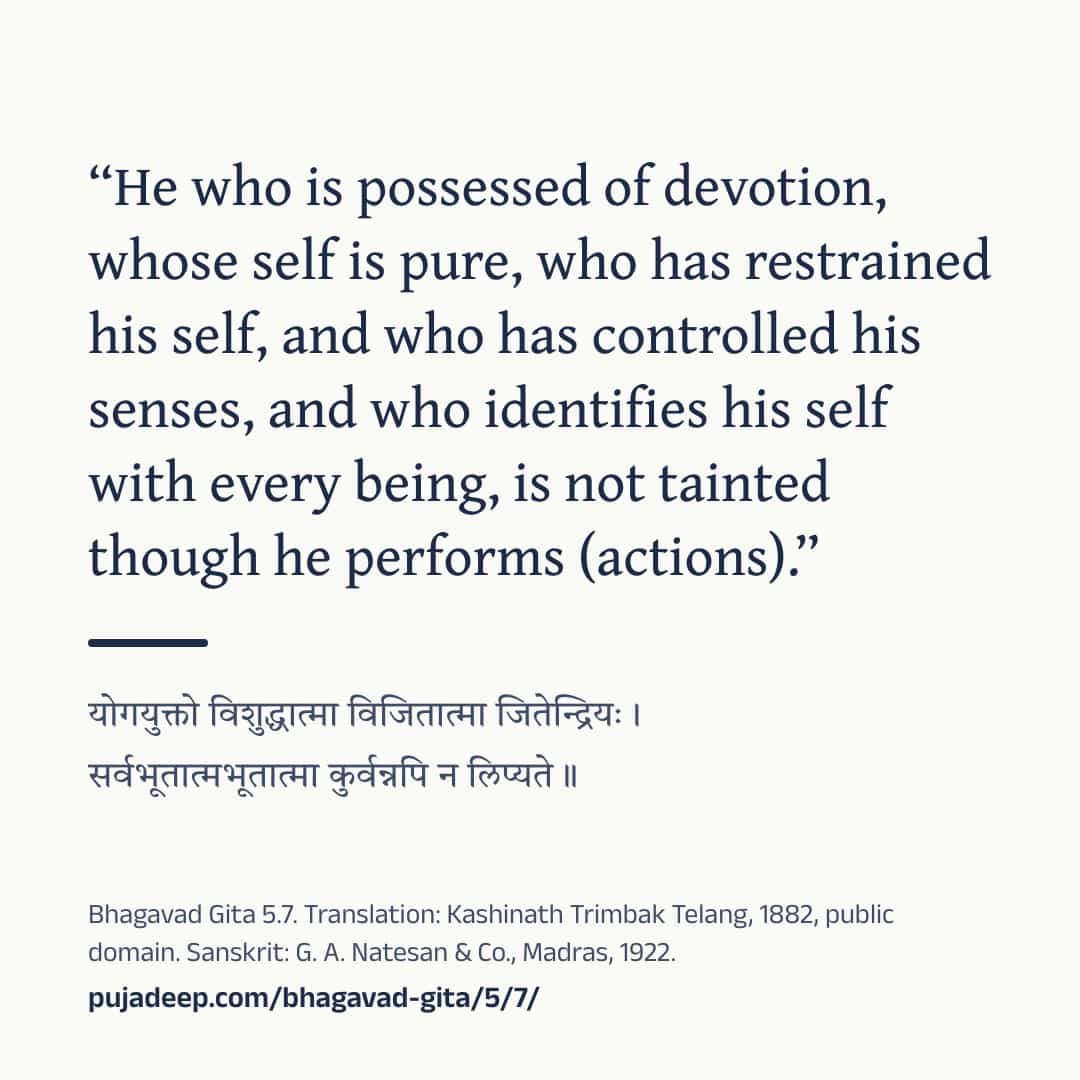
Drawing the picture
See the words
Bhagavad Gita 5.7

योगयुक्तो विशुद्धात्मा विजितात्मा जितेन्द्रियः ।
सर्वभूतात्मभूतात्मा कुर्वन्नपि न लिप्यते ॥

“He who is possessed of devotion, whose self is pure, who has restrained his self, and who has controlled his senses, and who identifies his self with every being, is not tainted though he performs (actions).”
(K. T. Telang, The Bhagavadgîtâ (The Sacred Books of the East, vol. VIII, Oxford: Clarendon Press, 1882), p. 64, public domain)

“He who is harmonised by Yoga, the self purified, SELF-ruled, the senses subdued, whose SELF is the SELF of all beings, although acting he is not polluted.”
(Annie Besant, The Bhagavad Gîtâ, or The Lord's Song (London: Theosophical Publishing Society, 1895), p. 59, public domain)

“With the mind purified by devotion to performance of action, and the body conquered, and senses subdued, one who realises his self, as the Self in all beings, though acting, is not tainted.”
(Swami Swarupananda, Srimad-Bhagavad-Gita (Mayavati: Prabuddha Bharata Press, 1909; first printed in Prabuddha Bharata, 1907–1909), p. 109, public domain)

Sanskrit: G. A. Natesan & Co., Madras, 1922.
https://pujadeep.com/bhagavad-gita/5/7/ Nothing is sent from this site. Your own app sends it, to the chat you choose. The picture quotes the translation you chose on this page, with its name and year.
Sanskrit text: The Bhagavad-Gita, or The Lord's Song, with the text in Devanagari and an English translation, 1922. Meanings: written for Pujadeep and checked against the cited edition. Source and changes
Questions families ask
Who speaks Bhagavad Gita 5.7?
Krishna speaks this verse, in chapter 5 (Karma Sannyasa Yoga).
Where does the Sanskrit text come from?
Sanskrit text: The Bhagavad-Gita, or The Lord's Song, with the text in Devanagari and an English translation, 1922. Meanings: written for Pujadeep and checked against the cited edition. See the source
Is the meaning on this page a translation?
Explanation written for this site from the sources listed here, and checked against the cited edition. It is not a translation and not the only way to read the text. Free to quote with credit.
Source and licence
- Sanskrit text
- The Bhagavad-Gita, or The Lord's Song, with the text in Devanagari and an English translation (Annie Besant, G. A. Natesan & Co., Madras, 1922). Public domain. The Sanskrit on these pages was read from this printing’s page images.
- Translation
- The Bhagavadgîtâ with the Sanatsugâtîya and the Anugîtâ, translated by Kâshinâth Trimbak Telang (The Sacred Books of the East, vol. VIII, ed. F. Max Müller) (Kashinath Trimbak Telang, F. Max Müller, Clarendon Press, Oxford, 1882). Public domain. Shown verbatim, as printed.
- Translation
- The Bhagavad Gîtâ, or The Lord's Song, translated by Annie Besant (Annie Besant, Theosophical Publishing Society, London, 1895). Public domain. Shown verbatim, as printed.
- Translation
- Srimad-Bhagavad-Gita, with Sanskrit Text; Paraphrase with Word-by-word Literal Translation; English Rendering and Comments, Index, &c., by the Swami Swarupananda (Himalayan Series, No. XX) (Swami Swarupananda, The Editors and Publishers, Advaita Ashrama, Mayavati, Prabuddha Bharata Press, Mayavati, Almora, Himalayas, 1909). Public domain. Shown verbatim, as printed.
- Common wording
- In this text, 32 words follow today's common wording, checked against sanskritdocuments.org; Sanskrit Wikisource; Gita Press, Gorakhpur; GRETIL, Göttingen and Bhaktivedanta Book Trust.
- Our explanation
- Explanation written for this site from the sources listed here, and checked against the cited edition. It is not a translation and not the only way to read the text. Free to quote with credit.
- Checked
- Checked against the cited edition, October 15, 2026.
- Updated
- October 25, 2026