Bhagavad Gita 5.10: meaning and translation
Chapter 5: Karma Sannyasa Yoga. Krishna says
Krishna says that a person who acts while placing all actions in Brahman and giving up attachment is not touched by sin, just as a lotus leaf is not wetted by the water it rests on.
Click or tap a word for its meaning and its dictionary page.
Text and layers
Text and layers
These choices stay in this browser.
Bhagavad Gita 5.10
ब्रह्मण्याधाय कर्माणि सङ्गं त्यक्त्वा करोति यः ।लिप्यते न स पापेन पद्मपत्रमिवाम्भसा ॥
Brahmanyadhaya karmani sangam tyaktva karoti yahLipyate na sa papena padmapatramivambhasa
brahmaṇyādhāya karmāṇi saṅgaṃ tyaktvā karoti yaḥ |lipyate na sa pāpena padmapatramivāmbhasā ||
Our explanation Krishna says that a person who acts while placing all actions in Brahman and giving up attachment is not touched by sin, just as a lotus leaf is not wetted by the water it rests on. The schools read “Brahman” here differently (see the views).
हिंदी अर्थ कृष्ण कहते हैं कि जो सब कर्मों को ब्रह्म में अर्पित करके, आसक्ति छोड़कर कर्म करता है, वह पाप से वैसे ही लिप्त नहीं होता जैसे कमल का पत्ता पानी में रहकर भी गीला नहीं होता। परंपराएँ यहाँ “ब्रह्म” शब्द का अर्थ अलग-अलग लेती हैं।
Word by word
Every word, with its dictionary page
Word by word
- ब्रह्मणि brahmaṇi · in Brahman (locative singular) Dictionary: brahman, Monier-Williams 1899, p. 738, col. 1 “one self-existent impersonal Spirit, the one universal Soul”
- आधाय ādhāya · placing (absolutive ('having done')) Dictionary: ā-dhā, Monier-Williams 1899, p. 138, col. 2 “to place on, put down, deposit, put”
- कर्माणि karmāṇi · actions (accusative plural (neuter)) Dictionary: karman, Monier-Williams 1899, p. 258, col. 2 “act, action, performance, business”
- सङ्गम् saṅgam · attachment (accusative singular) Dictionary: saṅga, Monier-Williams 1899, p. 1132, col. 3 “(esp.) worldly or selfish attachment or affection, desire”
- त्यक्त्वा tyaktvā · giving up (absolutive ('having done')) Dictionary: 1. tyaj, Monier-Williams 1899, p. 456, col. 3 “to leave, abandon, quit”
- करोति karoti · acts (present, 3rd person singular) Dictionary: 1. kṛ, Monier-Williams 1899, p. 301, col. 1 “to do, make, perform, accomplish, cause, effect”
- यः yaḥ · who (relative pronoun, nominative singular) Dictionary: yad, Monier-Williams 1899, p. 844, col. 2 “who, which, what, whichever, whatever, that”
- लिप्यते lipyate · is stained (passive, present, 3rd person singular) Dictionary: lip, Monier-Williams 1899, p. 902, col. 2 “to be attached to (loc.), stick, adhere”
- न na · not (indeclinable) Dictionary: 2. na, Monier-Williams 1899, p. 523, col. 1 “not, no, nor, neither”
- सः saḥ · he (pronoun, nominative singular) Dictionary: tad, Monier-Williams 1899, p. 434, col. 1 “that, this”
- पापेन pāpena · by sin (instrumental singular) Dictionary: pāpa, Monier-Williams 1899, p. 618, col. 2 “sin, vice, crime, guilt”
- पद्मपत्रम् padmapatram · a lotus leaf (compound, nominative singular) Dictionary: padma-pattra, Monier-Williams 1899, p. 584, col. 3 “leaf”; padma, Monier-Williams 1899, p. 584, col. 2 “a lotus”
- इव iva · like (indeclinable) Dictionary: iva, Monier-Williams 1899, p. 168, col. 3 “like, in the same manner as”
- अम्भसा ambhasā · by water (instrumental singular) Dictionary: ambhas, Monier-Williams 1899, p. 84, col. 1 “water”
Old translations
Kashinath Trimbak Telang, 1882. Public domain. Page 64.
He who, casting off (all) attachment, performs actions dedicating them to Brahman, is not tainted by sin, as the lotus-leaf1 (is not tainted) by water.
Footnotes (the translator’s own) - A very common simile. Cf. inter alia Khândogya-upanishad, p. 276; Sutta Nipâta, pp. 107–134; and Davids' Buddhism, p. 158 note. ↩
Compare 3 translations
Kashinath Trimbak Telang, 1882. Public domain. Page 64.
He who, casting off (all) attachment, performs actions dedicating them to Brahman, is not tainted by sin, as the lotus-leaf1 (is not tainted) by water.
Footnotes (the translator’s own) - A very common simile. Cf. inter alia Khândogya-upanishad, p. 276; Sutta Nipâta, pp. 107–134; and Davids' Buddhism, p. 158 note. ↩
You are reading this one
Annie Besant, 1895. Public domain. Page 60.
He who acteth, placing all actions in Brahman, abandoning attachment, is unpolluted by sin as a lotus-leaf by the waters.
You are reading this one
Swami Swarupananda, 1909 (first printed 1907). Public domain. Page 110.
He who does actions forsaking attachment, resigning them to Brahman, is not soiled by evil, like unto a lotus-leaf by water.
You are reading this one
Cite this verse
The translation: K. T. Telang, The Bhagavadgîtâ (The Sacred Books of the East, vol. VIII, Oxford: Clarendon Press, 1882), p. 64. Bhagavad Gita 5.10.
The translation: Annie Besant, The Bhagavad Gîtâ, or The Lord's Song (London: Theosophical Publishing Society, 1895), p. 60. Bhagavad Gita 5.10.
The translation: Swami Swarupananda, Srimad-Bhagavad-Gita (Mayavati: Prabuddha Bharata Press, 1909; first printed in Prabuddha Bharata, 1907–1909), p. 110. Bhagavad Gita 5.10.
Our explanation: “Bhagavad Gita 5.10: meaning and translation.” Pujadeep. Updated October 25, 2026. https://pujadeep.com/bhagavad-gita/5/10/
Pujadeep’s explanations are free to quote with credit: name Pujadeep and link to the page. How to credit
Classical readings, by school
Each reading is named by its school. None is presented as the only meaning.
What Advaita, Vishishtadvaita and Dvaita teach, in short
Shankara Advaita
Shankara says this verse is for the person who does not yet know the truth and is still engaged in action. He offers his actions to the Lord (Īśvara), as a servant acts for a master, with no attachment to the result, not even to liberation. The only result of such action is purity of mind.
Source: The Bhagavad-Gita, with the commentary of Sri Sankaracharya, translated by A. Mahadeva Sastri (2nd ed., Mysore: G. T. A. Printing Works, 1901), commentary on 5.10, p. 150. Summarised in our own words; none of its text is reproduced.
Ramanuja Vishishtadvaita
Ramanuja takes “brahma” here to mean matter (prakṛti), citing 14.3. The worker ascribes seeing, hearing and all other activity to matter in the form of the senses, thinks “I do nothing”, and so is free from the error of taking matter for the self, which is what binds.
Source: Sri Bhagavad-Gita with Sri Ramanujacharya's Visishtadvaita commentary, translated by A. Govindacharya (Madras, 1898), commentary on 5.10, p. 177. Summarised in our own words; none of its text is reproduced.
Share
Show the ways to share
Send one picture or the text to one chat. The picture names its source and the address of this page.
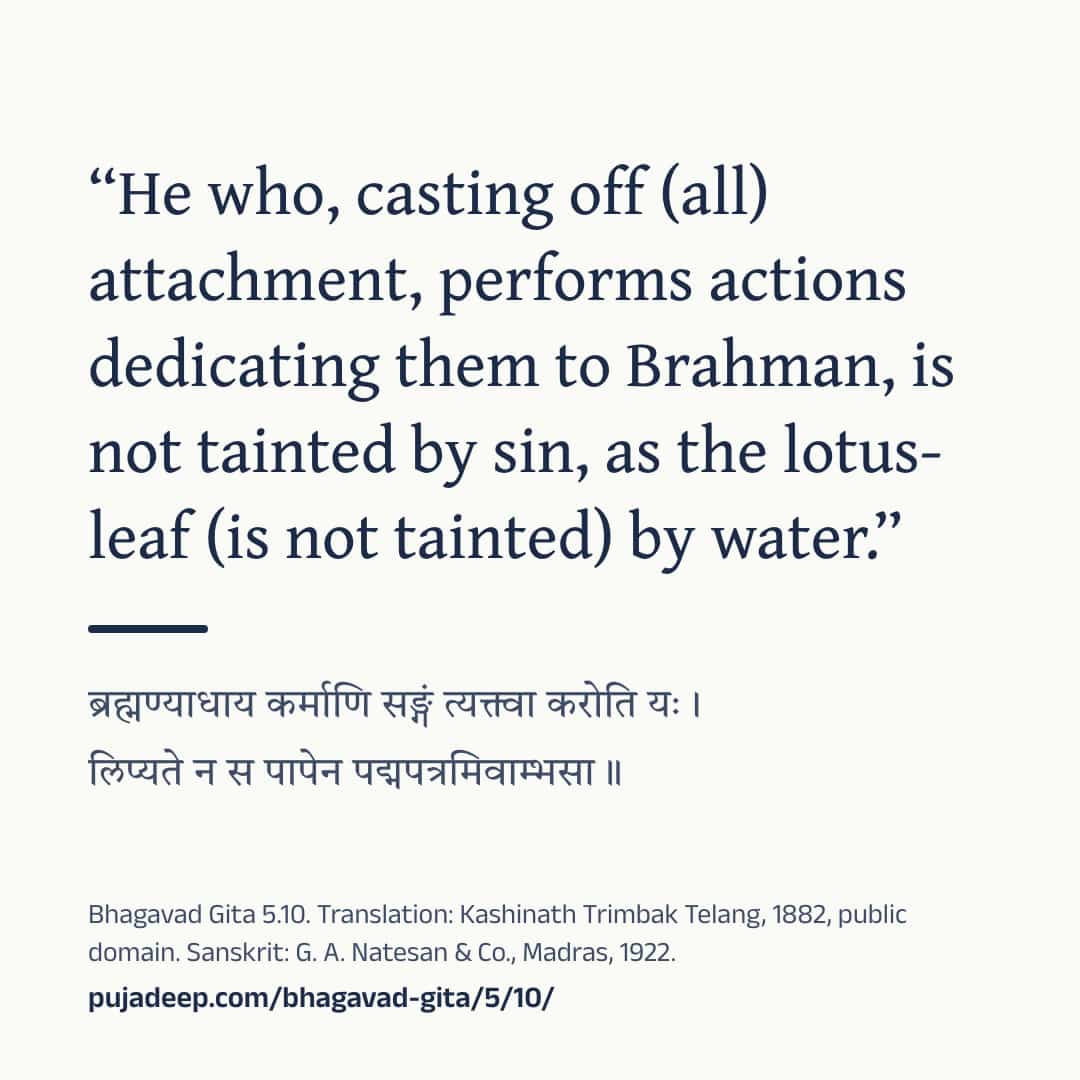
Drawing the picture
See the words
Bhagavad Gita 5.10

ब्रह्मण्याधाय कर्माणि सङ्गं त्यक्त्वा करोति यः ।
लिप्यते न स पापेन पद्मपत्रमिवाम्भसा ॥

“He who, casting off (all) attachment, performs actions dedicating them to Brahman, is not tainted by sin, as the lotus-leaf (is not tainted) by water.”
(K. T. Telang, The Bhagavadgîtâ (The Sacred Books of the East, vol. VIII, Oxford: Clarendon Press, 1882), p. 64, public domain)

“He who acteth, placing all actions in Brahman, abandoning attachment, is unpolluted by sin as a lotus-leaf by the waters.”
(Annie Besant, The Bhagavad Gîtâ, or The Lord's Song (London: Theosophical Publishing Society, 1895), p. 60, public domain)

“He who does actions forsaking attachment, resigning them to Brahman, is not soiled by evil, like unto a lotus-leaf by water.”
(Swami Swarupananda, Srimad-Bhagavad-Gita (Mayavati: Prabuddha Bharata Press, 1909; first printed in Prabuddha Bharata, 1907–1909), p. 110, public domain)

Sanskrit: G. A. Natesan & Co., Madras, 1922.
https://pujadeep.com/bhagavad-gita/5/10/ Nothing is sent from this site. Your own app sends it, to the chat you choose. The picture quotes the translation you chose on this page, with its name and year.
Sanskrit text: The Bhagavad-Gita, or The Lord's Song, with the text in Devanagari and an English translation, 1922. Meanings: written for Pujadeep and checked against the cited edition. Source and changes
Questions families ask
Who speaks Bhagavad Gita 5.10?
Krishna speaks this verse, in chapter 5 (Karma Sannyasa Yoga).
Where does the Sanskrit text come from?
Sanskrit text: The Bhagavad-Gita, or The Lord's Song, with the text in Devanagari and an English translation, 1922. Meanings: written for Pujadeep and checked against the cited edition. See the source
Is the meaning on this page a translation?
Explanation written for this site from the sources listed here, and checked against the cited edition. It is not a translation and not the only way to read the text. Free to quote with credit.
Source and licence
- Sanskrit text
- The Bhagavad-Gita, or The Lord's Song, with the text in Devanagari and an English translation (Annie Besant, G. A. Natesan & Co., Madras, 1922). Public domain. The Sanskrit on these pages was read from this printing’s page images.
- Translation
- The Bhagavadgîtâ with the Sanatsugâtîya and the Anugîtâ, translated by Kâshinâth Trimbak Telang (The Sacred Books of the East, vol. VIII, ed. F. Max Müller) (Kashinath Trimbak Telang, F. Max Müller, Clarendon Press, Oxford, 1882). Public domain. Shown verbatim, as printed.
- Translation
- The Bhagavad Gîtâ, or The Lord's Song, translated by Annie Besant (Annie Besant, Theosophical Publishing Society, London, 1895). Public domain. Shown verbatim, as printed.
- Translation
- Srimad-Bhagavad-Gita, with Sanskrit Text; Paraphrase with Word-by-word Literal Translation; English Rendering and Comments, Index, &c., by the Swami Swarupananda (Himalayan Series, No. XX) (Swami Swarupananda, The Editors and Publishers, Advaita Ashrama, Mayavati, Prabuddha Bharata Press, Mayavati, Almora, Himalayas, 1909). Public domain. Shown verbatim, as printed.
- Commentary
- The Bhagavad-Gita, with the commentary of Sri Sankaracharya, translated by A. Mahadeva Sastri (2nd ed., Mysore: G. T. A. Printing Works, 1901) (Public-domain scan, University of California Libraries). Summarised in our own words; none of its text is reproduced.
- Commentary
- Sri Bhagavad-Gita with Sri Ramanujacharya's Visishtadvaita commentary, translated by A. Govindacharya (Madras, 1898) (Scan uploaded to archive.org (folkscanomy collection)). Summarised in our own words; none of its text is reproduced.
- Common wording
- In this text, 32 words follow today's common wording, checked against sanskritdocuments.org; Sanskrit Wikisource; Gita Press, Gorakhpur; GRETIL, Göttingen and Bhaktivedanta Book Trust.
- Our explanation
- Explanation written for this site from the sources listed here, and checked against the cited edition. It is not a translation and not the only way to read the text. Free to quote with credit.
- Checked
- Checked against the cited edition, October 15, 2026.
- Updated
- October 25, 2026