Bhagavad Gita 5.11: meaning and translation
Chapter 5: Karma Sannyasa Yoga. Krishna says
Krishna says that yogis act with the body, the mind (manas), the understanding (buddhi), and even with the senses alone, giving up attachment, in order to purify themselves.
Click or tap a word for its meaning and its dictionary page.
Text and layers
Text and layers
These choices stay in this browser.
Bhagavad Gita 5.11
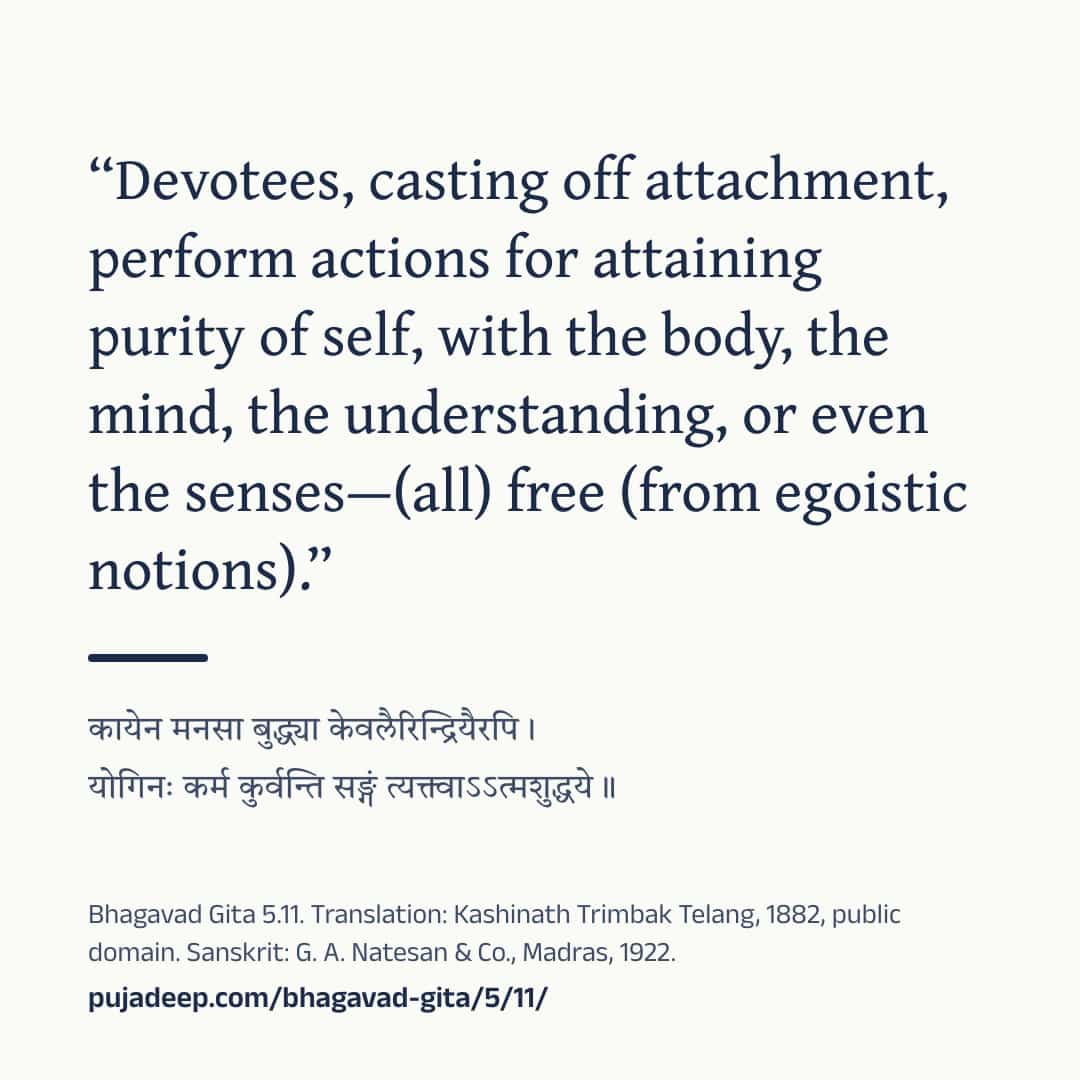
कायेन मनसा बुद्ध्या केवलैरिन्द्रियैरपि ।योगिनः कर्म कुर्वन्ति सङ्गं त्यक्त्वाऽऽत्मशुद्धये ॥
Kayena manasa buddhya kevalairindriyairapiYoginah karma kurvanti sangam tyaktvatmashuddhaye
kāyena manasā buddhyā kevalairindriyairapi |yoginaḥ karma kurvanti saṅgaṃ tyaktvā’’tmaśuddhaye ||
Our explanation Krishna says that yogis act with the body, the mind (manas), the understanding (buddhi), and even with the senses alone, giving up attachment, in order to purify themselves.
हिंदी अर्थ कृष्ण कहते हैं कि योगी आसक्ति छोड़कर, अपने को शुद्ध करने के लिए, शरीर से, मन से, बुद्धि से और केवल इंद्रियों से भी कर्म करते हैं।
Word by word
Every word, with its dictionary page
Word by word
- कायेन kāyena · with the body (instrumental singular) Dictionary: 2. kāya, Monier-Williams 1899, p. 274, col. 1 “the body”
- मनसा manasā · with the mind (instrumental singular) Dictionary: manas, Monier-Williams 1899, p. 783, col. 3 “mind (in its widest sense as applied to all the mental powers)”
- बुद्ध्या buddhyā · with the understanding (instrumental singular) Dictionary: buddhi, Monier-Williams 1899, p. 733, col. 3 “intelligence, reason, intellect, mind”
- केवलैः kevalaiḥ · alone, only (instrumental plural) Dictionary: kevala, Monier-Williams 1899, p. 309, col. 3 “alone, only, mere”
- इन्द्रियैः indriyaiḥ · with the senses (instrumental plural) Dictionary: indriya, Monier-Williams 1899, p. 167, col. 2 “faculty of sense, sense, organ of sense”
- अपि api · even (indeclinable) Dictionary: api, Monier-Williams 1899, p. 55, col. 1 “in the sense of even, also, very”
- योगिनः yoginaḥ · yogis (nominative plural) Dictionary: yogin, Monier-Williams 1899, p. 857, col. 3 “a follower of the Yoga system, a Yogin (usually called Yogī) or contemplative saint”
- कर्म karma · action (accusative singular (neuter)) Dictionary: karman, Monier-Williams 1899, p. 258, col. 2 “act, action, performance, business”
- कुर्वन्ति kurvanti · do, perform (present, 3rd person plural) Dictionary: 1. kṛ, Monier-Williams 1899, p. 301, col. 1 “to do, make, perform, accomplish, cause, effect”
- सङ्गम् saṅgam · attachment (accusative singular) Dictionary: saṅga, Monier-Williams 1899, p. 1132, col. 3 “(esp.) worldly or selfish attachment or affection, desire”
- त्यक्त्वा tyaktvā · giving up (absolutive ('having done')) Dictionary: 1. tyaj, Monier-Williams 1899, p. 456, col. 3 “to leave, abandon, quit”
- आत्मशुद्धये ātmaśuddhaye · to purify oneself (compound, dative singular) Dictionary: ātma-śuddhi, Monier-Williams 1899, p. 135, col. 3 “self-purification”
2 printings differ
Edition differences. Another printing or text reads this place differently.
- Spelling A digital text reads Same words. The 1922 edition marks the merged long ā with a double avagraha (त्यक्त्वाऽऽत्मशुद्धये), as it does in 1.28 and 4.7; the e-text writes त्यक्त्वात्मशुद्धये.
- Spelling A digital text reads Without the avagraha, like another digital text.
Old translations
Kashinath Trimbak Telang, 1882. Public domain. Page 64–65.
Devotees, casting off attachment, perform actions for attaining purity of self, with the body, the mind, the understanding, or even the senses1—(all) free (from egoistic notions).
Footnotes (the translator’s own) - Body=bathing, &c.; mind=meditation, &c.; understanding=ascertainment of truth; senses=hearing and celebrating God's name. ↩
Compare 3 translations
Kashinath Trimbak Telang, 1882. Public domain. Page 64–65.
Devotees, casting off attachment, perform actions for attaining purity of self, with the body, the mind, the understanding, or even the senses1—(all) free (from egoistic notions).
Footnotes (the translator’s own) - Body=bathing, &c.; mind=meditation, &c.; understanding=ascertainment of truth; senses=hearing and celebrating God's name. ↩
You are reading this one
Annie Besant, 1895. Public domain. Page 60.
Wholly by the body, by Manas, by Buddhi, and even by the senses, Yogîs perform action, having abandoned attachment, for the purification of the self.
You are reading this one
Swami Swarupananda, 1909 (first printed 1907). Public domain. Page 110.
Devotees in the path of work perform action, only with body, mind, senses, and intellect, forsaking attachment, for the purification of the heart.
You are reading this one
Cite this verse
The translation: K. T. Telang, The Bhagavadgîtâ (The Sacred Books of the East, vol. VIII, Oxford: Clarendon Press, 1882), pp. 64–65. Bhagavad Gita 5.11.
The translation: Annie Besant, The Bhagavad Gîtâ, or The Lord's Song (London: Theosophical Publishing Society, 1895), p. 60. Bhagavad Gita 5.11.
The translation: Swami Swarupananda, Srimad-Bhagavad-Gita (Mayavati: Prabuddha Bharata Press, 1909; first printed in Prabuddha Bharata, 1907–1909), p. 110. Bhagavad Gita 5.11.
Our explanation: “Bhagavad Gita 5.11: meaning and translation.” Pujadeep. Updated October 25, 2026. https://pujadeep.com/bhagavad-gita/5/11/
Pujadeep’s explanations are free to quote with credit: name Pujadeep and link to the page. How to credit
Classical readings, by school
No readings by school on this verse yet.
Share
Show the ways to share
Send one picture or the text to one chat. The picture names its source and the address of this page.
Drawing the picture
See the words
Bhagavad Gita 5.11

कायेन मनसा बुद्ध्या केवलैरिन्द्रियैरपि ।
योगिनः कर्म कुर्वन्ति सङ्गं त्यक्त्वाऽऽत्मशुद्धये ॥

“Devotees, casting off attachment, perform actions for attaining purity of self, with the body, the mind, the understanding, or even the senses—(all) free (from egoistic notions).”
(K. T. Telang, The Bhagavadgîtâ (The Sacred Books of the East, vol. VIII, Oxford: Clarendon Press, 1882), pp. 64–65, public domain)

“Wholly by the body, by Manas, by Buddhi, and even by the senses, Yogîs perform action, having abandoned attachment, for the purification of the self.”
(Annie Besant, The Bhagavad Gîtâ, or The Lord's Song (London: Theosophical Publishing Society, 1895), p. 60, public domain)

“Devotees in the path of work perform action, only with body, mind, senses, and intellect, forsaking attachment, for the purification of the heart.”
(Swami Swarupananda, Srimad-Bhagavad-Gita (Mayavati: Prabuddha Bharata Press, 1909; first printed in Prabuddha Bharata, 1907–1909), p. 110, public domain)

Sanskrit: G. A. Natesan & Co., Madras, 1922.
https://pujadeep.com/bhagavad-gita/5/11/ Nothing is sent from this site. Your own app sends it, to the chat you choose. The picture quotes the translation you chose on this page, with its name and year.
Sanskrit text: The Bhagavad-Gita, or The Lord's Song, with the text in Devanagari and an English translation, 1922. Meanings: written for Pujadeep and checked against the cited edition. Source and changes
Questions families ask
Who speaks Bhagavad Gita 5.11?
Krishna speaks this verse, in chapter 5 (Karma Sannyasa Yoga).
Where does the Sanskrit text come from?
Sanskrit text: The Bhagavad-Gita, or The Lord's Song, with the text in Devanagari and an English translation, 1922. Meanings: written for Pujadeep and checked against the cited edition. See the source
Is the meaning on this page a translation?
Explanation written for this site from the sources listed here, and checked against the cited edition. It is not a translation and not the only way to read the text. Free to quote with credit.
Source and licence
- Sanskrit text
- The Bhagavad-Gita, or The Lord's Song, with the text in Devanagari and an English translation (Annie Besant, G. A. Natesan & Co., Madras, 1922). Public domain. The Sanskrit on these pages was read from this printing’s page images.
- Translation
- The Bhagavadgîtâ with the Sanatsugâtîya and the Anugîtâ, translated by Kâshinâth Trimbak Telang (The Sacred Books of the East, vol. VIII, ed. F. Max Müller) (Kashinath Trimbak Telang, F. Max Müller, Clarendon Press, Oxford, 1882). Public domain. Shown verbatim, as printed.
- Translation
- The Bhagavad Gîtâ, or The Lord's Song, translated by Annie Besant (Annie Besant, Theosophical Publishing Society, London, 1895). Public domain. Shown verbatim, as printed.
- Translation
- Srimad-Bhagavad-Gita, with Sanskrit Text; Paraphrase with Word-by-word Literal Translation; English Rendering and Comments, Index, &c., by the Swami Swarupananda (Himalayan Series, No. XX) (Swami Swarupananda, The Editors and Publishers, Advaita Ashrama, Mayavati, Prabuddha Bharata Press, Mayavati, Almora, Himalayas, 1909). Public domain. Shown verbatim, as printed.
- Common wording
- In this text, 32 words follow today's common wording, checked against sanskritdocuments.org; Sanskrit Wikisource; Gita Press, Gorakhpur; GRETIL, Göttingen and Bhaktivedanta Book Trust.
- Our explanation
- Explanation written for this site from the sources listed here, and checked against the cited edition. It is not a translation and not the only way to read the text. Free to quote with credit.
- Checked
- Checked against the cited edition, October 15, 2026.
- Updated
- October 25, 2026