Bhagavad Gita 6.1: meaning and translation
Chapter 6: Dhyana Yoga. Krishna says
Krishna speaks.
Click or tap a word for its meaning and its dictionary page.
Text and layers
Text and layers
These choices stay in this browser.
Bhagavad Gita 6.1
श्रीभगवानुवाच ।
अनाश्रितः कर्मफलं कार्यं कर्म करोति यः ।स संन्यासी च योगी च न निरग्निर्न चाक्रियः ॥
Anashritah karmaphalam karyam karma karoti yahSa sannyasi cha yogi cha na niragnirna chakriyah
anāśritaḥ karmaphalaṃ kāryaṃ karma karoti yaḥ |sa saṃnyāsī ca yogī ca na niragnirna cākriyaḥ ||
Our explanation Krishna speaks. He says that the one who does the work that ought to be done (kārya), without depending on its fruit, is both a renunciant (saṃnyāsī) and a yogī. It is not the one who merely gives up the sacred fire, or who merely stops acting. The commentators differ on how far this praises the person who still acts (see the views).
हिंदी अर्थ कृष्ण कहते हैं कि जो कर्म के फल पर निर्भर हुए बिना करने योग्य कर्म (कार्य) करता है, वही संन्यासी है और वही योगी है। केवल यज्ञ की अग्नि छोड़ देने वाला या केवल कर्म छोड़ देने वाला ऐसा नहीं होता। टीकाकार अलग-अलग बताते हैं कि यह कर्म करने वाले की कितनी प्रशंसा है।
Word by word
Every word, with its dictionary page
Word by word
- अनाश्रितः anāśritaḥ · not depending on (past participle (masculine), nominative singular) Dictionary: an-āśrita, Monier-Williams 1899, p. 29, col. 1 “not supported, detached; disengaged, independent”
- कर्मफलम् karmaphalam · the fruit of action (compound (neuter), accusative singular) Dictionary: karma-phala, Monier-Williams 1899, p. 259, col. 1 “the fruit or recompense of actions”
- कार्यम् kāryam · that ought to be done (gerundive (to be done) (neuter), accusative singular) Dictionary: kārya, Monier-Williams 1899, p. 276, col. 1 “work or business to be done”
- कर्म karma · work, action (noun (neuter), accusative singular) Dictionary: karman, Monier-Williams 1899, p. 258, col. 2 “act, action, performance, business”
- करोति karoti · does (present, 3rd person singular) Dictionary: 1. kṛ, Monier-Williams 1899, p. 301, col. 1 “to do, make, perform, accomplish, cause, effect”
- यः yaḥ · who (pronoun (masculine), nominative singular) Dictionary: yad, Monier-Williams 1899, p. 844, col. 2 “who, which, what, whichever, whatever, that”
- सः saḥ · he (pronoun (masculine), nominative singular) Dictionary: tad, Monier-Williams 1899, p. 434, col. 1 “m. he, f. she, n. it, that, this”
- संन्यासी saṃnyāsī · a renunciant (noun (masculine), nominative singular) Dictionary: saṃ-nyāsin, Monier-Williams 1899, p. 1148, col. 1 “one who abandons or resigns worldly affairs, an ascetic”
- च ca · and (indeclinable) Dictionary: 2. ca, Monier-Williams 1899, p. 380, col. 1 “ind. and, both, also, moreover, as well as”
- योगी yogī · a yogī (noun (masculine), nominative singular) Dictionary: yogin, Monier-Williams 1899, p. 857, col. 3 “a follower of the Yoga system, a Yogin (usually called Yogī) or contemplative saint”
- च ca · and (indeclinable) Dictionary: 2. ca, Monier-Williams 1899, p. 380, col. 1 “ind. and, both, also, moreover, as well as”
- न na · not (indeclinable) Dictionary: 2. na, Monier-Williams 1899, p. 523, col. 1 “ind. not, no, nor, neither”
- निरग्निः niragniḥ · without the sacred fire (adjective (masculine), nominative singular) Dictionary: nir-agni, Monier-Williams 1899, p. 539, col. 2 “having no (consecrated) fire”
- न na · nor (indeclinable) Dictionary: 2. na, Monier-Williams 1899, p. 523, col. 1 “ind. not, no, nor, neither”
- च ca · and (indeclinable) Dictionary: 2. ca, Monier-Williams 1899, p. 380, col. 1 “ind. and, both, also, moreover, as well as”
- अक्रियः akriyaḥ · without action (adjective (masculine), nominative singular) Dictionary: a-kriya, Monier-Williams 1899, p. 3, col. 1 “without works; inactive”
Old translations
Kashinath Trimbak Telang, 1882. Public domain. Page 67.
The Deity said:
He who, regardless of the fruit of actions, performs the actions which ought to be performed, is the devotee and renouncer; not he who discards the (sacred) fires1, nor he who performs no acts.
Footnotes (the translator’s own) - Which are required for ordinary religious rites. ↩
Compare 3 translations
Kashinath Trimbak Telang, 1882. Public domain. Page 67.
The Deity said:
He who, regardless of the fruit of actions, performs the actions which ought to be performed, is the devotee and renouncer; not he who discards the (sacred) fires1, nor he who performs no acts.
Footnotes (the translator’s own) - Which are required for ordinary religious rites. ↩
You are reading this one
Annie Besant, 1895. Public domain. Page 65.
The Blessed Lord said:
He that performeth action as duty, independently of the fruit of action, he is a Sannyâsî, and he is a Yogî, not he that is without fire, and who doeth nothing.1
Footnotes (the translator’s own) - The Sannyâsî lights no sacrificial fire, and performs no sacrifices nor ceremonies; but merely to omit these, without true renunciation, is not to be a real Sannyâsî. ↩
You are reading this one
Swami Swarupananda, 1909 (first printed 1907). Public domain. Page 121.
The Blessed Lord said:
He who performs his bounden duty without leaning to the fruit of action—he is a renouncer of action as well as a devotee to action: not he, who is without fire, nor he who is without action.
You are reading this one
Cite this verse
The translation: K. T. Telang, The Bhagavadgîtâ (The Sacred Books of the East, vol. VIII, Oxford: Clarendon Press, 1882), p. 67. Bhagavad Gita 6.1.
The translation: Annie Besant, The Bhagavad Gîtâ, or The Lord's Song (London: Theosophical Publishing Society, 1895), p. 65. Bhagavad Gita 6.1.
The translation: Swami Swarupananda, Srimad-Bhagavad-Gita (Mayavati: Prabuddha Bharata Press, 1909; first printed in Prabuddha Bharata, 1907–1909), p. 121. Bhagavad Gita 6.1.
Our explanation: “Bhagavad Gita 6.1: meaning and translation.” Pujadeep. Updated October 25, 2026. https://pujadeep.com/bhagavad-gita/6/1/
Pujadeep’s explanations are free to quote with credit: name Pujadeep and link to the page. How to credit
Classical readings, by school
Each reading is named by its school. None is presented as the only meaning.
What Advaita, Vishishtadvaita and Dvaita teach, in short
Shankara Advaita
Shankara says the verse praises the person who works without wanting the fruit by calling him a renunciant and a yogī in a secondary sense only. Such work purifies the mind and leads in time to meditation (dhyāna-yoga). The renunciant in the full sense still gives up all action, as the scriptures teach.
Source: The Bhagavad-Gita, with the commentary of Sri Sankaracharya, translated by A. Mahadeva Sastri (2nd ed., Mysore: G. T. A. Printing Works, 1901), introduction to chapter 6 and commentary on 6.1–2, pp. 163–168. Summarised in our own words; none of its text is reproduced.
Ramanuja Vishishtadvaita
Ramanuja says this verse sums up the path of action (karma-yoga): the person who does his duty as worship of the Supreme, without seeking reward, walks both paths at once. He has the knowledge of the renunciant and the practice of the yogī, so he need not give up prescribed work.
Source: Sri Bhagavad-Gita with Sri Ramanujacharya's Visishtadvaita commentary, translated by A. Govindacharya (Madras, 1898), commentary on 6.1, pp. 193–194. Summarised in our own words; none of its text is reproduced.
Share
Show the ways to share
Send one picture or the text to one chat. The picture names its source and the address of this page.
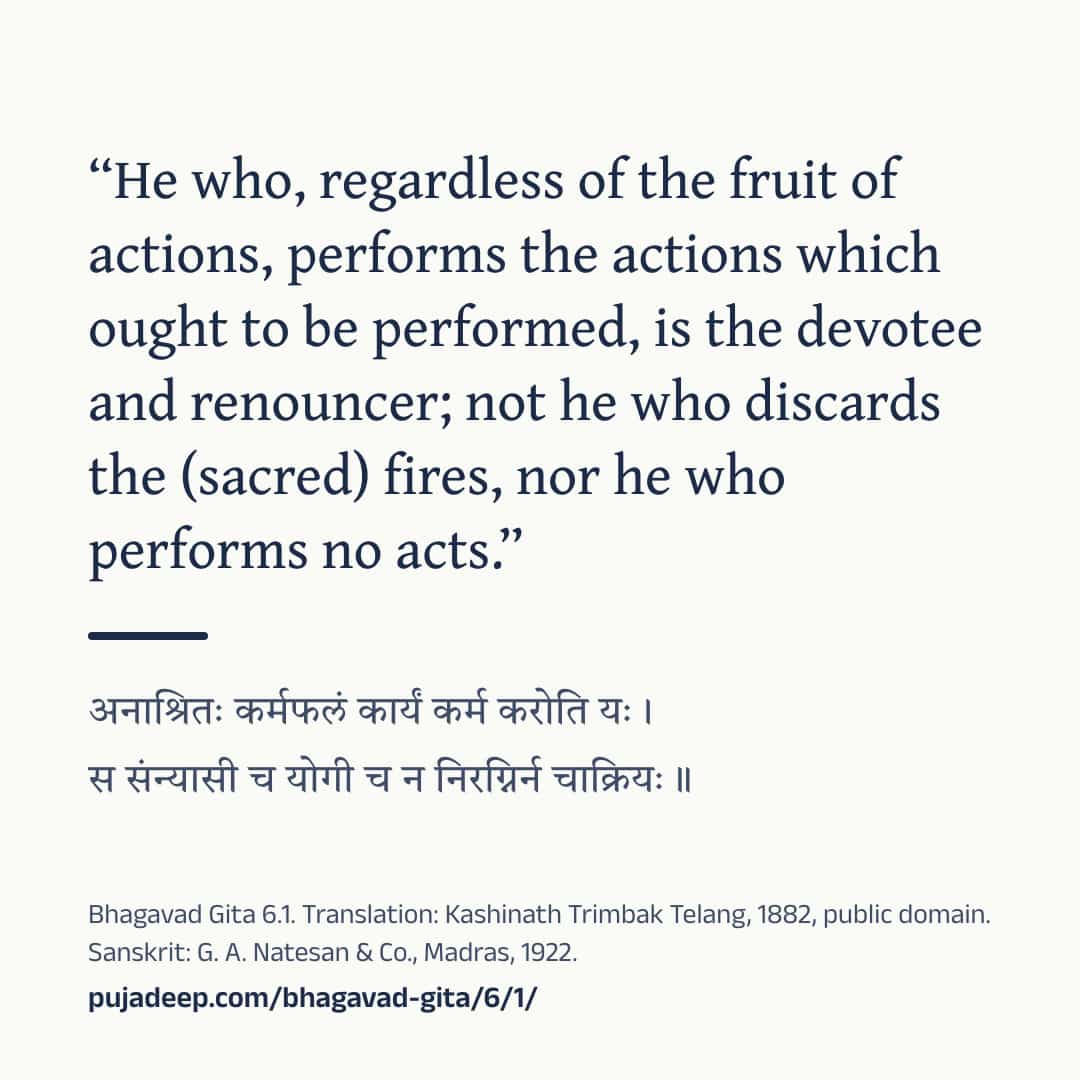
Drawing the picture
See the words
Bhagavad Gita 6.1

अनाश्रितः कर्मफलं कार्यं कर्म करोति यः ।
स संन्यासी च योगी च न निरग्निर्न चाक्रियः ॥

“He who, regardless of the fruit of actions, performs the actions which ought to be performed, is the devotee and renouncer; not he who discards the (sacred) fires, nor he who performs no acts.”
(K. T. Telang, The Bhagavadgîtâ (The Sacred Books of the East, vol. VIII, Oxford: Clarendon Press, 1882), p. 67, public domain)

“He that performeth action as duty, independently of the fruit of action, he is a Sannyâsî, and he is a Yogî, not he that is without fire, and who doeth nothing.”
(Annie Besant, The Bhagavad Gîtâ, or The Lord's Song (London: Theosophical Publishing Society, 1895), p. 65, public domain)

“He who performs his bounden duty without leaning to the fruit of action—he is a renouncer of action as well as a devotee to action: not he, who is without fire, nor he who is without action.”
(Swami Swarupananda, Srimad-Bhagavad-Gita (Mayavati: Prabuddha Bharata Press, 1909; first printed in Prabuddha Bharata, 1907–1909), p. 121, public domain)

Sanskrit: G. A. Natesan & Co., Madras, 1922.
https://pujadeep.com/bhagavad-gita/6/1/ Nothing is sent from this site. Your own app sends it, to the chat you choose. The picture quotes the translation you chose on this page, with its name and year.
Sanskrit text: The Bhagavad-Gita, or The Lord's Song, with the text in Devanagari and an English translation, 1922. Meanings: written for Pujadeep and checked against the cited edition. Source and changes
Questions families ask
Who speaks Bhagavad Gita 6.1?
Krishna speaks this verse, in chapter 6 (Dhyana Yoga).
Where does the Sanskrit text come from?
Sanskrit text: The Bhagavad-Gita, or The Lord's Song, with the text in Devanagari and an English translation, 1922. Meanings: written for Pujadeep and checked against the cited edition. See the source
Is the meaning on this page a translation?
Explanation written for this site from the sources listed here, and checked against the cited edition. It is not a translation and not the only way to read the text. Free to quote with credit.
Source and licence
- Sanskrit text
- The Bhagavad-Gita, or The Lord's Song, with the text in Devanagari and an English translation (Annie Besant, G. A. Natesan & Co., Madras, 1922). Public domain. The Sanskrit on these pages was read from this printing’s page images.
- Translation
- The Bhagavadgîtâ with the Sanatsugâtîya and the Anugîtâ, translated by Kâshinâth Trimbak Telang (The Sacred Books of the East, vol. VIII, ed. F. Max Müller) (Kashinath Trimbak Telang, F. Max Müller, Clarendon Press, Oxford, 1882). Public domain. Shown verbatim, as printed.
- Translation
- The Bhagavad Gîtâ, or The Lord's Song, translated by Annie Besant (Annie Besant, Theosophical Publishing Society, London, 1895). Public domain. Shown verbatim, as printed.
- Translation
- Srimad-Bhagavad-Gita, with Sanskrit Text; Paraphrase with Word-by-word Literal Translation; English Rendering and Comments, Index, &c., by the Swami Swarupananda (Himalayan Series, No. XX) (Swami Swarupananda, The Editors and Publishers, Advaita Ashrama, Mayavati, Prabuddha Bharata Press, Mayavati, Almora, Himalayas, 1909). Public domain. Shown verbatim, as printed.
- Commentary
- The Bhagavad-Gita, with the commentary of Sri Sankaracharya, translated by A. Mahadeva Sastri (2nd ed., Mysore: G. T. A. Printing Works, 1901) (Public-domain scan, University of California Libraries). Summarised in our own words; none of its text is reproduced.
- Commentary
- Sri Bhagavad-Gita with Sri Ramanujacharya's Visishtadvaita commentary, translated by A. Govindacharya (Madras, 1898) (Scan uploaded to archive.org (folkscanomy collection)). Summarised in our own words; none of its text is reproduced.
- Common wording
- In this text, 32 words follow today's common wording, checked against sanskritdocuments.org; Sanskrit Wikisource; Gita Press, Gorakhpur; GRETIL, Göttingen and Bhaktivedanta Book Trust.
- Our explanation
- Explanation written for this site from the sources listed here, and checked against the cited edition. It is not a translation and not the only way to read the text. Free to quote with credit.
- Checked
- Checked against the cited edition, October 15, 2026.
- Updated
- October 25, 2026