Bhagavad Gita 6.10: meaning and translation
Chapter 6: Dhyana Yoga. Krishna says
Krishna now turns to the practice of meditation.
Click or tap a word for its meaning and its dictionary page.
Text and layers
Text and layers
These choices stay in this browser.
Bhagavad Gita 6.10
योगी युञ्जीत सततमात्मानं रहसि स्थितः ।एकाकी यतचित्तात्मा निराशीरपरिग्रहः ॥
Yogi yunjita satatamatmanam rahasi sthitahEkaki yatachittatma nirashiraparigrahah
yogī yuñjīta satatamātmānaṃ rahasi sthitaḥ |ekākī yatacittātmā nirāśīraparigrahaḥ ||
Our explanation Krishna now turns to the practice of meditation. The yogī should constantly hold himself in yoga, staying in a quiet place, alone, with mind and body controlled, without hopes (nirāśī) and without possessions (aparigraha). The commentators differ on who is meant (see the views).
हिंदी अर्थ अब कृष्ण ध्यान के अभ्यास की बात करते हैं। योगी एकांत स्थान में, अकेले रहकर, मन और शरीर को वश में रखकर, आशा (निराशी) और संग्रह (अपरिग्रह) से रहित होकर, निरंतर स्वयं को योग में लगाए। टीकाकार इस पर अलग हैं कि यहाँ किसकी बात है।
Word by word
Every word, with its dictionary page
Word by word
- योगी yogī · the yogī (noun (masculine), nominative singular) Dictionary: yogin, Monier-Williams 1899, p. 857, col. 3 “a follower of the Yoga system, a Yogin (usually called Yogī) or contemplative saint”
- युञ्जीत yuñjīta · should hold in yoga (optative, 3rd person singular) Dictionary: 1. yuj, Monier-Williams 1899, p. 853, col. 2 “to yoke or join or fasten or harness”
- सततम् satatam · constantly (indeclinable) Dictionary: sa-tata, Monier-Williams 1899, p. 1138, col. 1 “constantly, always, ever”
- आत्मानम् ātmānam · himself (noun (masculine), accusative singular) Dictionary: ātman, Monier-Williams 1899, p. 135, col. 1 “the individual soul, self”
- रहसि rahasi · in a quiet place (noun (neuter), locative singular) Dictionary: 2. rahas, Monier-Williams 1899, p. 871, col. 1 “a lonely or deserted place, loneliness, solitude, privacy”
- स्थितः sthitaḥ · staying (past participle (masculine), nominative singular) Dictionary: sthita, Monier-Williams 1899, p. 1264, col. 1 “standing, staying, situated, resting or abiding or remaining in”
- एकाकी ekākī · alone (adjective (masculine), nominative singular) Dictionary: ekākin, Monier-Williams 1899, p. 231, col. 1 “alone, solitary”
- यतचित्तात्मा yatacittātmā · with mind and body controlled (compound (masculine), nominative singular) Dictionary: yata-cittātman, Monier-Williams 1899, p. 845, col. 2 “one who controls his soul and spirit”
- निराशीः nirāśīḥ · without hopes (adjective (masculine), nominative singular) Dictionary: nir-āśis, Monier-Williams 1899, p. 540, col. 2 “free from desire, indifferent”
- अपरिग्रहः aparigrahaḥ · without possessions (adjective (masculine), nominative singular) Dictionary: a-parigraha, Monier-Williams 1899, p. 51, col. 1 “destitute of possession”
Old translations
Kashinath Trimbak Telang, 1882. Public domain. Page 68.
A devotee should constantly devote his self to abstraction, remaining in a secret place1, alone, with his mind and self2 restrained, without expectations, and without belongings.
Footnotes (the translator’s own) Compare 3 translations
Kashinath Trimbak Telang, 1882. Public domain. Page 68.
A devotee should constantly devote his self to abstraction, remaining in a secret place1, alone, with his mind and self2 restrained, without expectations, and without belongings.
Footnotes (the translator’s own) You are reading this one
Annie Besant, 1895. Public domain. Page 67.
Let the Yogî constantly engage himself in Yoga, remaining in a secret place by himself, alone, with thought and self subdued, free from attachment and hope.
You are reading this one
Swami Swarupananda, 1909 (first printed 1907). Public domain. Page 126.
The Yogi should constantly practise concentration of the heart, retiring into solitude, alone, with the mind and body subdued, free from hope and possession.
You are reading this one
Cite this verse
The translation: K. T. Telang, The Bhagavadgîtâ (The Sacred Books of the East, vol. VIII, Oxford: Clarendon Press, 1882), p. 68. Bhagavad Gita 6.10.
The translation: Annie Besant, The Bhagavad Gîtâ, or The Lord's Song (London: Theosophical Publishing Society, 1895), p. 67. Bhagavad Gita 6.10.
The translation: Swami Swarupananda, Srimad-Bhagavad-Gita (Mayavati: Prabuddha Bharata Press, 1909; first printed in Prabuddha Bharata, 1907–1909), p. 126. Bhagavad Gita 6.10.
Our explanation: “Bhagavad Gita 6.10: meaning and translation.” Pujadeep. Updated October 25, 2026. https://pujadeep.com/bhagavad-gita/6/10/
Pujadeep’s explanations are free to quote with credit: name Pujadeep and link to the page. How to credit
Classical readings, by school
Each reading is named by its school. None is presented as the only meaning.
What Advaita, Vishishtadvaita and Dvaita teach, in short
Shankara Advaita
Shankara says the words 'in seclusion', 'alone' and 'without possessions' show that this meditation is for one who has renounced the world; he argues that it does not fit a householder's life.
Source: The Bhagavad-Gita, with the commentary of Sri Sankaracharya, translated by A. Mahadeva Sastri (2nd ed., Mysore: G. T. A. Printing Works, 1901), commentary on 6.10, p. 173, and the introduction, p. 165. Summarised in our own words; none of its text is reproduced.
Ramanuja Vishishtadvaita
Ramanuja says the yogī here is the one on the path of action, and 'constantly' means daily, at fixed times set apart for meditation, in a quiet place away from people and noise.
Source: Sri Bhagavad-Gita with Sri Ramanujacharya's Visishtadvaita commentary, translated by A. Govindacharya (Madras, 1898), commentary on 6.10, pp. 199–200. Summarised in our own words; none of its text is reproduced.
Share
Show the ways to share
Send one picture or the text to one chat. The picture names its source and the address of this page.
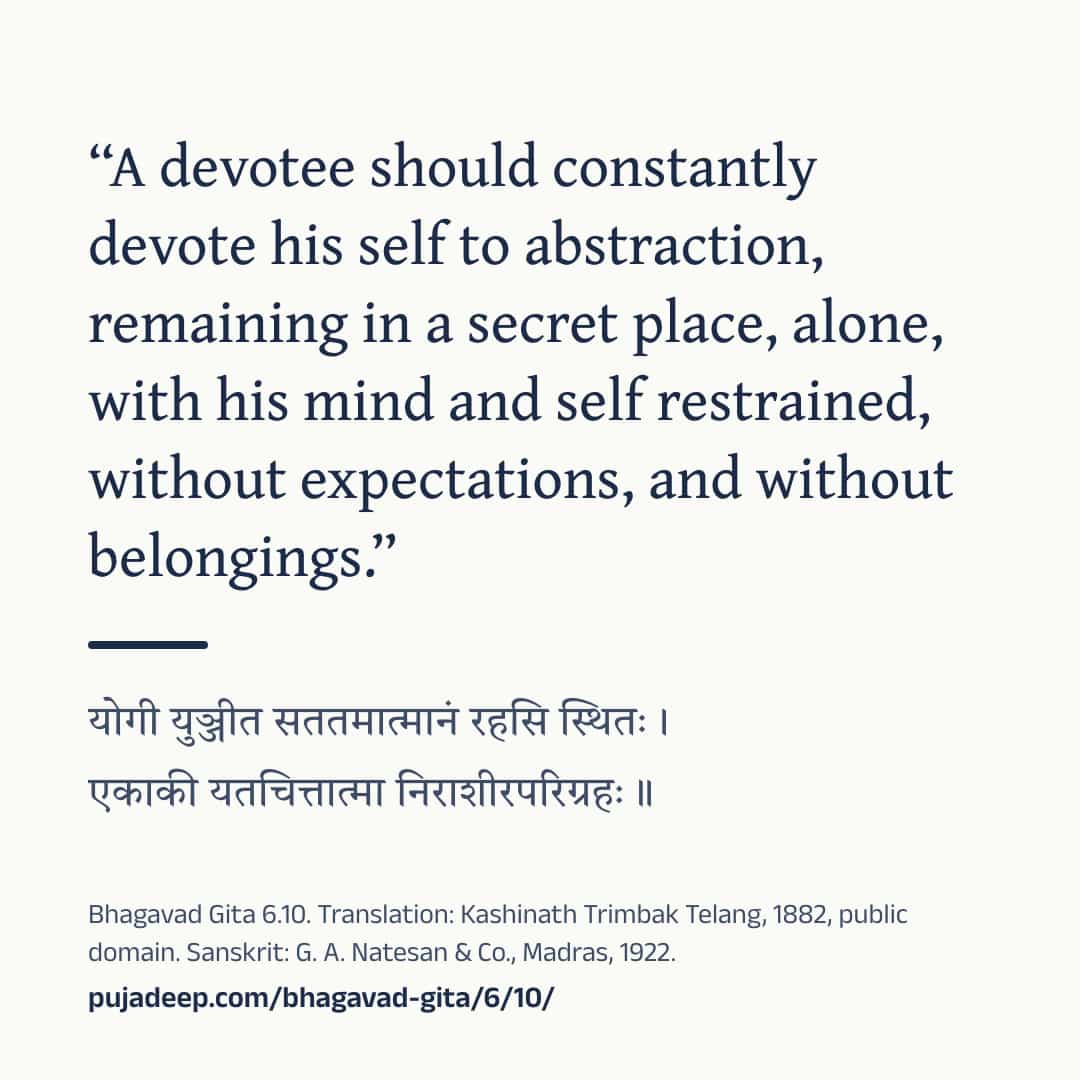
Drawing the picture
See the words
Bhagavad Gita 6.10

योगी युञ्जीत सततमात्मानं रहसि स्थितः ।
एकाकी यतचित्तात्मा निराशीरपरिग्रहः ॥

“A devotee should constantly devote his self to abstraction, remaining in a secret place, alone, with his mind and self restrained, without expectations, and without belongings.”
(K. T. Telang, The Bhagavadgîtâ (The Sacred Books of the East, vol. VIII, Oxford: Clarendon Press, 1882), p. 68, public domain)

“Let the Yogî constantly engage himself in Yoga, remaining in a secret place by himself, alone, with thought and self subdued, free from attachment and hope.”
(Annie Besant, The Bhagavad Gîtâ, or The Lord's Song (London: Theosophical Publishing Society, 1895), p. 67, public domain)

“The Yogi should constantly practise concentration of the heart, retiring into solitude, alone, with the mind and body subdued, free from hope and possession.”
(Swami Swarupananda, Srimad-Bhagavad-Gita (Mayavati: Prabuddha Bharata Press, 1909; first printed in Prabuddha Bharata, 1907–1909), p. 126, public domain)

Sanskrit: G. A. Natesan & Co., Madras, 1922.
https://pujadeep.com/bhagavad-gita/6/10/ Nothing is sent from this site. Your own app sends it, to the chat you choose. The picture quotes the translation you chose on this page, with its name and year.
Sanskrit text: The Bhagavad-Gita, or The Lord's Song, with the text in Devanagari and an English translation, 1922. Meanings: written for Pujadeep and checked against the cited edition. Source and changes
Questions families ask
Who speaks Bhagavad Gita 6.10?
Krishna speaks this verse, in chapter 6 (Dhyana Yoga).
Where does the Sanskrit text come from?
Sanskrit text: The Bhagavad-Gita, or The Lord's Song, with the text in Devanagari and an English translation, 1922. Meanings: written for Pujadeep and checked against the cited edition. See the source
Is the meaning on this page a translation?
Explanation written for this site from the sources listed here, and checked against the cited edition. It is not a translation and not the only way to read the text. Free to quote with credit.
Source and licence
- Sanskrit text
- The Bhagavad-Gita, or The Lord's Song, with the text in Devanagari and an English translation (Annie Besant, G. A. Natesan & Co., Madras, 1922). Public domain. The Sanskrit on these pages was read from this printing’s page images.
- Translation
- The Bhagavadgîtâ with the Sanatsugâtîya and the Anugîtâ, translated by Kâshinâth Trimbak Telang (The Sacred Books of the East, vol. VIII, ed. F. Max Müller) (Kashinath Trimbak Telang, F. Max Müller, Clarendon Press, Oxford, 1882). Public domain. Shown verbatim, as printed.
- Translation
- The Bhagavad Gîtâ, or The Lord's Song, translated by Annie Besant (Annie Besant, Theosophical Publishing Society, London, 1895). Public domain. Shown verbatim, as printed.
- Translation
- Srimad-Bhagavad-Gita, with Sanskrit Text; Paraphrase with Word-by-word Literal Translation; English Rendering and Comments, Index, &c., by the Swami Swarupananda (Himalayan Series, No. XX) (Swami Swarupananda, The Editors and Publishers, Advaita Ashrama, Mayavati, Prabuddha Bharata Press, Mayavati, Almora, Himalayas, 1909). Public domain. Shown verbatim, as printed.
- Commentary
- The Bhagavad-Gita, with the commentary of Sri Sankaracharya, translated by A. Mahadeva Sastri (2nd ed., Mysore: G. T. A. Printing Works, 1901) (Public-domain scan, University of California Libraries). Summarised in our own words; none of its text is reproduced.
- Commentary
- Sri Bhagavad-Gita with Sri Ramanujacharya's Visishtadvaita commentary, translated by A. Govindacharya (Madras, 1898) (Scan uploaded to archive.org (folkscanomy collection)). Summarised in our own words; none of its text is reproduced.
- Common wording
- In this text, 32 words follow today's common wording, checked against sanskritdocuments.org; Sanskrit Wikisource; Gita Press, Gorakhpur; GRETIL, Göttingen and Bhaktivedanta Book Trust.
- Our explanation
- Explanation written for this site from the sources listed here, and checked against the cited edition. It is not a translation and not the only way to read the text. Free to quote with credit.
- Checked
- Checked against the cited edition, October 15, 2026.
- Updated
- October 25, 2026