Bhagavad Gita 6.16: meaning and translation
Chapter 6: Dhyana Yoga. Krishna says
Yoga is not for one who eats too much or for one who does not eat at all, Krishna tells Arjuna, nor for one who sleeps too much or for one who stays awake too much.
Click or tap a word for its meaning and its dictionary page.
Text and layers
Text and layers
These choices stay in this browser.
Bhagavad Gita 6.16
नात्यश्नतस्तु योगोऽस्ति न चैकान्तमनश्नतः ।न चातिस्वप्नशीलस्य जाग्रतो नैव चार्जुन ॥
Natyashnatastu yogosti na chaikantamanashnatahNa chatisvapnashilasya jagrato naiva charjuna
nātyaśnatastu yogo’sti na caikāntamanaśnataḥ |na cātisvapnaśīlasya jāgrato naiva cārjuna ||
Our explanation Yoga is not for one who eats too much or for one who does not eat at all, Krishna tells Arjuna, nor for one who sleeps too much or for one who stays awake too much.
हिंदी अर्थ कृष्ण अर्जुन से कहते हैं कि योग न बहुत अधिक खाने वाले के लिए है, न बिल्कुल न खाने वाले के लिए; न बहुत सोने वाले के लिए, न बहुत जागने वाले के लिए।
Word by word
Every word, with its dictionary page
Word by word
- न na · not (indeclinable) Dictionary: 2. na, Monier-Williams 1899, p. 523, col. 1 “ind. not, no, nor, neither”
- अत्यश्नतः atyaśnataḥ · of one who eats too much (present participle (masculine), genitive singular) Dictionary: ati, Monier-Williams 1899, p. 12, col. 2 “As a prefix ... expresses beyond, over”; 2. aś, Monier-Williams 1899, p. 112, col. 2 “to eat, consume”
- तु tu · but (indeclinable) Dictionary: 2. tu, Monier-Williams 1899, p. 449, col. 3 “but”
- योगः yogaḥ · yoga (noun (masculine), nominative singular) Dictionary: yoga, Monier-Williams 1899, p. 856, col. 2 “the act of yoking, joining, attaching”
- अस्ति asti · is (present, 3rd person singular) Dictionary: 1. as, Monier-Williams 1899, p. 117, col. 2 “to be, live, exist, be present”
- न na · nor (indeclinable) Dictionary: 2. na, Monier-Williams 1899, p. 523, col. 1 “ind. not, no, nor, neither”
- च ca · and (indeclinable) Dictionary: 2. ca, Monier-Williams 1899, p. 380, col. 1 “ind. and, both, also, moreover, as well as”
- एकान्तम् ekāntam · at all, entirely (indeclinable) Dictionary: ekānta, Monier-Williams 1899, p. 230, col. 2 “solely, only, exclusively, absolutely”
- अनश्नतः anaśnataḥ · of one who does not eat (present participle (masculine), genitive singular) Dictionary: an-aśnat, Monier-Williams 1899, p. 27, col. 2 “not eating”
- न na · nor (indeclinable) Dictionary: 2. na, Monier-Williams 1899, p. 523, col. 1 “ind. not, no, nor, neither”
- च ca · and (indeclinable) Dictionary: 2. ca, Monier-Williams 1899, p. 380, col. 1 “ind. and, both, also, moreover, as well as”
- अतिस्वप्नशीलस्य atisvapnaśīlasya · of one given to too much sleep (compound (masculine), genitive singular) Dictionary: ati, Monier-Williams 1899, p. 12, col. 2 “As a prefix ... expresses beyond, over”; svapna, Monier-Williams 1899, p. 1280, col. 3 “sleep, sleeping”; śīla, Monier-Williams 1899, p. 1079, col. 1 “habit, custom, usage, natural or acquired way of living or acting, practice”
- जाग्रतः jāgrataḥ · of one who stays awake (present participle (masculine), genitive singular) Dictionary: jāgṛ, Monier-Williams 1899, p. 417, col. 1 “to be awake or watchful”
- न na · not (indeclinable) Dictionary: 2. na, Monier-Williams 1899, p. 523, col. 1 “ind. not, no, nor, neither”
- एव eva · at all (indeclinable) Dictionary: 1. eva, Monier-Williams 1899, p. 232, col. 2 “just, exactly, very, same, only, even, alone, merely”
- च ca · and (indeclinable) Dictionary: 2. ca, Monier-Williams 1899, p. 380, col. 1 “ind. and, both, also, moreover, as well as”
- अर्जुन arjuna · O Arjuna (noun (masculine), vocative singular) Dictionary: arjuna, Monier-Williams 1899, p. 90, col. 1
Old translations
Kashinath Trimbak Telang, 1882. Public domain. Page 69.
Devotion is not his, O Arguna! who eats too much, nor his who eats not at all; not his who is addicted to too much sleep, nor his who is (ever) awake.
Compare 3 translations
Kashinath Trimbak Telang, 1882. Public domain. Page 69.
Devotion is not his, O Arguna! who eats too much, nor his who eats not at all; not his who is addicted to too much sleep, nor his who is (ever) awake.
You are reading this one
Annie Besant, 1895. Public domain. Page 68.
Verily Yoga is not for him who eateth too much, nor who abstaineth to excess, nor who is addicted to too much sleep, or even to wakefulness, O Arjuna.
You are reading this one
Swami Swarupananda, 1909 (first printed 1907). Public domain. Page 129.
(Success in) Yoga is not for him who eats too much or too little—nor, O Arjuna, for him who sleeps too much or too little.
You are reading this one
Cite this verse
The translation: K. T. Telang, The Bhagavadgîtâ (The Sacred Books of the East, vol. VIII, Oxford: Clarendon Press, 1882), p. 69. Bhagavad Gita 6.16.
The translation: Annie Besant, The Bhagavad Gîtâ, or The Lord's Song (London: Theosophical Publishing Society, 1895), p. 68. Bhagavad Gita 6.16.
The translation: Swami Swarupananda, Srimad-Bhagavad-Gita (Mayavati: Prabuddha Bharata Press, 1909; first printed in Prabuddha Bharata, 1907–1909), p. 129. Bhagavad Gita 6.16.
Our explanation: “Bhagavad Gita 6.16: meaning and translation.” Pujadeep. Updated October 25, 2026. https://pujadeep.com/bhagavad-gita/6/16/
Pujadeep’s explanations are free to quote with credit: name Pujadeep and link to the page. How to credit
Classical readings, by school
No readings by school on this verse yet.
Share
Show the ways to share
Send one picture or the text to one chat. The picture names its source and the address of this page.
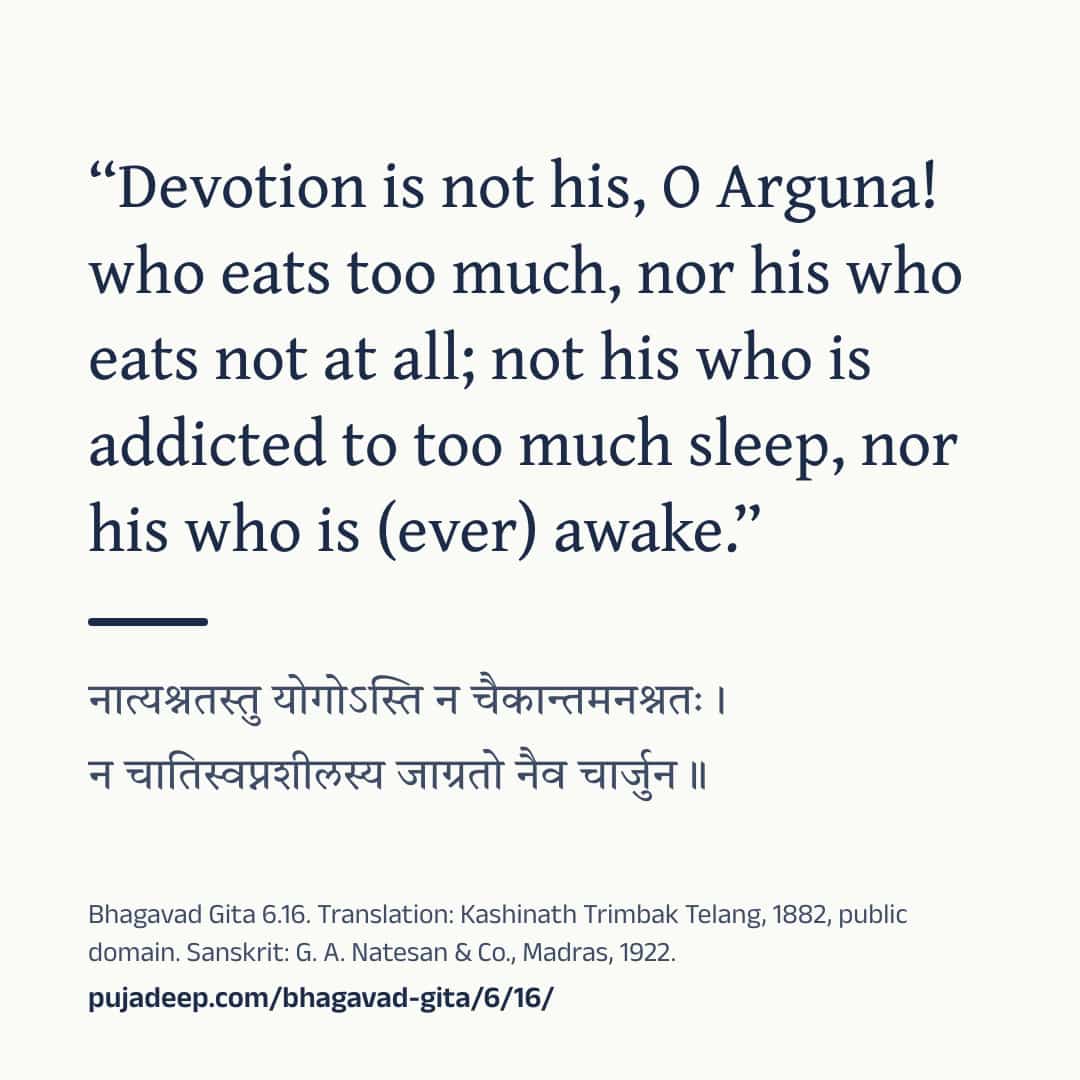
Drawing the picture
See the words
Bhagavad Gita 6.16

नात्यश्नतस्तु योगोऽस्ति न चैकान्तमनश्नतः ।
न चातिस्वप्नशीलस्य जाग्रतो नैव चार्जुन ॥

“Devotion is not his, O Arguna! who eats too much, nor his who eats not at all; not his who is addicted to too much sleep, nor his who is (ever) awake.”
(K. T. Telang, The Bhagavadgîtâ (The Sacred Books of the East, vol. VIII, Oxford: Clarendon Press, 1882), p. 69, public domain)

“Verily Yoga is not for him who eateth too much, nor who abstaineth to excess, nor who is addicted to too much sleep, or even to wakefulness, O Arjuna.”
(Annie Besant, The Bhagavad Gîtâ, or The Lord's Song (London: Theosophical Publishing Society, 1895), p. 68, public domain)

“(Success in) Yoga is not for him who eats too much or too little—nor, O Arjuna, for him who sleeps too much or too little.”
(Swami Swarupananda, Srimad-Bhagavad-Gita (Mayavati: Prabuddha Bharata Press, 1909; first printed in Prabuddha Bharata, 1907–1909), p. 129, public domain)

Sanskrit: G. A. Natesan & Co., Madras, 1922.
https://pujadeep.com/bhagavad-gita/6/16/ Nothing is sent from this site. Your own app sends it, to the chat you choose. The picture quotes the translation you chose on this page, with its name and year.
Sanskrit text: The Bhagavad-Gita, or The Lord's Song, with the text in Devanagari and an English translation, 1922. Meanings: written for Pujadeep and checked against the cited edition. Source and changes
Questions families ask
Who speaks Bhagavad Gita 6.16?
Krishna speaks this verse, in chapter 6 (Dhyana Yoga).
Where does the Sanskrit text come from?
Sanskrit text: The Bhagavad-Gita, or The Lord's Song, with the text in Devanagari and an English translation, 1922. Meanings: written for Pujadeep and checked against the cited edition. See the source
Is the meaning on this page a translation?
Explanation written for this site from the sources listed here, and checked against the cited edition. It is not a translation and not the only way to read the text. Free to quote with credit.
Source and licence
- Sanskrit text
- The Bhagavad-Gita, or The Lord's Song, with the text in Devanagari and an English translation (Annie Besant, G. A. Natesan & Co., Madras, 1922). Public domain. The Sanskrit on these pages was read from this printing’s page images.
- Translation
- The Bhagavadgîtâ with the Sanatsugâtîya and the Anugîtâ, translated by Kâshinâth Trimbak Telang (The Sacred Books of the East, vol. VIII, ed. F. Max Müller) (Kashinath Trimbak Telang, F. Max Müller, Clarendon Press, Oxford, 1882). Public domain. Shown verbatim, as printed.
- Translation
- The Bhagavad Gîtâ, or The Lord's Song, translated by Annie Besant (Annie Besant, Theosophical Publishing Society, London, 1895). Public domain. Shown verbatim, as printed.
- Translation
- Srimad-Bhagavad-Gita, with Sanskrit Text; Paraphrase with Word-by-word Literal Translation; English Rendering and Comments, Index, &c., by the Swami Swarupananda (Himalayan Series, No. XX) (Swami Swarupananda, The Editors and Publishers, Advaita Ashrama, Mayavati, Prabuddha Bharata Press, Mayavati, Almora, Himalayas, 1909). Public domain. Shown verbatim, as printed.
- Common wording
- In this text, 32 words follow today's common wording, checked against sanskritdocuments.org; Sanskrit Wikisource; Gita Press, Gorakhpur; GRETIL, Göttingen and Bhaktivedanta Book Trust.
- Our explanation
- Explanation written for this site from the sources listed here, and checked against the cited edition. It is not a translation and not the only way to read the text. Free to quote with credit.
- Checked
- Checked against the cited edition, October 15, 2026.
- Updated
- October 25, 2026