Bhagavad Gita 6.27: meaning and translation
Chapter 6: Dhyana Yoga. Krishna says
Krishna says that the highest joy comes to such a yogī, whose mind is fully at peace, whose restlessness (rajas) is stilled, who is free of stain and has become one with Brahman (brahma-bhūta).
Click or tap a word for its meaning and its dictionary page.
Text and layers
Text and layers
These choices stay in this browser.
Bhagavad Gita 6.27
प्रशान्तमनसं ह्येनं योगिनं सुखमुत्तमम् ।उपैति शान्तरजसं ब्रह्मभूतमकल्मषम् ॥
Prashantamanasam hyenam yoginam sukhamuttamamUpaiti shantarajasam brahmabhutamakalmasham
praśāntamanasaṃ hyenaṃ yoginaṃ sukhamuttamam |upaiti śāntarajasaṃ brahmabhūtamakalmaṣam ||
Our explanation Krishna says that the highest joy comes to such a yogī, whose mind is fully at peace, whose restlessness (rajas) is stilled, who is free of stain and has become one with Brahman (brahma-bhūta).
हिंदी अर्थ कृष्ण कहते हैं कि ऐसे योगी को उत्तम सुख मिलता है, जिसका मन पूरी तरह शांत है, जिसका रजोगुण (बेचैनी) शांत हो गया है, जो निष्पाप है और ब्रह्मभूत (ब्रह्म के साथ एक) हो गया है।
Word by word
Every word, with its dictionary page
Word by word
- प्रशान्तमनसम् praśāntamanasam · whose mind is at peace (compound (masculine), accusative singular) Dictionary: pra-śānta, Monier-Williams 1899, p. 695, col. 1 “tranquillized, calm, quiet, composed”; manas, Monier-Williams 1899, p. 783, col. 3 “mind (in its widest sense as applied to all the mental powers)”
- हि hi · indeed (indeclinable) Dictionary: 2. hi, Monier-Williams 1899, p. 1297, col. 3 “for, because, on account of”
- एनम् enam · this (pronoun (masculine), accusative singular) Dictionary: 1. ena, Monier-Williams 1899, p. 232, col. 1 “he, she, it; this, that”
- योगिनम् yoginam · yogī (noun (masculine), accusative singular) Dictionary: yogin, Monier-Williams 1899, p. 857, col. 3 “a follower of the Yoga system, a Yogin (usually called Yogī) or contemplative saint”
- सुखम् sukham · joy (noun (neuter), nominative singular) Dictionary: sukha, Monier-Williams 1899, p. 1221, col. 1 “ease, easiness, comfort, prosperity, pleasure, happiness”
- उत्तमम् uttamam · highest (adjective (neuter), nominative singular) Dictionary: ut-tama, Monier-Williams 1899, p. 177, col. 3 “uppermost, highest, chief; most elevated, principal; best, excellent”
- उपैति upaiti · comes to (present, 3rd person singular) Dictionary: 1. upe, Monier-Williams 1899, p. 215, col. 2 “to go or come or step near, approach, betake one's self to, arrive at”
- शान्तरजसम् śāntarajasam · whose rajas is stilled (compound (masculine), accusative singular) Dictionary: śānta, Monier-Williams 1899, p. 1064, col. 2 “appeased, pacified, tranquil, calm, free from passions, undisturbed, Up.; MBh. &c.”; rajas, Monier-Williams 1899, p. 863, col. 2 “the 'darkening' quality, passion, emotion, affection”
- ब्रह्मभूतम् brahmabhūtam · one with Brahman (compound (masculine), accusative singular) Dictionary: brahma-bhūta, Monier-Williams 1899, p. 739, col. 2 “become i.e. absorbed in Brahmă”
- अकल्मषम् akalmaṣam · free of stain (adjective (masculine), accusative singular) Dictionary: a-kalmaṣa, Monier-Williams 1899, p. 2, col. 1 “spotless”
Old translations
Kashinath Trimbak Telang, 1882. Public domain. Page 70.
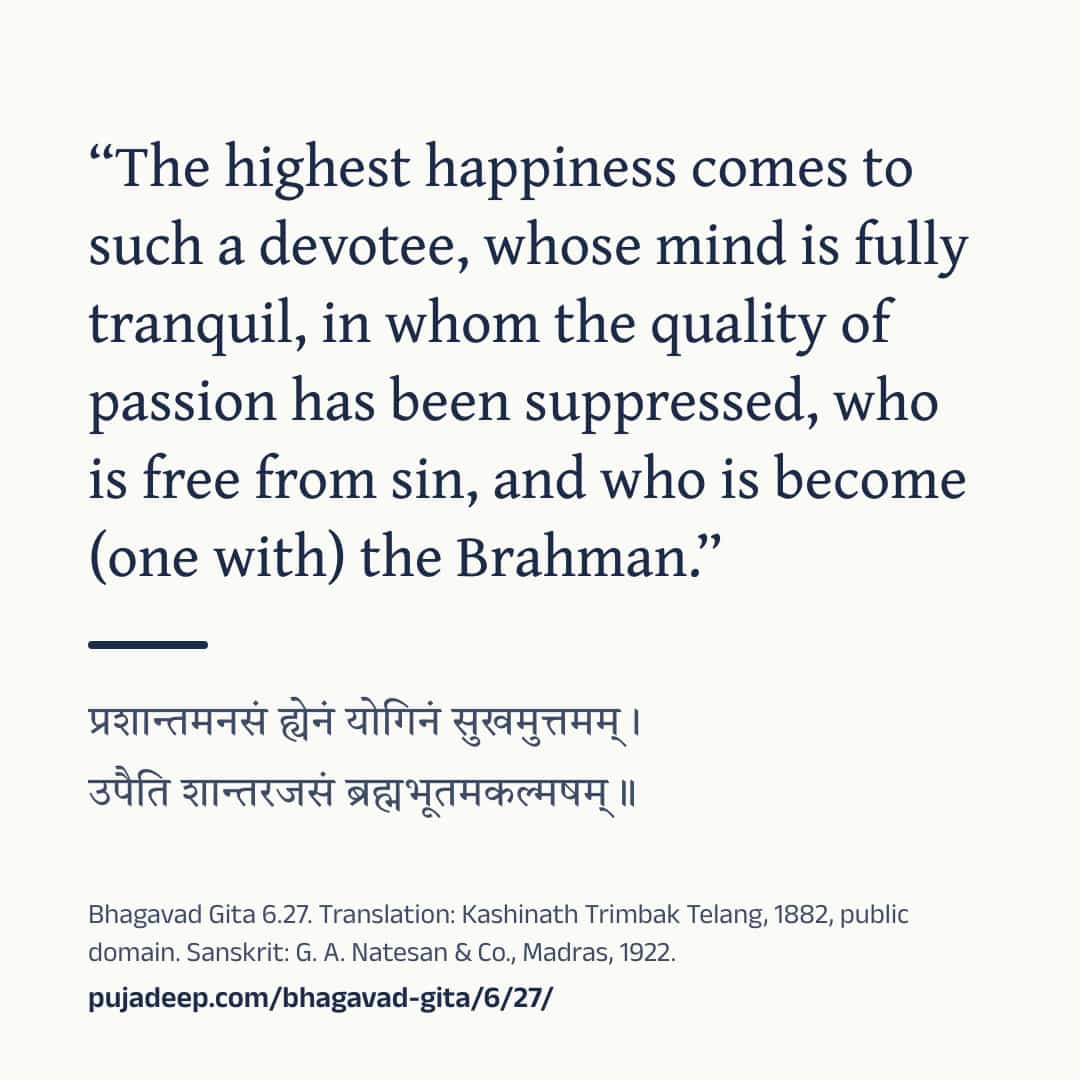
The highest happiness comes to such a devotee, whose mind is fully tranquil, in whom the quality of passion has been suppressed, who is free from sin, and who is become (one with) the Brahman.
Compare 3 translations
Kashinath Trimbak Telang, 1882. Public domain. Page 70.
The highest happiness comes to such a devotee, whose mind is fully tranquil, in whom the quality of passion has been suppressed, who is free from sin, and who is become (one with) the Brahman.
You are reading this one
Annie Besant, 1895. Public domain. Page 70.
Supreme joy is for that Yogî whose Manas is peaceful, whose passion-nature is calmed, who is sinless and of the nature of Brahman.
You are reading this one
Swami Swarupananda, 1909 (first printed 1907). Public domain. Page 133.
Verily, the supreme bliss comes to that Yogi, of perfectly tranquil mind, and passions quieted, Brahman-become, and freed from taint.
You are reading this one
Cite this verse
The translation: K. T. Telang, The Bhagavadgîtâ (The Sacred Books of the East, vol. VIII, Oxford: Clarendon Press, 1882), p. 70. Bhagavad Gita 6.27.
The translation: Annie Besant, The Bhagavad Gîtâ, or The Lord's Song (London: Theosophical Publishing Society, 1895), p. 70. Bhagavad Gita 6.27.
The translation: Swami Swarupananda, Srimad-Bhagavad-Gita (Mayavati: Prabuddha Bharata Press, 1909; first printed in Prabuddha Bharata, 1907–1909), p. 133. Bhagavad Gita 6.27.
Our explanation: “Bhagavad Gita 6.27: meaning and translation.” Pujadeep. Updated October 25, 2026. https://pujadeep.com/bhagavad-gita/6/27/
Pujadeep’s explanations are free to quote with credit: name Pujadeep and link to the page. How to credit
Classical readings, by school
No readings by school on this verse yet.
Share
Show the ways to share
Send one picture or the text to one chat. The picture names its source and the address of this page.
Drawing the picture
See the words
Bhagavad Gita 6.27

प्रशान्तमनसं ह्येनं योगिनं सुखमुत्तमम् ।
उपैति शान्तरजसं ब्रह्मभूतमकल्मषम् ॥

“The highest happiness comes to such a devotee, whose mind is fully tranquil, in whom the quality of passion has been suppressed, who is free from sin, and who is become (one with) the Brahman.”
(K. T. Telang, The Bhagavadgîtâ (The Sacred Books of the East, vol. VIII, Oxford: Clarendon Press, 1882), p. 70, public domain)

“Supreme joy is for that Yogî whose Manas is peaceful, whose passion-nature is calmed, who is sinless and of the nature of Brahman.”
(Annie Besant, The Bhagavad Gîtâ, or The Lord's Song (London: Theosophical Publishing Society, 1895), p. 70, public domain)

“Verily, the supreme bliss comes to that Yogi, of perfectly tranquil mind, and passions quieted, Brahman-become, and freed from taint.”
(Swami Swarupananda, Srimad-Bhagavad-Gita (Mayavati: Prabuddha Bharata Press, 1909; first printed in Prabuddha Bharata, 1907–1909), p. 133, public domain)

Sanskrit: G. A. Natesan & Co., Madras, 1922.
https://pujadeep.com/bhagavad-gita/6/27/ Nothing is sent from this site. Your own app sends it, to the chat you choose. The picture quotes the translation you chose on this page, with its name and year.
Sanskrit text: The Bhagavad-Gita, or The Lord's Song, with the text in Devanagari and an English translation, 1922. Meanings: written for Pujadeep and checked against the cited edition. Source and changes
Questions families ask
Who speaks Bhagavad Gita 6.27?
Krishna speaks this verse, in chapter 6 (Dhyana Yoga).
Where does the Sanskrit text come from?
Sanskrit text: The Bhagavad-Gita, or The Lord's Song, with the text in Devanagari and an English translation, 1922. Meanings: written for Pujadeep and checked against the cited edition. See the source
Is the meaning on this page a translation?
Explanation written for this site from the sources listed here, and checked against the cited edition. It is not a translation and not the only way to read the text. Free to quote with credit.
Source and licence
- Sanskrit text
- The Bhagavad-Gita, or The Lord's Song, with the text in Devanagari and an English translation (Annie Besant, G. A. Natesan & Co., Madras, 1922). Public domain. The Sanskrit on these pages was read from this printing’s page images.
- Translation
- The Bhagavadgîtâ with the Sanatsugâtîya and the Anugîtâ, translated by Kâshinâth Trimbak Telang (The Sacred Books of the East, vol. VIII, ed. F. Max Müller) (Kashinath Trimbak Telang, F. Max Müller, Clarendon Press, Oxford, 1882). Public domain. Shown verbatim, as printed.
- Translation
- The Bhagavad Gîtâ, or The Lord's Song, translated by Annie Besant (Annie Besant, Theosophical Publishing Society, London, 1895). Public domain. Shown verbatim, as printed.
- Translation
- Srimad-Bhagavad-Gita, with Sanskrit Text; Paraphrase with Word-by-word Literal Translation; English Rendering and Comments, Index, &c., by the Swami Swarupananda (Himalayan Series, No. XX) (Swami Swarupananda, The Editors and Publishers, Advaita Ashrama, Mayavati, Prabuddha Bharata Press, Mayavati, Almora, Himalayas, 1909). Public domain. Shown verbatim, as printed.
- Common wording
- In this text, 32 words follow today's common wording, checked against sanskritdocuments.org; Sanskrit Wikisource; Gita Press, Gorakhpur; GRETIL, Göttingen and Bhaktivedanta Book Trust.
- Our explanation
- Explanation written for this site from the sources listed here, and checked against the cited edition. It is not a translation and not the only way to read the text. Free to quote with credit.
- Checked
- Checked against the cited edition, October 15, 2026.
- Updated
- October 25, 2026