Bhagavad Gita 6.41: meaning and translation
Chapter 6: Dhyana Yoga. Krishna says
Krishna says that the one who fell from yoga reaches the worlds of those who did good, lives there for very many years, and is then born again in the home of pure and prosperous people.
Click or tap a word for its meaning and its dictionary page.
Text and layers
Text and layers
These choices stay in this browser.
Bhagavad Gita 6.41
प्राप्य पुण्यकृतां लोकानुषित्वा शाश्वतीः समाः ।शुचीनां श्रीमतां गेहे योगभ्रष्टोऽभिजायते ॥
Prapya punyakritam lokanushitva shashvatih samahShuchinam shrimatam gehe yogabhrashtobhijayate
prāpya puṇyakṛtāṃ lokānuṣitvā śāśvatīḥ samāḥ |śucīnāṃ śrīmatāṃ gehe yogabhraṣṭo’bhijāyate ||
Our explanation Krishna says that the one who fell from yoga reaches the worlds of those who did good, lives there for very many years, and is then born again in the home of pure and prosperous people. These are Krishna's words about what follows death; the schools read them as part of the teaching on rebirth.
हिंदी अर्थ कृष्ण कहते हैं कि योग से गिरा हुआ व्यक्ति पुण्य करने वालों के लोकों में जाता है, वहाँ बहुत वर्षों तक रहता है, और फिर पवित्र और समृद्ध लोगों के घर में जन्म लेता है। मृत्यु के बाद की बात कृष्ण के ये वचन हैं; परंपराएँ इन्हें पुनर्जन्म की शिक्षा का अंग मानती हैं।
Word by word
Every word, with its dictionary page
Word by word
- प्राप्य prāpya · having reached (absolutive (having done)) Dictionary: prāp, Monier-Williams 1899, p. 707, col. 2 “to attain to, reach, arrive at, meet with, find”
- पुण्यकृताम् puṇyakṛtām · of those who did good (compound (masculine), genitive plural) Dictionary: puṇya-kṛt, Monier-Williams 1899, p. 632, col. 1
- लोकान् lokān · the worlds (noun (masculine), accusative plural) Dictionary: loka, Monier-Williams 1899, p. 906, col. 1 “the wide space or world”
- उषित्वा uṣitvā · having lived (absolutive (having done)) Dictionary: 5. vas, Monier-Williams 1899, p. 932, col. 2 “to dwell, live, stop (at a place), stay”
- शाश्वतीः śāśvatīḥ · endless, very many (adjective (feminine), accusative plural) Dictionary: śāśvata, Monier-Williams 1899, p. 1068, col. 3 “eternal, constant, perpetual”
- समाः samāḥ · years (noun (feminine), accusative plural) Dictionary: samā, Monier-Williams 1899, p. 1153, col. 2 “a year”
- शुचीनाम् śucīnām · of the pure (adjective (masculine), genitive plural) Dictionary: śuci, Monier-Williams 1899, p. 1081, col. 1 “clear, clean, pure (lit. and fig.), holy, unsullied, undefiled, innocent, honest, virtuous”
- श्रीमताम् śrīmatām · of the prosperous (adjective (masculine), genitive plural) Dictionary: śrī-mat, Monier-Williams 1899, p. 1100, col. 2 “possessed of fortune, fortunate, auspicious, wealthy, prosperous”
- गेहे gehe · in the home (noun (neuter), locative singular) Dictionary: geha, Monier-Williams 1899, p. 363, col. 2 “a house, dwelling, habitation”
- योगभ्रष्टः yogabhraṣṭaḥ · one fallen from yoga (compound (masculine), nominative singular) Dictionary: yoga-bhraṣṭa, Monier-Williams 1899, p. 857, col. 1 “one who has fallen from the practice of Yoga or self-concentration”
- अभिजायते abhijāyate · is born (present, 3rd person singular) Dictionary: abhi-jan, Monier-Williams 1899, p. 62, col. 2 “to be born or produced”
2 printings differ
Edition differences. Another printing or text reads this place differently.
- The printed edition reads: प्राप्य पुण्यकृतां लोकानुषित्वा शाश्वतीः समाः ।
शुचीनां श्रीमतां गेह योगभ्रष्टोऽभिजायते ॥ The print reads गेह, without the e-sign on ह; read as a dropped vowel sign and restored to गेहे ('in the home'), because the locative is needed and both proofreading references read गेहे. - Word The 1922 Madras printing reads: शुचीनां श्रीमतां गेह योगभ्रष्टोऽभिजायते The 1922 base printing (leaf n109) reads गेह, without the e-sign on ह, a dropped vowel sign; see normalisations.
Old translations
Kashinath Trimbak Telang, 1882. Public domain. Page 72.
He who is fallen from devotion attains the worlds of those who perform meritorious acts, dwells (there) for many a year, and is afterwards born into a family of holy and illustrious1 men.
Footnotes (the translator’s own) - 'Kings or emperors,' says Madhusûdana. ↩
Compare 3 translations
Kashinath Trimbak Telang, 1882. Public domain. Page 72.
He who is fallen from devotion attains the worlds of those who perform meritorious acts, dwells (there) for many a year, and is afterwards born into a family of holy and illustrious1 men.
Footnotes (the translator’s own) - 'Kings or emperors,' says Madhusûdana. ↩
You are reading this one
Annie Besant, 1895. Public domain. Page 73.
Having attained to the worlds of the pure-doing, and having dwelt there for eternal years, he who fell from Yoga is reborn in a pure and blessed house;
This sentence goes on in 6.42.
You are reading this one
Swami Swarupananda, 1909 (first printed 1907). Public domain. Page 140.
Having attained to the worlds of the righteous, and dwelling there for everlasting years, the fallen in Yoga, reincarnates in the home of the pure and the prosperous.
You are reading this one
Cite this verse
The translation: K. T. Telang, The Bhagavadgîtâ (The Sacred Books of the East, vol. VIII, Oxford: Clarendon Press, 1882), p. 72. Bhagavad Gita 6.41.
The translation: Annie Besant, The Bhagavad Gîtâ, or The Lord's Song (London: Theosophical Publishing Society, 1895), p. 73. Bhagavad Gita 6.41.
The translation: Swami Swarupananda, Srimad-Bhagavad-Gita (Mayavati: Prabuddha Bharata Press, 1909; first printed in Prabuddha Bharata, 1907–1909), p. 140. Bhagavad Gita 6.41.
Our explanation: “Bhagavad Gita 6.41: meaning and translation.” Pujadeep. Updated October 25, 2026. https://pujadeep.com/bhagavad-gita/6/41/
Pujadeep’s explanations are free to quote with credit: name Pujadeep and link to the page. How to credit
Classical readings, by school
Each reading is named by its school. None is presented as the only meaning.
What Advaita, Vishishtadvaita and Dvaita teach, in short
Shankara Advaita
Shankara says this is said of a renunciant on the path of meditation. The 'worlds of those who did good' are the worlds of those who performed great sacrifices such as the horse sacrifice.
Source: The Bhagavad-Gita, with the commentary of Sri Sankaracharya, translated by A. Mahadeva Sastri (2nd ed., Mysore: G. T. A. Printing Works, 1901), commentary on 6.41–42, p. 185. Summarised in our own words; none of its text is reproduced.
Ramanuja Vishishtadvaita
Ramanuja says that whatever desire drew the seeker away from yoga is fulfilled in those worlds, and that his rebirth among people fit for yoga is itself due to the power of the yoga he began.
Source: Sri Bhagavad-Gita with Sri Ramanujacharya's Visishtadvaita commentary, translated by A. Govindacharya (Madras, 1898), commentary on 6.41–42, pp. 215–216. Summarised in our own words; none of its text is reproduced.
Share
Show the ways to share
Send one picture or the text to one chat. The picture names its source and the address of this page.
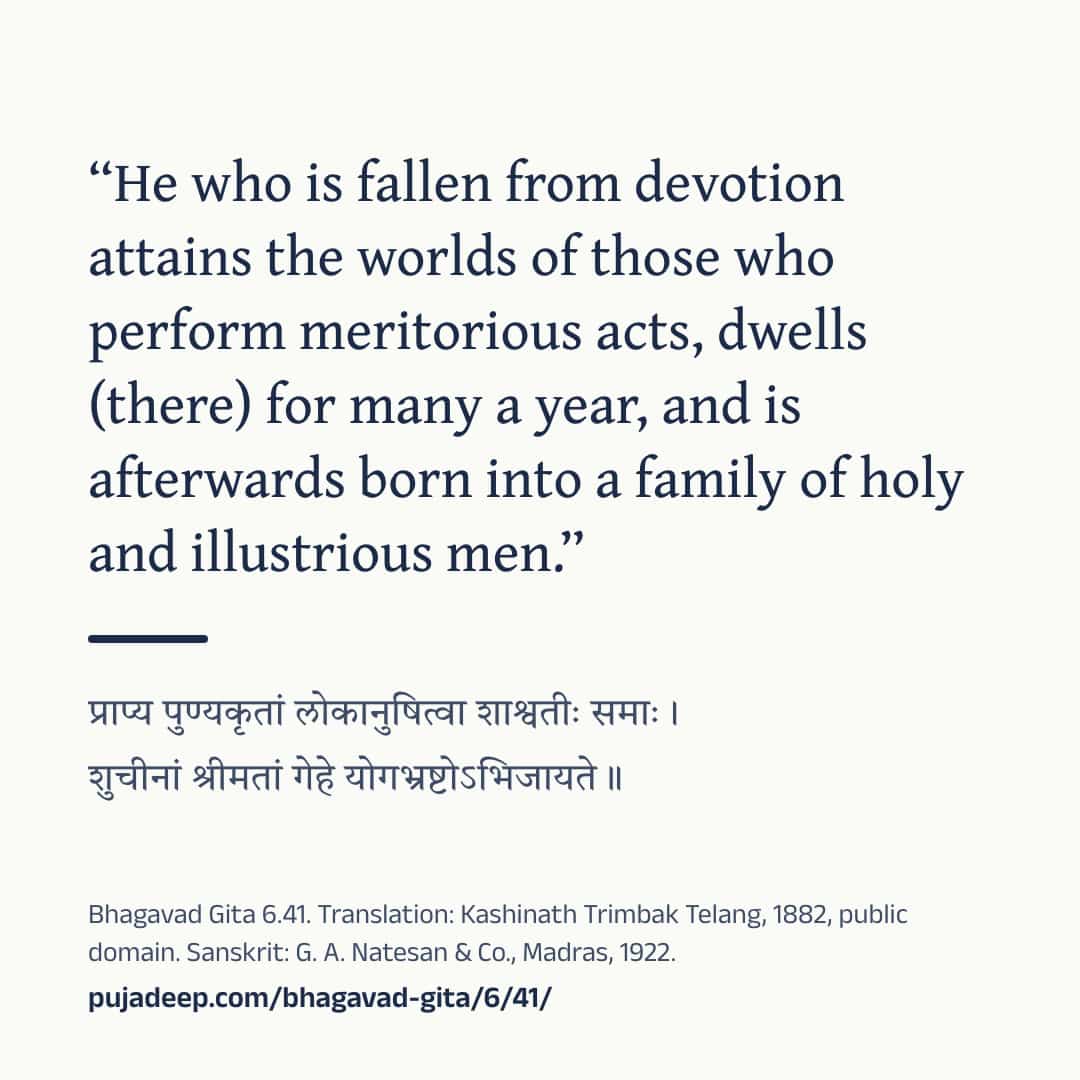
Drawing the picture
See the words
Bhagavad Gita 6.41

प्राप्य पुण्यकृतां लोकानुषित्वा शाश्वतीः समाः ।
शुचीनां श्रीमतां गेहे योगभ्रष्टोऽभिजायते ॥

“He who is fallen from devotion attains the worlds of those who perform meritorious acts, dwells (there) for many a year, and is afterwards born into a family of holy and illustrious men.”
(K. T. Telang, The Bhagavadgîtâ (The Sacred Books of the East, vol. VIII, Oxford: Clarendon Press, 1882), p. 72, public domain)

“Having attained to the worlds of the pure-doing, and having dwelt there for eternal years, he who fell from Yoga is reborn in a pure and blessed house;”
(Annie Besant, The Bhagavad Gîtâ, or The Lord's Song (London: Theosophical Publishing Society, 1895), p. 73, public domain)
This sentence goes on in 6.42.

“Having attained to the worlds of the righteous, and dwelling there for everlasting years, the fallen in Yoga, reincarnates in the home of the pure and the prosperous.”
(Swami Swarupananda, Srimad-Bhagavad-Gita (Mayavati: Prabuddha Bharata Press, 1909; first printed in Prabuddha Bharata, 1907–1909), p. 140, public domain)

Sanskrit: G. A. Natesan & Co., Madras, 1922.
https://pujadeep.com/bhagavad-gita/6/41/ Nothing is sent from this site. Your own app sends it, to the chat you choose. The picture quotes the translation you chose on this page, with its name and year.
Sanskrit text: The Bhagavad-Gita, or The Lord's Song, with the text in Devanagari and an English translation, 1922. Meanings: written for Pujadeep and checked against the cited edition. Source and changes
Questions families ask
Who speaks Bhagavad Gita 6.41?
Krishna speaks this verse, in chapter 6 (Dhyana Yoga).
Where does the Sanskrit text come from?
Sanskrit text: The Bhagavad-Gita, or The Lord's Song, with the text in Devanagari and an English translation, 1922. Meanings: written for Pujadeep and checked against the cited edition. See the source
Is the meaning on this page a translation?
Explanation written for this site from the sources listed here, and checked against the cited edition. It is not a translation and not the only way to read the text. Free to quote with credit.
Source and licence
- Sanskrit text
- The Bhagavad-Gita, or The Lord's Song, with the text in Devanagari and an English translation (Annie Besant, G. A. Natesan & Co., Madras, 1922). Public domain. The Sanskrit on these pages was read from this printing’s page images.
- Translation
- The Bhagavadgîtâ with the Sanatsugâtîya and the Anugîtâ, translated by Kâshinâth Trimbak Telang (The Sacred Books of the East, vol. VIII, ed. F. Max Müller) (Kashinath Trimbak Telang, F. Max Müller, Clarendon Press, Oxford, 1882). Public domain. Shown verbatim, as printed.
- Translation
- The Bhagavad Gîtâ, or The Lord's Song, translated by Annie Besant (Annie Besant, Theosophical Publishing Society, London, 1895). Public domain. Shown verbatim, as printed.
- Translation
- Srimad-Bhagavad-Gita, with Sanskrit Text; Paraphrase with Word-by-word Literal Translation; English Rendering and Comments, Index, &c., by the Swami Swarupananda (Himalayan Series, No. XX) (Swami Swarupananda, The Editors and Publishers, Advaita Ashrama, Mayavati, Prabuddha Bharata Press, Mayavati, Almora, Himalayas, 1909). Public domain. Shown verbatim, as printed.
- Commentary
- The Bhagavad-Gita, with the commentary of Sri Sankaracharya, translated by A. Mahadeva Sastri (2nd ed., Mysore: G. T. A. Printing Works, 1901) (Public-domain scan, University of California Libraries). Summarised in our own words; none of its text is reproduced.
- Commentary
- Sri Bhagavad-Gita with Sri Ramanujacharya's Visishtadvaita commentary, translated by A. Govindacharya (Madras, 1898) (Scan uploaded to archive.org (folkscanomy collection)). Summarised in our own words; none of its text is reproduced.
- Common wording
- In this text, 32 words follow today's common wording, checked against sanskritdocuments.org; Sanskrit Wikisource; Gita Press, Gorakhpur; GRETIL, Göttingen and Bhaktivedanta Book Trust.
- Our explanation
- Explanation written for this site from the sources listed here, and checked against the cited edition. It is not a translation and not the only way to read the text. Free to quote with credit.
- Checked
- Checked against the cited edition, October 15, 2026.
- Updated
- October 25, 2026