Bhagavad Gita 6.45: meaning and translation
Chapter 6: Dhyana Yoga. Krishna says
Krishna says that the yogī who strives hard, cleansed of faults and perfected over many births, then reaches the highest goal.
Click or tap a word for its meaning and its dictionary page.
Text and layers
Text and layers
These choices stay in this browser.
Bhagavad Gita 6.45
प्रयत्नाद्यतमानस्तु योगी संशुद्धकिल्बिषः ।अनेकजन्मसंसिद्धस्ततो याति परां गतिम् ॥
Prayatnadyatamanastu yogi sanshuddhakilbishahAnekajanmasansiddhastato yati param gatim
prayatnādyatamānastu yogī saṃśuddhakilbiṣaḥ |anekajanmasaṃsiddhastato yāti parāṃ gatim ||
Our explanation Krishna says that the yogī who strives hard, cleansed of faults and perfected over many births, then reaches the highest goal.
हिंदी अर्थ कृष्ण कहते हैं कि जो योगी पूरे प्रयत्न से साधना करता है, दोषों से शुद्ध होकर और अनेक जन्मों में सिद्ध होकर, वह फिर परम गति को पाता है।
Word by word
Every word, with its dictionary page
Word by word
- प्रयत्नात् prayatnāt · with effort (noun (masculine), ablative singular) Dictionary: pra-yatna, Monier-Williams 1899, p. 687, col. 3 “persevering effort, continued exertion or endeavour”
- यतमानः yatamānaḥ · striving (present participle (masculine), nominative singular) Dictionary: 2. yat, Monier-Williams 1899, p. 840, col. 3 “to exert one's self, take pains, endeavour, make effort”
- तु tu · but (indeclinable) Dictionary: 2. tu, Monier-Williams 1899, p. 449, col. 3 “but”
- योगी yogī · the yogī (noun (masculine), nominative singular) Dictionary: yogin, Monier-Williams 1899, p. 857, col. 3 “a follower of the Yoga system, a Yogin (usually called Yogī) or contemplative saint”
- संशुद्धकिल्बिषः saṃśuddhakilbiṣaḥ · cleansed of faults (compound (masculine), nominative singular) Dictionary: saṃ-śuddha-kilbiṣa, Monier-Williams 1899, p. 1117, col. 3 “one whose offences are expiated, purified from sin”
- अनेकजन्मसंसिद्धः anekajanmasaṃsiddhaḥ · perfected over many births (compound (masculine), nominative singular) Dictionary: an-eka, Monier-Williams 1899, p. 42, col. 2 “not one, many, much”; janman, Monier-Williams 1899, p. 411, col. 3 “birth, production”; saṃ-siddha, Monier-Williams 1899, p. 1119, col. 2 “fully or thoroughly performed or accomplished”
- ततः tataḥ · then (indeclinable) Dictionary: tatas, Monier-Williams 1899, p. 432, col. 2 “thereupon, then, after that”
- याति yāti · reaches (present, 3rd person singular) Dictionary: 1. yā, Monier-Williams 1899, p. 849, col. 1 “to go, proceed, move, walk, set out”
- पराम् parām · highest (adjective (feminine), accusative singular) Dictionary: 1. para, Monier-Williams 1899, p. 586, col. 1 “better or worse than, superior or inferior to, best or worst, highest, supreme, chief”
- गतिम् gatim · goal (noun (feminine), accusative singular) Dictionary: gati, Monier-Williams 1899, p. 347, col. 3 “path, way, course”
Old translations
Kashinath Trimbak Telang, 1882. Public domain. Page 73.
But the devotee working with great efforts1, and cleared of his sins, attains perfection after many births, and then reaches the supreme goal.
Footnotes (the translator’s own) - As distinguished from the others who work half-heartedly, so to say. See p. 72. ↩
Compare 3 translations
Kashinath Trimbak Telang, 1882. Public domain. Page 73.
But the devotee working with great efforts1, and cleared of his sins, attains perfection after many births, and then reaches the supreme goal.
Footnotes (the translator’s own) - As distinguished from the others who work half-heartedly, so to say. See p. 72. ↩
You are reading this one
Annie Besant, 1895. Public domain. Page 73.
But the Yogî, verily, labouring with assiduity, purified from sin, fully perfected through manifold births, he treadeth the supreme Path.
This sentence begins in 6.44.
You are reading this one
Swami Swarupananda, 1909 (first printed 1907). Public domain. Page 142.
The Yogi striving assiduously, purified of taint, gradually gaining perfection through many births, then reaches the highest goal.
You are reading this one
Cite this verse
The translation: K. T. Telang, The Bhagavadgîtâ (The Sacred Books of the East, vol. VIII, Oxford: Clarendon Press, 1882), p. 73. Bhagavad Gita 6.45.
The translation: Annie Besant, The Bhagavad Gîtâ, or The Lord's Song (London: Theosophical Publishing Society, 1895), p. 73. Bhagavad Gita 6.45.
The translation: Swami Swarupananda, Srimad-Bhagavad-Gita (Mayavati: Prabuddha Bharata Press, 1909; first printed in Prabuddha Bharata, 1907–1909), p. 142. Bhagavad Gita 6.45.
Our explanation: “Bhagavad Gita 6.45: meaning and translation.” Pujadeep. Updated October 25, 2026. https://pujadeep.com/bhagavad-gita/6/45/
Pujadeep’s explanations are free to quote with credit: name Pujadeep and link to the page. How to credit
Classical readings, by school
No readings by school on this verse yet.
Share
Show the ways to share
Send one picture or the text to one chat. The picture names its source and the address of this page.
Drawing the picture
See the words
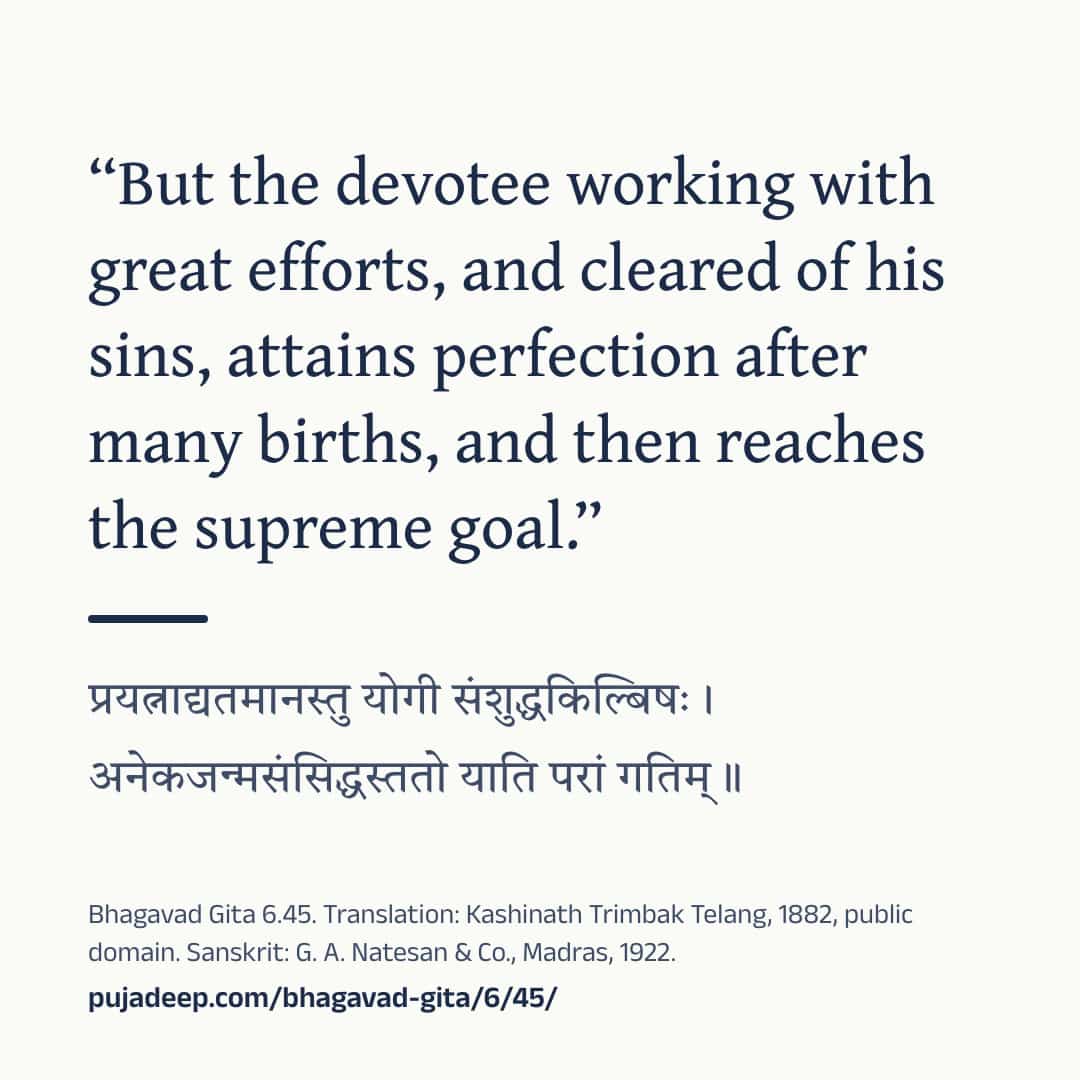
Bhagavad Gita 6.45

प्रयत्नाद्यतमानस्तु योगी संशुद्धकिल्बिषः ।
अनेकजन्मसंसिद्धस्ततो याति परां गतिम् ॥

“But the devotee working with great efforts, and cleared of his sins, attains perfection after many births, and then reaches the supreme goal.”
(K. T. Telang, The Bhagavadgîtâ (The Sacred Books of the East, vol. VIII, Oxford: Clarendon Press, 1882), p. 73, public domain)

“But the Yogî, verily, labouring with assiduity, purified from sin, fully perfected through manifold births, he treadeth the supreme Path.”
(Annie Besant, The Bhagavad Gîtâ, or The Lord's Song (London: Theosophical Publishing Society, 1895), p. 73, public domain)
This sentence begins in 6.44.

“The Yogi striving assiduously, purified of taint, gradually gaining perfection through many births, then reaches the highest goal.”
(Swami Swarupananda, Srimad-Bhagavad-Gita (Mayavati: Prabuddha Bharata Press, 1909; first printed in Prabuddha Bharata, 1907–1909), p. 142, public domain)

Sanskrit: G. A. Natesan & Co., Madras, 1922.
https://pujadeep.com/bhagavad-gita/6/45/ Nothing is sent from this site. Your own app sends it, to the chat you choose. The picture quotes the translation you chose on this page, with its name and year.
Sanskrit text: The Bhagavad-Gita, or The Lord's Song, with the text in Devanagari and an English translation, 1922. Meanings: written for Pujadeep and checked against the cited edition. Source and changes
Questions families ask
Who speaks Bhagavad Gita 6.45?
Krishna speaks this verse, in chapter 6 (Dhyana Yoga).
Where does the Sanskrit text come from?
Sanskrit text: The Bhagavad-Gita, or The Lord's Song, with the text in Devanagari and an English translation, 1922. Meanings: written for Pujadeep and checked against the cited edition. See the source
Is the meaning on this page a translation?
Explanation written for this site from the sources listed here, and checked against the cited edition. It is not a translation and not the only way to read the text. Free to quote with credit.
Source and licence
- Sanskrit text
- The Bhagavad-Gita, or The Lord's Song, with the text in Devanagari and an English translation (Annie Besant, G. A. Natesan & Co., Madras, 1922). Public domain. The Sanskrit on these pages was read from this printing’s page images.
- Translation
- The Bhagavadgîtâ with the Sanatsugâtîya and the Anugîtâ, translated by Kâshinâth Trimbak Telang (The Sacred Books of the East, vol. VIII, ed. F. Max Müller) (Kashinath Trimbak Telang, F. Max Müller, Clarendon Press, Oxford, 1882). Public domain. Shown verbatim, as printed.
- Translation
- The Bhagavad Gîtâ, or The Lord's Song, translated by Annie Besant (Annie Besant, Theosophical Publishing Society, London, 1895). Public domain. Shown verbatim, as printed.
- Translation
- Srimad-Bhagavad-Gita, with Sanskrit Text; Paraphrase with Word-by-word Literal Translation; English Rendering and Comments, Index, &c., by the Swami Swarupananda (Himalayan Series, No. XX) (Swami Swarupananda, The Editors and Publishers, Advaita Ashrama, Mayavati, Prabuddha Bharata Press, Mayavati, Almora, Himalayas, 1909). Public domain. Shown verbatim, as printed.
- Common wording
- In this text, 32 words follow today's common wording, checked against sanskritdocuments.org; Sanskrit Wikisource; Gita Press, Gorakhpur; GRETIL, Göttingen and Bhaktivedanta Book Trust.
- Our explanation
- Explanation written for this site from the sources listed here, and checked against the cited edition. It is not a translation and not the only way to read the text. Free to quote with credit.
- Checked
- Checked against the cited edition, October 15, 2026.
- Updated
- October 25, 2026