Bhagavad Gita 6.42: meaning and translation
Chapter 6: Dhyana Yoga. Krishna says
Or, Krishna says, he is born into a family of wise yogīs; such a birth is very hard to gain in this world.
Click or tap a word for its meaning and its dictionary page.
Text and layers
Text and layers
These choices stay in this browser.
Bhagavad Gita 6.42
अथवा योगिनामेव कुले भवति धीमताम् ।एतद्धि दुर्लभतरं लोके जन्म यदीदृशम् ॥
Athava yoginameva kule bhavati dhimatamEtaddhi durlabhataram loke janma yadidrisham
athavā yogināmeva kule bhavati dhīmatām |etaddhi durlabhataraṃ loke janma yadīdṛśam ||
Our explanation Or, Krishna says, he is born into a family of wise yogīs; such a birth is very hard to gain in this world.
हिंदी अर्थ कृष्ण कहते हैं कि या फिर वह बुद्धिमान योगियों के कुल में जन्म लेता है; ऐसा जन्म इस संसार में बहुत दुर्लभ है।
Word by word
Every word, with its dictionary page
Word by word
- अथवा athavā · or (indeclinable) Dictionary: atha-vā, Monier-Williams 1899, p. 17, col. 3 “or; (when repeated) either or; or rather”
- योगिनाम् yoginām · of yogīs (noun (masculine), genitive plural) Dictionary: yogin, Monier-Williams 1899, p. 857, col. 3 “a follower of the Yoga system, a Yogin (usually called Yogī) or contemplative saint”
- एव eva · indeed (indeclinable) Dictionary: 1. eva, Monier-Williams 1899, p. 232, col. 2 “just, exactly, very, same, only, even, alone, merely”
- कुले kule · in the family (noun (neuter), locative singular) Dictionary: kula, Monier-Williams 1899, p. 294, col. 2 “a race, family, community”
- भवति bhavati · is born (present, 3rd person singular) Dictionary: 1. bhū, Monier-Williams 1899, p. 760, col. 2 “arise, come into being, exist”
- धीमताम् dhīmatām · of the wise (adjective (masculine), genitive plural) Dictionary: dhī-mat, Monier-Williams 1899, p. 516, col. 3 “intelligent, wise, learned, sensible”
- एतत् etat · this (pronoun (neuter), nominative singular) Dictionary: etad, Monier-Williams 1899, p. 231, col. 2 “this, this here, here”
- हि hi · for (indeclinable) Dictionary: 2. hi, Monier-Williams 1899, p. 1297, col. 3 “for, because, on account of”
- दुर्लभतरम् durlabhataram · harder to gain (adjective (neuter), nominative singular) Dictionary: dur-labha, Monier-Williams 1899, p. 486, col. 3 “d° to be obtained or found, hard, scarce, rare”; 1. tara, Monier-Williams 1899, p. 438, col. 3 “an affix forming the compar. degree of adjectives”
- लोके loke · in the world (noun (masculine), locative singular) Dictionary: loka, Monier-Williams 1899, p. 906, col. 1 “the wide space or world”
- जन्म janma · birth (noun (neuter), nominative singular) Dictionary: janman, Monier-Williams 1899, p. 411, col. 3 “birth, production”
- यत् yat · which (pronoun (neuter), nominative singular) Dictionary: yad, Monier-Williams 1899, p. 844, col. 2 “who, which, what, whichever, whatever, that”
- ईदृशम् īdṛśam · such (adjective (neuter), nominative singular) Dictionary: īdṛśa, Monier-Williams 1899, p. 170, col. 2 “endowed with such qualities, such”
Old translations
Kashinath Trimbak Telang, 1882. Public domain. Page 72.
Or he is even born into a family of talented devotees; for such a birth as that in this world is more difficult to obtain.
Compare 3 translations
Kashinath Trimbak Telang, 1882. Public domain. Page 72.
Or he is even born into a family of talented devotees; for such a birth as that in this world is more difficult to obtain.
You are reading this one
Annie Besant, 1895. Public domain. Page 73.
Or else he is born into a family of intelligent Yogîs; but such a birth as that is hard to obtain in this world.
This sentence begins in 6.41.
You are reading this one
Swami Swarupananda, 1909 (first printed 1907). Public domain. Page 140.
Or else he is born into a family of wise Yogis only; verily, a birth such as that, is very rare to obtain in this world.
You are reading this one
Cite this verse
The translation: K. T. Telang, The Bhagavadgîtâ (The Sacred Books of the East, vol. VIII, Oxford: Clarendon Press, 1882), p. 72. Bhagavad Gita 6.42.
The translation: Annie Besant, The Bhagavad Gîtâ, or The Lord's Song (London: Theosophical Publishing Society, 1895), p. 73. Bhagavad Gita 6.42.
The translation: Swami Swarupananda, Srimad-Bhagavad-Gita (Mayavati: Prabuddha Bharata Press, 1909; first printed in Prabuddha Bharata, 1907–1909), p. 140. Bhagavad Gita 6.42.
Our explanation: “Bhagavad Gita 6.42: meaning and translation.” Pujadeep. Updated October 25, 2026. https://pujadeep.com/bhagavad-gita/6/42/
Pujadeep’s explanations are free to quote with credit: name Pujadeep and link to the page. How to credit
Classical readings, by school
No readings by school on this verse yet.
Share
Show the ways to share
Send one picture or the text to one chat. The picture names its source and the address of this page.
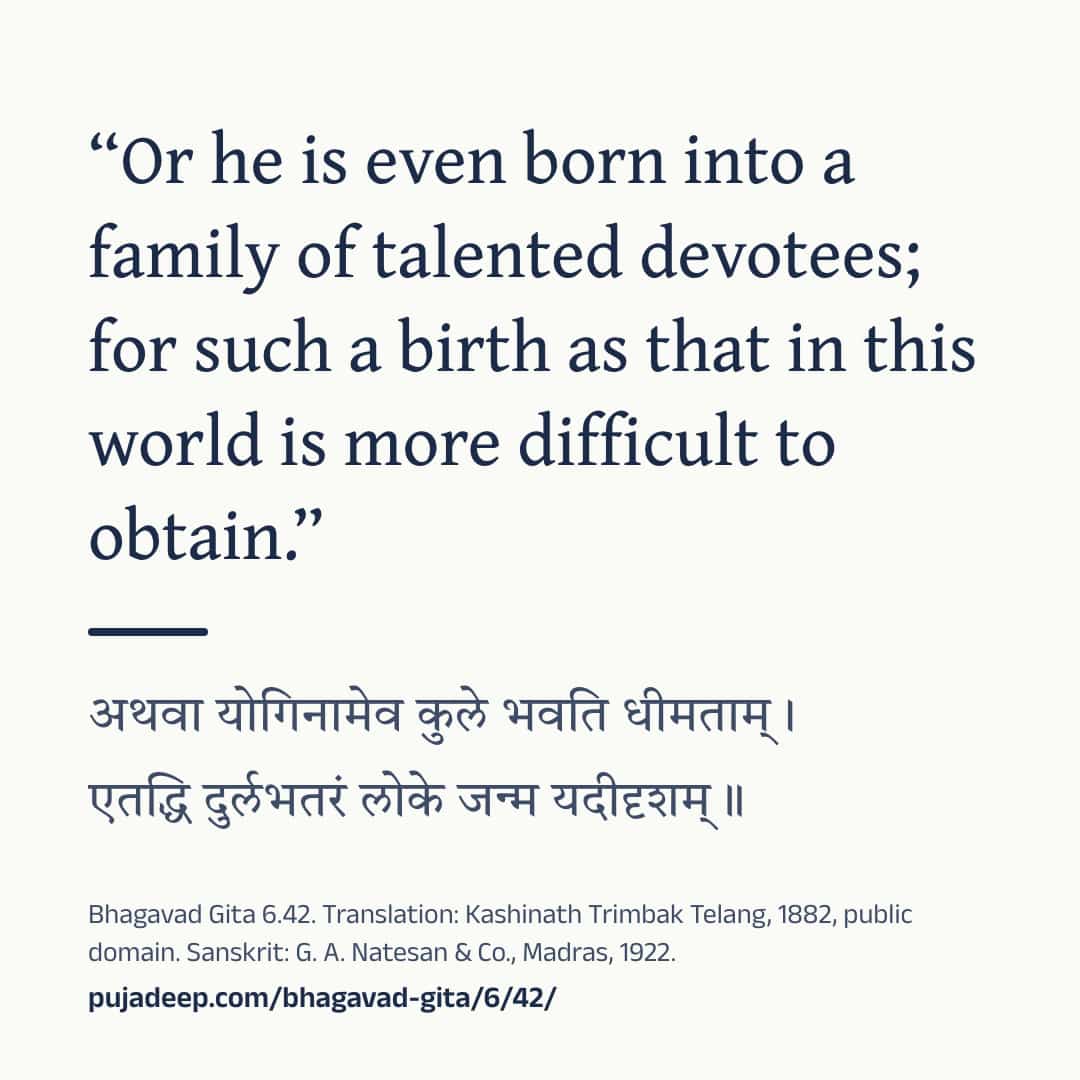
Drawing the picture
See the words
Bhagavad Gita 6.42

अथवा योगिनामेव कुले भवति धीमताम् ।
एतद्धि दुर्लभतरं लोके जन्म यदीदृशम् ॥

“Or he is even born into a family of talented devotees; for such a birth as that in this world is more difficult to obtain.”
(K. T. Telang, The Bhagavadgîtâ (The Sacred Books of the East, vol. VIII, Oxford: Clarendon Press, 1882), p. 72, public domain)

“Or else he is born into a family of intelligent Yogîs; but such a birth as that is hard to obtain in this world.”
(Annie Besant, The Bhagavad Gîtâ, or The Lord's Song (London: Theosophical Publishing Society, 1895), p. 73, public domain)
This sentence begins in 6.41.

“Or else he is born into a family of wise Yogis only; verily, a birth such as that, is very rare to obtain in this world.”
(Swami Swarupananda, Srimad-Bhagavad-Gita (Mayavati: Prabuddha Bharata Press, 1909; first printed in Prabuddha Bharata, 1907–1909), p. 140, public domain)

Sanskrit: G. A. Natesan & Co., Madras, 1922.
https://pujadeep.com/bhagavad-gita/6/42/ Nothing is sent from this site. Your own app sends it, to the chat you choose. The picture quotes the translation you chose on this page, with its name and year.
Sanskrit text: The Bhagavad-Gita, or The Lord's Song, with the text in Devanagari and an English translation, 1922. Meanings: written for Pujadeep and checked against the cited edition. Source and changes
Questions families ask
Who speaks Bhagavad Gita 6.42?
Krishna speaks this verse, in chapter 6 (Dhyana Yoga).
Where does the Sanskrit text come from?
Sanskrit text: The Bhagavad-Gita, or The Lord's Song, with the text in Devanagari and an English translation, 1922. Meanings: written for Pujadeep and checked against the cited edition. See the source
Is the meaning on this page a translation?
Explanation written for this site from the sources listed here, and checked against the cited edition. It is not a translation and not the only way to read the text. Free to quote with credit.
Source and licence
- Sanskrit text
- The Bhagavad-Gita, or The Lord's Song, with the text in Devanagari and an English translation (Annie Besant, G. A. Natesan & Co., Madras, 1922). Public domain. The Sanskrit on these pages was read from this printing’s page images.
- Translation
- The Bhagavadgîtâ with the Sanatsugâtîya and the Anugîtâ, translated by Kâshinâth Trimbak Telang (The Sacred Books of the East, vol. VIII, ed. F. Max Müller) (Kashinath Trimbak Telang, F. Max Müller, Clarendon Press, Oxford, 1882). Public domain. Shown verbatim, as printed.
- Translation
- The Bhagavad Gîtâ, or The Lord's Song, translated by Annie Besant (Annie Besant, Theosophical Publishing Society, London, 1895). Public domain. Shown verbatim, as printed.
- Translation
- Srimad-Bhagavad-Gita, with Sanskrit Text; Paraphrase with Word-by-word Literal Translation; English Rendering and Comments, Index, &c., by the Swami Swarupananda (Himalayan Series, No. XX) (Swami Swarupananda, The Editors and Publishers, Advaita Ashrama, Mayavati, Prabuddha Bharata Press, Mayavati, Almora, Himalayas, 1909). Public domain. Shown verbatim, as printed.
- Common wording
- In this text, 32 words follow today's common wording, checked against sanskritdocuments.org; Sanskrit Wikisource; Gita Press, Gorakhpur; GRETIL, Göttingen and Bhaktivedanta Book Trust.
- Our explanation
- Explanation written for this site from the sources listed here, and checked against the cited edition. It is not a translation and not the only way to read the text. Free to quote with credit.
- Checked
- Checked against the cited edition, October 15, 2026.
- Updated
- October 25, 2026