Bhagavad Gita 6.35: meaning and translation
Chapter 6: Dhyana Yoga. Krishna says
Krishna answers that the mind is, without doubt, restless and hard to hold back, but it can be held by practice (abhyāsa) and by detachment (vairāgya).
Click or tap a word for its meaning and its dictionary page.
Text and layers
Text and layers
These choices stay in this browser.
Bhagavad Gita 6.35
श्रीभगवानुवाच ।
असंशयं महाबाहो मनो दुर्निग्रहं चलम् ।अभ्यासेन तु कौन्तेय वैराग्येण च गृह्यते ॥
Asanshayam mahabaho mano durnigraham chalamAbhyasena tu kaunteya vairagyena cha grihyate
asaṃśayaṃ mahābāho mano durnigrahaṃ calam |abhyāsena tu kaunteya vairāgyeṇa ca gṛhyate ||
Our explanation Krishna answers that the mind is, without doubt, restless and hard to hold back, but it can be held by practice (abhyāsa) and by detachment (vairāgya). He calls Arjuna mighty-armed and son of Kunti.
हिंदी अर्थ कृष्ण उत्तर देते हैं कि निःसंदेह मन चंचल है और उसे वश में करना कठिन है, पर अभ्यास और वैराग्य से उसे वश में किया जा सकता है। वे अर्जुन को महाबाहो और कौन्तेय कहकर पुकारते हैं।
Word by word
Every word, with its dictionary page
Word by word
- असंशयम् asaṃśayam · without doubt (indeclinable) Dictionary: a-saṃśaya, Monier-Williams 1899, p. 117, col. 3 “without doubt”
- महाबाहो mahābāho · O mighty-armed (noun (masculine), vocative singular) Dictionary: mahā-bāhu, Monier-Williams 1899, p. 798, col. 1 “long-armed”
- मनः manaḥ · the mind (noun (neuter), nominative singular) Dictionary: manas, Monier-Williams 1899, p. 783, col. 3 “mind (in its widest sense as applied to all the mental powers)”
- दुर्निग्रहम् durnigraham · hard to hold back (adjective (neuter), nominative singular) Dictionary: dur-nigraha, Monier-Williams 1899, p. 486, col. 1 “difficult to be restrained or conquered”
- चलम् calam · restless (adjective (neuter), nominative singular) Dictionary: cala, Monier-Williams 1899, p. 391, col. 1 “moving, trembling, shaking, loose”
- अभ्यासेन abhyāsena · by practice (noun (masculine), instrumental singular) Dictionary: abhy-āsa, Monier-Williams 1899, p. 77, col. 1 “(in Yoga phil.) the effort of the mind to remain in its unmodified condition of purity”
- तु tu · but (indeclinable) Dictionary: 2. tu, Monier-Williams 1899, p. 449, col. 3 “but”
- कौन्तेय kaunteya · O son of Kunti (noun (masculine), vocative singular) Dictionary: kaunteya, Monier-Williams 1899, p. 316, col. 2 “metron. fr. Kuntī”
- वैराग्येण vairāgyeṇa · by detachment (noun (neuter), instrumental singular) Dictionary: vairāgya, Monier-Williams 1899, p. 1025, col. 2 “freedom from all worldly desires, indifference to worldly objects and to life”
- च ca · and (indeclinable) Dictionary: 2. ca, Monier-Williams 1899, p. 380, col. 1 “ind. and, both, also, moreover, as well as”
- गृह्यते gṛhyate · is held (present passive, 3rd person singular) Dictionary: grah, Monier-Williams 1899, p. 371, col. 3 “to seize, take”
Old translations
Kashinath Trimbak Telang, 1882. Public domain. Page 71.
The Deity said:
Doubtless, O you of mighty arms! the mind is difficult to restrain, and fickle1. Still, O son of Kuntî! it may be restrained by constant practice and by indifference (to worldly objects).
Footnotes (the translator’s own) - Cf. Dhammapada, stanza 33 seq. ↩
Compare 3 translations
Kashinath Trimbak Telang, 1882. Public domain. Page 71.
The Deity said:
Doubtless, O you of mighty arms! the mind is difficult to restrain, and fickle1. Still, O son of Kuntî! it may be restrained by constant practice and by indifference (to worldly objects).
Footnotes (the translator’s own) - Cf. Dhammapada, stanza 33 seq. ↩
You are reading this one
Annie Besant, 1895. Public domain. Page 71.
The Blessed Lord said:
Without doubt, O mighty-armed, Manas is hard to curb and restless; but it may be curbed by constant practice and by indifference.
You are reading this one
Swami Swarupananda, 1909 (first printed 1907). Public domain. Page 137.
The Blessed Lord said:
Without doubt, O mighty-armed, the mind is restless, and difficult to control; but through practice and renunciation, O son of Kunti, it may be governed.
You are reading this one
Cite this verse
The translation: K. T. Telang, The Bhagavadgîtâ (The Sacred Books of the East, vol. VIII, Oxford: Clarendon Press, 1882), p. 71. Bhagavad Gita 6.35.
The translation: Annie Besant, The Bhagavad Gîtâ, or The Lord's Song (London: Theosophical Publishing Society, 1895), p. 71. Bhagavad Gita 6.35.
The translation: Swami Swarupananda, Srimad-Bhagavad-Gita (Mayavati: Prabuddha Bharata Press, 1909; first printed in Prabuddha Bharata, 1907–1909), p. 137. Bhagavad Gita 6.35.
Our explanation: “Bhagavad Gita 6.35: meaning and translation.” Pujadeep. Updated October 25, 2026. https://pujadeep.com/bhagavad-gita/6/35/
Pujadeep’s explanations are free to quote with credit: name Pujadeep and link to the page. How to credit
Classical readings, by school
Each reading is named by its school. None is presented as the only meaning.
What Advaita, Vishishtadvaita and Dvaita teach, in short
Shankara Advaita
Shankara explains practice as returning again and again to the same thought about one object of meditation, and detachment as freedom from desire for any pleasure, gained by seeing the faults in such pleasures.
Source: The Bhagavad-Gita, with the commentary of Sri Sankaracharya, translated by A. Mahadeva Sastri (2nd ed., Mysore: G. T. A. Printing Works, 1901), commentary on 6.35, p. 183. Summarised in our own words; none of its text is reproduced.
Ramanuja Vishishtadvaita
Ramanuja says Arjuna's difficulty is not with the mind in general but with holding it on the self, something people have no experience of. Krishna's answer is that steady effort and dispassion make even this possible.
Source: Sri Bhagavad-Gita with Sri Ramanujacharya's Visishtadvaita commentary, translated by A. Govindacharya (Madras, 1898), commentary on 6.33–35, pp. 211–213. Summarised in our own words; none of its text is reproduced.
This verse is on our page of well-known Gita verses, by theme
Share
Show the ways to share
Send one picture or the text to one chat. The picture names its source and the address of this page.
Drawing the picture
See the words
Bhagavad Gita 6.35

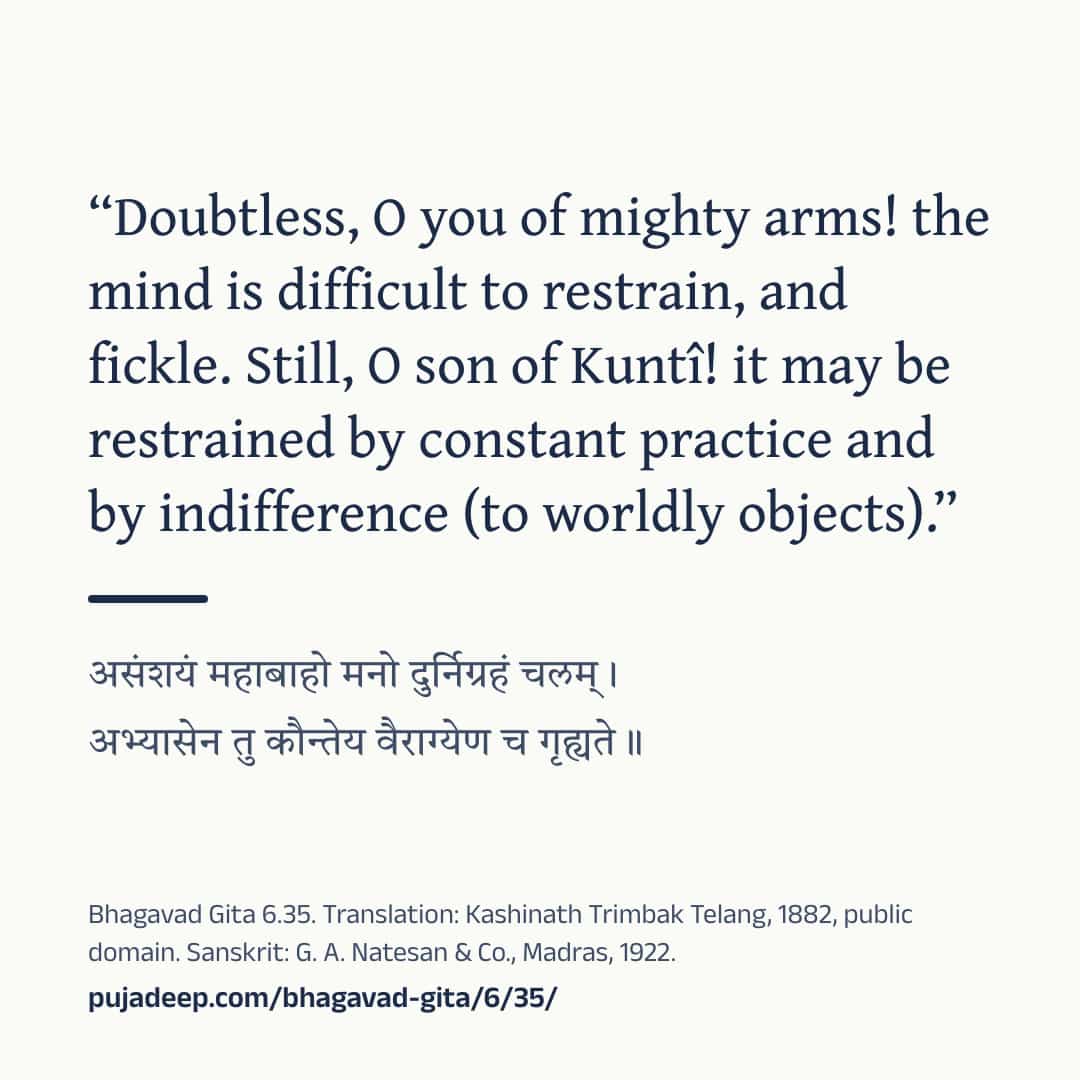
असंशयं महाबाहो मनो दुर्निग्रहं चलम् ।
अभ्यासेन तु कौन्तेय वैराग्येण च गृह्यते ॥

“Doubtless, O you of mighty arms! the mind is difficult to restrain, and fickle. Still, O son of Kuntî! it may be restrained by constant practice and by indifference (to worldly objects).”
(K. T. Telang, The Bhagavadgîtâ (The Sacred Books of the East, vol. VIII, Oxford: Clarendon Press, 1882), p. 71, public domain)

“Without doubt, O mighty-armed, Manas is hard to curb and restless; but it may be curbed by constant practice and by indifference.”
(Annie Besant, The Bhagavad Gîtâ, or The Lord's Song (London: Theosophical Publishing Society, 1895), p. 71, public domain)

“Without doubt, O mighty-armed, the mind is restless, and difficult to control; but through practice and renunciation, O son of Kunti, it may be governed.”
(Swami Swarupananda, Srimad-Bhagavad-Gita (Mayavati: Prabuddha Bharata Press, 1909; first printed in Prabuddha Bharata, 1907–1909), p. 137, public domain)

Sanskrit: G. A. Natesan & Co., Madras, 1922.
https://pujadeep.com/bhagavad-gita/6/35/ Nothing is sent from this site. Your own app sends it, to the chat you choose. The picture quotes the translation you chose on this page, with its name and year.
Sanskrit text: The Bhagavad-Gita, or The Lord's Song, with the text in Devanagari and an English translation, 1922. Meanings: written for Pujadeep and checked against the cited edition. Source and changes
Questions families ask
Who speaks Bhagavad Gita 6.35?
Krishna speaks this verse, in chapter 6 (Dhyana Yoga).
Where does the Sanskrit text come from?
Sanskrit text: The Bhagavad-Gita, or The Lord's Song, with the text in Devanagari and an English translation, 1922. Meanings: written for Pujadeep and checked against the cited edition. See the source
Is the meaning on this page a translation?
Explanation written for this site from the sources listed here, and checked against the cited edition. It is not a translation and not the only way to read the text. Free to quote with credit.
Source and licence
- Sanskrit text
- The Bhagavad-Gita, or The Lord's Song, with the text in Devanagari and an English translation (Annie Besant, G. A. Natesan & Co., Madras, 1922). Public domain. The Sanskrit on these pages was read from this printing’s page images.
- Translation
- The Bhagavadgîtâ with the Sanatsugâtîya and the Anugîtâ, translated by Kâshinâth Trimbak Telang (The Sacred Books of the East, vol. VIII, ed. F. Max Müller) (Kashinath Trimbak Telang, F. Max Müller, Clarendon Press, Oxford, 1882). Public domain. Shown verbatim, as printed.
- Translation
- The Bhagavad Gîtâ, or The Lord's Song, translated by Annie Besant (Annie Besant, Theosophical Publishing Society, London, 1895). Public domain. Shown verbatim, as printed.
- Translation
- Srimad-Bhagavad-Gita, with Sanskrit Text; Paraphrase with Word-by-word Literal Translation; English Rendering and Comments, Index, &c., by the Swami Swarupananda (Himalayan Series, No. XX) (Swami Swarupananda, The Editors and Publishers, Advaita Ashrama, Mayavati, Prabuddha Bharata Press, Mayavati, Almora, Himalayas, 1909). Public domain. Shown verbatim, as printed.
- Commentary
- The Bhagavad-Gita, with the commentary of Sri Sankaracharya, translated by A. Mahadeva Sastri (2nd ed., Mysore: G. T. A. Printing Works, 1901) (Public-domain scan, University of California Libraries). Summarised in our own words; none of its text is reproduced.
- Commentary
- Sri Bhagavad-Gita with Sri Ramanujacharya's Visishtadvaita commentary, translated by A. Govindacharya (Madras, 1898) (Scan uploaded to archive.org (folkscanomy collection)). Summarised in our own words; none of its text is reproduced.
- Common wording
- In this text, 32 words follow today's common wording, checked against sanskritdocuments.org; Sanskrit Wikisource; Gita Press, Gorakhpur; GRETIL, Göttingen and Bhaktivedanta Book Trust.
- Our explanation
- Explanation written for this site from the sources listed here, and checked against the cited edition. It is not a translation and not the only way to read the text. Free to quote with credit.
- Checked
- Checked against the cited edition, October 15, 2026.
- Updated
- October 25, 2026