Bhagavad Gita 6.25: meaning and translation
Chapter 6: Dhyana Yoga. Krishna says
Krishna: Little by little he should become still, with the understanding held firm, and making the mind rest in the self, he should think of nothing else.
Click or tap a word for its meaning and its dictionary page.
Text and layers
Text and layers
These choices stay in this browser.
Bhagavad Gita 6.25
शनैःशनैरुपरमेद् बुद्ध्या धृतिगृहीतया ।आत्मसंस्थं मनः कृत्वा न किञ्चिदपि चिन्तयेत् ॥
Shanaihshanairuparamed buddhya dhritigrihitayaAtmasanstham manah kritva na kinchidapi chintayet
śanaiḥśanairuparamed buddhyā dhṛtigṛhītayā |ātmasaṃsthaṃ manaḥ kṛtvā na kiñcidapi cintayet ||
Our explanation Little by little he should become still, with the understanding held firm, and making the mind rest in the self, he should think of nothing else.
हिंदी अर्थ धीरे-धीरे, धैर्य से थामी हुई बुद्धि के साथ, वह शांत हो; और मन को आत्मा में स्थित करके कुछ और न सोचे।
Word by word
Every word, with its dictionary page
Word by word
- शनैःशनैः śanaiḥśanaiḥ · little by little (indeclinable) Dictionary: śanais, Monier-Williams 1899, p. 1051, col. 3 “quietly, softly, gently, gradually”
- उपरमेत् uparamet · should become still (optative, 3rd person singular) Dictionary: upa-ram, Monier-Williams 1899, p. 204, col. 3 “to cease from action, be inactive or quiet (as a quietist)”
- बुद्ध्या buddhyā · with the understanding (noun (feminine), instrumental singular) Dictionary: buddhi, Monier-Williams 1899, p. 733, col. 3 “intelligence, reason, intellect, mind, discernment, judgment”
- धृतिगृहीतया dhṛtigṛhītayā · held by firmness (compound (feminine), instrumental singular) Dictionary: dhṛti, Monier-Williams 1899, p. 519, col. 3 “firmness, constancy, resolution”; gṛhīta, Monier-Williams 1899, p. 362, col. 3 “grasped, taken, seized, caught, held, laid hold of”
- आत्मसंस्थम् ātmasaṃstham · resting in the self (compound (neuter), accusative singular) Dictionary: ātma-saṃstha, Monier-Williams 1899, p. 135, col. 3 “based on or connected with the person”
- मनः manaḥ · the mind (noun (neuter), accusative singular) Dictionary: manas, Monier-Williams 1899, p. 783, col. 3 “mind (in its widest sense as applied to all the mental powers)”
- कृत्वा kṛtvā · making (absolutive (having done)) Dictionary: 1. kṛ, Monier-Williams 1899, p. 301, col. 1 “to do, make, perform, accomplish, cause, effect”
- न na · not (indeclinable) Dictionary: 2. na, Monier-Williams 1899, p. 523, col. 1 “ind. not, no, nor, neither”
- किञ्चित् kiñcit · anything (pronoun (neuter), accusative singular) Dictionary: kiṃ-cid, Monier-Williams 1899, p. 283, col. 1 “something”
- अपि api · at all (indeclinable) Dictionary: api, Monier-Williams 1899, p. 55, col. 1 “in the sense of even, also, very”
- चिन्तयेत् cintayet · should think (optative, 3rd person singular) Dictionary: cint, Monier-Williams 1899, p. 398, col. 1 “to think, have a thought or idea, reflect, consider”
1 printing differs
Edition differences. Another printing or text reads this place differently.
- Spelling A digital text reads Same letters. The 1922 edition prints शनैःशनैः as one word; this e-text prints two.
Old translations
Kashinath Trimbak Telang, 1882. Public domain.
Telang translates verses 24–25 as one sentence; see 6.24. Read it at 6.24
Compare 3 translations
Kashinath Trimbak Telang, 1882. Public domain.
Telang translates verses 24–25 as one sentence; see 6.24. Read it at 6.24
You are reading this one
Annie Besant, 1895. Public domain. Page 69–70.
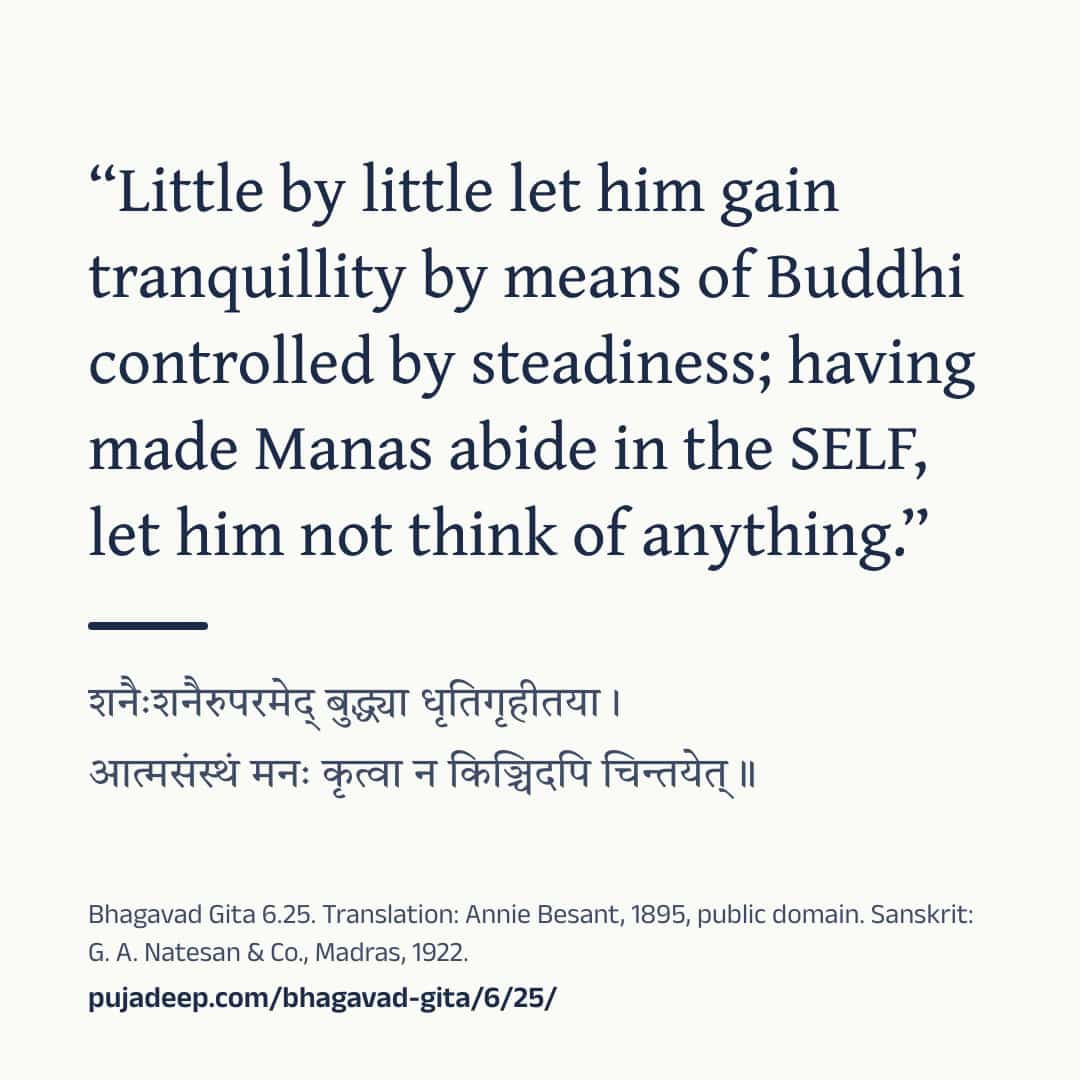
Little by little let him gain tranquillity by means of Buddhi controlled by steadiness; having made Manas abide in the SELF, let him not think of anything.
This sentence begins in 6.24.
You are reading this one
Swami Swarupananda, 1909 (first printed 1907). Public domain. Page 133.
With the intellect set in patience, with the mind fastened on the Self, let him attain quietude by degrees: let him not think of anything.
This sentence begins in 6.24.
You are reading this one
Cite this verse
The translation: K. T. Telang, The Bhagavadgîtâ (The Sacred Books of the East, vol. VIII, Oxford: Clarendon Press, 1882), p. 70. Bhagavad Gita 6.24–25.
The translation: Annie Besant, The Bhagavad Gîtâ, or The Lord's Song (London: Theosophical Publishing Society, 1895), pp. 69–70. Bhagavad Gita 6.25.
The translation: Swami Swarupananda, Srimad-Bhagavad-Gita (Mayavati: Prabuddha Bharata Press, 1909; first printed in Prabuddha Bharata, 1907–1909), p. 133. Bhagavad Gita 6.25.
Our explanation: “Bhagavad Gita 6.25: meaning and translation.” Pujadeep. Updated October 25, 2026. https://pujadeep.com/bhagavad-gita/6/25/
Pujadeep’s explanations are free to quote with credit: name Pujadeep and link to the page. How to credit
Classical readings, by school
No readings by school on this verse yet.
Share
Show the ways to share
Send one picture or the text to one chat. The picture names its source and the address of this page.
Drawing the picture
See the words
Bhagavad Gita 6.25

शनैःशनैरुपरमेद् बुद्ध्या धृतिगृहीतया ।
आत्मसंस्थं मनः कृत्वा न किञ्चिदपि चिन्तयेत् ॥

“Little by little let him gain tranquillity by means of Buddhi controlled by steadiness; having made Manas abide in the SELF, let him not think of anything.”
(Annie Besant, The Bhagavad Gîtâ, or The Lord's Song (London: Theosophical Publishing Society, 1895), pp. 69–70, public domain)
This sentence begins in 6.24.

“With the intellect set in patience, with the mind fastened on the Self, let him attain quietude by degrees: let him not think of anything.”
(Swami Swarupananda, Srimad-Bhagavad-Gita (Mayavati: Prabuddha Bharata Press, 1909; first printed in Prabuddha Bharata, 1907–1909), p. 133, public domain)
This sentence begins in 6.24.

Sanskrit: G. A. Natesan & Co., Madras, 1922.
https://pujadeep.com/bhagavad-gita/6/25/ Nothing is sent from this site. Your own app sends it, to the chat you choose. The picture quotes the translation you chose on this page, with its name and year.
Sanskrit text: The Bhagavad-Gita, or The Lord's Song, with the text in Devanagari and an English translation, 1922. Meanings: written for Pujadeep and checked against the cited edition. Source and changes
Questions families ask
Who speaks Bhagavad Gita 6.25?
Krishna speaks this verse, in chapter 6 (Dhyana Yoga).
Where does the Sanskrit text come from?
Sanskrit text: The Bhagavad-Gita, or The Lord's Song, with the text in Devanagari and an English translation, 1922. Meanings: written for Pujadeep and checked against the cited edition. See the source
Is the meaning on this page a translation?
Explanation written for this site from the sources listed here, and checked against the cited edition. It is not a translation and not the only way to read the text. Free to quote with credit.
Source and licence
- Sanskrit text
- The Bhagavad-Gita, or The Lord's Song, with the text in Devanagari and an English translation (Annie Besant, G. A. Natesan & Co., Madras, 1922). Public domain. The Sanskrit on these pages was read from this printing’s page images.
- Translation
- The Bhagavadgîtâ with the Sanatsugâtîya and the Anugîtâ, translated by Kâshinâth Trimbak Telang (The Sacred Books of the East, vol. VIII, ed. F. Max Müller) (Kashinath Trimbak Telang, F. Max Müller, Clarendon Press, Oxford, 1882). Public domain. Shown verbatim, as printed.
- Translation
- The Bhagavad Gîtâ, or The Lord's Song, translated by Annie Besant (Annie Besant, Theosophical Publishing Society, London, 1895). Public domain. Shown verbatim, as printed.
- Translation
- Srimad-Bhagavad-Gita, with Sanskrit Text; Paraphrase with Word-by-word Literal Translation; English Rendering and Comments, Index, &c., by the Swami Swarupananda (Himalayan Series, No. XX) (Swami Swarupananda, The Editors and Publishers, Advaita Ashrama, Mayavati, Prabuddha Bharata Press, Mayavati, Almora, Himalayas, 1909). Public domain. Shown verbatim, as printed.
- Common wording
- In this text, 32 words follow today's common wording, checked against sanskritdocuments.org; Sanskrit Wikisource; Gita Press, Gorakhpur; GRETIL, Göttingen and Bhaktivedanta Book Trust.
- Our explanation
- Explanation written for this site from the sources listed here, and checked against the cited edition. It is not a translation and not the only way to read the text. Free to quote with credit.
- Checked
- Checked against the cited edition, October 15, 2026.
- Updated
- October 25, 2026