Bhagavad Gita 6.36: meaning and translation
Chapter 6: Dhyana Yoga. Krishna says
Krishna says that in his view yoga is hard to reach for one whose self is not controlled, but one who is self-controlled and keeps striving can reach it by the right means.
Click or tap a word for its meaning and its dictionary page.
Text and layers
Text and layers
These choices stay in this browser.
Bhagavad Gita 6.36
असंयतात्मना योगो दुष्प्राप इति मे मतिः ।वश्यात्मना तु यतता शक्योऽवाप्तुमुपायतः ॥
Asanyatatmana yogo dushprapa iti me matihVashyatmana tu yatata shakyovaptumupayatah
asaṃyatātmanā yogo duṣprāpa iti me matiḥ |vaśyātmanā tu yatatā śakyo’vāptumupāyataḥ ||
Our explanation Krishna says that in his view yoga is hard to reach for one whose self is not controlled, but one who is self-controlled and keeps striving can reach it by the right means.
हिंदी अर्थ कृष्ण कहते हैं कि उनके मत में जिसका मन वश में नहीं, उसके लिए योग पाना कठिन है; पर जो संयमी है और प्रयत्न करता रहता है, वह उचित उपायों से उसे पा सकता है।
Word by word
Every word, with its dictionary page
Word by word
- असंयतात्मना asaṃyatātmanā · by one whose self is not controlled (compound (masculine), instrumental singular) Dictionary: a-saṃyatātman, Monier-Williams 1899, p. 117, col. 2 “having the soul uncontrolled”
- योगः yogaḥ · yoga (noun (masculine), nominative singular) Dictionary: yoga, Monier-Williams 1899, p. 856, col. 2 “the act of yoking, joining, attaching”
- दुष्प्रापः duṣprāpaḥ · hard to reach (adjective (masculine), nominative singular) Dictionary: duṣ-prāpa, Monier-Williams 1899, p. 488, col. 1 “hard to attain, inaccessible, remote”
- इति iti · thus (indeclinable) Dictionary: 2. iti, Monier-Williams 1899, p. 165, col. 1 “in this manner, thus”
- मे me · "my" (Krishna's) (pronoun, genitive singular) Dictionary: 1. mad, Monier-Williams 1899, p. 777, col. 2 “base of the first pers. pron. in the sg. number (esp. in comp.)”
- मतिः matiḥ · view (noun (feminine), nominative singular) Dictionary: mati, Monier-Williams 1899, p. 783, col. 2 “the mind, perception, understanding, intelligence, sense, judgment”
- वश्यात्मना vaśyātmanā · by one who is self-controlled (compound (masculine), instrumental singular) Dictionary: vaśyātman, Monier-Williams 1899, p. 929, col. 3 “of subdued mind”
- तु tu · but (indeclinable) Dictionary: 2. tu, Monier-Williams 1899, p. 449, col. 3 “but”
- यतता yatatā · striving (present participle (masculine), instrumental singular) Dictionary: 2. yat, Monier-Williams 1899, p. 840, col. 3 “to exert one's self, take pains, endeavour, make effort”
- शक्यः śakyaḥ · can be (gerundive (to be done) (masculine), nominative singular) Dictionary: śakya, Monier-Williams 1899, p. 1045, col. 1 “able, possible, practicable”
- अवाप्तुम् avāptum · to reach (infinitive (to do)) Dictionary: avāp, Monier-Williams 1899, p. 107, col. 1 “to reach, attain, obtain, gain, get”
- उपायतः upāyataḥ · by the right means (indeclinable) Dictionary: upāya, Monier-Williams 1899, p. 215, col. 2 “that by which one reaches one's aim, a means or expedient (of any kind)”
Old translations
Kashinath Trimbak Telang, 1882. Public domain. Page 71–72.
It is my belief, that devotion is hard to obtain for one who does not restrain his self. But by one who is self-restrained and assiduous, it can be obtained through (proper) expedients.
Compare 3 translations
Kashinath Trimbak Telang, 1882. Public domain. Page 71–72.
It is my belief, that devotion is hard to obtain for one who does not restrain his self. But by one who is self-restrained and assiduous, it can be obtained through (proper) expedients.
You are reading this one
Annie Besant, 1895. Public domain. Page 72.
Yoga is hard to attain, methinks, by a self that is uncontrolled; but by the SELF-ruled it is verily to be attained, if he labour to approach thereto with energy.
You are reading this one
Swami Swarupananda, 1909 (first printed 1907). Public domain. Page 138.
Yoga is hard to be attained by one of uncontrolled self: such is my conviction; but the self-controlled, striving by right means, can obtain it.
You are reading this one
Cite this verse
The translation: K. T. Telang, The Bhagavadgîtâ (The Sacred Books of the East, vol. VIII, Oxford: Clarendon Press, 1882), pp. 71–72. Bhagavad Gita 6.36.
The translation: Annie Besant, The Bhagavad Gîtâ, or The Lord's Song (London: Theosophical Publishing Society, 1895), p. 72. Bhagavad Gita 6.36.
The translation: Swami Swarupananda, Srimad-Bhagavad-Gita (Mayavati: Prabuddha Bharata Press, 1909; first printed in Prabuddha Bharata, 1907–1909), p. 138. Bhagavad Gita 6.36.
Our explanation: “Bhagavad Gita 6.36: meaning and translation.” Pujadeep. Updated October 25, 2026. https://pujadeep.com/bhagavad-gita/6/36/
Pujadeep’s explanations are free to quote with credit: name Pujadeep and link to the page. How to credit
Classical readings, by school
No readings by school on this verse yet.
Share
Show the ways to share
Send one picture or the text to one chat. The picture names its source and the address of this page.
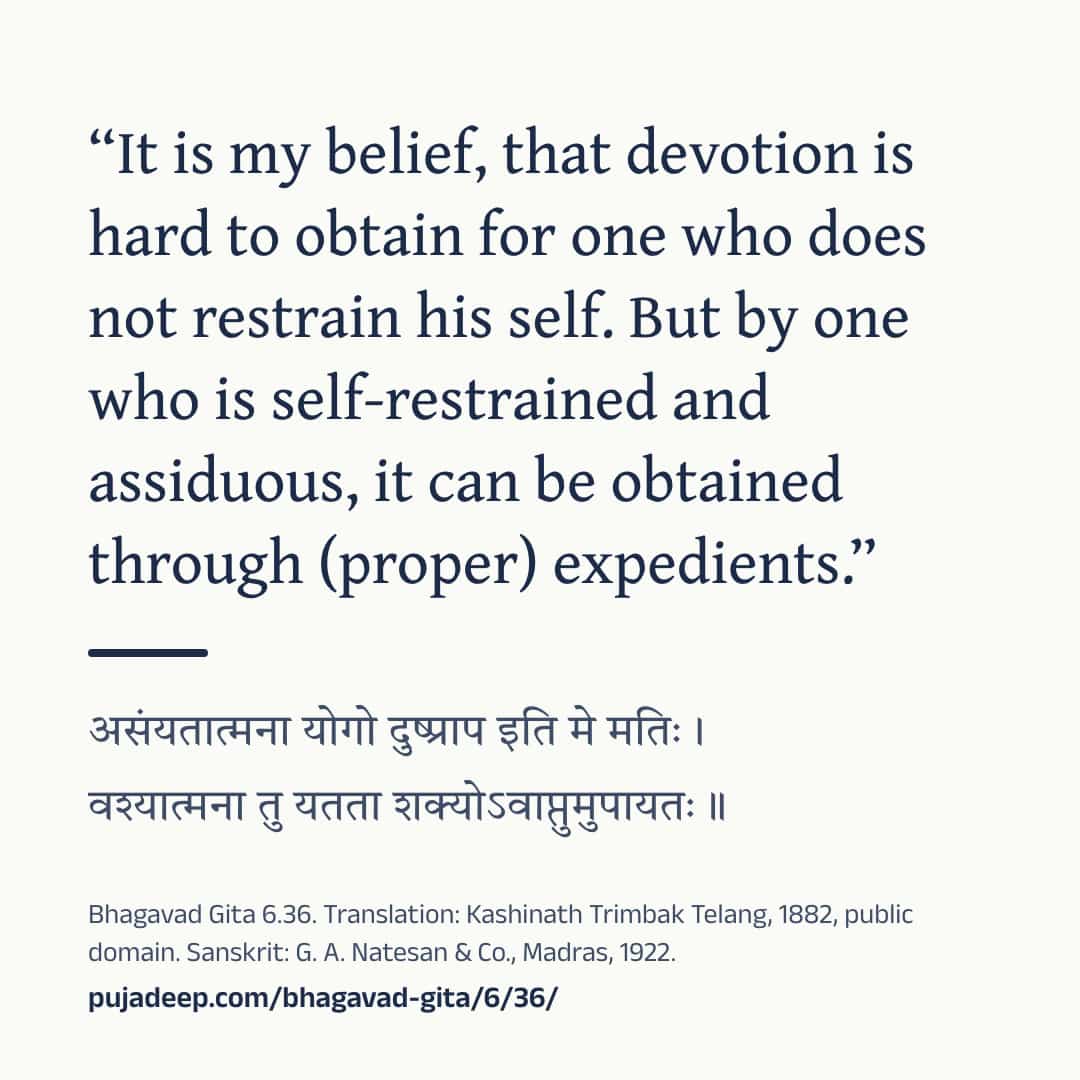
Drawing the picture
See the words
Bhagavad Gita 6.36

असंयतात्मना योगो दुष्प्राप इति मे मतिः ।
वश्यात्मना तु यतता शक्योऽवाप्तुमुपायतः ॥

“It is my belief, that devotion is hard to obtain for one who does not restrain his self. But by one who is self-restrained and assiduous, it can be obtained through (proper) expedients.”
(K. T. Telang, The Bhagavadgîtâ (The Sacred Books of the East, vol. VIII, Oxford: Clarendon Press, 1882), pp. 71–72, public domain)

“Yoga is hard to attain, methinks, by a self that is uncontrolled; but by the SELF-ruled it is verily to be attained, if he labour to approach thereto with energy.”
(Annie Besant, The Bhagavad Gîtâ, or The Lord's Song (London: Theosophical Publishing Society, 1895), p. 72, public domain)

“Yoga is hard to be attained by one of uncontrolled self: such is my conviction; but the self-controlled, striving by right means, can obtain it.”
(Swami Swarupananda, Srimad-Bhagavad-Gita (Mayavati: Prabuddha Bharata Press, 1909; first printed in Prabuddha Bharata, 1907–1909), p. 138, public domain)

Sanskrit: G. A. Natesan & Co., Madras, 1922.
https://pujadeep.com/bhagavad-gita/6/36/ Nothing is sent from this site. Your own app sends it, to the chat you choose. The picture quotes the translation you chose on this page, with its name and year.
Sanskrit text: The Bhagavad-Gita, or The Lord's Song, with the text in Devanagari and an English translation, 1922. Meanings: written for Pujadeep and checked against the cited edition. Source and changes
Questions families ask
Who speaks Bhagavad Gita 6.36?
Krishna speaks this verse, in chapter 6 (Dhyana Yoga).
Where does the Sanskrit text come from?
Sanskrit text: The Bhagavad-Gita, or The Lord's Song, with the text in Devanagari and an English translation, 1922. Meanings: written for Pujadeep and checked against the cited edition. See the source
Is the meaning on this page a translation?
Explanation written for this site from the sources listed here, and checked against the cited edition. It is not a translation and not the only way to read the text. Free to quote with credit.
Source and licence
- Sanskrit text
- The Bhagavad-Gita, or The Lord's Song, with the text in Devanagari and an English translation (Annie Besant, G. A. Natesan & Co., Madras, 1922). Public domain. The Sanskrit on these pages was read from this printing’s page images.
- Translation
- The Bhagavadgîtâ with the Sanatsugâtîya and the Anugîtâ, translated by Kâshinâth Trimbak Telang (The Sacred Books of the East, vol. VIII, ed. F. Max Müller) (Kashinath Trimbak Telang, F. Max Müller, Clarendon Press, Oxford, 1882). Public domain. Shown verbatim, as printed.
- Translation
- The Bhagavad Gîtâ, or The Lord's Song, translated by Annie Besant (Annie Besant, Theosophical Publishing Society, London, 1895). Public domain. Shown verbatim, as printed.
- Translation
- Srimad-Bhagavad-Gita, with Sanskrit Text; Paraphrase with Word-by-word Literal Translation; English Rendering and Comments, Index, &c., by the Swami Swarupananda (Himalayan Series, No. XX) (Swami Swarupananda, The Editors and Publishers, Advaita Ashrama, Mayavati, Prabuddha Bharata Press, Mayavati, Almora, Himalayas, 1909). Public domain. Shown verbatim, as printed.
- Common wording
- In this text, 32 words follow today's common wording, checked against sanskritdocuments.org; Sanskrit Wikisource; Gita Press, Gorakhpur; GRETIL, Göttingen and Bhaktivedanta Book Trust.
- Our explanation
- Explanation written for this site from the sources listed here, and checked against the cited edition. It is not a translation and not the only way to read the text. Free to quote with credit.
- Checked
- Checked against the cited edition, October 15, 2026.
- Updated
- October 25, 2026