Bhagavad Gita 6.43: meaning and translation
Chapter 6: Dhyana Yoga. Krishna says
There, Krishna says, he regains the understanding of his former body and strives again for perfection.
Click or tap a word for its meaning and its dictionary page.
Text and layers
Text and layers
These choices stay in this browser.
Bhagavad Gita 6.43
तत्र तं बुद्धिसंयोगं लभते पौर्वदेहिकम् ।यतते च ततो भूयः संसिद्धौ कुरुनन्दन ॥
Tatra tam buddhisanyogam labhate paurvadehikamYatate cha tato bhuyah sansiddhau kurunandana
tatra taṃ buddhisaṃyogaṃ labhate paurvadehikam |yatate ca tato bhūyaḥ saṃsiddhau kurunandana ||
Our explanation There, Krishna says, he regains the understanding of his former body and strives again for perfection. Krishna calls Arjuna joy of the Kurus (kurunandana).
हिंदी अर्थ कृष्ण कहते हैं कि वहाँ वह अपने पिछले शरीर की बुद्धि का संयोग फिर पाता है, और फिर से सिद्धि के लिए प्रयत्न करता है। वे अर्जुन को कुरुनंदन कहकर पुकारते हैं।
Word by word
Every word, with its dictionary page
Word by word
- तत्र tatra · there (indeclinable) Dictionary: tatra, Monier-Williams 1899, p. 433, col. 2 “in that, therein, in that case”
- तम् tam · that (pronoun (masculine), accusative singular) Dictionary: tad, Monier-Williams 1899, p. 434, col. 1 “m. he, f. she, n. it, that, this”
- बुद्धिसंयोगम् buddhisaṃyogam · union with understanding (compound (masculine), accusative singular) Dictionary: buddhi, Monier-Williams 1899, p. 733, col. 3 “intelligence, reason, intellect, mind, discernment, judgment”; saṃ-yoga, Monier-Williams 1899, p. 1112, col. 2 “conjunction, combination, connection”
- लभते labhate · regains (present, 3rd person singular) Dictionary: labh, Monier-Williams 1899, p. 896, col. 2 “to gain possession of, obtain, receive”
- पौर्वदेहिकम् paurvadehikam · of the former body (adjective (masculine), accusative singular) Dictionary: paurva-dehika, Monier-Williams 1899, p. 651, col. 3 “belonging to or derived from a former body”
- यतते yatate · strives (present, 3rd person singular) Dictionary: 2. yat, Monier-Williams 1899, p. 840, col. 3 “to exert one's self, take pains, endeavour, make effort”
- च ca · and (indeclinable) Dictionary: 2. ca, Monier-Williams 1899, p. 380, col. 1 “ind. and, both, also, moreover, as well as”
- ततः tataḥ · then (indeclinable) Dictionary: tatas, Monier-Williams 1899, p. 432, col. 2 “thereupon, then, after that”
- भूयः bhūyaḥ · again, more (indeclinable) Dictionary: bhūyas, Monier-Williams 1899, p. 763, col. 3 “once more, again, anew”
- संसिद्धौ saṃsiddhau · for perfection (noun (feminine), locative singular) Dictionary: saṃ-siddhi, Monier-Williams 1899, p. 1119, col. 2 “complete accomplishment or fulfilment, perfection, success”
- कुरुनन्दन kurunandana · O joy of the Kurus (noun (masculine), vocative singular) Dictionary: kuru-nandana, Monier-Williams 1899, p. 294, col. 1 “a descendant of Kuru”
Old translations
Kashinath Trimbak Telang, 1882. Public domain. Page 72.
There he comes into contact with the knowledge which belonged to him in his former body, and then again, O descendant of Kuru! he works for perfection1.
Footnotes (the translator’s own) - I. e. final emancipation. ↩
Compare 3 translations
Kashinath Trimbak Telang, 1882. Public domain. Page 72.
There he comes into contact with the knowledge which belonged to him in his former body, and then again, O descendant of Kuru! he works for perfection1.
Footnotes (the translator’s own) - I. e. final emancipation. ↩
You are reading this one
Annie Besant, 1895. Public domain. Page 73.
There he obtaineth the complete yogic wisdom belonging to his former body, and then again laboureth for perfection, O joy of the Kurus!
You are reading this one
Swami Swarupananda, 1909 (first printed 1907). Public domain. Page 141.
There he is united with the intelligence acquired in his former body, and strives more than before, for perfection, O son of the Kurus.
You are reading this one
Cite this verse
The translation: K. T. Telang, The Bhagavadgîtâ (The Sacred Books of the East, vol. VIII, Oxford: Clarendon Press, 1882), p. 72. Bhagavad Gita 6.43.
The translation: Annie Besant, The Bhagavad Gîtâ, or The Lord's Song (London: Theosophical Publishing Society, 1895), p. 73. Bhagavad Gita 6.43.
The translation: Swami Swarupananda, Srimad-Bhagavad-Gita (Mayavati: Prabuddha Bharata Press, 1909; first printed in Prabuddha Bharata, 1907–1909), p. 141. Bhagavad Gita 6.43.
Our explanation: “Bhagavad Gita 6.43: meaning and translation.” Pujadeep. Updated October 25, 2026. https://pujadeep.com/bhagavad-gita/6/43/
Pujadeep’s explanations are free to quote with credit: name Pujadeep and link to the page. How to credit
Classical readings, by school
No readings by school on this verse yet.
Share
Show the ways to share
Send one picture or the text to one chat. The picture names its source and the address of this page.
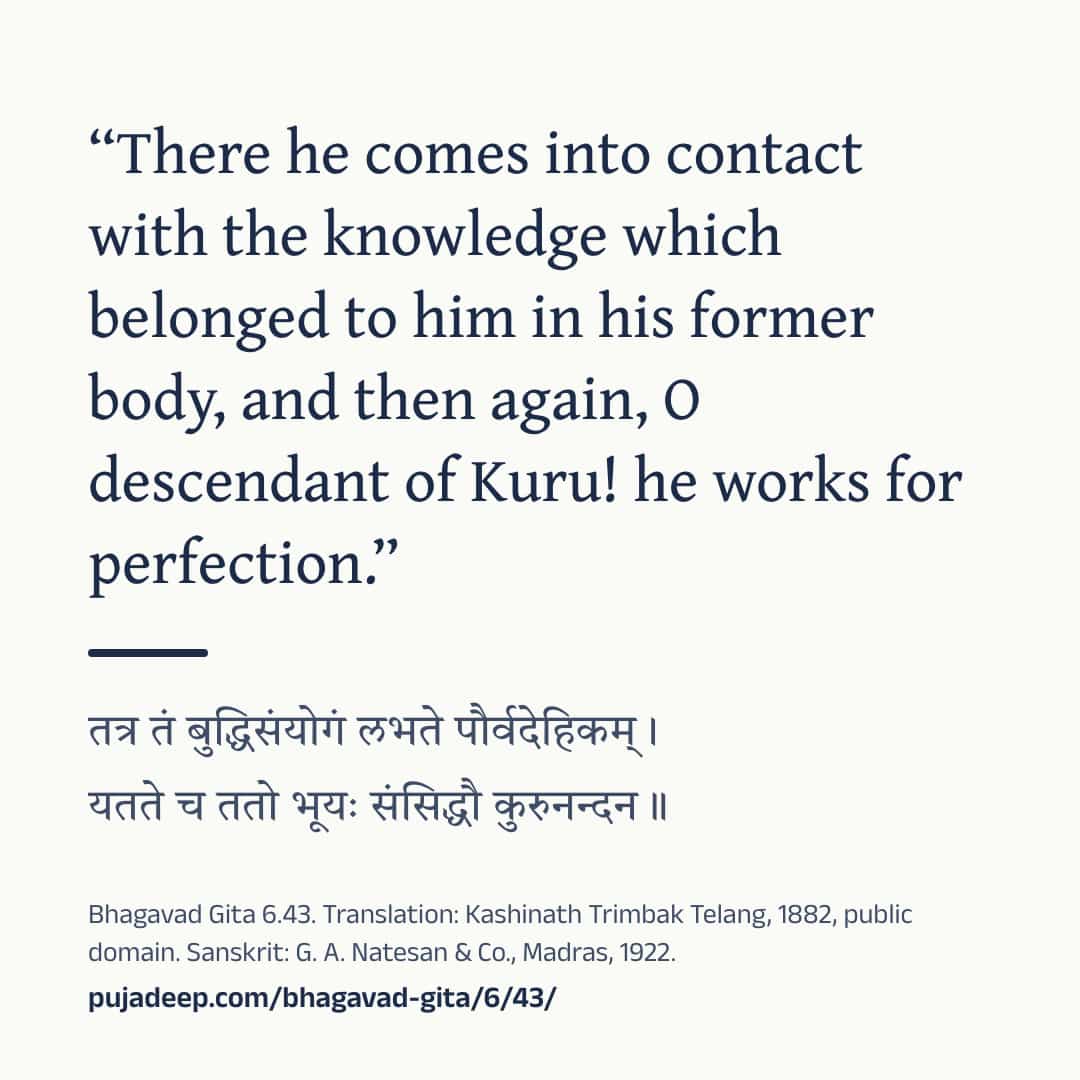
Drawing the picture
See the words
Bhagavad Gita 6.43

तत्र तं बुद्धिसंयोगं लभते पौर्वदेहिकम् ।
यतते च ततो भूयः संसिद्धौ कुरुनन्दन ॥

“There he comes into contact with the knowledge which belonged to him in his former body, and then again, O descendant of Kuru! he works for perfection.”
(K. T. Telang, The Bhagavadgîtâ (The Sacred Books of the East, vol. VIII, Oxford: Clarendon Press, 1882), p. 72, public domain)

“There he obtaineth the complete yogic wisdom belonging to his former body, and then again laboureth for perfection, O joy of the Kurus!”
(Annie Besant, The Bhagavad Gîtâ, or The Lord's Song (London: Theosophical Publishing Society, 1895), p. 73, public domain)

“There he is united with the intelligence acquired in his former body, and strives more than before, for perfection, O son of the Kurus.”
(Swami Swarupananda, Srimad-Bhagavad-Gita (Mayavati: Prabuddha Bharata Press, 1909; first printed in Prabuddha Bharata, 1907–1909), p. 141, public domain)

Sanskrit: G. A. Natesan & Co., Madras, 1922.
https://pujadeep.com/bhagavad-gita/6/43/ Nothing is sent from this site. Your own app sends it, to the chat you choose. The picture quotes the translation you chose on this page, with its name and year.
Sanskrit text: The Bhagavad-Gita, or The Lord's Song, with the text in Devanagari and an English translation, 1922. Meanings: written for Pujadeep and checked against the cited edition. Source and changes
Questions families ask
Who speaks Bhagavad Gita 6.43?
Krishna speaks this verse, in chapter 6 (Dhyana Yoga).
Where does the Sanskrit text come from?
Sanskrit text: The Bhagavad-Gita, or The Lord's Song, with the text in Devanagari and an English translation, 1922. Meanings: written for Pujadeep and checked against the cited edition. See the source
Is the meaning on this page a translation?
Explanation written for this site from the sources listed here, and checked against the cited edition. It is not a translation and not the only way to read the text. Free to quote with credit.
Source and licence
- Sanskrit text
- The Bhagavad-Gita, or The Lord's Song, with the text in Devanagari and an English translation (Annie Besant, G. A. Natesan & Co., Madras, 1922). Public domain. The Sanskrit on these pages was read from this printing’s page images.
- Translation
- The Bhagavadgîtâ with the Sanatsugâtîya and the Anugîtâ, translated by Kâshinâth Trimbak Telang (The Sacred Books of the East, vol. VIII, ed. F. Max Müller) (Kashinath Trimbak Telang, F. Max Müller, Clarendon Press, Oxford, 1882). Public domain. Shown verbatim, as printed.
- Translation
- The Bhagavad Gîtâ, or The Lord's Song, translated by Annie Besant (Annie Besant, Theosophical Publishing Society, London, 1895). Public domain. Shown verbatim, as printed.
- Translation
- Srimad-Bhagavad-Gita, with Sanskrit Text; Paraphrase with Word-by-word Literal Translation; English Rendering and Comments, Index, &c., by the Swami Swarupananda (Himalayan Series, No. XX) (Swami Swarupananda, The Editors and Publishers, Advaita Ashrama, Mayavati, Prabuddha Bharata Press, Mayavati, Almora, Himalayas, 1909). Public domain. Shown verbatim, as printed.
- Common wording
- In this text, 32 words follow today's common wording, checked against sanskritdocuments.org; Sanskrit Wikisource; Gita Press, Gorakhpur; GRETIL, Göttingen and Bhaktivedanta Book Trust.
- Our explanation
- Explanation written for this site from the sources listed here, and checked against the cited edition. It is not a translation and not the only way to read the text. Free to quote with credit.
- Checked
- Checked against the cited edition, October 15, 2026.
- Updated
- October 25, 2026