Bhagavad Gita 6.44: meaning and translation
Chapter 6: Dhyana Yoga. Krishna says
By that same earlier practice he is carried forward even against his will, Krishna says.
Click or tap a word for its meaning and its dictionary page.
Text and layers
Text and layers
These choices stay in this browser.
Bhagavad Gita 6.44
पूर्वाभ्यासेन तेनैव ह्रियते ह्यवशोऽपि सः ।जिज्ञासुरपि योगस्य शब्दब्रह्मातिवर्तते ॥
Purvabhyasena tenaiva hriyate hyavashopi sahJijnasurapi yogasya shabdabrahmativartate
pūrvābhyāsena tenaiva hriyate hyavaśo’pi saḥ |jijñāsurapi yogasya śabdabrahmātivartate ||
Our explanation By that same earlier practice he is carried forward even against his will, Krishna says. Even one who only wants to know about yoga goes beyond śabda-brahma, 'Brahman as word'. The schools explain this term in different ways (see the views).
हिंदी अर्थ कृष्ण कहते हैं कि उसी पुराने अभ्यास से वह, न चाहते हुए भी, आगे खिंच जाता है। योग को केवल जानने की इच्छा रखने वाला भी शब्दब्रह्म (“शब्द रूप ब्रह्म”) से आगे निकल जाता है। परंपराएँ इस शब्द को अलग-अलग ढंग से समझाती हैं।
Word by word
Every word, with its dictionary page
Word by word
- पूर्वाभ्यासेन pūrvābhyāsena · by the earlier practice (compound (masculine), instrumental singular) Dictionary: pūrvābhyāsa, Monier-Williams 1899, p. 644, col. 3
- तेन tena · by that (pronoun (masculine), instrumental singular) Dictionary: tad, Monier-Williams 1899, p. 434, col. 1 “m. he, f. she, n. it, that, this”
- एव eva · same (indeclinable) Dictionary: 1. eva, Monier-Williams 1899, p. 232, col. 2 “just, exactly, very, same, only, even, alone, merely”
- ह्रियते hriyate · is carried along (present passive, 3rd person singular) Dictionary: hṛ, Monier-Williams 1899, p. 1302, col. 1 “to take away, carry off, seize”
- हि hi · indeed (indeclinable) Dictionary: 2. hi, Monier-Williams 1899, p. 1297, col. 3 “for, because, on account of”
- अवशः avaśaḥ · against his will (adjective (masculine), nominative singular) Dictionary: a-vaśa, Monier-Williams 1899, p. 104, col. 1 “not having one's own free will, doing something against one's desire or unwillingly”
- अपि api · even (indeclinable) Dictionary: api, Monier-Williams 1899, p. 55, col. 1 “in the sense of even, also, very”
- सः saḥ · he (pronoun (masculine), nominative singular) Dictionary: tad, Monier-Williams 1899, p. 434, col. 1 “m. he, f. she, n. it, that, this”
- जिज्ञासुः jijñāsuḥ · one who wants to know (adjective (masculine), nominative singular) Dictionary: jijñāsu, Monier-Williams 1899, p. 421, col. 1 “desirous of knowing, inquiring into”
- अपि api · even (indeclinable) Dictionary: api, Monier-Williams 1899, p. 55, col. 1 “in the sense of even, also, very”
- योगस्य yogasya · about yoga (noun (masculine), genitive singular) Dictionary: yoga, Monier-Williams 1899, p. 856, col. 2 “the act of yoking, joining, attaching”
- शब्दब्रह्म śabdabrahma · Brahman as word (compound (neuter), accusative singular) Dictionary: śabda-brahman, Monier-Williams 1899, p. 1053, col. 1 “the Veda considered as a revealed sound or word and identified with the Supreme”
- अतिवर्तते ativartate · goes beyond (present, 3rd person singular) Dictionary: ati-vṛt, Monier-Williams 1899, p. 15, col. 3 “to pass beyond, surpass, cross; to get over, overcome”
Old translations
Kashinath Trimbak Telang, 1882. Public domain. Page 72–73.
For even though reluctant1, he is led away by the self-same former practice, and although he only wishes to learn devotion, he rises above the (fruits of action laid down in the) divine word.
Footnotes (the translator’s own) - 'As Arguna himself,' says Madhusûdana, 'receives instruction in knowledge, though he comes to the battle-field without any such object; hence it was said before, "nothing is here abortive."' See p. 47. ↩
Compare 3 translations
Kashinath Trimbak Telang, 1882. Public domain. Page 72–73.
For even though reluctant1, he is led away by the self-same former practice, and although he only wishes to learn devotion, he rises above the (fruits of action laid down in the) divine word.
Footnotes (the translator’s own) - 'As Arguna himself,' says Madhusûdana, 'receives instruction in knowledge, though he comes to the battle-field without any such object; hence it was said before, "nothing is here abortive."' See p. 47. ↩
You are reading this one
Annie Besant, 1895. Public domain. Page 73.
By that former practice he is involuntarily guided. Only wishing to know Yoga, one goeth beyond the Brâhmic word,1
This sentence goes on in 6.45.
Footnotes (the translator’s own) - The Vedas. ↩
You are reading this one
Swami Swarupananda, 1909 (first printed 1907). Public domain. Page 141.
By that previous practice alone, he is borne on in spite of himself. Even the enquirer after Yoga, rises superior to the performer of Vedic actions.
You are reading this one
Cite this verse
The translation: K. T. Telang, The Bhagavadgîtâ (The Sacred Books of the East, vol. VIII, Oxford: Clarendon Press, 1882), pp. 72–73. Bhagavad Gita 6.44.
The translation: Annie Besant, The Bhagavad Gîtâ, or The Lord's Song (London: Theosophical Publishing Society, 1895), p. 73. Bhagavad Gita 6.44.
The translation: Swami Swarupananda, Srimad-Bhagavad-Gita (Mayavati: Prabuddha Bharata Press, 1909; first printed in Prabuddha Bharata, 1907–1909), p. 141. Bhagavad Gita 6.44.
Our explanation: “Bhagavad Gita 6.44: meaning and translation.” Pujadeep. Updated October 25, 2026. https://pujadeep.com/bhagavad-gita/6/44/
Pujadeep’s explanations are free to quote with credit: name Pujadeep and link to the page. How to credit
Classical readings, by school
Each reading is named by its school. None is presented as the only meaning.
What Advaita, Vishishtadvaita and Dvaita teach, in short
Shankara Advaita
Shankara takes śabda-brahma to be the Veda as the source of ritual works: even one who only seeks to know yoga goes beyond the results of Vedic ritual. He adds that the pull of past yoga can be held back for a time by wrong deeds, but is not destroyed.
Source: The Bhagavad-Gita, with the commentary of Sri Sankaracharya, translated by A. Mahadeva Sastri (2nd ed., Mysore: G. T. A. Printing Works, 1901), commentary on 6.44, pp. 185–186. Summarised in our own words; none of its text is reproduced.
Ramanuja Vishishtadvaita
Ramanuja takes śabda-brahma to be matter, the vast stuff that takes on names such as god, human, earth and heaven. Even the one who only enquires about yoga at last goes beyond it to the self, which no such name describes.
Source: Sri Bhagavad-Gita with Sri Ramanujacharya's Visishtadvaita commentary, translated by A. Govindacharya (Madras, 1898), commentary on 6.43–44, pp. 217–218. Summarised in our own words; none of its text is reproduced.
Share
Show the ways to share
Send one picture or the text to one chat. The picture names its source and the address of this page.
Drawing the picture
See the words
Bhagavad Gita 6.44

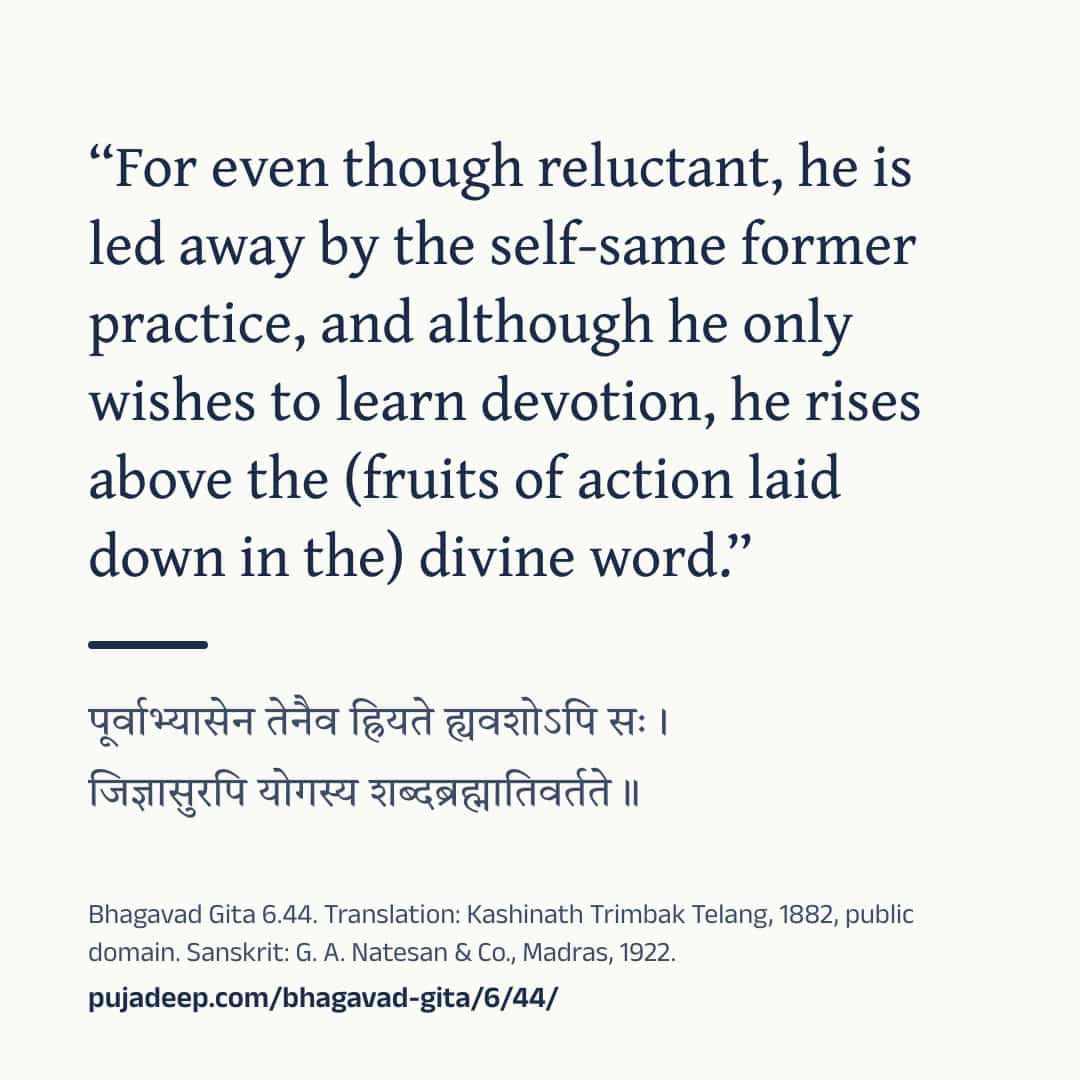
पूर्वाभ्यासेन तेनैव ह्रियते ह्यवशोऽपि सः ।
जिज्ञासुरपि योगस्य शब्दब्रह्मातिवर्तते ॥

“For even though reluctant, he is led away by the self-same former practice, and although he only wishes to learn devotion, he rises above the (fruits of action laid down in the) divine word.”
(K. T. Telang, The Bhagavadgîtâ (The Sacred Books of the East, vol. VIII, Oxford: Clarendon Press, 1882), pp. 72–73, public domain)

“By that former practice he is involuntarily guided. Only wishing to know Yoga, one goeth beyond the Brâhmic word,”
(Annie Besant, The Bhagavad Gîtâ, or The Lord's Song (London: Theosophical Publishing Society, 1895), p. 73, public domain)
This sentence goes on in 6.45.

“By that previous practice alone, he is borne on in spite of himself. Even the enquirer after Yoga, rises superior to the performer of Vedic actions.”
(Swami Swarupananda, Srimad-Bhagavad-Gita (Mayavati: Prabuddha Bharata Press, 1909; first printed in Prabuddha Bharata, 1907–1909), p. 141, public domain)

Sanskrit: G. A. Natesan & Co., Madras, 1922.
https://pujadeep.com/bhagavad-gita/6/44/ Nothing is sent from this site. Your own app sends it, to the chat you choose. The picture quotes the translation you chose on this page, with its name and year.
Sanskrit text: The Bhagavad-Gita, or The Lord's Song, with the text in Devanagari and an English translation, 1922. Meanings: written for Pujadeep and checked against the cited edition. Source and changes
Questions families ask
Who speaks Bhagavad Gita 6.44?
Krishna speaks this verse, in chapter 6 (Dhyana Yoga).
Where does the Sanskrit text come from?
Sanskrit text: The Bhagavad-Gita, or The Lord's Song, with the text in Devanagari and an English translation, 1922. Meanings: written for Pujadeep and checked against the cited edition. See the source
Is the meaning on this page a translation?
Explanation written for this site from the sources listed here, and checked against the cited edition. It is not a translation and not the only way to read the text. Free to quote with credit.
Source and licence
- Sanskrit text
- The Bhagavad-Gita, or The Lord's Song, with the text in Devanagari and an English translation (Annie Besant, G. A. Natesan & Co., Madras, 1922). Public domain. The Sanskrit on these pages was read from this printing’s page images.
- Translation
- The Bhagavadgîtâ with the Sanatsugâtîya and the Anugîtâ, translated by Kâshinâth Trimbak Telang (The Sacred Books of the East, vol. VIII, ed. F. Max Müller) (Kashinath Trimbak Telang, F. Max Müller, Clarendon Press, Oxford, 1882). Public domain. Shown verbatim, as printed.
- Translation
- The Bhagavad Gîtâ, or The Lord's Song, translated by Annie Besant (Annie Besant, Theosophical Publishing Society, London, 1895). Public domain. Shown verbatim, as printed.
- Translation
- Srimad-Bhagavad-Gita, with Sanskrit Text; Paraphrase with Word-by-word Literal Translation; English Rendering and Comments, Index, &c., by the Swami Swarupananda (Himalayan Series, No. XX) (Swami Swarupananda, The Editors and Publishers, Advaita Ashrama, Mayavati, Prabuddha Bharata Press, Mayavati, Almora, Himalayas, 1909). Public domain. Shown verbatim, as printed.
- Commentary
- The Bhagavad-Gita, with the commentary of Sri Sankaracharya, translated by A. Mahadeva Sastri (2nd ed., Mysore: G. T. A. Printing Works, 1901) (Public-domain scan, University of California Libraries). Summarised in our own words; none of its text is reproduced.
- Commentary
- Sri Bhagavad-Gita with Sri Ramanujacharya's Visishtadvaita commentary, translated by A. Govindacharya (Madras, 1898) (Scan uploaded to archive.org (folkscanomy collection)). Summarised in our own words; none of its text is reproduced.
- Common wording
- In this text, 32 words follow today's common wording, checked against sanskritdocuments.org; Sanskrit Wikisource; Gita Press, Gorakhpur; GRETIL, Göttingen and Bhaktivedanta Book Trust.
- Our explanation
- Explanation written for this site from the sources listed here, and checked against the cited edition. It is not a translation and not the only way to read the text. Free to quote with credit.
- Checked
- Checked against the cited edition, October 15, 2026.
- Updated
- October 25, 2026