Bhagavad Gita 6.40: meaning and translation
Chapter 6: Dhyana Yoga. Krishna says
Krishna answers that for such a person there is no ruin, neither in this world nor in the next, for no one who does good, dear friend (tāta), comes to a bad end.
Click or tap a word for its meaning and its dictionary page.
Text and layers
Text and layers
These choices stay in this browser.
Bhagavad Gita 6.40
श्रीभगवानुवाच ।
पार्थ नैवेह नामुत्र विनाशस्तस्य विद्यते ।न हि कल्याणकृत्कश्चिद्दुर्गतिं तात गच्छति ॥
Partha naiveha namutra vinashastasya vidyateNa hi kalyanakritkashchiddurgatim tata gachchhati
pārtha naiveha nāmutra vināśastasya vidyate |na hi kalyāṇakṛtkaściddurgatiṃ tāta gacchati ||
Our explanation Krishna answers that for such a person there is no ruin, neither in this world nor in the next, for no one who does good, dear friend (tāta), comes to a bad end.
हिंदी अर्थ कृष्ण उत्तर देते हैं कि ऐसे व्यक्ति का न इस लोक में नाश होता है, न परलोक में; क्योंकि हे तात (प्रिय), भलाई करने वाला कोई भी दुर्गति को नहीं पाता।
Word by word
Every word, with its dictionary page
Word by word
- पार्थ pārtha · O Partha (son of Pritha) (noun (masculine), vocative singular) Dictionary: 2. pārtha, Monier-Williams 1899, p. 621, col. 3 “metron. of Yudhi-shṭhira or Bhīma-sena or Arjuna”
- न na · not (indeclinable) Dictionary: 2. na, Monier-Williams 1899, p. 523, col. 1 “ind. not, no, nor, neither”
- एव eva · at all (indeclinable) Dictionary: 1. eva, Monier-Williams 1899, p. 232, col. 2 “just, exactly, very, same, only, even, alone, merely”
- इह iha · here, in this world (indeclinable) Dictionary: iha, Monier-Williams 1899, p. 169, col. 3 “in this place, here”
- न na · nor (indeclinable) Dictionary: 2. na, Monier-Williams 1899, p. 523, col. 1 “ind. not, no, nor, neither”
- अमुत्र amutra · in the next world (indeclinable) Dictionary: amutra, Monier-Williams 1899, p. 82, col. 1 “there above, i.e. in the other world, in the life to come”
- विनाशः vināśaḥ · ruin (noun (masculine), nominative singular) Dictionary: vi-nāśa, Monier-Williams 1899, p. 969, col. 3 “utter loss, annihilation, perdition, destruction, decay”
- तस्य tasya · for him (pronoun (masculine), genitive singular) Dictionary: tad, Monier-Williams 1899, p. 434, col. 1 “m. he, f. she, n. it, that, this”
- विद्यते vidyate · there is (present passive, 3rd person singular) Dictionary: 3. vid, Monier-Williams 1899, p. 965, col. 1 “to be found, exist, be”
- न na · no (indeclinable) Dictionary: 2. na, Monier-Williams 1899, p. 523, col. 1 “ind. not, no, nor, neither”
- हि hi · for (indeclinable) Dictionary: 2. hi, Monier-Williams 1899, p. 1297, col. 3 “for, because, on account of”
- कल्याणकृत् kalyāṇakṛt · one who does good (compound (masculine), nominative singular) Dictionary: kalyāṇa-kṛt, Monier-Williams 1899, p. 263, col. 2 “doing good, virtuous”
- कश्चित् kaścit · anyone (pronoun (masculine), nominative singular) Dictionary: kim, Monier-Williams 1899, p. 282, col. 2 “what? how? whence? wherefore? why?”
- दुर्गतिम् durgatim · a bad end (noun (feminine), accusative singular) Dictionary: dur-gati, Monier-Williams 1899, p. 485, col. 2 “misfortune, distress, poverty”
- तात tāta · dear friend (noun (masculine), vocative singular) Dictionary: tāta, Monier-Williams 1899, p. 441, col. 3 “a term of affection addressed to a junior”
- गच्छति gacchati · comes to (present, 3rd person singular) Dictionary: 1. gam, Monier-Williams 1899, p. 347, col. 1 “to go, move, go away, set out, come”
1 printing differs
Edition differences. Another printing or text reads this place differently.
- Spelling A digital text reads Same letters. The e-text prints a space before दुर्गतिं; the 1922 edition joins कश्चिद्दुर्गतिं.
Old translations
Kashinath Trimbak Telang, 1882. Public domain. Page 72.
The Deity said:
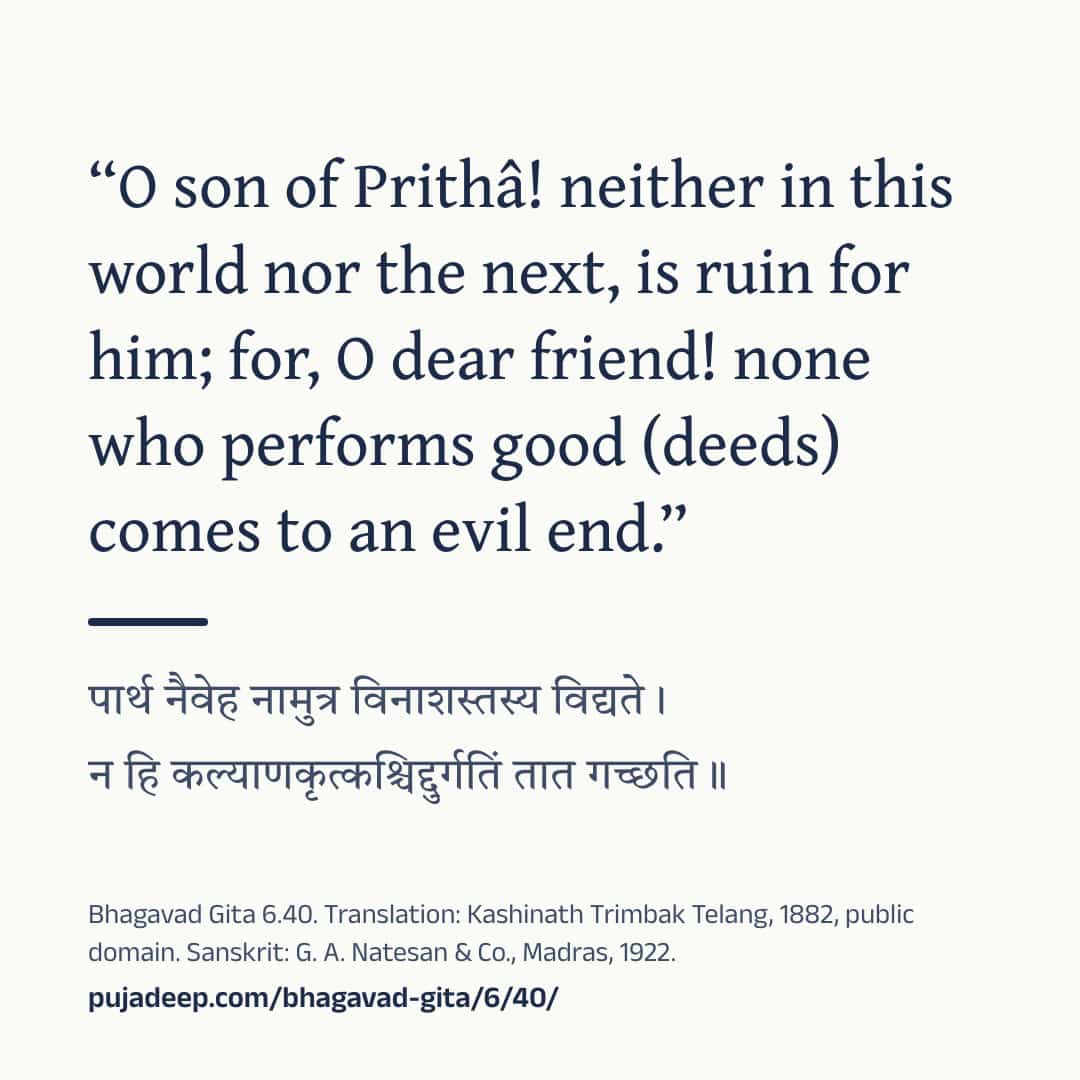
O son of Prithâ! neither in this world nor the next, is ruin for him; for, O dear friend! none who performs good (deeds) comes to an evil end.
Compare 3 translations
Kashinath Trimbak Telang, 1882. Public domain. Page 72.
The Deity said:
O son of Prithâ! neither in this world nor the next, is ruin for him; for, O dear friend! none who performs good (deeds) comes to an evil end.
You are reading this one
Annie Besant, 1895. Public domain. Page 72–73.
The Blessed Lord said:
O son of Prithâ, neither in this world nor in the life to come is there destruction for him; never doth any who worketh righteousness, O beloved, tread the path of woe.
You are reading this one
Swami Swarupananda, 1909 (first printed 1907). Public domain. Page 139.
The Blessed Lord said:
Verily, O son of Prithâ, there is destruction for him, neither here nor hereafter: for, the doer of good, O my son, never comes to grief.
You are reading this one
Cite this verse
The translation: K. T. Telang, The Bhagavadgîtâ (The Sacred Books of the East, vol. VIII, Oxford: Clarendon Press, 1882), p. 72. Bhagavad Gita 6.40.
The translation: Annie Besant, The Bhagavad Gîtâ, or The Lord's Song (London: Theosophical Publishing Society, 1895), pp. 72–73. Bhagavad Gita 6.40.
The translation: Swami Swarupananda, Srimad-Bhagavad-Gita (Mayavati: Prabuddha Bharata Press, 1909; first printed in Prabuddha Bharata, 1907–1909), p. 139. Bhagavad Gita 6.40.
Our explanation: “Bhagavad Gita 6.40: meaning and translation.” Pujadeep. Updated October 25, 2026. https://pujadeep.com/bhagavad-gita/6/40/
Pujadeep’s explanations are free to quote with credit: name Pujadeep and link to the page. How to credit
Classical readings, by school
No readings by school on this verse yet.
Share
Show the ways to share
Send one picture or the text to one chat. The picture names its source and the address of this page.
Drawing the picture
See the words
Bhagavad Gita 6.40

पार्थ नैवेह नामुत्र विनाशस्तस्य विद्यते ।
न हि कल्याणकृत्कश्चिद्दुर्गतिं तात गच्छति ॥

“O son of Prithâ! neither in this world nor the next, is ruin for him; for, O dear friend! none who performs good (deeds) comes to an evil end.”
(K. T. Telang, The Bhagavadgîtâ (The Sacred Books of the East, vol. VIII, Oxford: Clarendon Press, 1882), p. 72, public domain)

“O son of Prithâ, neither in this world nor in the life to come is there destruction for him; never doth any who worketh righteousness, O beloved, tread the path of woe.”
(Annie Besant, The Bhagavad Gîtâ, or The Lord's Song (London: Theosophical Publishing Society, 1895), pp. 72–73, public domain)

“Verily, O son of Prithâ, there is destruction for him, neither here nor hereafter: for, the doer of good, O my son, never comes to grief.”
(Swami Swarupananda, Srimad-Bhagavad-Gita (Mayavati: Prabuddha Bharata Press, 1909; first printed in Prabuddha Bharata, 1907–1909), p. 139, public domain)

Sanskrit: G. A. Natesan & Co., Madras, 1922.
https://pujadeep.com/bhagavad-gita/6/40/ Nothing is sent from this site. Your own app sends it, to the chat you choose. The picture quotes the translation you chose on this page, with its name and year.
Sanskrit text: The Bhagavad-Gita, or The Lord's Song, with the text in Devanagari and an English translation, 1922. Meanings: written for Pujadeep and checked against the cited edition. Source and changes
Questions families ask
Who speaks Bhagavad Gita 6.40?
Krishna speaks this verse, in chapter 6 (Dhyana Yoga).
Where does the Sanskrit text come from?
Sanskrit text: The Bhagavad-Gita, or The Lord's Song, with the text in Devanagari and an English translation, 1922. Meanings: written for Pujadeep and checked against the cited edition. See the source
Is the meaning on this page a translation?
Explanation written for this site from the sources listed here, and checked against the cited edition. It is not a translation and not the only way to read the text. Free to quote with credit.
Source and licence
- Sanskrit text
- The Bhagavad-Gita, or The Lord's Song, with the text in Devanagari and an English translation (Annie Besant, G. A. Natesan & Co., Madras, 1922). Public domain. The Sanskrit on these pages was read from this printing’s page images.
- Translation
- The Bhagavadgîtâ with the Sanatsugâtîya and the Anugîtâ, translated by Kâshinâth Trimbak Telang (The Sacred Books of the East, vol. VIII, ed. F. Max Müller) (Kashinath Trimbak Telang, F. Max Müller, Clarendon Press, Oxford, 1882). Public domain. Shown verbatim, as printed.
- Translation
- The Bhagavad Gîtâ, or The Lord's Song, translated by Annie Besant (Annie Besant, Theosophical Publishing Society, London, 1895). Public domain. Shown verbatim, as printed.
- Translation
- Srimad-Bhagavad-Gita, with Sanskrit Text; Paraphrase with Word-by-word Literal Translation; English Rendering and Comments, Index, &c., by the Swami Swarupananda (Himalayan Series, No. XX) (Swami Swarupananda, The Editors and Publishers, Advaita Ashrama, Mayavati, Prabuddha Bharata Press, Mayavati, Almora, Himalayas, 1909). Public domain. Shown verbatim, as printed.
- Common wording
- In this text, 32 words follow today's common wording, checked against sanskritdocuments.org; Sanskrit Wikisource; Gita Press, Gorakhpur; GRETIL, Göttingen and Bhaktivedanta Book Trust.
- Our explanation
- Explanation written for this site from the sources listed here, and checked against the cited edition. It is not a translation and not the only way to read the text. Free to quote with credit.
- Checked
- Checked against the cited edition, October 15, 2026.
- Updated
- October 25, 2026