Bhagavad Gita 6.34: meaning and translation
Chapter 6: Dhyana Yoga. Arjuna says
For the mind, Arjuna says, is restless, turbulent, strong and stubborn.
Click or tap a word for its meaning and its dictionary page.
Text and layers
Text and layers
These choices stay in this browser.
Bhagavad Gita 6.34
चञ्चलं हि मनः कृष्ण प्रमाथि बलवद् दृढम् ।तस्याऽहं निग्रहं मन्ये वायोरिव सुदुष्करम् ॥
Chanchalam hi manah krishna pramathi balavad dridhamTasyaham nigraham manye vayoriva sudushkaram
cañcalaṃ hi manaḥ kṛṣṇa pramāthi balavad dṛḍham |tasyā’haṃ nigrahaṃ manye vāyoriva suduṣkaram ||
Our explanation For the mind, Arjuna says, is restless, turbulent, strong and stubborn. He thinks it is as hard to hold back as the wind.
हिंदी अर्थ अर्जुन कहते हैं कि मन चंचल, उथल-पुथल करने वाला, बलवान और हठी है। उन्हें लगता है कि उसे रोकना हवा को रोकने जितना कठिन है।
Word by word
Every word, with its dictionary page
Word by word
- चञ्चलम् cañcalam · restless (adjective (neuter), nominative singular) Dictionary: cañcala, Monier-Williams 1899, p. 382, col. 2 “moving to and fro, movable, unsteady, shaking”
- हि hi · for (indeclinable) Dictionary: 2. hi, Monier-Williams 1899, p. 1297, col. 3 “for, because, on account of”
- मनः manaḥ · the mind (noun (neuter), nominative singular) Dictionary: manas, Monier-Williams 1899, p. 783, col. 3 “mind (in its widest sense as applied to all the mental powers)”
- कृष्ण kṛṣṇa · O Krishna (noun (masculine), vocative singular) Dictionary: kṛṣṇa, Monier-Williams 1899, p. 306, col. 2 “N. of a celebrated Avatār of the god Vishṇu, or sometimes identified with Vishṇu himself”
- प्रमाथि pramāthi · turbulent (adjective (neuter), nominative singular) Dictionary: pra-māthin, Monier-Williams 1899, p. 685, col. 2 “stirring about, tearing, rending, troubling, harassing”
- बलवत् balavat · strong (adjective (neuter), nominative singular) Dictionary: bala-vat, Monier-Williams 1899, p. 723, col. 1 “possessing power, powerful, mighty, strong”
- दृढम् dṛḍham · stubborn (adjective (neuter), nominative singular) Dictionary: dṛḍha, Monier-Williams 1899, p. 490, col. 2 “fixed, firm, hard, strong, solid, massive”
- तस्य tasya · its (pronoun (neuter), genitive singular) Dictionary: tad, Monier-Williams 1899, p. 434, col. 1 “m. he, f. she, n. it, that, this”
- अहम् aham · "I" (Arjuna) (pronoun, nominative singular) Dictionary: aham, Monier-Williams 1899, p. 124, col. 2 “nom. sg. ‘I,’”
- निग्रहम् nigraham · holding back (noun (masculine), accusative singular) Dictionary: ni-graha, Monier-Williams 1899, p. 546, col. 1 “keeping down or back, restraining, binding, coercion, suppression, subjugation, Mn.; MBh. &c.”
- मन्ये manye · think (present, 1st person singular) Dictionary: man, Monier-Williams 1899, p. 783, col. 1 “to think, believe, imagine, suppose, conjecture”
- वायोः vāyoḥ · of the wind (noun (masculine), genitive singular) Dictionary: 1. vāyu, Monier-Williams 1899, p. 942, col. 2 “wind, air”
- इव iva · like (indeclinable) Dictionary: iva, Monier-Williams 1899, p. 168, col. 3 “like, in the same manner as”
- सुदुष्करम् suduṣkaram · very hard to do (adjective (masculine), accusative singular) Dictionary: su-duṣkara, Monier-Williams 1899, p. 1225, col. 1 “very d° to be done, most arduous”
1 printing differs
Edition differences. Another printing or text reads this place differently.
- Spelling A digital text reads Same words. The 1922 edition marks the merged vowel with an avagraha (तस्याऽहं); this e-text does not.
Old translations
Kashinath Trimbak Telang, 1882. Public domain. Page 71.
For, O Krishna! the mind is fickle, boisterous1, strong, and obstinate; and I think that to restrain it is as difficult as (to restrain) the wind.
Footnotes (the translator’s own) - Troublesome to the body, senses, &c. ↩
Compare 3 translations
Kashinath Trimbak Telang, 1882. Public domain. Page 71.
For, O Krishna! the mind is fickle, boisterous1, strong, and obstinate; and I think that to restrain it is as difficult as (to restrain) the wind.
Footnotes (the translator’s own) - Troublesome to the body, senses, &c. ↩
You are reading this one
Annie Besant, 1895. Public domain. Page 71.
For Manas is verily restless, O Krishna; it is impetuous, strong and difficult to bend; I deem it as hard to curb as the wind.
This sentence begins in 6.33.
You are reading this one
Swami Swarupananda, 1909 (first printed 1907). Public domain. Page 136.
Verily, the mind, O Krishna, is restless, turbulent, strong, and unyielding; I regard it quite as hard to achieve its control, as that of the wind.
You are reading this one
Cite this verse
The translation: K. T. Telang, The Bhagavadgîtâ (The Sacred Books of the East, vol. VIII, Oxford: Clarendon Press, 1882), p. 71. Bhagavad Gita 6.34.
The translation: Annie Besant, The Bhagavad Gîtâ, or The Lord's Song (London: Theosophical Publishing Society, 1895), p. 71. Bhagavad Gita 6.34.
The translation: Swami Swarupananda, Srimad-Bhagavad-Gita (Mayavati: Prabuddha Bharata Press, 1909; first printed in Prabuddha Bharata, 1907–1909), p. 136. Bhagavad Gita 6.34.
Our explanation: “Bhagavad Gita 6.34: meaning and translation.” Pujadeep. Updated October 25, 2026. https://pujadeep.com/bhagavad-gita/6/34/
Pujadeep’s explanations are free to quote with credit: name Pujadeep and link to the page. How to credit
Classical readings, by school
No readings by school on this verse yet.
Share
Show the ways to share
Send one picture or the text to one chat. The picture names its source and the address of this page.
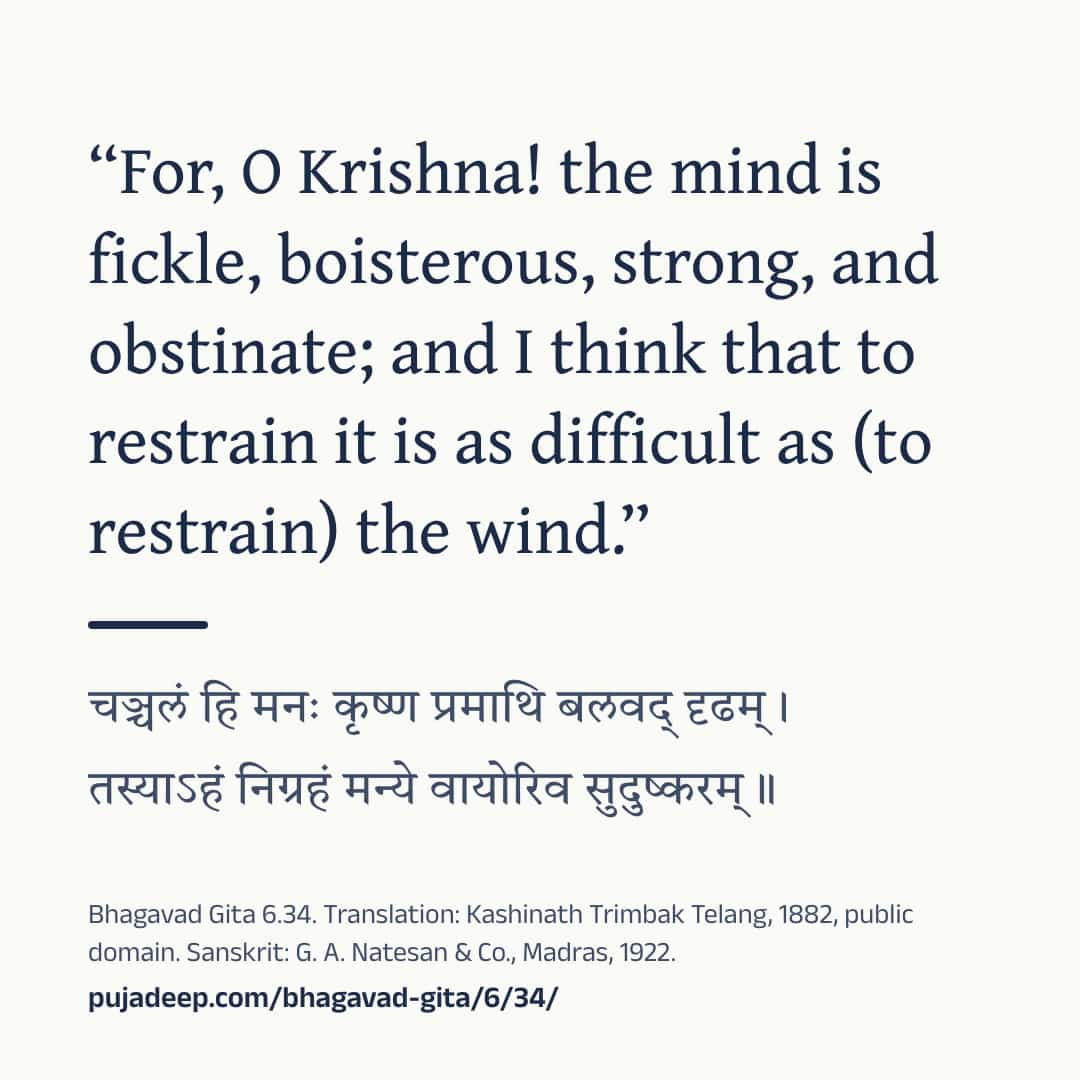
Drawing the picture
See the words
Bhagavad Gita 6.34

चञ्चलं हि मनः कृष्ण प्रमाथि बलवद् दृढम् ।
तस्याऽहं निग्रहं मन्ये वायोरिव सुदुष्करम् ॥

“For, O Krishna! the mind is fickle, boisterous, strong, and obstinate; and I think that to restrain it is as difficult as (to restrain) the wind.”
(K. T. Telang, The Bhagavadgîtâ (The Sacred Books of the East, vol. VIII, Oxford: Clarendon Press, 1882), p. 71, public domain)

“For Manas is verily restless, O Krishna; it is impetuous, strong and difficult to bend; I deem it as hard to curb as the wind.”
(Annie Besant, The Bhagavad Gîtâ, or The Lord's Song (London: Theosophical Publishing Society, 1895), p. 71, public domain)
This sentence begins in 6.33.

“Verily, the mind, O Krishna, is restless, turbulent, strong, and unyielding; I regard it quite as hard to achieve its control, as that of the wind.”
(Swami Swarupananda, Srimad-Bhagavad-Gita (Mayavati: Prabuddha Bharata Press, 1909; first printed in Prabuddha Bharata, 1907–1909), p. 136, public domain)

Sanskrit: G. A. Natesan & Co., Madras, 1922.
https://pujadeep.com/bhagavad-gita/6/34/ Nothing is sent from this site. Your own app sends it, to the chat you choose. The picture quotes the translation you chose on this page, with its name and year.
Sanskrit text: The Bhagavad-Gita, or The Lord's Song, with the text in Devanagari and an English translation, 1922. Meanings: written for Pujadeep and checked against the cited edition. Source and changes
Questions families ask
Who speaks Bhagavad Gita 6.34?
Arjuna speaks this verse, in chapter 6 (Dhyana Yoga).
Where does the Sanskrit text come from?
Sanskrit text: The Bhagavad-Gita, or The Lord's Song, with the text in Devanagari and an English translation, 1922. Meanings: written for Pujadeep and checked against the cited edition. See the source
Is the meaning on this page a translation?
Explanation written for this site from the sources listed here, and checked against the cited edition. It is not a translation and not the only way to read the text. Free to quote with credit.
Source and licence
- Sanskrit text
- The Bhagavad-Gita, or The Lord's Song, with the text in Devanagari and an English translation (Annie Besant, G. A. Natesan & Co., Madras, 1922). Public domain. The Sanskrit on these pages was read from this printing’s page images.
- Translation
- The Bhagavadgîtâ with the Sanatsugâtîya and the Anugîtâ, translated by Kâshinâth Trimbak Telang (The Sacred Books of the East, vol. VIII, ed. F. Max Müller) (Kashinath Trimbak Telang, F. Max Müller, Clarendon Press, Oxford, 1882). Public domain. Shown verbatim, as printed.
- Translation
- The Bhagavad Gîtâ, or The Lord's Song, translated by Annie Besant (Annie Besant, Theosophical Publishing Society, London, 1895). Public domain. Shown verbatim, as printed.
- Translation
- Srimad-Bhagavad-Gita, with Sanskrit Text; Paraphrase with Word-by-word Literal Translation; English Rendering and Comments, Index, &c., by the Swami Swarupananda (Himalayan Series, No. XX) (Swami Swarupananda, The Editors and Publishers, Advaita Ashrama, Mayavati, Prabuddha Bharata Press, Mayavati, Almora, Himalayas, 1909). Public domain. Shown verbatim, as printed.
- Common wording
- In this text, 32 words follow today's common wording, checked against sanskritdocuments.org; Sanskrit Wikisource; Gita Press, Gorakhpur; GRETIL, Göttingen and Bhaktivedanta Book Trust.
- Our explanation
- Explanation written for this site from the sources listed here, and checked against the cited edition. It is not a translation and not the only way to read the text. Free to quote with credit.
- Checked
- Checked against the cited edition, October 15, 2026.
- Updated
- October 25, 2026