Bhagavad Gita 6.37: meaning and translation
Chapter 6: Dhyana Yoga. Arjuna says
Arjuna asks a new question.
Click or tap a word for its meaning and its dictionary page.
Text and layers
Text and layers
These choices stay in this browser.
Bhagavad Gita 6.37
अर्जुन उवाच ।
अयतिः श्रद्धयोपेतो योगाच्चलितमानसः ।अप्राप्य योगसंसिद्धिं कां गतिं कृष्ण गच्छति ॥
Ayatih shraddhayopeto yogachchalitamanasahAprapya yogasansiddhim kam gatim krishna gachchhati
ayatiḥ śraddhayopeto yogāccalitamānasaḥ |aprāpya yogasaṃsiddhiṃ kāṃ gatiṃ kṛṣṇa gacchati ||
Our explanation Arjuna asks a new question. What becomes of the person who has faith but does not strive enough, whose mind slips away from yoga, and who does not reach the fulfilment of yoga? What way does he go?
हिंदी अर्थ अर्जुन एक नया प्रश्न पूछते हैं। जिसमें श्रद्धा तो है पर जो पर्याप्त प्रयत्न नहीं करता, जिसका मन योग से हट जाता है, और जो योग की सिद्धि तक नहीं पहुँचता, उसकी क्या गति होती है?
Word by word
Every word, with its dictionary page
Word by word
- अयतिः ayatiḥ · not striving enough (adjective (masculine), nominative singular) Dictionary: a-yati, Monier-Williams 1899, p. 84, col. 3 “no ascetic”
- श्रद्धया śraddhayā · with faith (noun (feminine), instrumental singular) Dictionary: śraddhā, Monier-Williams 1899, p. 1095, col. 3 “faith, trust, confidence, trustfulness, faithfulness, belief in”
- उपेतः upetaḥ · endowed (past participle (masculine), nominative singular) Dictionary: upeta, Monier-Williams 1899, p. 215, col. 3 “accompanied by, endowed with, furnished with, having, possessing”
- योगात् yogāt · from yoga (noun (masculine), ablative singular) Dictionary: yoga, Monier-Williams 1899, p. 856, col. 2 “the act of yoking, joining, attaching”
- चलितमानसः calitamānasaḥ · whose mind has slipped (compound (masculine), nominative singular) Dictionary: calita, Monier-Williams 1899, p. 391, col. 2 “moved from one's usual course, disturbed, disordered”; mānasa, Monier-Williams 1899, p. 810, col. 1 “n. (ifc. f. ā) the mental powers, mind, spirit”
- अप्राप्य aprāpya · not reaching (absolutive (having done)) Dictionary: 2. a-prāpya, Monier-Williams 1899, p. 59, col. 2 “not having obtained; not reaching”
- योगसंसिद्धिम् yogasaṃsiddhim · the fulfilment of yoga (compound (feminine), accusative singular) Dictionary: yoga, Monier-Williams 1899, p. 856, col. 2 “the act of yoking, joining, attaching”; saṃ-siddhi, Monier-Williams 1899, p. 1119, col. 2 “complete accomplishment or fulfilment, perfection, success”
- काम् kām · what (pronoun (feminine), accusative singular) Dictionary: kim, Monier-Williams 1899, p. 282, col. 2 “what? how? whence? wherefore? why?”
- गतिम् gatim · way, end (noun (feminine), accusative singular) Dictionary: gati, Monier-Williams 1899, p. 347, col. 3 “path, way, course”
- कृष्ण kṛṣṇa · O Krishna (noun (masculine), vocative singular) Dictionary: kṛṣṇa, Monier-Williams 1899, p. 306, col. 2 “N. of a celebrated Avatār of the god Vishṇu, or sometimes identified with Vishṇu himself”
- गच्छति gacchati · goes (present, 3rd person singular) Dictionary: 1. gam, Monier-Williams 1899, p. 347, col. 1 “to go, move, go away, set out, come”
Old translations
Kashinath Trimbak Telang, 1882. Public domain. Page 72.
Arguna said:
What is the end of him, O Krishna! who does not attain the consummation of his devotion, being not assiduous1, and having a mind shaken off from devotion, (though) full of faith?
Footnotes (the translator’s own) - Cf. p. 73 infra. ↩
Compare 3 translations
Kashinath Trimbak Telang, 1882. Public domain. Page 72.
Arguna said:
What is the end of him, O Krishna! who does not attain the consummation of his devotion, being not assiduous1, and having a mind shaken off from devotion, (though) full of faith?
Footnotes (the translator’s own) - Cf. p. 73 infra. ↩
You are reading this one
Annie Besant, 1895. Public domain. Page 72.
Arjuna said:
He who is unsubdued but who possesseth faith, with Manas wandering away from Yoga, and who faileth to attain perfection in Yoga, by what road doth he go, O Krishna?
You are reading this one
Swami Swarupananda, 1909 (first printed 1907). Public domain. Page 138.
Arjuna said:
Though possessed of Shraddhá but unable to control himself, with the mind wandering away from Yoga, what end does one, failing to gain perfection in Yoga, meet, O Krishna?
You are reading this one
Cite this verse
The translation: K. T. Telang, The Bhagavadgîtâ (The Sacred Books of the East, vol. VIII, Oxford: Clarendon Press, 1882), p. 72. Bhagavad Gita 6.37.
The translation: Annie Besant, The Bhagavad Gîtâ, or The Lord's Song (London: Theosophical Publishing Society, 1895), p. 72. Bhagavad Gita 6.37.
The translation: Swami Swarupananda, Srimad-Bhagavad-Gita (Mayavati: Prabuddha Bharata Press, 1909; first printed in Prabuddha Bharata, 1907–1909), p. 138. Bhagavad Gita 6.37.
Our explanation: “Bhagavad Gita 6.37: meaning and translation.” Pujadeep. Updated October 25, 2026. https://pujadeep.com/bhagavad-gita/6/37/
Pujadeep’s explanations are free to quote with credit: name Pujadeep and link to the page. How to credit
Classical readings, by school
No readings by school on this verse yet.
Share
Show the ways to share
Send one picture or the text to one chat. The picture names its source and the address of this page.
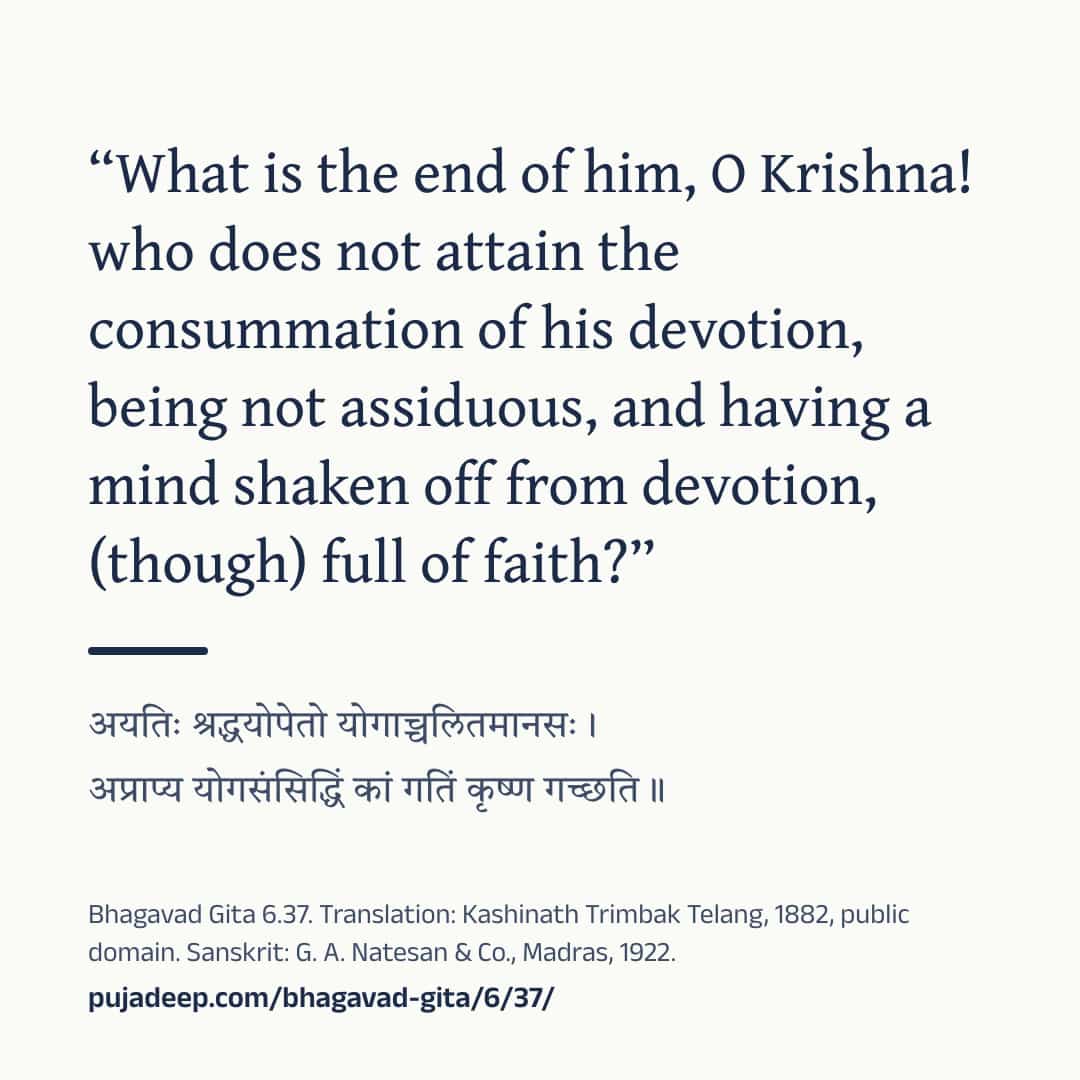
Drawing the picture
See the words
Bhagavad Gita 6.37

अयतिः श्रद्धयोपेतो योगाच्चलितमानसः ।
अप्राप्य योगसंसिद्धिं कां गतिं कृष्ण गच्छति ॥

“What is the end of him, O Krishna! who does not attain the consummation of his devotion, being not assiduous, and having a mind shaken off from devotion, (though) full of faith?”
(K. T. Telang, The Bhagavadgîtâ (The Sacred Books of the East, vol. VIII, Oxford: Clarendon Press, 1882), p. 72, public domain)

“He who is unsubdued but who possesseth faith, with Manas wandering away from Yoga, and who faileth to attain perfection in Yoga, by what road doth he go, O Krishna?”
(Annie Besant, The Bhagavad Gîtâ, or The Lord's Song (London: Theosophical Publishing Society, 1895), p. 72, public domain)

“Though possessed of Shraddhá but unable to control himself, with the mind wandering away from Yoga, what end does one, failing to gain perfection in Yoga, meet, O Krishna?”
(Swami Swarupananda, Srimad-Bhagavad-Gita (Mayavati: Prabuddha Bharata Press, 1909; first printed in Prabuddha Bharata, 1907–1909), p. 138, public domain)

Sanskrit: G. A. Natesan & Co., Madras, 1922.
https://pujadeep.com/bhagavad-gita/6/37/ Nothing is sent from this site. Your own app sends it, to the chat you choose. The picture quotes the translation you chose on this page, with its name and year.
Sanskrit text: The Bhagavad-Gita, or The Lord's Song, with the text in Devanagari and an English translation, 1922. Meanings: written for Pujadeep and checked against the cited edition. Source and changes
Questions families ask
Who speaks Bhagavad Gita 6.37?
Arjuna speaks this verse, in chapter 6 (Dhyana Yoga).
Where does the Sanskrit text come from?
Sanskrit text: The Bhagavad-Gita, or The Lord's Song, with the text in Devanagari and an English translation, 1922. Meanings: written for Pujadeep and checked against the cited edition. See the source
Is the meaning on this page a translation?
Explanation written for this site from the sources listed here, and checked against the cited edition. It is not a translation and not the only way to read the text. Free to quote with credit.
Source and licence
- Sanskrit text
- The Bhagavad-Gita, or The Lord's Song, with the text in Devanagari and an English translation (Annie Besant, G. A. Natesan & Co., Madras, 1922). Public domain. The Sanskrit on these pages was read from this printing’s page images.
- Translation
- The Bhagavadgîtâ with the Sanatsugâtîya and the Anugîtâ, translated by Kâshinâth Trimbak Telang (The Sacred Books of the East, vol. VIII, ed. F. Max Müller) (Kashinath Trimbak Telang, F. Max Müller, Clarendon Press, Oxford, 1882). Public domain. Shown verbatim, as printed.
- Translation
- The Bhagavad Gîtâ, or The Lord's Song, translated by Annie Besant (Annie Besant, Theosophical Publishing Society, London, 1895). Public domain. Shown verbatim, as printed.
- Translation
- Srimad-Bhagavad-Gita, with Sanskrit Text; Paraphrase with Word-by-word Literal Translation; English Rendering and Comments, Index, &c., by the Swami Swarupananda (Himalayan Series, No. XX) (Swami Swarupananda, The Editors and Publishers, Advaita Ashrama, Mayavati, Prabuddha Bharata Press, Mayavati, Almora, Himalayas, 1909). Public domain. Shown verbatim, as printed.
- Common wording
- In this text, 32 words follow today's common wording, checked against sanskritdocuments.org; Sanskrit Wikisource; Gita Press, Gorakhpur; GRETIL, Göttingen and Bhaktivedanta Book Trust.
- Our explanation
- Explanation written for this site from the sources listed here, and checked against the cited edition. It is not a translation and not the only way to read the text. Free to quote with credit.
- Checked
- Checked against the cited edition, October 15, 2026.
- Updated
- October 25, 2026