Bhagavad Gita 6.38: meaning and translation
Chapter 6: Dhyana Yoga. Arjuna says
Arjuna asks whether such a person, fallen from both, perishes like a torn cloud, without support and confused on the path to Brahman.
Click or tap a word for its meaning and its dictionary page.
Text and layers
Text and layers
These choices stay in this browser.
Bhagavad Gita 6.38
कच्चिन्नोभयविभ्रष्टश्छिन्नाभ्रमिव नश्यति ।अप्रतिष्ठो महाबाहो विमूढो ब्रह्मणः पथि ॥
Kachchinnobhayavibhrashtashchhinnabhramiva nashyatiApratishtho mahabaho vimudho brahmanah pathi
kaccinnobhayavibhraṣṭaśchinnābhramiva naśyati |apratiṣṭho mahābāho vimūḍho brahmaṇaḥ pathi ||
Our explanation Arjuna asks whether such a person, fallen from both, perishes like a torn cloud, without support and confused on the path to Brahman. The commentators explain 'both' (see the views).
हिंदी अर्थ अर्जुन पूछते हैं कि क्या ऐसा व्यक्ति दोनों ओर से गिरकर, बिखरे बादल की तरह, बिना सहारे के और ब्रह्म के मार्ग में भ्रमित होकर नष्ट हो जाता है? टीकाकार “दोनों” का अर्थ समझाते हैं।
Word by word
Every word, with its dictionary page
Word by word
- कच्चित् kaccit · is it that? (indeclinable) Dictionary: 2. kad, Monier-Williams 1899, p. 247, col. 3 “kac-cid is also used, like the simple kad, as a particle of interrogation”
- न na · not (indeclinable) Dictionary: 2. na, Monier-Williams 1899, p. 523, col. 1 “ind. not, no, nor, neither”
- उभयविभ्रष्टः ubhayavibhraṣṭaḥ · fallen from both (compound (masculine), nominative singular) Dictionary: ubhaya, Monier-Williams 1899, p. 216, col. 2 “both, of both kinds”; vi-bhraṣṭa, Monier-Williams 1899, p. 979, col. 2 “fallen, sunk”
- छिन्नाभ्रम् chinnābhram · a torn cloud (compound (neuter), nominative singular) Dictionary: chinnābhra, Monier-Williams 1899, p. 1327, col. 2 “a cloud torn asunder”
- इव iva · like (indeclinable) Dictionary: iva, Monier-Williams 1899, p. 168, col. 3 “like, in the same manner as”
- नश्यति naśyati · perishes (present, 3rd person singular) Dictionary: 2. naś, Monier-Williams 1899, p. 532, col. 1 “to be lost, perish, disappear, be gone”
- अप्रतिष्ठः apratiṣṭhaḥ · without support (adjective (masculine), nominative singular) Dictionary: a-pratiṣṭha, Monier-Williams 1899, p. 58, col. 1 “having no solid ground, no value, fluctuating, unsafe”
- महाबाहो mahābāho · O mighty-armed (noun (masculine), vocative singular) Dictionary: mahā-bāhu, Monier-Williams 1899, p. 798, col. 1 “long-armed”
- विमूढः vimūḍhaḥ · confused (past participle (masculine), nominative singular) Dictionary: vi-mūḍha, Monier-Williams 1899, p. 980, col. 3; vi-mugdha, Monier-Williams 1899, p. 980, col. 3 “confused, bewildered, infatuated”
- ब्रह्मणः brahmaṇaḥ · of Brahman (noun (neuter), genitive singular) Dictionary: brahman, Monier-Williams 1899, p. 738, col. 1 “one self-existent impersonal Spirit, the one universal Soul”
- पथि pathi · on the path (noun (masculine), locative singular) Dictionary: pathin, Monier-Williams 1899, p. 582, col. 3 “a way, path, road, course”
Old translations
Kashinath Trimbak Telang, 1882. Public domain. Page 72.
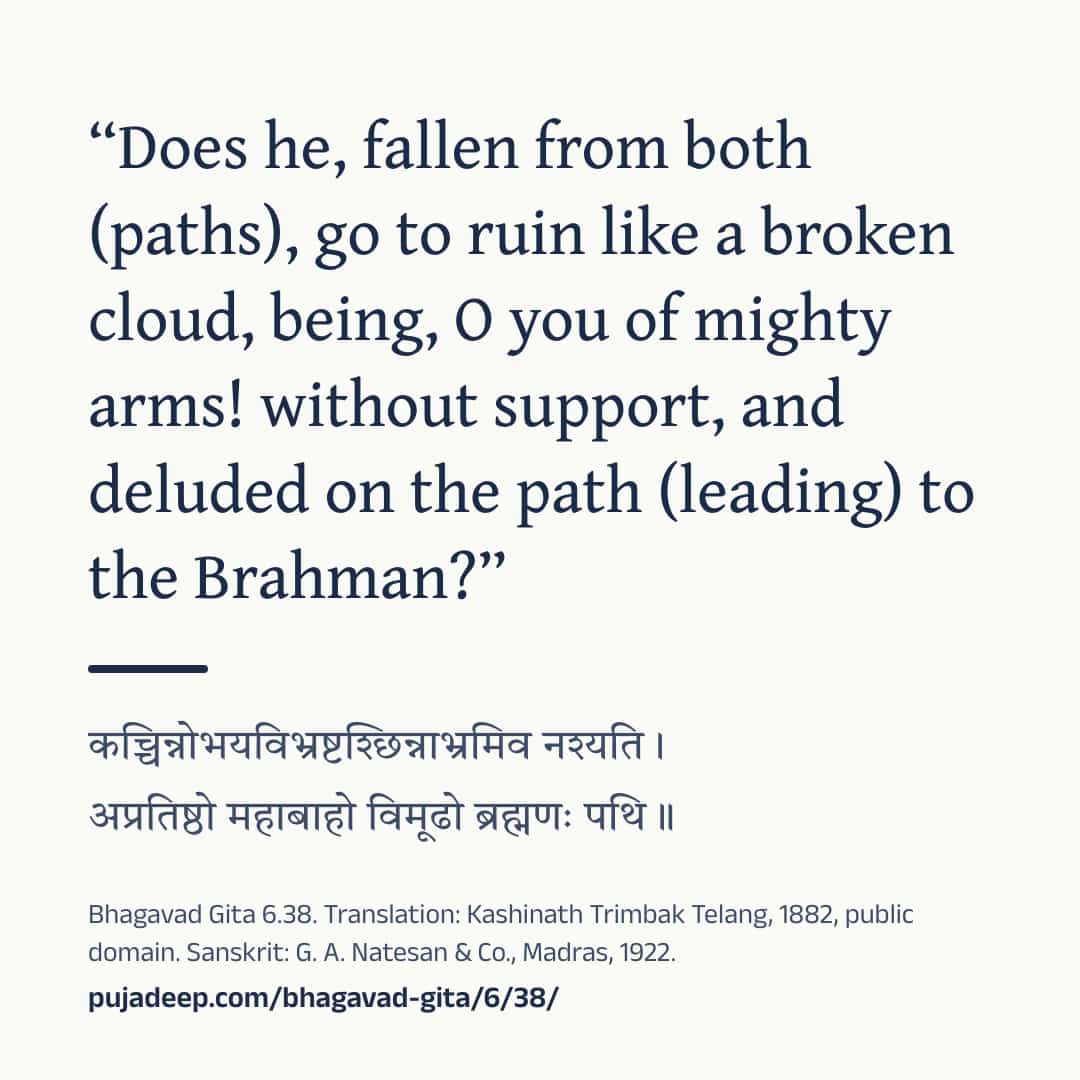
Does he, fallen from both (paths)1, go to ruin like a broken cloud, being, O you of mighty arms! without support, and deluded on the path (leading) to the Brahman?
Footnotes (the translator’s own) - The path to heaven, and that to final emancipation. ↩
Compare 3 translations
Kashinath Trimbak Telang, 1882. Public domain. Page 72.
Does he, fallen from both (paths)1, go to ruin like a broken cloud, being, O you of mighty arms! without support, and deluded on the path (leading) to the Brahman?
Footnotes (the translator’s own) - The path to heaven, and that to final emancipation. ↩
You are reading this one
Annie Besant, 1895. Public domain. Page 72.
Fallen from both, is he destroyed like a rent cloud, unsteadfast, O mighty-armed, deluded in the path of Brahman?
You are reading this one
Swami Swarupananda, 1909 (first printed 1907). Public domain. Page 138–139.
Does he not, fallen from both, perish, without support, like a rent cloud, O mighty-armed, deluded in the path of Brahman?
You are reading this one
Cite this verse
The translation: K. T. Telang, The Bhagavadgîtâ (The Sacred Books of the East, vol. VIII, Oxford: Clarendon Press, 1882), p. 72. Bhagavad Gita 6.38.
The translation: Annie Besant, The Bhagavad Gîtâ, or The Lord's Song (London: Theosophical Publishing Society, 1895), p. 72. Bhagavad Gita 6.38.
The translation: Swami Swarupananda, Srimad-Bhagavad-Gita (Mayavati: Prabuddha Bharata Press, 1909; first printed in Prabuddha Bharata, 1907–1909), pp. 138–139. Bhagavad Gita 6.38.
Our explanation: “Bhagavad Gita 6.38: meaning and translation.” Pujadeep. Updated October 25, 2026. https://pujadeep.com/bhagavad-gita/6/38/
Pujadeep’s explanations are free to quote with credit: name Pujadeep and link to the page. How to credit
Classical readings, by school
Each reading is named by its school. None is presented as the only meaning.
What Advaita, Vishishtadvaita and Dvaita teach, in short
Shankara Advaita
Shankara takes 'both' to be the path of action and the path of yoga: the renunciant has given up the works that bring results in this world and the next, but has not yet gained the knowledge that yoga brings.
Source: The Bhagavad-Gita, with the commentary of Sri Sankaracharya, translated by A. Mahadeva Sastri (2nd ed., Mysore: G. T. A. Printing Works, 1901), commentary on 6.37–38, p. 184. Summarised in our own words; none of its text is reproduced.
Ramanuja Vishishtadvaita
Ramanuja takes 'both' to be the two goals the seeker could have had: the enjoyments of heaven, which come from works, and the realisation of the self, which comes from yoga.
Source: Sri Bhagavad-Gita with Sri Ramanujacharya's Visishtadvaita commentary, translated by A. Govindacharya (Madras, 1898), commentary on 6.37–39, pp. 213–215. Summarised in our own words; none of its text is reproduced.
Share
Show the ways to share
Send one picture or the text to one chat. The picture names its source and the address of this page.
Drawing the picture
See the words
Bhagavad Gita 6.38

कच्चिन्नोभयविभ्रष्टश्छिन्नाभ्रमिव नश्यति ।
अप्रतिष्ठो महाबाहो विमूढो ब्रह्मणः पथि ॥

“Does he, fallen from both (paths), go to ruin like a broken cloud, being, O you of mighty arms! without support, and deluded on the path (leading) to the Brahman?”
(K. T. Telang, The Bhagavadgîtâ (The Sacred Books of the East, vol. VIII, Oxford: Clarendon Press, 1882), p. 72, public domain)

“Fallen from both, is he destroyed like a rent cloud, unsteadfast, O mighty-armed, deluded in the path of Brahman?”
(Annie Besant, The Bhagavad Gîtâ, or The Lord's Song (London: Theosophical Publishing Society, 1895), p. 72, public domain)

“Does he not, fallen from both, perish, without support, like a rent cloud, O mighty-armed, deluded in the path of Brahman?”
(Swami Swarupananda, Srimad-Bhagavad-Gita (Mayavati: Prabuddha Bharata Press, 1909; first printed in Prabuddha Bharata, 1907–1909), pp. 138–139, public domain)

Sanskrit: G. A. Natesan & Co., Madras, 1922.
https://pujadeep.com/bhagavad-gita/6/38/ Nothing is sent from this site. Your own app sends it, to the chat you choose. The picture quotes the translation you chose on this page, with its name and year.
Sanskrit text: The Bhagavad-Gita, or The Lord's Song, with the text in Devanagari and an English translation, 1922. Meanings: written for Pujadeep and checked against the cited edition. Source and changes
Questions families ask
Who speaks Bhagavad Gita 6.38?
Arjuna speaks this verse, in chapter 6 (Dhyana Yoga).
Where does the Sanskrit text come from?
Sanskrit text: The Bhagavad-Gita, or The Lord's Song, with the text in Devanagari and an English translation, 1922. Meanings: written for Pujadeep and checked against the cited edition. See the source
Is the meaning on this page a translation?
Explanation written for this site from the sources listed here, and checked against the cited edition. It is not a translation and not the only way to read the text. Free to quote with credit.
Source and licence
- Sanskrit text
- The Bhagavad-Gita, or The Lord's Song, with the text in Devanagari and an English translation (Annie Besant, G. A. Natesan & Co., Madras, 1922). Public domain. The Sanskrit on these pages was read from this printing’s page images.
- Translation
- The Bhagavadgîtâ with the Sanatsugâtîya and the Anugîtâ, translated by Kâshinâth Trimbak Telang (The Sacred Books of the East, vol. VIII, ed. F. Max Müller) (Kashinath Trimbak Telang, F. Max Müller, Clarendon Press, Oxford, 1882). Public domain. Shown verbatim, as printed.
- Translation
- The Bhagavad Gîtâ, or The Lord's Song, translated by Annie Besant (Annie Besant, Theosophical Publishing Society, London, 1895). Public domain. Shown verbatim, as printed.
- Translation
- Srimad-Bhagavad-Gita, with Sanskrit Text; Paraphrase with Word-by-word Literal Translation; English Rendering and Comments, Index, &c., by the Swami Swarupananda (Himalayan Series, No. XX) (Swami Swarupananda, The Editors and Publishers, Advaita Ashrama, Mayavati, Prabuddha Bharata Press, Mayavati, Almora, Himalayas, 1909). Public domain. Shown verbatim, as printed.
- Commentary
- The Bhagavad-Gita, with the commentary of Sri Sankaracharya, translated by A. Mahadeva Sastri (2nd ed., Mysore: G. T. A. Printing Works, 1901) (Public-domain scan, University of California Libraries). Summarised in our own words; none of its text is reproduced.
- Commentary
- Sri Bhagavad-Gita with Sri Ramanujacharya's Visishtadvaita commentary, translated by A. Govindacharya (Madras, 1898) (Scan uploaded to archive.org (folkscanomy collection)). Summarised in our own words; none of its text is reproduced.
- Common wording
- In this text, 32 words follow today's common wording, checked against sanskritdocuments.org; Sanskrit Wikisource; Gita Press, Gorakhpur; GRETIL, Göttingen and Bhaktivedanta Book Trust.
- Our explanation
- Explanation written for this site from the sources listed here, and checked against the cited edition. It is not a translation and not the only way to read the text. Free to quote with credit.
- Checked
- Checked against the cited edition, October 15, 2026.
- Updated
- October 25, 2026