Bhagavad Gita 6.31: meaning and translation
Chapter 6: Dhyana Yoga. Krishna says
The yogī who, standing in oneness (ekatva), worships Krishna as present in all beings, lives in Krishna, Krishna says, whatever his way of life.
Click or tap a word for its meaning and its dictionary page.
Text and layers
Text and layers
These choices stay in this browser.
Bhagavad Gita 6.31
सर्वभूतस्थितं यो मां भजत्येकत्वमास्थितः ।सर्वथा वर्त्तमानोऽपि स योगी मयि वर्तते ॥
Sarvabhutasthitam yo mam bhajatyekatvamasthitahSarvatha varttamanopi sa yogi mayi vartate
sarvabhūtasthitaṃ yo māṃ bhajatyekatvamāsthitaḥ |sarvathā varttamāno’pi sa yogī mayi vartate ||
Our explanation The yogī who, standing in oneness (ekatva), worships Krishna as present in all beings, lives in Krishna, Krishna says, whatever his way of life.
हिंदी अर्थ कृष्ण कहते हैं कि जो योगी एकत्व में स्थित होकर उन्हें सब प्राणियों में स्थित मानकर भजता है, वह किसी भी प्रकार से रहे, कृष्ण में ही रहता है।
Word by word
Every word, with its dictionary page
Word by word
- सर्वभूतस्थितम् sarvabhūtasthitam · present in all beings (compound (masculine), accusative singular) Dictionary: sarva-bhūta, Monier-Williams 1899, p. 1186, col. 2 “all beings”; sthita, Monier-Williams 1899, p. 1264, col. 1 “standing, staying, situated, resting or abiding or remaining in”
- यः yaḥ · who (pronoun (masculine), nominative singular) Dictionary: yad, Monier-Williams 1899, p. 844, col. 2 “who, which, what, whichever, whatever, that”
- माम् mām · "me" (Krishna) (pronoun, accusative singular) Dictionary: 1. mad, Monier-Williams 1899, p. 777, col. 2 “base of the first pers. pron. in the sg. number (esp. in comp.)”
- भजति bhajati · worships (present, 3rd person singular) Dictionary: bhaj, Monier-Williams 1899, p. 743, col. 1 “to serve, honour, revere, love, adore”
- एकत्वम् ekatvam · oneness (noun (neuter), accusative singular) Dictionary: eka-tva, Monier-Williams 1899, p. 228, col. 1 “oneness, unity, union, coincidence, identity”
- आस्थितः āsthitaḥ · standing in (past participle (masculine), nominative singular) Dictionary: ā-sthita, Monier-Williams 1899, p. 161, col. 2 “staying or sitting on, dwelling on, abiding”
- सर्वथा sarvathā · in every way (indeclinable) Dictionary: sarvathā, Monier-Williams 1899, p. 1189, col. 2 “in every way, in ev° respect, by all means”
- वर्त्तमानः varttamānaḥ · living (present participle (masculine), nominative singular) Dictionary: 1. vṛt, Monier-Williams 1899, p. 1009, col. 1 “to be, live, exist, be found, remain, stay, abide, dwell”
- अपि api · even (indeclinable) Dictionary: api, Monier-Williams 1899, p. 55, col. 1 “in the sense of even, also, very”
- सः saḥ · he (pronoun (masculine), nominative singular) Dictionary: tad, Monier-Williams 1899, p. 434, col. 1 “m. he, f. she, n. it, that, this”
- योगी yogī · that yogī (noun (masculine), nominative singular) Dictionary: yogin, Monier-Williams 1899, p. 857, col. 3 “a follower of the Yoga system, a Yogin (usually called Yogī) or contemplative saint”
- मयि mayi · in "me" (Krishna) (pronoun, locative singular) Dictionary: 1. mad, Monier-Williams 1899, p. 777, col. 2 “base of the first pers. pron. in the sg. number (esp. in comp.)”
- वर्तते vartate · lives (present, 3rd person singular) Dictionary: 1. vṛt, Monier-Williams 1899, p. 1009, col. 1 “to be, live, exist, be found, remain, stay, abide, dwell”
1 printing differs
Edition differences. Another printing or text reads this place differently.
- Spelling A digital text reads Same word. The 1922 edition writes वर्त्तमानो with a doubled त after र, an accepted optional spelling (Pāṇini 8.4.46); this e-text and another digital text write वर्तमानो. The same verse's वर्तते is printed with one त.
Old translations
Kashinath Trimbak Telang, 1882. Public domain. Page 71.
The devotee who worships me abiding in all beings, holding that all is one1, lives in me, however he may be living2.
Footnotes (the translator’s own) Compare 3 translations
Kashinath Trimbak Telang, 1882. Public domain. Page 71.
The devotee who worships me abiding in all beings, holding that all is one1, lives in me, however he may be living2.
Footnotes (the translator’s own) You are reading this one
Annie Besant, 1895. Public domain. Page 70–71.
He who, established in unity, worshippeth Me, abiding in all beings, that Yogî cometh to Me, whatever his mode of existence.
You are reading this one
Swami Swarupananda, 1909 (first printed 1907). Public domain. Page 135.
He who worships Me, dwelling in all beings, being established in unity, whatever his mode of life, that Yogi abides in Me.
You are reading this one
Cite this verse
The translation: K. T. Telang, The Bhagavadgîtâ (The Sacred Books of the East, vol. VIII, Oxford: Clarendon Press, 1882), p. 71. Bhagavad Gita 6.31.
The translation: Annie Besant, The Bhagavad Gîtâ, or The Lord's Song (London: Theosophical Publishing Society, 1895), pp. 70–71. Bhagavad Gita 6.31.
The translation: Swami Swarupananda, Srimad-Bhagavad-Gita (Mayavati: Prabuddha Bharata Press, 1909; first printed in Prabuddha Bharata, 1907–1909), p. 135. Bhagavad Gita 6.31.
Our explanation: “Bhagavad Gita 6.31: meaning and translation.” Pujadeep. Updated October 25, 2026. https://pujadeep.com/bhagavad-gita/6/31/
Pujadeep’s explanations are free to quote with credit: name Pujadeep and link to the page. How to credit
Classical readings, by school
Each reading is named by its school. None is presented as the only meaning.
What Advaita, Vishishtadvaita and Dvaita teach, in short
Shankara Advaita
Shankara says such a person of right knowledge dwells in the supreme state, the state of Vishnu, and nothing blocks his path to liberation, whatever his way of life.
Source: The Bhagavad-Gita, with the commentary of Sri Sankaracharya, translated by A. Mahadeva Sastri (2nd ed., Mysore: G. T. A. Printing Works, 1901), commentary on 6.31, p. 181. Summarised in our own words; none of its text is reproduced.
Ramanuja Vishishtadvaita
Ramanuja reads 'oneness' as setting aside the differences that matter creates, and 'whatever his way of life' as 'whether in meditation or out of it'. Such a yogī always sees the Lord alone in himself and in all beings.
Source: Sri Bhagavad-Gita with Sri Ramanujacharya's Visishtadvaita commentary, translated by A. Govindacharya (Madras, 1898), commentary on 6.31, pp. 209–210. Summarised in our own words; none of its text is reproduced.
Share
Show the ways to share
Send one picture or the text to one chat. The picture names its source and the address of this page.
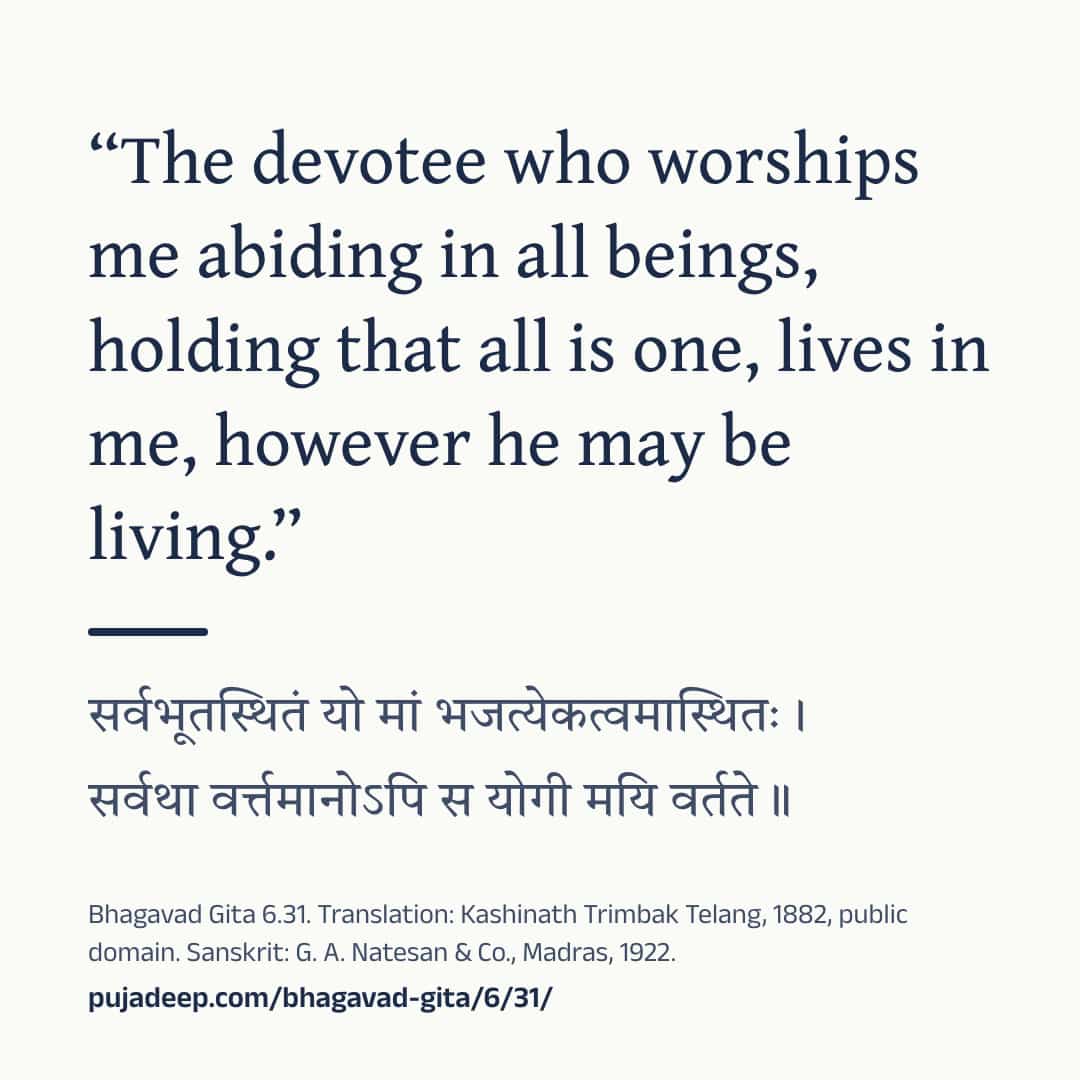
Drawing the picture
See the words
Bhagavad Gita 6.31

सर्वभूतस्थितं यो मां भजत्येकत्वमास्थितः ।
सर्वथा वर्त्तमानोऽपि स योगी मयि वर्तते ॥

“The devotee who worships me abiding in all beings, holding that all is one, lives in me, however he may be living.”
(K. T. Telang, The Bhagavadgîtâ (The Sacred Books of the East, vol. VIII, Oxford: Clarendon Press, 1882), p. 71, public domain)

“He who, established in unity, worshippeth Me, abiding in all beings, that Yogî cometh to Me, whatever his mode of existence.”
(Annie Besant, The Bhagavad Gîtâ, or The Lord's Song (London: Theosophical Publishing Society, 1895), pp. 70–71, public domain)

“He who worships Me, dwelling in all beings, being established in unity, whatever his mode of life, that Yogi abides in Me.”
(Swami Swarupananda, Srimad-Bhagavad-Gita (Mayavati: Prabuddha Bharata Press, 1909; first printed in Prabuddha Bharata, 1907–1909), p. 135, public domain)

Sanskrit: G. A. Natesan & Co., Madras, 1922.
https://pujadeep.com/bhagavad-gita/6/31/ Nothing is sent from this site. Your own app sends it, to the chat you choose. The picture quotes the translation you chose on this page, with its name and year.
Sanskrit text: The Bhagavad-Gita, or The Lord's Song, with the text in Devanagari and an English translation, 1922. Meanings: written for Pujadeep and checked against the cited edition. Source and changes
Questions families ask
Who speaks Bhagavad Gita 6.31?
Krishna speaks this verse, in chapter 6 (Dhyana Yoga).
Where does the Sanskrit text come from?
Sanskrit text: The Bhagavad-Gita, or The Lord's Song, with the text in Devanagari and an English translation, 1922. Meanings: written for Pujadeep and checked against the cited edition. See the source
Is the meaning on this page a translation?
Explanation written for this site from the sources listed here, and checked against the cited edition. It is not a translation and not the only way to read the text. Free to quote with credit.
Source and licence
- Sanskrit text
- The Bhagavad-Gita, or The Lord's Song, with the text in Devanagari and an English translation (Annie Besant, G. A. Natesan & Co., Madras, 1922). Public domain. The Sanskrit on these pages was read from this printing’s page images.
- Translation
- The Bhagavadgîtâ with the Sanatsugâtîya and the Anugîtâ, translated by Kâshinâth Trimbak Telang (The Sacred Books of the East, vol. VIII, ed. F. Max Müller) (Kashinath Trimbak Telang, F. Max Müller, Clarendon Press, Oxford, 1882). Public domain. Shown verbatim, as printed.
- Translation
- The Bhagavad Gîtâ, or The Lord's Song, translated by Annie Besant (Annie Besant, Theosophical Publishing Society, London, 1895). Public domain. Shown verbatim, as printed.
- Translation
- Srimad-Bhagavad-Gita, with Sanskrit Text; Paraphrase with Word-by-word Literal Translation; English Rendering and Comments, Index, &c., by the Swami Swarupananda (Himalayan Series, No. XX) (Swami Swarupananda, The Editors and Publishers, Advaita Ashrama, Mayavati, Prabuddha Bharata Press, Mayavati, Almora, Himalayas, 1909). Public domain. Shown verbatim, as printed.
- Commentary
- The Bhagavad-Gita, with the commentary of Sri Sankaracharya, translated by A. Mahadeva Sastri (2nd ed., Mysore: G. T. A. Printing Works, 1901) (Public-domain scan, University of California Libraries). Summarised in our own words; none of its text is reproduced.
- Commentary
- Sri Bhagavad-Gita with Sri Ramanujacharya's Visishtadvaita commentary, translated by A. Govindacharya (Madras, 1898) (Scan uploaded to archive.org (folkscanomy collection)). Summarised in our own words; none of its text is reproduced.
- Common wording
- In this text, 32 words follow today's common wording, checked against sanskritdocuments.org; Sanskrit Wikisource; Gita Press, Gorakhpur; GRETIL, Göttingen and Bhaktivedanta Book Trust.
- Our explanation
- Explanation written for this site from the sources listed here, and checked against the cited edition. It is not a translation and not the only way to read the text. Free to quote with credit.
- Checked
- Checked against the cited edition, October 15, 2026.
- Updated
- October 25, 2026