Bhagavad Gita 6.21: meaning and translation
Chapter 6: Dhyana Yoga. Krishna says
Krishna: In that state, the sentence goes on, a person knows a boundless joy that the understanding (buddhi) can grasp but the senses cannot, and, once settled there, does not move away from the truth.
Click or tap a word for its meaning and its dictionary page.
Text and layers
Text and layers
These choices stay in this browser.
Bhagavad Gita 6.21
सुखमात्यन्तिकं यत्तद् बुद्धिग्राह्यमतीन्द्रियम् ।वेत्ति यत्र न चैवाऽयं स्थितश्चलति तत्त्वतः ॥
Sukhamatyantikam yattad buddhigrahyamatindriyamVetti yatra na chaivayam sthitashchalati tattvatah
sukhamātyantikaṃ yattad buddhigrāhyamatīndriyam |vetti yatra na caivā’yaṃ sthitaścalati tattvataḥ ||
Our explanation In that state, the sentence goes on, a person knows a boundless joy that the understanding (buddhi) can grasp but the senses cannot, and, once settled there, does not move away from the truth.
हिंदी अर्थ वाक्य आगे कहता है कि उस अवस्था में व्यक्ति उस असीम सुख को जानता है जिसे बुद्धि ग्रहण कर सकती है पर इंद्रियाँ नहीं, और वहाँ स्थित होकर वह सत्य से नहीं हटता।
Word by word
Every word, with its dictionary page
Word by word
- सुखम् sukham · joy (noun (neuter), accusative singular) Dictionary: sukha, Monier-Williams 1899, p. 1221, col. 1 “ease, easiness, comfort, prosperity, pleasure, happiness”
- आत्यन्तिकम् ātyantikam · boundless (adjective (neuter), accusative singular) Dictionary: ātyantika, Monier-Williams 1899, p. 136, col. 1 “continual, uninterrupted, infinite, endless”
- यत् yat · which (pronoun (neuter), accusative singular) Dictionary: yad, Monier-Williams 1899, p. 844, col. 2 “who, which, what, whichever, whatever, that”
- तत् tat · that (pronoun (neuter), accusative singular) Dictionary: tad, Monier-Williams 1899, p. 434, col. 1 “m. he, f. she, n. it, that, this”
- बुद्धिग्राह्यम् buddhigrāhyam · grasped by the understanding (compound (neuter), accusative singular) Dictionary: buddhi, Monier-Williams 1899, p. 733, col. 3 “intelligence, reason, intellect, mind, discernment, judgment”; grāhya, Monier-Williams 1899, p. 373, col. 1 “to be perceived or recognised or understood”
- अतीन्द्रियम् atīndriyam · beyond the senses (adjective (neuter), accusative singular) Dictionary: atīndriya, Monier-Williams 1899, p. 16, col. 2 “beyond the (cognizance of the) senses”
- वेत्ति vetti · knows (present, 3rd person singular) Dictionary: 1. vid, Monier-Williams 1899, p. 963, col. 2 “to know, understand, perceive, learn”
- यत्र yatra · where (indeclinable) Dictionary: yatra, Monier-Williams 1899, p. 841, col. 2 “in or to which place, where, wherein, wherever”
- न na · not (indeclinable) Dictionary: 2. na, Monier-Williams 1899, p. 523, col. 1 “ind. not, no, nor, neither”
- च ca · and (indeclinable) Dictionary: 2. ca, Monier-Williams 1899, p. 380, col. 1 “ind. and, both, also, moreover, as well as”
- एव eva · indeed (indeclinable) Dictionary: 1. eva, Monier-Williams 1899, p. 232, col. 2 “just, exactly, very, same, only, even, alone, merely”
- अयम् ayam · he (pronoun (masculine), nominative singular) Dictionary: 1. idam, Monier-Williams 1899, p. 165, col. 2 “this, this here, referring to something near the speaker”
- स्थितः sthitaḥ · settled (past participle (masculine), nominative singular) Dictionary: sthita, Monier-Williams 1899, p. 1264, col. 1 “standing, staying, situated, resting or abiding or remaining in”
- चलति calati · moves away (present, 3rd person singular) Dictionary: cal, Monier-Williams 1899, p. 391, col. 1 “to be moved, stir, tremble, shake, quiver, be agitated”
- तत्त्वतः tattvataḥ · from the truth (indeclinable) Dictionary: tattva, Monier-Williams 1899, p. 433, col. 1 “according to the true state or nature of anything, in truth”
1 printing differs
Edition differences. Another printing or text reads this place differently.
- Spelling A digital text reads Same words. The 1922 edition marks the merged vowel with an avagraha (चैवाऽयं); this e-text does not.
Old translations
Kashinath Trimbak Telang, 1882. Public domain.
Telang translates verses 20–23 as one sentence; see 6.20. Read it at 6.20
Compare 3 translations
Kashinath Trimbak Telang, 1882. Public domain.
Telang translates verses 20–23 as one sentence; see 6.20. Read it at 6.20
You are reading this one
Annie Besant, 1895. Public domain. Page 69.
When he knoweth the infinite delight grasped by Buddhi, beyond the senses, and, established therein, moveth not from the Reality;
This sentence begins in 6.20. This sentence goes on in 6.22.
You are reading this one
Swami Swarupananda, 1909 (first printed 1907). Public domain.
Swarupananda renders verses 20–23 together; see 6.20. Read it at 6.20
You are reading this one
Cite this verse
The translation: K. T. Telang, The Bhagavadgîtâ (The Sacred Books of the East, vol. VIII, Oxford: Clarendon Press, 1882), pp. 69–70. Bhagavad Gita 6.20–23.
The translation: Annie Besant, The Bhagavad Gîtâ, or The Lord's Song (London: Theosophical Publishing Society, 1895), p. 69. Bhagavad Gita 6.21.
The translation: Swami Swarupananda, Srimad-Bhagavad-Gita (Mayavati: Prabuddha Bharata Press, 1909; first printed in Prabuddha Bharata, 1907–1909), pp. 131–132. Bhagavad Gita 6.20–23.
Our explanation: “Bhagavad Gita 6.21: meaning and translation.” Pujadeep. Updated October 25, 2026. https://pujadeep.com/bhagavad-gita/6/21/
Pujadeep’s explanations are free to quote with credit: name Pujadeep and link to the page. How to credit
Classical readings, by school
No readings by school on this verse yet.
Share
Show the ways to share
Send one picture or the text to one chat. The picture names its source and the address of this page.
Drawing the picture
See the words
Bhagavad Gita 6.21

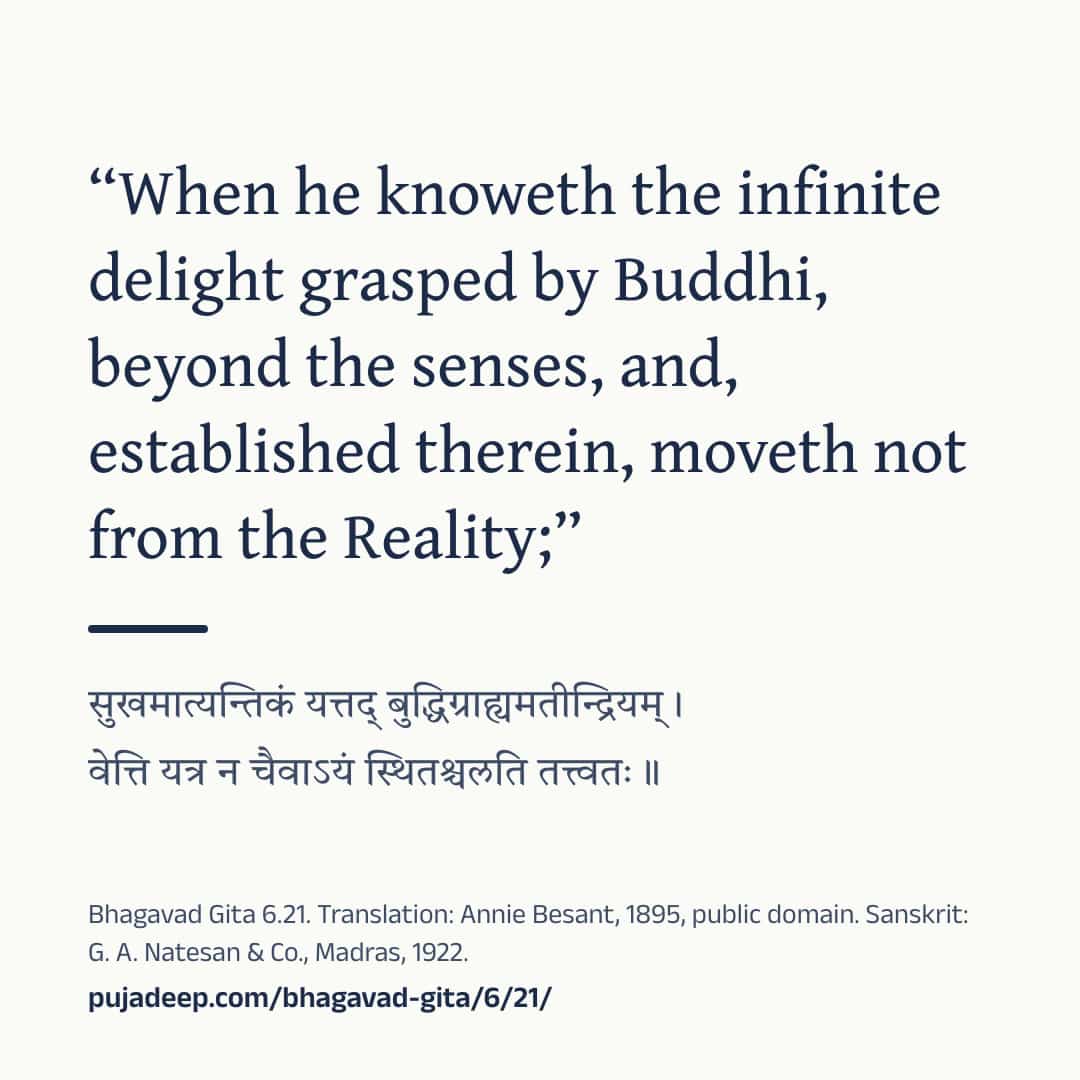
सुखमात्यन्तिकं यत्तद् बुद्धिग्राह्यमतीन्द्रियम् ।
वेत्ति यत्र न चैवाऽयं स्थितश्चलति तत्त्वतः ॥

“When he knoweth the infinite delight grasped by Buddhi, beyond the senses, and, established therein, moveth not from the Reality;”
(Annie Besant, The Bhagavad Gîtâ, or The Lord's Song (London: Theosophical Publishing Society, 1895), p. 69, public domain)
This sentence begins in 6.20. This sentence goes on in 6.22.

Sanskrit: G. A. Natesan & Co., Madras, 1922.
https://pujadeep.com/bhagavad-gita/6/21/ Nothing is sent from this site. Your own app sends it, to the chat you choose. The picture quotes the translation you chose on this page, with its name and year.
Sanskrit text: The Bhagavad-Gita, or The Lord's Song, with the text in Devanagari and an English translation, 1922. Meanings: written for Pujadeep and checked against the cited edition. Source and changes
Questions families ask
Who speaks Bhagavad Gita 6.21?
Krishna speaks this verse, in chapter 6 (Dhyana Yoga).
Where does the Sanskrit text come from?
Sanskrit text: The Bhagavad-Gita, or The Lord's Song, with the text in Devanagari and an English translation, 1922. Meanings: written for Pujadeep and checked against the cited edition. See the source
Is the meaning on this page a translation?
Explanation written for this site from the sources listed here, and checked against the cited edition. It is not a translation and not the only way to read the text. Free to quote with credit.
Source and licence
- Sanskrit text
- The Bhagavad-Gita, or The Lord's Song, with the text in Devanagari and an English translation (Annie Besant, G. A. Natesan & Co., Madras, 1922). Public domain. The Sanskrit on these pages was read from this printing’s page images.
- Translation
- The Bhagavadgîtâ with the Sanatsugâtîya and the Anugîtâ, translated by Kâshinâth Trimbak Telang (The Sacred Books of the East, vol. VIII, ed. F. Max Müller) (Kashinath Trimbak Telang, F. Max Müller, Clarendon Press, Oxford, 1882). Public domain. Shown verbatim, as printed.
- Translation
- The Bhagavad Gîtâ, or The Lord's Song, translated by Annie Besant (Annie Besant, Theosophical Publishing Society, London, 1895). Public domain. Shown verbatim, as printed.
- Translation
- Srimad-Bhagavad-Gita, with Sanskrit Text; Paraphrase with Word-by-word Literal Translation; English Rendering and Comments, Index, &c., by the Swami Swarupananda (Himalayan Series, No. XX) (Swami Swarupananda, The Editors and Publishers, Advaita Ashrama, Mayavati, Prabuddha Bharata Press, Mayavati, Almora, Himalayas, 1909). Public domain. Shown verbatim, as printed.
- Common wording
- In this text, 32 words follow today's common wording, checked against sanskritdocuments.org; Sanskrit Wikisource; Gita Press, Gorakhpur; GRETIL, Göttingen and Bhaktivedanta Book Trust.
- Our explanation
- Explanation written for this site from the sources listed here, and checked against the cited edition. It is not a translation and not the only way to read the text. Free to quote with credit.
- Checked
- Checked against the cited edition, October 15, 2026.
- Updated
- October 25, 2026