Bhagavad Gita 6.12: meaning and translation
Chapter 6: Dhyana Yoga. Krishna says
Krishna: Sitting there, making the mind one-pointed and holding the workings of thought and senses in check, he should practise yoga for the purification of the self.
Click or tap a word for its meaning and its dictionary page.
Text and layers
Text and layers
These choices stay in this browser.
Bhagavad Gita 6.12
तत्रैकाग्रं मनः कृत्वा यतचित्तेन्द्रियक्रियः ।उपविश्यासने युञ्ज्याद्योगमात्मविशुद्धये ॥
Tatraikagram manah kritva yatachittendriyakriyahUpavishyasane yunjyadyogamatmavishuddhaye
tatraikāgraṃ manaḥ kṛtvā yatacittendriyakriyaḥ |upaviśyāsane yuñjyādyogamātmaviśuddhaye ||
Our explanation Sitting there, making the mind one-pointed and holding the workings of thought and senses in check, he should practise yoga for the purification of the self.
हिंदी अर्थ उस आसन पर बैठकर, मन को एकाग्र करके, चित्त और इंद्रियों की क्रियाओं को वश में रखकर, वह आत्मा की शुद्धि के लिए योग का अभ्यास करे।
Word by word
Every word, with its dictionary page
Word by word
- तत्र tatra · there (indeclinable) Dictionary: tatra, Monier-Williams 1899, p. 433, col. 2 “in that, therein, in that case”
- एकाग्रम् ekāgram · one-pointed (adjective (neuter), accusative singular) Dictionary: ekāgra, Monier-Williams 1899, p. 230, col. 1 “one-pointed, having one point, fixing one's attention upon one point or object, closely attentive”
- मनः manaḥ · the mind (noun (neuter), accusative singular) Dictionary: manas, Monier-Williams 1899, p. 783, col. 3 “mind (in its widest sense as applied to all the mental powers)”
- कृत्वा kṛtvā · making (absolutive (having done)) Dictionary: 1. kṛ, Monier-Williams 1899, p. 301, col. 1 “to do, make, perform, accomplish, cause, effect”
- यतचित्तेन्द्रियक्रियः yatacittendriyakriyaḥ · holding thought and senses in check (compound (masculine), nominative singular) Dictionary: yata, Monier-Williams 1899, p. 845, col. 2 “restrained, held in, held forth, kept down or limited, subdued, governed, controlled”; citta, Monier-Williams 1899, p. 395, col. 3 “the heart, mind”; indriya, Monier-Williams 1899, p. 167, col. 2 “faculty of sense, sense, organ of sense”; kriyā, Monier-Williams 1899, p. 320, col. 3 “doing, performing, performance”
- उपविश्य upaviśya · sitting (absolutive (having done)) Dictionary: upa-viś, Monier-Williams 1899, p. 207, col. 1 “to sit down, take a seat”
- आसने āsane · on the seat (noun (neuter), locative singular) Dictionary: 1. āsana, Monier-Williams 1899, p. 159, col. 3 “seat, place, stool”
- युञ्ज्यात् yuñjyāt · should practise (optative, 3rd person singular) Dictionary: 1. yuj, Monier-Williams 1899, p. 853, col. 2 “to yoke or join or fasten or harness”
- योगम् yogam · yoga (noun (masculine), accusative singular) Dictionary: yoga, Monier-Williams 1899, p. 856, col. 2 “the act of yoking, joining, attaching”
- आत्मविशुद्धये ātmaviśuddhaye · for the purification of the self (compound (feminine), dative singular) Dictionary: ātman, Monier-Williams 1899, p. 135, col. 1 “the individual soul, self”; vi-śuddhi, Monier-Williams 1899, p. 991, col. 2 “complete purification, purity (also fig.), holiness, virtue”
Old translations
Kashinath Trimbak Telang, 1882. Public domain.
Telang translates verses 11–12 as one sentence; see 6.11. Read it at 6.11
Compare 3 translations
Kashinath Trimbak Telang, 1882. Public domain.
Telang translates verses 11–12 as one sentence; see 6.11. Read it at 6.11
You are reading this one
Annie Besant, 1895. Public domain. Page 67.
There, having made Manas one-pointed, with thought and the functions of the senses subdued, steady on his seat, he should practise Yoga, for the purification of the self.
This sentence begins in 6.11.
You are reading this one
Swami Swarupananda, 1909 (first printed 1907). Public domain. Page 127.
There, seated on that seat, making the mind one-pointed, and subduing the action of the imaging faculty and the senses, let him practise Yoga for the purification of the heart.
This sentence begins in 6.11.
You are reading this one
Cite this verse
The translation: K. T. Telang, The Bhagavadgîtâ (The Sacred Books of the East, vol. VIII, Oxford: Clarendon Press, 1882), pp. 68–69. Bhagavad Gita 6.11–12.
The translation: Annie Besant, The Bhagavad Gîtâ, or The Lord's Song (London: Theosophical Publishing Society, 1895), p. 67. Bhagavad Gita 6.12.
The translation: Swami Swarupananda, Srimad-Bhagavad-Gita (Mayavati: Prabuddha Bharata Press, 1909; first printed in Prabuddha Bharata, 1907–1909), p. 127. Bhagavad Gita 6.12.
Our explanation: “Bhagavad Gita 6.12: meaning and translation.” Pujadeep. Updated October 25, 2026. https://pujadeep.com/bhagavad-gita/6/12/
Pujadeep’s explanations are free to quote with credit: name Pujadeep and link to the page. How to credit
Classical readings, by school
No readings by school on this verse yet.
Share
Show the ways to share
Send one picture or the text to one chat. The picture names its source and the address of this page.
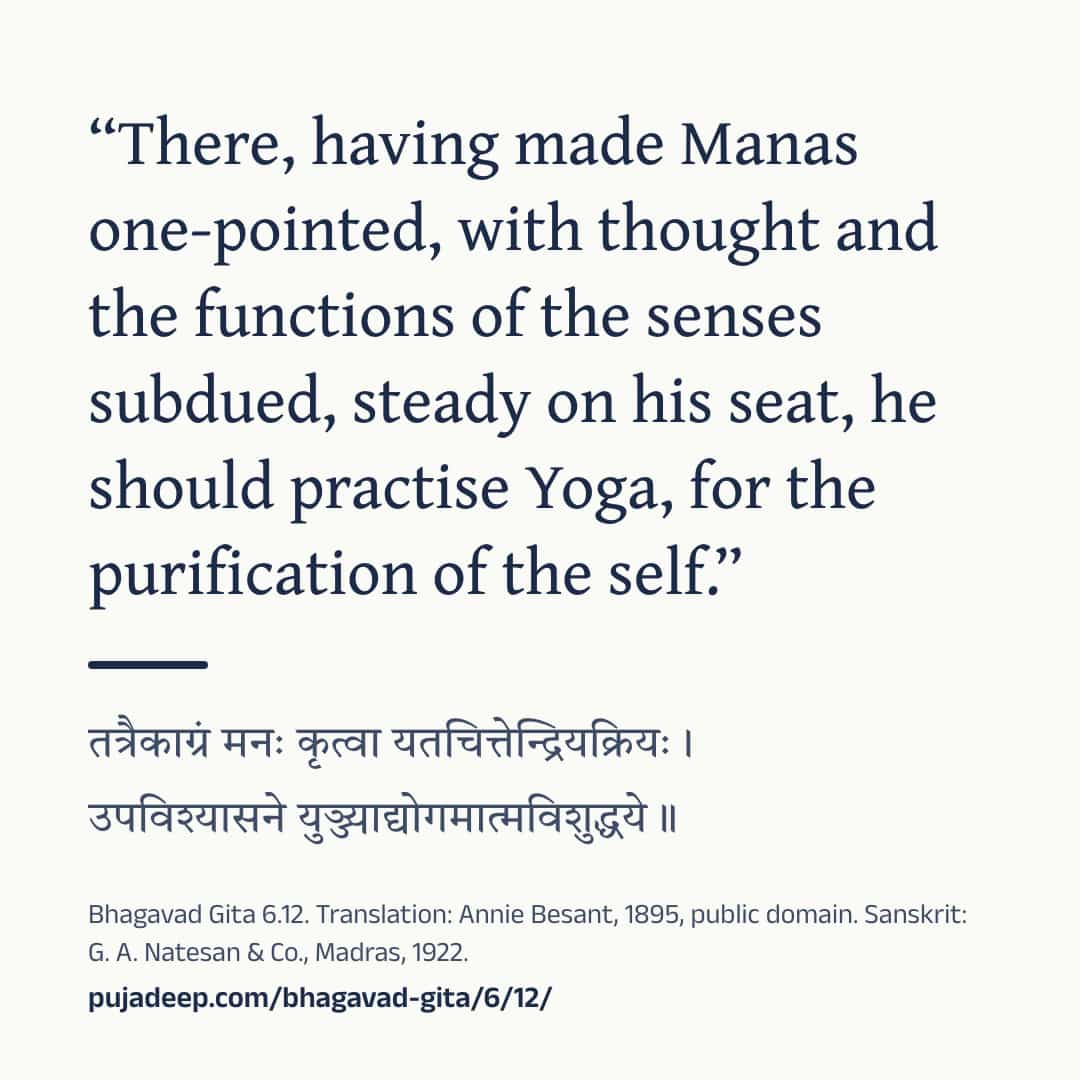
Drawing the picture
See the words
Bhagavad Gita 6.12

तत्रैकाग्रं मनः कृत्वा यतचित्तेन्द्रियक्रियः ।
उपविश्यासने युञ्ज्याद्योगमात्मविशुद्धये ॥

“There, having made Manas one-pointed, with thought and the functions of the senses subdued, steady on his seat, he should practise Yoga, for the purification of the self.”
(Annie Besant, The Bhagavad Gîtâ, or The Lord's Song (London: Theosophical Publishing Society, 1895), p. 67, public domain)
This sentence begins in 6.11.

“There, seated on that seat, making the mind one-pointed, and subduing the action of the imaging faculty and the senses, let him practise Yoga for the purification of the heart.”
(Swami Swarupananda, Srimad-Bhagavad-Gita (Mayavati: Prabuddha Bharata Press, 1909; first printed in Prabuddha Bharata, 1907–1909), p. 127, public domain)
This sentence begins in 6.11.

Sanskrit: G. A. Natesan & Co., Madras, 1922.
https://pujadeep.com/bhagavad-gita/6/12/ Nothing is sent from this site. Your own app sends it, to the chat you choose. The picture quotes the translation you chose on this page, with its name and year.
Sanskrit text: The Bhagavad-Gita, or The Lord's Song, with the text in Devanagari and an English translation, 1922. Meanings: written for Pujadeep and checked against the cited edition. Source and changes
Questions families ask
Who speaks Bhagavad Gita 6.12?
Krishna speaks this verse, in chapter 6 (Dhyana Yoga).
Where does the Sanskrit text come from?
Sanskrit text: The Bhagavad-Gita, or The Lord's Song, with the text in Devanagari and an English translation, 1922. Meanings: written for Pujadeep and checked against the cited edition. See the source
Is the meaning on this page a translation?
Explanation written for this site from the sources listed here, and checked against the cited edition. It is not a translation and not the only way to read the text. Free to quote with credit.
Source and licence
- Sanskrit text
- The Bhagavad-Gita, or The Lord's Song, with the text in Devanagari and an English translation (Annie Besant, G. A. Natesan & Co., Madras, 1922). Public domain. The Sanskrit on these pages was read from this printing’s page images.
- Translation
- The Bhagavadgîtâ with the Sanatsugâtîya and the Anugîtâ, translated by Kâshinâth Trimbak Telang (The Sacred Books of the East, vol. VIII, ed. F. Max Müller) (Kashinath Trimbak Telang, F. Max Müller, Clarendon Press, Oxford, 1882). Public domain. Shown verbatim, as printed.
- Translation
- The Bhagavad Gîtâ, or The Lord's Song, translated by Annie Besant (Annie Besant, Theosophical Publishing Society, London, 1895). Public domain. Shown verbatim, as printed.
- Translation
- Srimad-Bhagavad-Gita, with Sanskrit Text; Paraphrase with Word-by-word Literal Translation; English Rendering and Comments, Index, &c., by the Swami Swarupananda (Himalayan Series, No. XX) (Swami Swarupananda, The Editors and Publishers, Advaita Ashrama, Mayavati, Prabuddha Bharata Press, Mayavati, Almora, Himalayas, 1909). Public domain. Shown verbatim, as printed.
- Common wording
- In this text, 32 words follow today's common wording, checked against sanskritdocuments.org; Sanskrit Wikisource; Gita Press, Gorakhpur; GRETIL, Göttingen and Bhaktivedanta Book Trust.
- Our explanation
- Explanation written for this site from the sources listed here, and checked against the cited edition. It is not a translation and not the only way to read the text. Free to quote with credit.
- Checked
- Checked against the cited edition, October 15, 2026.
- Updated
- October 25, 2026