Bhagavad Gita 6.14: meaning and translation
Chapter 6: Dhyana Yoga. Krishna says
Calm and fearless, firm in the vow of brahmacarya (the disciplined life of a celibate student), with the mind held in check and thinking of Krishna, he should sit joined in yoga, with Krishna as his highest goal.
Click or tap a word for its meaning and its dictionary page.
Text and layers
Text and layers
These choices stay in this browser.
Bhagavad Gita 6.14
प्रशान्तात्मा विगतभीर्ब्रह्मचारिव्रते स्थितः ।मनः संयम्य मच्चित्तो युक्त आसीत मत्परः ॥
Prashantatma vigatabhirbrahmacharivrate sthitahManah sanyamya machchitto yukta asita matparah
praśāntātmā vigatabhīrbrahmacārivrate sthitaḥ |manaḥ saṃyamya maccitto yukta āsīta matparaḥ ||
Our explanation Calm and fearless, firm in the vow of brahmacarya (the disciplined life of a celibate student), with the mind held in check and thinking of Krishna, he should sit joined in yoga, with Krishna as his highest goal.
हिंदी अर्थ शांत चित्त, निर्भय, ब्रह्मचर्य (संयमी विद्यार्थी के जीवन) के व्रत में स्थिर, मन को वश में रखकर और कृष्ण का चिंतन करते हुए, वह कृष्ण को परम लक्ष्य मानकर योग में युक्त होकर बैठे।
Word by word
Every word, with its dictionary page
Word by word
- प्रशान्तात्मा praśāntātmā · calm in mind (compound (masculine), nominative singular) Dictionary: pra-śāntātman, Monier-Williams 1899, p. 695, col. 2 “composed in mind, peaceful, calm”
- विगतभीः vigatabhīḥ · free from fear (compound (masculine), nominative singular) Dictionary: vi-gata-bhī, Monier-Williams 1899, p. 957, col. 1 “fearless”
- ब्रह्मचारिव्रते brahmacārivrate · in the vow of brahmacarya (compound (neuter), locative singular) Dictionary: brahma-cārin, Monier-Williams 1899, p. 738, col. 2 “practising sacred study as an unmarried student, observing chastity”; vrata, Monier-Williams 1899, p. 1042, col. 2 “a religious vow or practice, any pious observance”
- स्थितः sthitaḥ · firm (past participle (masculine), nominative singular) Dictionary: sthita, Monier-Williams 1899, p. 1264, col. 1 “standing, staying, situated, resting or abiding or remaining in”
- मनः manaḥ · the mind (noun (neuter), accusative singular) Dictionary: manas, Monier-Williams 1899, p. 783, col. 3 “mind (in its widest sense as applied to all the mental powers)”
- संयम्य saṃyamya · holding in check (absolutive (having done)) Dictionary: saṃ-yam, Monier-Williams 1899, p. 1111, col. 3 “to hold together, hold in, hold fast, restrain, curb, suppress, control”
- मच्चित्तः maccittaḥ · with thought on "me" (Krishna) (compound (masculine), nominative singular) Dictionary: mac-citta, Monier-Williams 1899, p. 777, col. 2 “having the mind (fixed) on me, thinking of me”
- युक्तः yuktaḥ · joined in yoga (past participle (masculine), nominative singular) Dictionary: yukta, Monier-Williams 1899, p. 853, col. 2 “yoked or joined or fastened or attached or harnessed”
- आसीत āsīta · should sit (optative, 3rd person singular) Dictionary: 2. ās, Monier-Williams 1899, p. 159, col. 3 “to sit, sit down, rest, lie”
- मत्परः matparaḥ · with "me" (Krishna) as the highest goal (compound (masculine), nominative singular) Dictionary: mat-para, Monier-Williams 1899, p. 777, col. 2 “devoted to me”
Old translations
Kashinath Trimbak Telang, 1882. Public domain.
Telang translates verses 13–14 as one sentence; see 6.13. Read it at 6.13
Compare 3 translations
Kashinath Trimbak Telang, 1882. Public domain.
Telang translates verses 13–14 as one sentence; see 6.13. Read it at 6.13
You are reading this one
Annie Besant, 1895. Public domain. Page 67–68.
The self serene, fearless, firm in the vow of the Brahmachârî, Manas controlled, thinking on Me, harmonised, let him sit concentrated on Me.
You are reading this one
Swami Swarupananda, 1909 (first printed 1907). Public domain. Page 128.
With the heart serene and fearless, firm in the vow of a Brahmachari, with the mind controlled, and ever thinking of Me, let him sit (in Yoga) having Me as his supreme goal.
You are reading this one
Cite this verse
The translation: K. T. Telang, The Bhagavadgîtâ (The Sacred Books of the East, vol. VIII, Oxford: Clarendon Press, 1882), p. 69. Bhagavad Gita 6.13–14.
The translation: Annie Besant, The Bhagavad Gîtâ, or The Lord's Song (London: Theosophical Publishing Society, 1895), pp. 67–68. Bhagavad Gita 6.14.
The translation: Swami Swarupananda, Srimad-Bhagavad-Gita (Mayavati: Prabuddha Bharata Press, 1909; first printed in Prabuddha Bharata, 1907–1909), p. 128. Bhagavad Gita 6.14.
Our explanation: “Bhagavad Gita 6.14: meaning and translation.” Pujadeep. Updated October 25, 2026. https://pujadeep.com/bhagavad-gita/6/14/
Pujadeep’s explanations are free to quote with credit: name Pujadeep and link to the page. How to credit
Classical readings, by school
No readings by school on this verse yet.
Share
Show the ways to share
Send one picture or the text to one chat. The picture names its source and the address of this page.
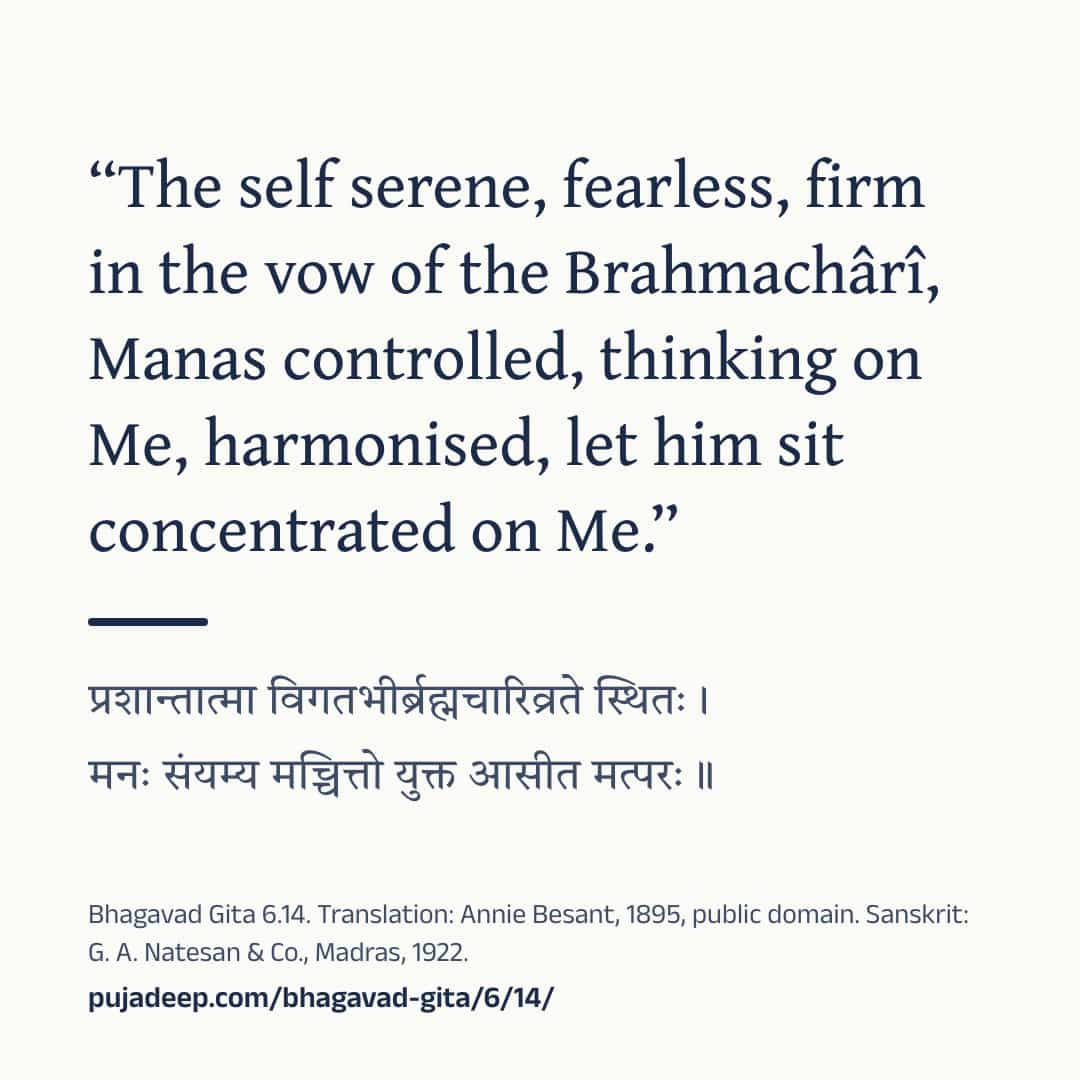
Drawing the picture
See the words
Bhagavad Gita 6.14

प्रशान्तात्मा विगतभीर्ब्रह्मचारिव्रते स्थितः ।
मनः संयम्य मच्चित्तो युक्त आसीत मत्परः ॥

“The self serene, fearless, firm in the vow of the Brahmachârî, Manas controlled, thinking on Me, harmonised, let him sit concentrated on Me.”
(Annie Besant, The Bhagavad Gîtâ, or The Lord's Song (London: Theosophical Publishing Society, 1895), pp. 67–68, public domain)

“With the heart serene and fearless, firm in the vow of a Brahmachari, with the mind controlled, and ever thinking of Me, let him sit (in Yoga) having Me as his supreme goal.”
(Swami Swarupananda, Srimad-Bhagavad-Gita (Mayavati: Prabuddha Bharata Press, 1909; first printed in Prabuddha Bharata, 1907–1909), p. 128, public domain)

Sanskrit: G. A. Natesan & Co., Madras, 1922.
https://pujadeep.com/bhagavad-gita/6/14/ Nothing is sent from this site. Your own app sends it, to the chat you choose. The picture quotes the translation you chose on this page, with its name and year.
Sanskrit text: The Bhagavad-Gita, or The Lord's Song, with the text in Devanagari and an English translation, 1922. Meanings: written for Pujadeep and checked against the cited edition. Source and changes
Questions families ask
Who speaks Bhagavad Gita 6.14?
Krishna speaks this verse, in chapter 6 (Dhyana Yoga).
Where does the Sanskrit text come from?
Sanskrit text: The Bhagavad-Gita, or The Lord's Song, with the text in Devanagari and an English translation, 1922. Meanings: written for Pujadeep and checked against the cited edition. See the source
Is the meaning on this page a translation?
Explanation written for this site from the sources listed here, and checked against the cited edition. It is not a translation and not the only way to read the text. Free to quote with credit.
Source and licence
- Sanskrit text
- The Bhagavad-Gita, or The Lord's Song, with the text in Devanagari and an English translation (Annie Besant, G. A. Natesan & Co., Madras, 1922). Public domain. The Sanskrit on these pages was read from this printing’s page images.
- Translation
- The Bhagavadgîtâ with the Sanatsugâtîya and the Anugîtâ, translated by Kâshinâth Trimbak Telang (The Sacred Books of the East, vol. VIII, ed. F. Max Müller) (Kashinath Trimbak Telang, F. Max Müller, Clarendon Press, Oxford, 1882). Public domain. Shown verbatim, as printed.
- Translation
- The Bhagavad Gîtâ, or The Lord's Song, translated by Annie Besant (Annie Besant, Theosophical Publishing Society, London, 1895). Public domain. Shown verbatim, as printed.
- Translation
- Srimad-Bhagavad-Gita, with Sanskrit Text; Paraphrase with Word-by-word Literal Translation; English Rendering and Comments, Index, &c., by the Swami Swarupananda (Himalayan Series, No. XX) (Swami Swarupananda, The Editors and Publishers, Advaita Ashrama, Mayavati, Prabuddha Bharata Press, Mayavati, Almora, Himalayas, 1909). Public domain. Shown verbatim, as printed.
- Common wording
- In this text, 32 words follow today's common wording, checked against sanskritdocuments.org; Sanskrit Wikisource; Gita Press, Gorakhpur; GRETIL, Göttingen and Bhaktivedanta Book Trust.
- Our explanation
- Explanation written for this site from the sources listed here, and checked against the cited edition. It is not a translation and not the only way to read the text. Free to quote with credit.
- Checked
- Checked against the cited edition, October 15, 2026.
- Updated
- October 25, 2026