Bhagavad Gita 6.17: meaning and translation
Chapter 6: Dhyana Yoga. Krishna says
Krishna says that for the one who is measured in food and recreation, measured in effort at work, and measured in sleeping and waking, yoga becomes the remover of sorrow.
Click or tap a word for its meaning and its dictionary page.
Text and layers
Text and layers
These choices stay in this browser.
Bhagavad Gita 6.17
युक्ताहारविहारस्य युक्तचेष्टस्य कर्मसु ।युक्तस्वप्नावबोधस्य योगो भवति दुःखहा ॥
Yuktaharaviharasya yuktacheshtasya karmasuYuktasvapnavabodhasya yogo bhavati duhkhaha
yuktāhāravihārasya yuktaceṣṭasya karmasu |yuktasvapnāvabodhasya yogo bhavati duḥkhahā ||
Our explanation Krishna says that for the one who is measured in food and recreation, measured in effort at work, and measured in sleeping and waking, yoga becomes the remover of sorrow.
हिंदी अर्थ कृष्ण कहते हैं कि जिसका आहार और विहार नियमित है, कर्मों में जिसका प्रयास संतुलित है, और जिसका सोना-जागना नियमित है, उसके लिए योग दुःखों को दूर करने वाला बनता है।
Word by word
Every word, with its dictionary page
Word by word
- युक्ताहारविहारस्य yuktāhāravihārasya · of one measured in food and recreation (compound (masculine), genitive singular) Dictionary: yukta, Monier-Williams 1899, p. 853, col. 3 “fit, suitable, appropriate, proper, right”; ā-hāra, Monier-Williams 1899, p. 163, col. 1 “taking food; food”; vi-hāra, Monier-Williams 1899, p. 1003, col. 3 “walking for pleasure or amusement, wandering, roaming”
- युक्तचेष्टस्य yuktaceṣṭasya · of one measured in effort (compound (masculine), genitive singular) Dictionary: yukta, Monier-Williams 1899, p. 853, col. 3 “fit, suitable, appropriate, proper, right”; ceṣṭa, Monier-Williams 1899, p. 402, col. 1 “action, activity, effort”
- कर्मसु karmasu · in actions (noun (neuter), locative plural) Dictionary: karman, Monier-Williams 1899, p. 258, col. 2 “act, action, performance, business”
- युक्तस्वप्नावबोधस्य yuktasvapnāvabodhasya · of one measured in sleep and waking (compound (masculine), genitive singular) Dictionary: yukta, Monier-Williams 1899, p. 853, col. 3 “fit, suitable, appropriate, proper, right”; svapna, Monier-Williams 1899, p. 1280, col. 3 “sleep, sleeping”; ava-bodha, Monier-Williams 1899, p. 101, col. 2 “waking, being awake”
- योगः yogaḥ · yoga (noun (masculine), nominative singular) Dictionary: yoga, Monier-Williams 1899, p. 856, col. 2 “the act of yoking, joining, attaching”
- भवति bhavati · becomes (present, 3rd person singular) Dictionary: 1. bhū, Monier-Williams 1899, p. 760, col. 2 “arise, come into being, exist”
- दुःखहा duḥkhahā · the remover of sorrow (compound (masculine), nominative singular) Dictionary: duḥkha-han, Monier-Williams 1899, p. 483, col. 3 “removing pain”
Old translations
Kashinath Trimbak Telang, 1882. Public domain. Page 69.
That devotion which destroys (all) misery is his, who takes due food and exercise1, who toils duly in all works, and who sleeps and awakes (in) due (time)2.
Footnotes (the translator’s own) Compare 3 translations
Kashinath Trimbak Telang, 1882. Public domain. Page 69.
That devotion which destroys (all) misery is his, who takes due food and exercise1, who toils duly in all works, and who sleeps and awakes (in) due (time)2.
Footnotes (the translator’s own) You are reading this one
Annie Besant, 1895. Public domain. Page 68.
The Yoga that is pain-destroying is for him who is regulated in eating and amusement, regulated in performing actions, regulated in sleeping and waking.
You are reading this one
Swami Swarupananda, 1909 (first printed 1907). Public domain. Page 129.
To him who is temperate in eating and recreation, in his effort for work, and in sleep and wakefulness, Yoga becomes the destroyer of misery.
You are reading this one
Cite this verse
The translation: K. T. Telang, The Bhagavadgîtâ (The Sacred Books of the East, vol. VIII, Oxford: Clarendon Press, 1882), p. 69. Bhagavad Gita 6.17.
The translation: Annie Besant, The Bhagavad Gîtâ, or The Lord's Song (London: Theosophical Publishing Society, 1895), p. 68. Bhagavad Gita 6.17.
The translation: Swami Swarupananda, Srimad-Bhagavad-Gita (Mayavati: Prabuddha Bharata Press, 1909; first printed in Prabuddha Bharata, 1907–1909), p. 129. Bhagavad Gita 6.17.
Our explanation: “Bhagavad Gita 6.17: meaning and translation.” Pujadeep. Updated October 25, 2026. https://pujadeep.com/bhagavad-gita/6/17/
Pujadeep’s explanations are free to quote with credit: name Pujadeep and link to the page. How to credit
Classical readings, by school
No readings by school on this verse yet.
Share
Show the ways to share
Send one picture or the text to one chat. The picture names its source and the address of this page.
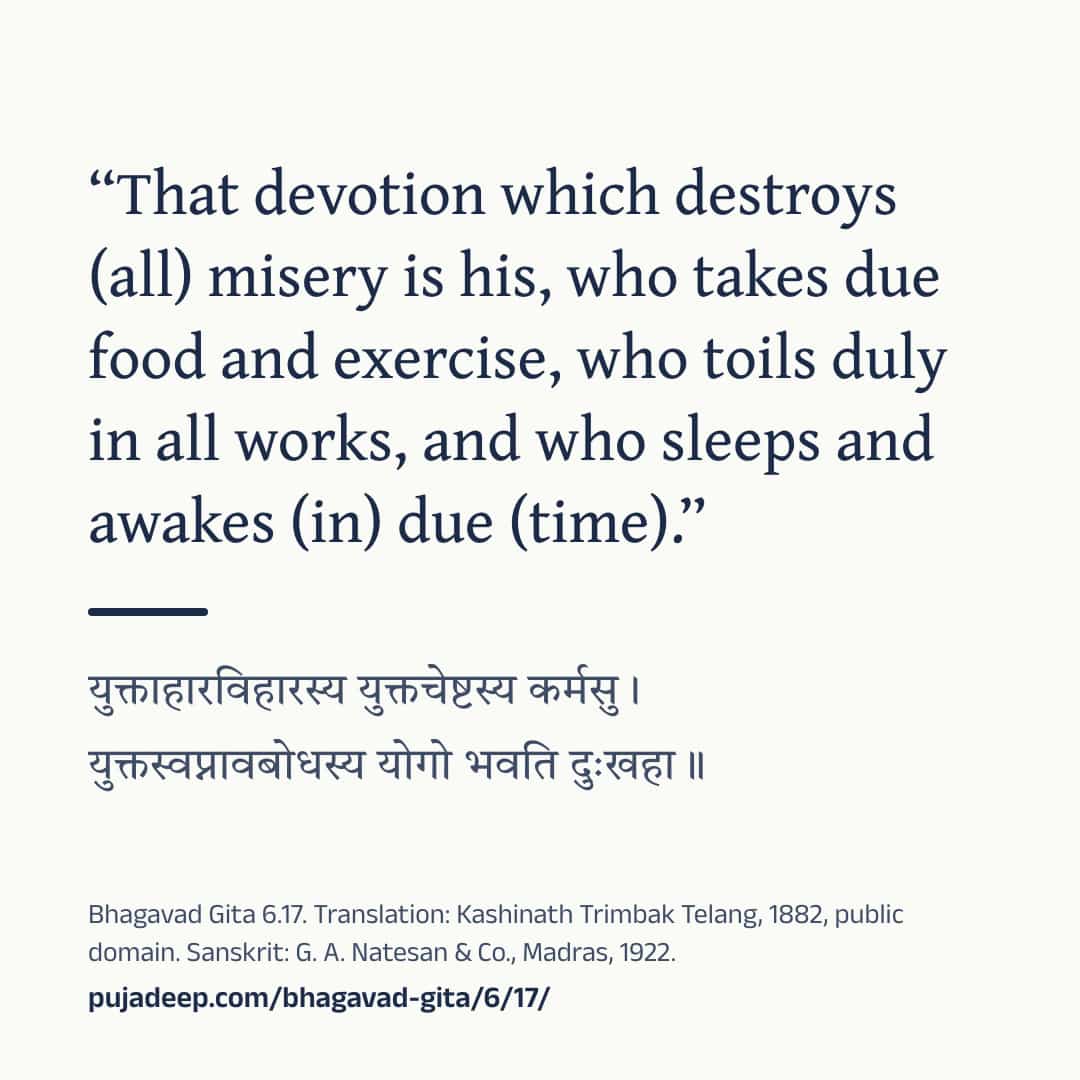
Drawing the picture
See the words
Bhagavad Gita 6.17

युक्ताहारविहारस्य युक्तचेष्टस्य कर्मसु ।
युक्तस्वप्नावबोधस्य योगो भवति दुःखहा ॥

“That devotion which destroys (all) misery is his, who takes due food and exercise, who toils duly in all works, and who sleeps and awakes (in) due (time).”
(K. T. Telang, The Bhagavadgîtâ (The Sacred Books of the East, vol. VIII, Oxford: Clarendon Press, 1882), p. 69, public domain)

“The Yoga that is pain-destroying is for him who is regulated in eating and amusement, regulated in performing actions, regulated in sleeping and waking.”
(Annie Besant, The Bhagavad Gîtâ, or The Lord's Song (London: Theosophical Publishing Society, 1895), p. 68, public domain)

“To him who is temperate in eating and recreation, in his effort for work, and in sleep and wakefulness, Yoga becomes the destroyer of misery.”
(Swami Swarupananda, Srimad-Bhagavad-Gita (Mayavati: Prabuddha Bharata Press, 1909; first printed in Prabuddha Bharata, 1907–1909), p. 129, public domain)

Sanskrit: G. A. Natesan & Co., Madras, 1922.
https://pujadeep.com/bhagavad-gita/6/17/ Nothing is sent from this site. Your own app sends it, to the chat you choose. The picture quotes the translation you chose on this page, with its name and year.
Sanskrit text: The Bhagavad-Gita, or The Lord's Song, with the text in Devanagari and an English translation, 1922. Meanings: written for Pujadeep and checked against the cited edition. Source and changes
Questions families ask
Who speaks Bhagavad Gita 6.17?
Krishna speaks this verse, in chapter 6 (Dhyana Yoga).
Where does the Sanskrit text come from?
Sanskrit text: The Bhagavad-Gita, or The Lord's Song, with the text in Devanagari and an English translation, 1922. Meanings: written for Pujadeep and checked against the cited edition. See the source
Is the meaning on this page a translation?
Explanation written for this site from the sources listed here, and checked against the cited edition. It is not a translation and not the only way to read the text. Free to quote with credit.
Source and licence
- Sanskrit text
- The Bhagavad-Gita, or The Lord's Song, with the text in Devanagari and an English translation (Annie Besant, G. A. Natesan & Co., Madras, 1922). Public domain. The Sanskrit on these pages was read from this printing’s page images.
- Translation
- The Bhagavadgîtâ with the Sanatsugâtîya and the Anugîtâ, translated by Kâshinâth Trimbak Telang (The Sacred Books of the East, vol. VIII, ed. F. Max Müller) (Kashinath Trimbak Telang, F. Max Müller, Clarendon Press, Oxford, 1882). Public domain. Shown verbatim, as printed.
- Translation
- The Bhagavad Gîtâ, or The Lord's Song, translated by Annie Besant (Annie Besant, Theosophical Publishing Society, London, 1895). Public domain. Shown verbatim, as printed.
- Translation
- Srimad-Bhagavad-Gita, with Sanskrit Text; Paraphrase with Word-by-word Literal Translation; English Rendering and Comments, Index, &c., by the Swami Swarupananda (Himalayan Series, No. XX) (Swami Swarupananda, The Editors and Publishers, Advaita Ashrama, Mayavati, Prabuddha Bharata Press, Mayavati, Almora, Himalayas, 1909). Public domain. Shown verbatim, as printed.
- Common wording
- In this text, 32 words follow today's common wording, checked against sanskritdocuments.org; Sanskrit Wikisource; Gita Press, Gorakhpur; GRETIL, Göttingen and Bhaktivedanta Book Trust.
- Our explanation
- Explanation written for this site from the sources listed here, and checked against the cited edition. It is not a translation and not the only way to read the text. Free to quote with credit.
- Checked
- Checked against the cited edition, October 15, 2026.
- Updated
- October 25, 2026