Bhagavad Gita 6.18: meaning and translation
Chapter 6: Dhyana Yoga. Krishna says
When the well-controlled mind rests in the self alone, free from craving for any object of desire, then a person is called 'joined in yoga' (yukta), Krishna says.
Click or tap a word for its meaning and its dictionary page.
Text and layers
Text and layers
These choices stay in this browser.
Bhagavad Gita 6.18
यदा विनियतं चित्तमात्मन्येवावतिष्ठते ।निःस्पृहः सर्वकामेभ्यो युक्त इत्युच्यते तदा ॥
Yada viniyatam chittamatmanyevavatishthateNihsprihah sarvakamebhyo yukta ityuchyate tada
yadā viniyataṃ cittamātmanyevāvatiṣṭhate |niḥspṛhaḥ sarvakāmebhyo yukta ityucyate tadā ||
Our explanation When the well-controlled mind rests in the self alone, free from craving for any object of desire, then a person is called 'joined in yoga' (yukta), Krishna says.
हिंदी अर्थ कृष्ण कहते हैं कि जब भली-भाँति वश में किया हुआ चित्त केवल आत्मा में स्थित रहता है, और किसी भी कामना की वस्तु के लिए लालसा नहीं रहती, तब व्यक्ति को युक्त कहा जाता है।
Word by word
Every word, with its dictionary page
Word by word
- यदा yadā · when (indeclinable) Dictionary: yadā, Monier-Williams 1899, p. 844, col. 1 “when, at what time, whenever”
- विनियतम् viniyatam · well controlled (past participle (neuter), nominative singular) Dictionary: vi-niyata, Monier-Williams 1899, p. 970, col. 2 “restrained, checked, regulated”
- चित्तम् cittam · the mind (noun (neuter), nominative singular) Dictionary: citta, Monier-Williams 1899, p. 395, col. 3 “the heart, mind”
- आत्मनि ātmani · in the self (noun (masculine), locative singular) Dictionary: ātman, Monier-Williams 1899, p. 135, col. 1 “the individual soul, self”
- एव eva · alone (indeclinable) Dictionary: 1. eva, Monier-Williams 1899, p. 232, col. 2 “just, exactly, very, same, only, even, alone, merely”
- अवतिष्ठते avatiṣṭhate · rests (present, 3rd person singular) Dictionary: ava-sthā, Monier-Williams 1899, p. 105, col. 3 “to stay, abide, stop at any place (loc.)”
- निःस्पृहः niḥspṛhaḥ · free from craving (adjective (masculine), nominative singular) Dictionary: niḥ-spṛha, Monier-Williams 1899, p. 539, col. 2 “free from desire, not longing for”
- सर्वकामेभ्यः sarvakāmebhyaḥ · for all desires (compound (masculine), ablative plural) Dictionary: sarva, Monier-Williams 1899, p. 1184, col. 3 “whole, entire, all, every”; kāma, Monier-Williams 1899, p. 271, col. 3 “wish, desire, longing”
- युक्तः yuktaḥ · joined in yoga (past participle (masculine), nominative singular) Dictionary: yukta, Monier-Williams 1899, p. 853, col. 2 “yoked or joined or fastened or attached or harnessed”
- इति iti · thus (indeclinable) Dictionary: 2. iti, Monier-Williams 1899, p. 165, col. 1 “in this manner, thus”
- उच्यते ucyate · is called (present passive, 3rd person singular) Dictionary: vac, Monier-Williams 1899, p. 912, col. 1 “to be called or accounted, be regarded as”
- तदा tadā · then (indeclinable) Dictionary: tadā, Monier-Williams 1899, p. 434, col. 3 “at that time, then, in that case”
Old translations
Kashinath Trimbak Telang, 1882. Public domain. Page 69.
When (a man's) mind well restrained becomes steady upon the self alone, then he being indifferent to all objects of desire, is said to be devoted.
Compare 3 translations
Kashinath Trimbak Telang, 1882. Public domain. Page 69.
When (a man's) mind well restrained becomes steady upon the self alone, then he being indifferent to all objects of desire, is said to be devoted.
You are reading this one
Annie Besant, 1895. Public domain. Page 68.
When his subdued thought is fixed on the SELF, free from longing after all desirable things, then it is said, "he is harmonised."
You are reading this one
Swami Swarupananda, 1909 (first printed 1907). Public domain. Page 130.
When the completely controlled mind rests serenely in the Self alone, free from longing after all desires, then is one called steadfast, (in the Self).
You are reading this one
Cite this verse
The translation: K. T. Telang, The Bhagavadgîtâ (The Sacred Books of the East, vol. VIII, Oxford: Clarendon Press, 1882), p. 69. Bhagavad Gita 6.18.
The translation: Annie Besant, The Bhagavad Gîtâ, or The Lord's Song (London: Theosophical Publishing Society, 1895), p. 68. Bhagavad Gita 6.18.
The translation: Swami Swarupananda, Srimad-Bhagavad-Gita (Mayavati: Prabuddha Bharata Press, 1909; first printed in Prabuddha Bharata, 1907–1909), p. 130. Bhagavad Gita 6.18.
Our explanation: “Bhagavad Gita 6.18: meaning and translation.” Pujadeep. Updated October 25, 2026. https://pujadeep.com/bhagavad-gita/6/18/
Pujadeep’s explanations are free to quote with credit: name Pujadeep and link to the page. How to credit
Classical readings, by school
No readings by school on this verse yet.
Share
Show the ways to share
Send one picture or the text to one chat. The picture names its source and the address of this page.
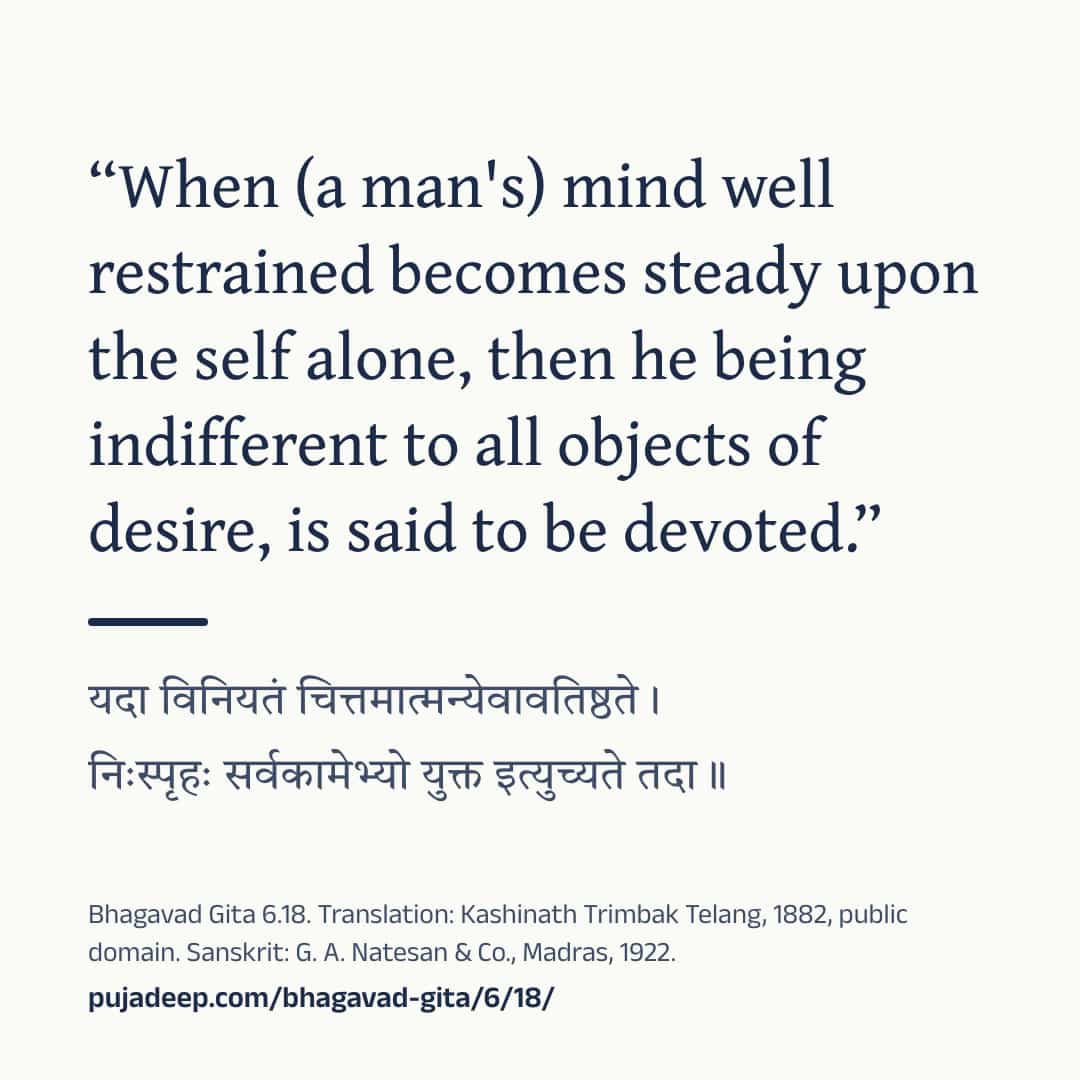
Drawing the picture
See the words
Bhagavad Gita 6.18

यदा विनियतं चित्तमात्मन्येवावतिष्ठते ।
निःस्पृहः सर्वकामेभ्यो युक्त इत्युच्यते तदा ॥

“When (a man's) mind well restrained becomes steady upon the self alone, then he being indifferent to all objects of desire, is said to be devoted.”
(K. T. Telang, The Bhagavadgîtâ (The Sacred Books of the East, vol. VIII, Oxford: Clarendon Press, 1882), p. 69, public domain)

“When his subdued thought is fixed on the SELF, free from longing after all desirable things, then it is said, "he is harmonised."”
(Annie Besant, The Bhagavad Gîtâ, or The Lord's Song (London: Theosophical Publishing Society, 1895), p. 68, public domain)

“When the completely controlled mind rests serenely in the Self alone, free from longing after all desires, then is one called steadfast, (in the Self).”
(Swami Swarupananda, Srimad-Bhagavad-Gita (Mayavati: Prabuddha Bharata Press, 1909; first printed in Prabuddha Bharata, 1907–1909), p. 130, public domain)

Sanskrit: G. A. Natesan & Co., Madras, 1922.
https://pujadeep.com/bhagavad-gita/6/18/ Nothing is sent from this site. Your own app sends it, to the chat you choose. The picture quotes the translation you chose on this page, with its name and year.
Sanskrit text: The Bhagavad-Gita, or The Lord's Song, with the text in Devanagari and an English translation, 1922. Meanings: written for Pujadeep and checked against the cited edition. Source and changes
Questions families ask
Who speaks Bhagavad Gita 6.18?
Krishna speaks this verse, in chapter 6 (Dhyana Yoga).
Where does the Sanskrit text come from?
Sanskrit text: The Bhagavad-Gita, or The Lord's Song, with the text in Devanagari and an English translation, 1922. Meanings: written for Pujadeep and checked against the cited edition. See the source
Is the meaning on this page a translation?
Explanation written for this site from the sources listed here, and checked against the cited edition. It is not a translation and not the only way to read the text. Free to quote with credit.
Source and licence
- Sanskrit text
- The Bhagavad-Gita, or The Lord's Song, with the text in Devanagari and an English translation (Annie Besant, G. A. Natesan & Co., Madras, 1922). Public domain. The Sanskrit on these pages was read from this printing’s page images.
- Translation
- The Bhagavadgîtâ with the Sanatsugâtîya and the Anugîtâ, translated by Kâshinâth Trimbak Telang (The Sacred Books of the East, vol. VIII, ed. F. Max Müller) (Kashinath Trimbak Telang, F. Max Müller, Clarendon Press, Oxford, 1882). Public domain. Shown verbatim, as printed.
- Translation
- The Bhagavad Gîtâ, or The Lord's Song, translated by Annie Besant (Annie Besant, Theosophical Publishing Society, London, 1895). Public domain. Shown verbatim, as printed.
- Translation
- Srimad-Bhagavad-Gita, with Sanskrit Text; Paraphrase with Word-by-word Literal Translation; English Rendering and Comments, Index, &c., by the Swami Swarupananda (Himalayan Series, No. XX) (Swami Swarupananda, The Editors and Publishers, Advaita Ashrama, Mayavati, Prabuddha Bharata Press, Mayavati, Almora, Himalayas, 1909). Public domain. Shown verbatim, as printed.
- Common wording
- In this text, 32 words follow today's common wording, checked against sanskritdocuments.org; Sanskrit Wikisource; Gita Press, Gorakhpur; GRETIL, Göttingen and Bhaktivedanta Book Trust.
- Our explanation
- Explanation written for this site from the sources listed here, and checked against the cited edition. It is not a translation and not the only way to read the text. Free to quote with credit.
- Checked
- Checked against the cited edition, October 15, 2026.
- Updated
- October 25, 2026