Bhagavad Gita 6.19: meaning and translation
Chapter 6: Dhyana Yoga. Krishna says
'A lamp in a windless place does not flicker': Krishna says this is the comparison used for the yogī whose mind is controlled and who practises the yoga of the self.
Click or tap a word for its meaning and its dictionary page.
Text and layers
Text and layers
These choices stay in this browser.
Bhagavad Gita 6.19
यथा दीपो निवातस्थो नेङ्गते सोपमा स्मृता ।योगिनो यतचित्तस्य युञ्जतो योगमात्मनः ॥
Yatha dipo nivatastho nengate sopama smritaYogino yatachittasya yunjato yogamatmanah
yathā dīpo nivātastho neṅgate sopamā smṛtā |yogino yatacittasya yuñjato yogamātmanaḥ ||
Our explanation 'A lamp in a windless place does not flicker': Krishna says this is the comparison used for the yogī whose mind is controlled and who practises the yoga of the self.
हिंदी अर्थ “हवा रहित स्थान में रखा दीपक नहीं हिलता”—कृष्ण कहते हैं कि यही उपमा उस योगी के लिए दी जाती है जिसका चित्त वश में है और जो आत्मा के योग का अभ्यास करता है।
Word by word
Every word, with its dictionary page
Word by word
- यथा yathā · as (indeclinable) Dictionary: yathā, Monier-Williams 1899, p. 841, col. 2 “in which manner or way, according as, as, like”
- दीपः dīpaḥ · a lamp (noun (masculine), nominative singular) Dictionary: dīpa, Monier-Williams 1899, p. 481, col. 1 “a light, lamp, lantern”
- निवातस्थः nivātasthaḥ · in a windless place (compound (masculine), nominative singular) Dictionary: 1. ni-vāta, Monier-Williams 1899, p. 559, col. 2 “sheltered from the wind, calm”; stha, Monier-Williams 1899, p. 1262, col. 3 “standing, staying, abiding, being situated in”
- न na · not (indeclinable) Dictionary: 2. na, Monier-Williams 1899, p. 523, col. 1 “ind. not, no, nor, neither”
- इङ्गते iṅgate · flickers (present, 3rd person singular) Dictionary: iṅg, Monier-Williams 1899, p. 164, col. 1 “to go, go to or towards; to move or agitate”
- सा sā · that (pronoun (feminine), nominative singular) Dictionary: tad, Monier-Williams 1899, p. 434, col. 1 “m. he, f. she, n. it, that, this”
- उपमा upamā · the comparison (noun (feminine), nominative singular) Dictionary: 3. upa-mā, Monier-Williams 1899, p. 203, col. 3 “comparison, resemblance, equality, similarity”
- स्मृता smṛtā · is used, is handed down (past participle (feminine), nominative singular) Dictionary: smṛta, Monier-Williams 1899, p. 1272, col. 2 “handed down, taught, prescribed”
- योगिनः yoginaḥ · of the yogī (noun (masculine), genitive singular) Dictionary: yogin, Monier-Williams 1899, p. 857, col. 3 “a follower of the Yoga system, a Yogin (usually called Yogī) or contemplative saint”
- यतचित्तस्य yatacittasya · whose mind is controlled (compound (masculine), genitive singular) Dictionary: yata, Monier-Williams 1899, p. 845, col. 2 “restrained, held in, held forth, kept down or limited, subdued, governed, controlled”; citta, Monier-Williams 1899, p. 395, col. 3 “the heart, mind”
- युञ्जतः yuñjataḥ · practising (present participle (masculine), genitive singular) Dictionary: 1. yuj, Monier-Williams 1899, p. 853, col. 2 “to yoke or join or fasten or harness”
- योगम् yogam · yoga (noun (masculine), accusative singular) Dictionary: yoga, Monier-Williams 1899, p. 856, col. 2 “the act of yoking, joining, attaching”
- आत्मनः ātmanaḥ · of the self (noun (masculine), genitive singular) Dictionary: ātman, Monier-Williams 1899, p. 135, col. 1 “the individual soul, self”
Old translations
Kashinath Trimbak Telang, 1882. Public domain. Page 69.
As a light standing in a windless (place) flickers not, that is declared to be the parallel for a devotee, whose mind is restrained, and who devotes his self to abstraction.
Compare 3 translations
Kashinath Trimbak Telang, 1882. Public domain. Page 69.
As a light standing in a windless (place) flickers not, that is declared to be the parallel for a devotee, whose mind is restrained, and who devotes his self to abstraction.
You are reading this one
Annie Besant, 1895. Public domain. Page 68.
"As a lamp sheltered from the wind flickereth not;" such the traditional simile of the Yogî of subdued thought, absorbed in the Yoga of the SELF.
You are reading this one
Swami Swarupananda, 1909 (first printed 1907). Public domain. Page 130.
"As a lamp in a spot sheltered from the wind, does not flicker,"—even such has been the simile used for a Yogi of subdued mind, practising concentration in the Self.
You are reading this one
Cite this verse
The translation: K. T. Telang, The Bhagavadgîtâ (The Sacred Books of the East, vol. VIII, Oxford: Clarendon Press, 1882), p. 69. Bhagavad Gita 6.19.
The translation: Annie Besant, The Bhagavad Gîtâ, or The Lord's Song (London: Theosophical Publishing Society, 1895), p. 68. Bhagavad Gita 6.19.
The translation: Swami Swarupananda, Srimad-Bhagavad-Gita (Mayavati: Prabuddha Bharata Press, 1909; first printed in Prabuddha Bharata, 1907–1909), p. 130. Bhagavad Gita 6.19.
Our explanation: “Bhagavad Gita 6.19: meaning and translation.” Pujadeep. Updated October 25, 2026. https://pujadeep.com/bhagavad-gita/6/19/
Pujadeep’s explanations are free to quote with credit: name Pujadeep and link to the page. How to credit
Classical readings, by school
No readings by school on this verse yet.
Share
Show the ways to share
Send one picture or the text to one chat. The picture names its source and the address of this page.
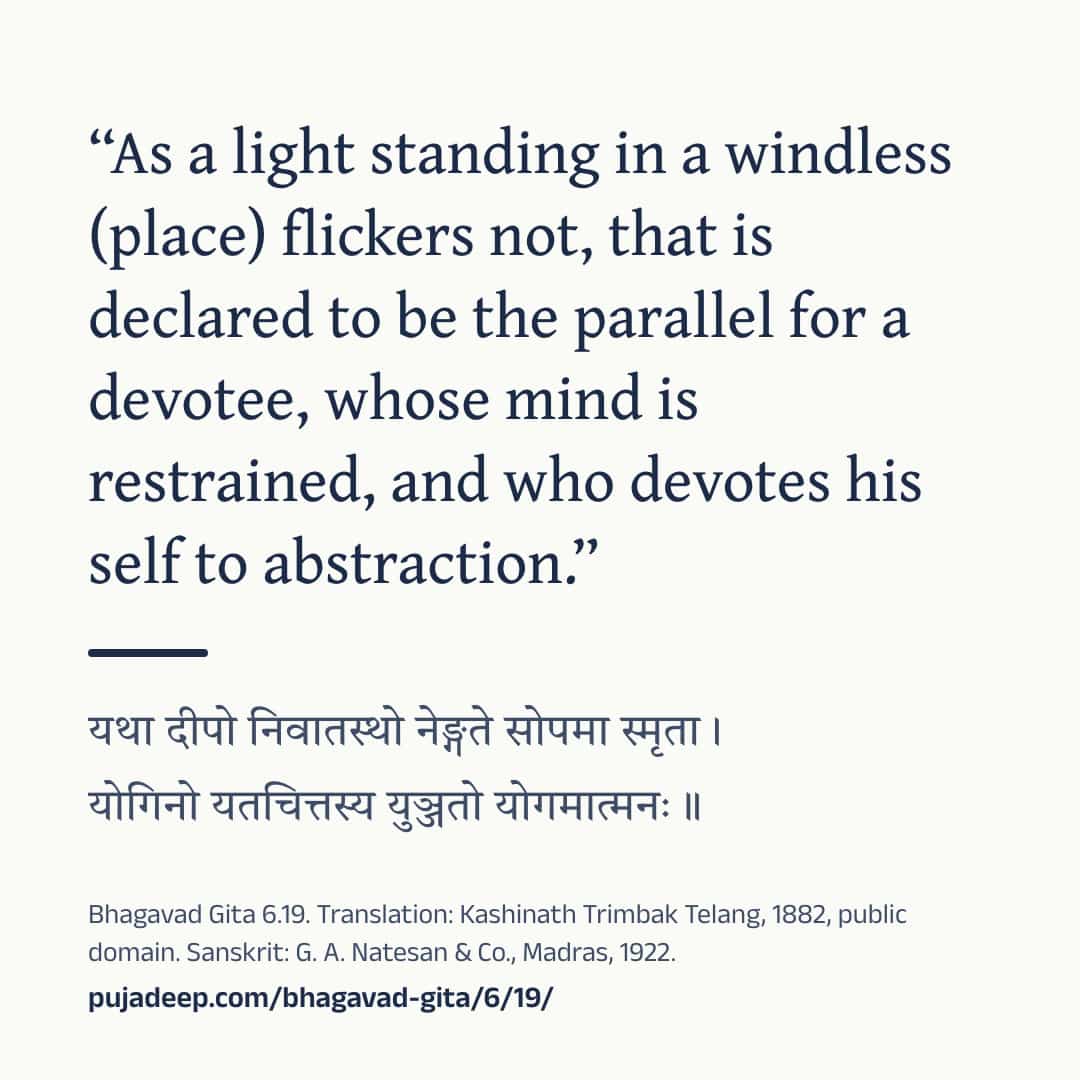
Drawing the picture
See the words
Bhagavad Gita 6.19

यथा दीपो निवातस्थो नेङ्गते सोपमा स्मृता ।
योगिनो यतचित्तस्य युञ्जतो योगमात्मनः ॥

“As a light standing in a windless (place) flickers not, that is declared to be the parallel for a devotee, whose mind is restrained, and who devotes his self to abstraction.”
(K. T. Telang, The Bhagavadgîtâ (The Sacred Books of the East, vol. VIII, Oxford: Clarendon Press, 1882), p. 69, public domain)

“"As a lamp sheltered from the wind flickereth not;" such the traditional simile of the Yogî of subdued thought, absorbed in the Yoga of the SELF.”
(Annie Besant, The Bhagavad Gîtâ, or The Lord's Song (London: Theosophical Publishing Society, 1895), p. 68, public domain)

“"As a lamp in a spot sheltered from the wind, does not flicker,"—even such has been the simile used for a Yogi of subdued mind, practising concentration in the Self.”
(Swami Swarupananda, Srimad-Bhagavad-Gita (Mayavati: Prabuddha Bharata Press, 1909; first printed in Prabuddha Bharata, 1907–1909), p. 130, public domain)

Sanskrit: G. A. Natesan & Co., Madras, 1922.
https://pujadeep.com/bhagavad-gita/6/19/ Nothing is sent from this site. Your own app sends it, to the chat you choose. The picture quotes the translation you chose on this page, with its name and year.
Sanskrit text: The Bhagavad-Gita, or The Lord's Song, with the text in Devanagari and an English translation, 1922. Meanings: written for Pujadeep and checked against the cited edition. Source and changes
Questions families ask
Who speaks Bhagavad Gita 6.19?
Krishna speaks this verse, in chapter 6 (Dhyana Yoga).
Where does the Sanskrit text come from?
Sanskrit text: The Bhagavad-Gita, or The Lord's Song, with the text in Devanagari and an English translation, 1922. Meanings: written for Pujadeep and checked against the cited edition. See the source
Is the meaning on this page a translation?
Explanation written for this site from the sources listed here, and checked against the cited edition. It is not a translation and not the only way to read the text. Free to quote with credit.
Source and licence
- Sanskrit text
- The Bhagavad-Gita, or The Lord's Song, with the text in Devanagari and an English translation (Annie Besant, G. A. Natesan & Co., Madras, 1922). Public domain. The Sanskrit on these pages was read from this printing’s page images.
- Translation
- The Bhagavadgîtâ with the Sanatsugâtîya and the Anugîtâ, translated by Kâshinâth Trimbak Telang (The Sacred Books of the East, vol. VIII, ed. F. Max Müller) (Kashinath Trimbak Telang, F. Max Müller, Clarendon Press, Oxford, 1882). Public domain. Shown verbatim, as printed.
- Translation
- The Bhagavad Gîtâ, or The Lord's Song, translated by Annie Besant (Annie Besant, Theosophical Publishing Society, London, 1895). Public domain. Shown verbatim, as printed.
- Translation
- Srimad-Bhagavad-Gita, with Sanskrit Text; Paraphrase with Word-by-word Literal Translation; English Rendering and Comments, Index, &c., by the Swami Swarupananda (Himalayan Series, No. XX) (Swami Swarupananda, The Editors and Publishers, Advaita Ashrama, Mayavati, Prabuddha Bharata Press, Mayavati, Almora, Himalayas, 1909). Public domain. Shown verbatim, as printed.
- Common wording
- In this text, 32 words follow today's common wording, checked against sanskritdocuments.org; Sanskrit Wikisource; Gita Press, Gorakhpur; GRETIL, Göttingen and Bhaktivedanta Book Trust.
- Our explanation
- Explanation written for this site from the sources listed here, and checked against the cited edition. It is not a translation and not the only way to read the text. Free to quote with credit.
- Checked
- Checked against the cited edition, October 15, 2026.
- Updated
- October 25, 2026