Bhagavad Gita 6.33: meaning and translation
Chapter 6: Dhyana Yoga. Arjuna says
Arjuna speaks.
Click or tap a word for its meaning and its dictionary page.
Text and layers
Text and layers
These choices stay in this browser.
Bhagavad Gita 6.33
अर्जुन उवाच ।
योऽयं योगस्त्वया प्रोक्तः साम्येन मधुसूदन ।एतस्याहं न पश्यामि चञ्चलत्वात्स्थितिं स्थिराम् ॥
Yoyam yogastvaya proktah samyena madhusudanaEtasyaham na pashyami chanchalatvatsthitim sthiram
yo’yaṃ yogastvayā proktaḥ sāmyena madhusūdana |etasyāhaṃ na paśyāmi cañcalatvātsthitiṃ sthirām ||
Our explanation Arjuna speaks. He tells Krishna, Madhusudana, that he cannot see how this yoga of evenness that Krishna has taught can last, because the mind is restless.
हिंदी अर्थ अर्जुन बोलते हैं। वे कृष्ण (मधुसूदन) से कहते हैं कि कृष्ण ने समत्व का जो योग बताया है, मन की चंचलता के कारण उन्हें उसकी स्थिर टिकाऊ अवस्था नहीं दिखती।
Word by word
Every word, with its dictionary page
Word by word
- यः yaḥ · which (pronoun (masculine), nominative singular) Dictionary: yad, Monier-Williams 1899, p. 844, col. 2 “who, which, what, whichever, whatever, that”
- अयम् ayam · this (pronoun (masculine), nominative singular) Dictionary: 1. idam, Monier-Williams 1899, p. 165, col. 2 “this, this here, referring to something near the speaker”
- योगः yogaḥ · yoga (noun (masculine), nominative singular) Dictionary: yoga, Monier-Williams 1899, p. 856, col. 2 “the act of yoking, joining, attaching”
- त्वया tvayā · by you (Krishna) (pronoun, instrumental singular) Dictionary: 2. tva, Monier-Williams 1899, p. 463, col. 2 “base of the 2nd personal pron.”
- प्रोक्तः proktaḥ · taught (past participle (masculine), nominative singular) Dictionary: prokta, Monier-Williams 1899, p. 690, col. 2 “announced, told, taught, mentioned”
- साम्येन sāmyena · as evenness (noun (neuter), instrumental singular) Dictionary: sāmya, Monier-Williams 1899, p. 1207, col. 2 “equality, evenness, equilibrium, equipoise”
- मधुसूदन madhusūdana · O Madhusudana (Krishna) (noun (masculine), vocative singular) Dictionary: madhu-sūdana, Monier-Williams 1899, p. 780, col. 3 “destroyer of the demon Madhu”
- एतस्य etasya · of this (pronoun (masculine), genitive singular) Dictionary: etad, Monier-Williams 1899, p. 231, col. 2 “this, this here, here”
- अहम् aham · "I" (Arjuna) (pronoun, nominative singular) Dictionary: aham, Monier-Williams 1899, p. 124, col. 2 “nom. sg. ‘I,’”
- न na · not (indeclinable) Dictionary: 2. na, Monier-Williams 1899, p. 523, col. 1 “ind. not, no, nor, neither”
- पश्यामि paśyāmi · see (present, 1st person singular) Dictionary: 1. paś, Monier-Williams 1899, p. 611, col. 2 “behold, look at, observe, perceive, notice”
- चञ्चलत्वात् cañcalatvāt · because of restlessness (noun (neuter), ablative singular) Dictionary: cañcala-tva, Monier-Williams 1899, p. 382, col. 2 “unsteadiness, fickleness”
- स्थितिम् sthitim · steadiness (noun (feminine), accusative singular) Dictionary: sthiti, Monier-Williams 1899, p. 1264, col. 2 “standing, staying, remaining, abiding”
- स्थिराम् sthirām · firm (adjective (feminine), accusative singular) Dictionary: sthira, Monier-Williams 1899, p. 1264, col. 3 “fixed, immovable, motionless, still, calm”
2 printings differ
Edition differences. Another printing or text reads this place differently.
- The printed edition reads: योऽयं योगस्त्वया प्रोक्तः साम्येन मधुसूदन ।
एतस्याहं न पश्यामि चञ्जलत्वात्स्थितिं स्थिराम् ॥ The print reads चञ्जलत्वात्, with the ञ्ज ligature (the same sort as युञ्जन्, 6.28) for ञ्च; read as a wrong sort and corrected, because 6.26 and 6.34 print चञ्चल correctly and both proofreading references read चञ्चलत्वात्. - Spelling The 1922 Madras printing reads: एतस्याहं न पश्यामि चञ्जलत्वात्स्थितिं स्थिराम् The 1922 base printing (leaf n106) reads चञ्जलत्वात्, with the ञ्ज ligature (a wrong sort) for ञ्च, a printing flaw; see normalisations.
Old translations
Kashinath Trimbak Telang, 1882. Public domain. Page 71.
Arguna said:
I cannot see, O destroyer of Madhu! (how) the sustained existence (is to be secured) of this devotion by means of equanimity which you have declared—in consequence of fickleness.
Compare 3 translations
Kashinath Trimbak Telang, 1882. Public domain. Page 71.
Arguna said:
I cannot see, O destroyer of Madhu! (how) the sustained existence (is to be secured) of this devotion by means of equanimity which you have declared—in consequence of fickleness.
You are reading this one
Annie Besant, 1895. Public domain. Page 71.
Arjuna said:
This Yoga which Thou hast declared to be by equanimity, O Madhusûdana, I see not a stable foundation for it, owing to restlessness;
This sentence goes on in 6.34.
You are reading this one
Swami Swarupananda, 1909 (first printed 1907). Public domain. Page 136.
Arjuna said:
This Yoga which has been taught by Thee, O slayer of Madhu, as characterised by evenness, I do not see (the possibility of) its lasting endurance, owing to restlessness (of the mind).
You are reading this one
Cite this verse
The translation: K. T. Telang, The Bhagavadgîtâ (The Sacred Books of the East, vol. VIII, Oxford: Clarendon Press, 1882), p. 71. Bhagavad Gita 6.33.
The translation: Annie Besant, The Bhagavad Gîtâ, or The Lord's Song (London: Theosophical Publishing Society, 1895), p. 71. Bhagavad Gita 6.33.
The translation: Swami Swarupananda, Srimad-Bhagavad-Gita (Mayavati: Prabuddha Bharata Press, 1909; first printed in Prabuddha Bharata, 1907–1909), p. 136. Bhagavad Gita 6.33.
Our explanation: “Bhagavad Gita 6.33: meaning and translation.” Pujadeep. Updated October 25, 2026. https://pujadeep.com/bhagavad-gita/6/33/
Pujadeep’s explanations are free to quote with credit: name Pujadeep and link to the page. How to credit
Classical readings, by school
No readings by school on this verse yet.
Share
Show the ways to share
Send one picture or the text to one chat. The picture names its source and the address of this page.
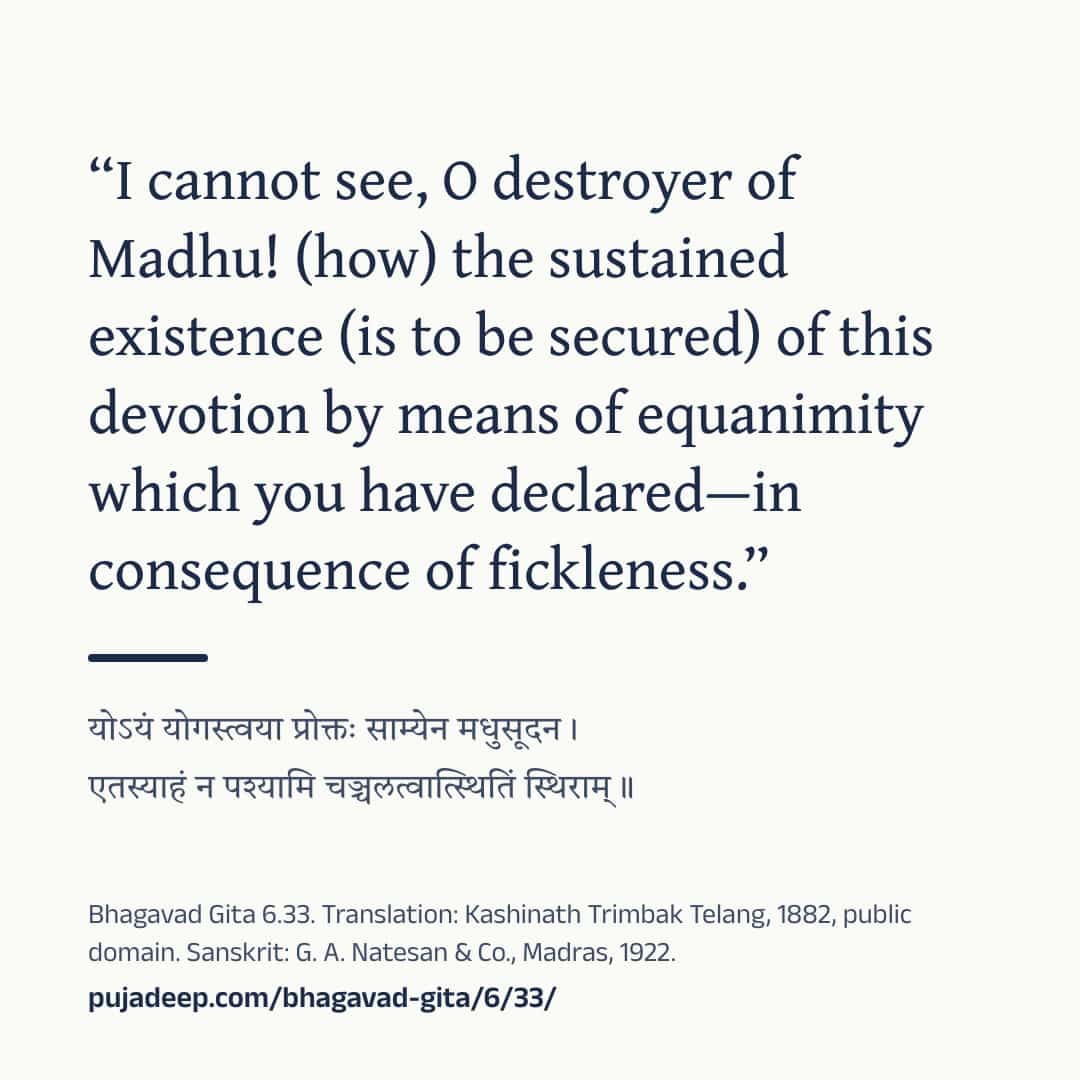
Drawing the picture
See the words
Bhagavad Gita 6.33

योऽयं योगस्त्वया प्रोक्तः साम्येन मधुसूदन ।
एतस्याहं न पश्यामि चञ्चलत्वात्स्थितिं स्थिराम् ॥

“I cannot see, O destroyer of Madhu! (how) the sustained existence (is to be secured) of this devotion by means of equanimity which you have declared—in consequence of fickleness.”
(K. T. Telang, The Bhagavadgîtâ (The Sacred Books of the East, vol. VIII, Oxford: Clarendon Press, 1882), p. 71, public domain)

“This Yoga which Thou hast declared to be by equanimity, O Madhusûdana, I see not a stable foundation for it, owing to restlessness;”
(Annie Besant, The Bhagavad Gîtâ, or The Lord's Song (London: Theosophical Publishing Society, 1895), p. 71, public domain)
This sentence goes on in 6.34.

“This Yoga which has been taught by Thee, O slayer of Madhu, as characterised by evenness, I do not see (the possibility of) its lasting endurance, owing to restlessness (of the mind).”
(Swami Swarupananda, Srimad-Bhagavad-Gita (Mayavati: Prabuddha Bharata Press, 1909; first printed in Prabuddha Bharata, 1907–1909), p. 136, public domain)

Sanskrit: G. A. Natesan & Co., Madras, 1922.
https://pujadeep.com/bhagavad-gita/6/33/ Nothing is sent from this site. Your own app sends it, to the chat you choose. The picture quotes the translation you chose on this page, with its name and year.
Sanskrit text: The Bhagavad-Gita, or The Lord's Song, with the text in Devanagari and an English translation, 1922. Meanings: written for Pujadeep and checked against the cited edition. Source and changes
Questions families ask
Who speaks Bhagavad Gita 6.33?
Arjuna speaks this verse, in chapter 6 (Dhyana Yoga).
Where does the Sanskrit text come from?
Sanskrit text: The Bhagavad-Gita, or The Lord's Song, with the text in Devanagari and an English translation, 1922. Meanings: written for Pujadeep and checked against the cited edition. See the source
Is the meaning on this page a translation?
Explanation written for this site from the sources listed here, and checked against the cited edition. It is not a translation and not the only way to read the text. Free to quote with credit.
Source and licence
- Sanskrit text
- The Bhagavad-Gita, or The Lord's Song, with the text in Devanagari and an English translation (Annie Besant, G. A. Natesan & Co., Madras, 1922). Public domain. The Sanskrit on these pages was read from this printing’s page images.
- Translation
- The Bhagavadgîtâ with the Sanatsugâtîya and the Anugîtâ, translated by Kâshinâth Trimbak Telang (The Sacred Books of the East, vol. VIII, ed. F. Max Müller) (Kashinath Trimbak Telang, F. Max Müller, Clarendon Press, Oxford, 1882). Public domain. Shown verbatim, as printed.
- Translation
- The Bhagavad Gîtâ, or The Lord's Song, translated by Annie Besant (Annie Besant, Theosophical Publishing Society, London, 1895). Public domain. Shown verbatim, as printed.
- Translation
- Srimad-Bhagavad-Gita, with Sanskrit Text; Paraphrase with Word-by-word Literal Translation; English Rendering and Comments, Index, &c., by the Swami Swarupananda (Himalayan Series, No. XX) (Swami Swarupananda, The Editors and Publishers, Advaita Ashrama, Mayavati, Prabuddha Bharata Press, Mayavati, Almora, Himalayas, 1909). Public domain. Shown verbatim, as printed.
- Common wording
- In this text, 32 words follow today's common wording, checked against sanskritdocuments.org; Sanskrit Wikisource; Gita Press, Gorakhpur; GRETIL, Göttingen and Bhaktivedanta Book Trust.
- Our explanation
- Explanation written for this site from the sources listed here, and checked against the cited edition. It is not a translation and not the only way to read the text. Free to quote with credit.
- Checked
- Checked against the cited edition, October 15, 2026.
- Updated
- October 25, 2026