Bhagavad Gita 6.39: meaning and translation
Chapter 6: Dhyana Yoga. Arjuna says
Arjuna asks Krishna to remove this doubt completely, for no one but Krishna can remove it.
Click or tap a word for its meaning and its dictionary page.
Text and layers
Text and layers
These choices stay in this browser.
Bhagavad Gita 6.39
एतन्मे संशयं कृष्ण छेत्तुमर्हस्यशेषतः ।त्वदन्यः संशयस्यास्य छेत्ता नह्युपपद्यते ॥
Etanme sanshayam krishna chhettumarhasyasheshatahTvadanyah sanshayasyasya chhetta nahyupapadyate
etanme saṃśayaṃ kṛṣṇa chettumarhasyaśeṣataḥ |tvadanyaḥ saṃśayasyāsya chettā nahyupapadyate ||
Our explanation Arjuna asks Krishna to remove this doubt completely, for no one but Krishna can remove it.
हिंदी अर्थ अर्जुन कृष्ण से कहते हैं कि वे इस संशय को पूरी तरह दूर करें, क्योंकि कृष्ण के सिवा कोई और इसे दूर नहीं कर सकता।
Word by word
Every word, with its dictionary page
Word by word
- एतत् etat · this (pronoun (neuter), accusative singular) Dictionary: etad, Monier-Williams 1899, p. 231, col. 2 “this, this here, here”
- मे me · "my" (Arjuna's) (pronoun, genitive singular) Dictionary: 1. mad, Monier-Williams 1899, p. 777, col. 2 “base of the first pers. pron. in the sg. number (esp. in comp.)”
- संशयम् saṃśayam · doubt (noun (masculine), accusative singular) Dictionary: saṃ-śaya, Monier-Williams 1899, p. 1117, col. 3 “uncertainty, irresolution, hesitation, doubt”
- कृष्ण kṛṣṇa · O Krishna (noun (masculine), vocative singular) Dictionary: kṛṣṇa, Monier-Williams 1899, p. 306, col. 2 “N. of a celebrated Avatār of the god Vishṇu, or sometimes identified with Vishṇu himself”
- छेत्तुम् chettum · to cut away (infinitive (to do)) Dictionary: 1. chid, Monier-Williams 1899, p. 406, col. 2 “to cut off, amputate, cut through”
- अर्हसि arhasi · you ought (present, 2nd person singular) Dictionary: arh, Monier-Williams 1899, p. 93, col. 3 “to be able”
- अशेषतः aśeṣataḥ · completely (indeclinable) Dictionary: a-śeṣa, Monier-Williams 1899, p. 113, col. 3 “entirely, wholly”
- त्वदन्यः tvadanyaḥ · other than you (Krishna) (compound (masculine), nominative singular) Dictionary: 2. tva, Monier-Williams 1899, p. 463, col. 2 “base of the 2nd personal pron.”; 2. anya, Monier-Williams 1899, p. 45, col. 2 “other, different”
- संशयस्य saṃśayasya · of doubt (noun (masculine), genitive singular) Dictionary: saṃ-śaya, Monier-Williams 1899, p. 1117, col. 3 “uncertainty, irresolution, hesitation, doubt”
- अस्य asya · this (pronoun (masculine), genitive singular) Dictionary: 1. idam, Monier-Williams 1899, p. 165, col. 2 “this, this here, referring to something near the speaker”
- छेत्ता chettā · one who removes (noun (masculine), nominative singular) Dictionary: chettṛ, Monier-Williams 1899, p. 407, col. 1 “a remover”
- न na · not (indeclinable) Dictionary: 2. na, Monier-Williams 1899, p. 523, col. 1 “ind. not, no, nor, neither”
- हि hi · for (indeclinable) Dictionary: 2. hi, Monier-Williams 1899, p. 1297, col. 3 “for, because, on account of”
- उपपद्यते upapadyate · is found (present, 3rd person singular) Dictionary: 1. upa-pad, Monier-Williams 1899, p. 201, col. 3 “to be present, exist”
3 printings differ
Edition differences. Another printing or text reads this place differently.
- The printed edition reads: एतं मे संशयं कृष्ण छेत्तुमर्हस्यशेषतः ।
त्वदन्यः संशयस्यास्य छेत्ता नह्युपपद्यते ॥ - Word The 1922 Madras printing reads: एतं मे संशयं कृष्ण छेत्तुमर्हस्यशेषतः The 1922 base printing (leaf n108) reads एतं (masculine, agreeing with संशयं). Under decision 14 the display follows the common wording एतन्मे (एतत्, neuter, joined with मे), printed by Gita Press (p. 107) and read in sanskritdocuments.org, GRETIL and Sanskrit Wikisource. The sense is the same: 'this doubt of mine'.
- Spelling A digital text reads Same letters. The 1922 edition prints नह्युपपद्यते as one word.
Old translations
Kashinath Trimbak Telang, 1882. Public domain. Page 72.
Be pleased, O Krishna! to entirely destroy this doubt of mine, for none else than you can destroy this doubt.
Compare 3 translations
Kashinath Trimbak Telang, 1882. Public domain. Page 72.
Be pleased, O Krishna! to entirely destroy this doubt of mine, for none else than you can destroy this doubt.
You are reading this one
Annie Besant, 1895. Public domain. Page 72.
Deign, O Krishna, to completely dispel this doubt of mine; for there is none to be found save Thyself able to destroy this doubt.
You are reading this one
Swami Swarupananda, 1909 (first printed 1907). Public domain. Page 139.
This doubt of mine, O Krishna, Thou shouldst completely dispel; for it is not possible for any but Thee to dispel this doubt.
You are reading this one
Cite this verse
The translation: K. T. Telang, The Bhagavadgîtâ (The Sacred Books of the East, vol. VIII, Oxford: Clarendon Press, 1882), p. 72. Bhagavad Gita 6.39.
The translation: Annie Besant, The Bhagavad Gîtâ, or The Lord's Song (London: Theosophical Publishing Society, 1895), p. 72. Bhagavad Gita 6.39.
The translation: Swami Swarupananda, Srimad-Bhagavad-Gita (Mayavati: Prabuddha Bharata Press, 1909; first printed in Prabuddha Bharata, 1907–1909), p. 139. Bhagavad Gita 6.39.
Our explanation: “Bhagavad Gita 6.39: meaning and translation.” Pujadeep. Updated October 25, 2026. https://pujadeep.com/bhagavad-gita/6/39/
Pujadeep’s explanations are free to quote with credit: name Pujadeep and link to the page. How to credit
Classical readings, by school
No readings by school on this verse yet.
Share
Show the ways to share
Send one picture or the text to one chat. The picture names its source and the address of this page.
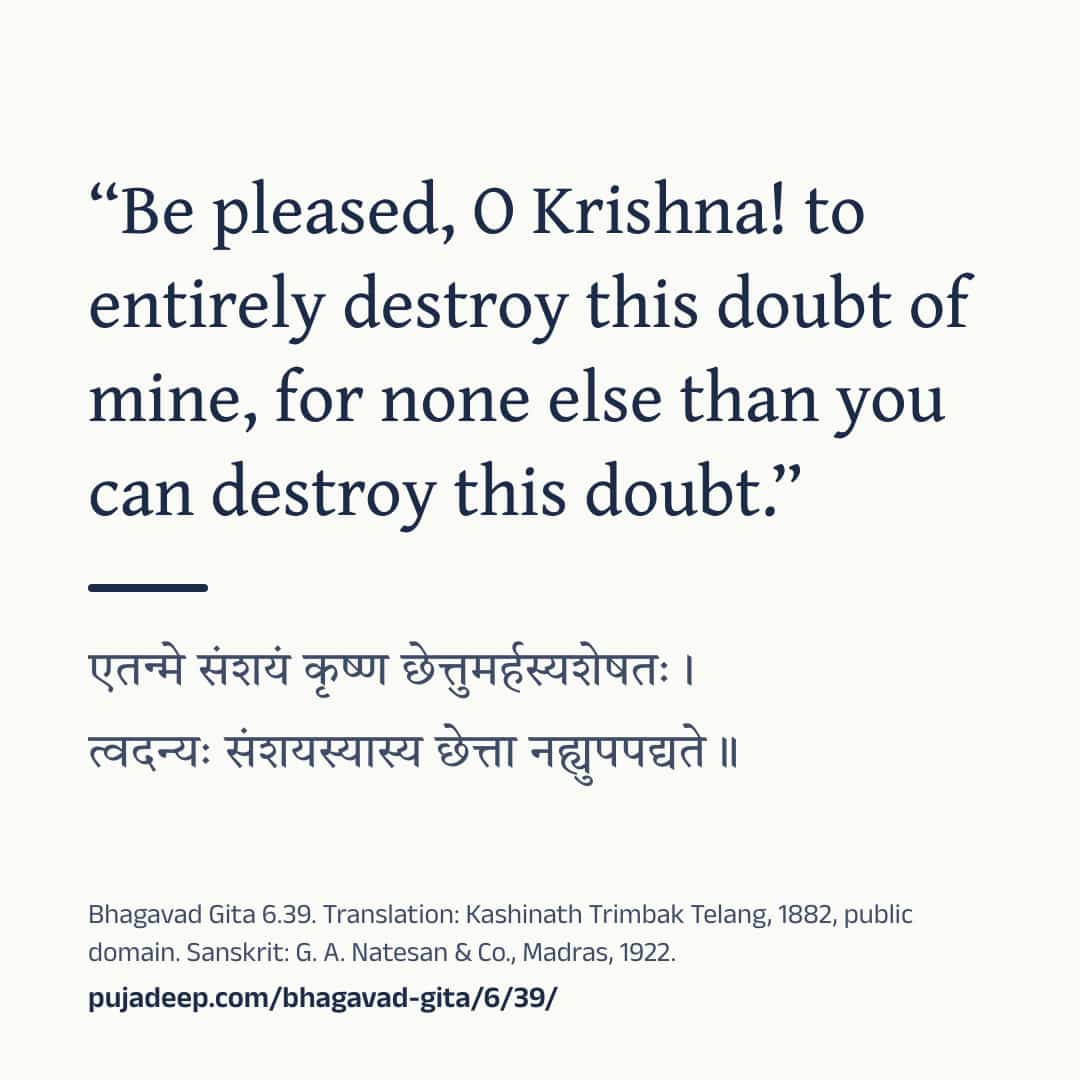
Drawing the picture
See the words
Bhagavad Gita 6.39

एतन्मे संशयं कृष्ण छेत्तुमर्हस्यशेषतः ।
त्वदन्यः संशयस्यास्य छेत्ता नह्युपपद्यते ॥

“Be pleased, O Krishna! to entirely destroy this doubt of mine, for none else than you can destroy this doubt.”
(K. T. Telang, The Bhagavadgîtâ (The Sacred Books of the East, vol. VIII, Oxford: Clarendon Press, 1882), p. 72, public domain)

“Deign, O Krishna, to completely dispel this doubt of mine; for there is none to be found save Thyself able to destroy this doubt.”
(Annie Besant, The Bhagavad Gîtâ, or The Lord's Song (London: Theosophical Publishing Society, 1895), p. 72, public domain)

“This doubt of mine, O Krishna, Thou shouldst completely dispel; for it is not possible for any but Thee to dispel this doubt.”
(Swami Swarupananda, Srimad-Bhagavad-Gita (Mayavati: Prabuddha Bharata Press, 1909; first printed in Prabuddha Bharata, 1907–1909), p. 139, public domain)

Sanskrit: G. A. Natesan & Co., Madras, 1922.
https://pujadeep.com/bhagavad-gita/6/39/ Nothing is sent from this site. Your own app sends it, to the chat you choose. The picture quotes the translation you chose on this page, with its name and year.
Sanskrit text: The Bhagavad-Gita, or The Lord's Song, with the text in Devanagari and an English translation, 1922. Meanings: written for Pujadeep and checked against the cited edition. Source and changes
Questions families ask
Who speaks Bhagavad Gita 6.39?
Arjuna speaks this verse, in chapter 6 (Dhyana Yoga).
Where does the Sanskrit text come from?
Sanskrit text: The Bhagavad-Gita, or The Lord's Song, with the text in Devanagari and an English translation, 1922. Meanings: written for Pujadeep and checked against the cited edition. See the source
Is the meaning on this page a translation?
Explanation written for this site from the sources listed here, and checked against the cited edition. It is not a translation and not the only way to read the text. Free to quote with credit.
Source and licence
- Sanskrit text
- The Bhagavad-Gita, or The Lord's Song, with the text in Devanagari and an English translation (Annie Besant, G. A. Natesan & Co., Madras, 1922). Public domain. The Sanskrit on these pages was read from this printing’s page images.
- Translation
- The Bhagavadgîtâ with the Sanatsugâtîya and the Anugîtâ, translated by Kâshinâth Trimbak Telang (The Sacred Books of the East, vol. VIII, ed. F. Max Müller) (Kashinath Trimbak Telang, F. Max Müller, Clarendon Press, Oxford, 1882). Public domain. Shown verbatim, as printed.
- Translation
- The Bhagavad Gîtâ, or The Lord's Song, translated by Annie Besant (Annie Besant, Theosophical Publishing Society, London, 1895). Public domain. Shown verbatim, as printed.
- Translation
- Srimad-Bhagavad-Gita, with Sanskrit Text; Paraphrase with Word-by-word Literal Translation; English Rendering and Comments, Index, &c., by the Swami Swarupananda (Himalayan Series, No. XX) (Swami Swarupananda, The Editors and Publishers, Advaita Ashrama, Mayavati, Prabuddha Bharata Press, Mayavati, Almora, Himalayas, 1909). Public domain. Shown verbatim, as printed.
- Common wording
- In this text, 32 words follow today's common wording, checked against sanskritdocuments.org; Sanskrit Wikisource; Gita Press, Gorakhpur; GRETIL, Göttingen and Bhaktivedanta Book Trust.
- Our explanation
- Explanation written for this site from the sources listed here, and checked against the cited edition. It is not a translation and not the only way to read the text. Free to quote with credit.
- Checked
- Checked against the cited edition, October 15, 2026.
- Updated
- October 25, 2026