Bhagavad Gita 6.29: meaning and translation
Chapter 6: Dhyana Yoga. Krishna says
Krishna says that the one whose self is joined in yoga, seeing the same everywhere, sees the self in all beings and all beings in the self.
Click or tap a word for its meaning and its dictionary page.
Text and layers
Text and layers
These choices stay in this browser.
Bhagavad Gita 6.29
सर्वभूतस्थमात्मानं सर्वभूतानि चात्मनि ।ईक्षते योगयुक्तात्मा सर्वत्र समदर्शनः ॥
Sarvabhutasthamatmanam sarvabhutani chatmaniIkshate yogayuktatma sarvatra samadarshanah
sarvabhūtasthamātmānaṃ sarvabhūtāni cātmani |īkṣate yogayuktātmā sarvatra samadarśanaḥ ||
Our explanation Krishna says that the one whose self is joined in yoga, seeing the same everywhere, sees the self in all beings and all beings in the self. The schools explain this 'seeing the same' in different ways (see the views).
हिंदी अर्थ कृष्ण कहते हैं कि जिसका आत्मा योग में युक्त है और जो सब जगह समान देखता है, वह आत्मा को सब प्राणियों में और सब प्राणियों को आत्मा में देखता है। इस “समान देखने” को परंपराएँ अलग-अलग ढंग से समझाती हैं।
Word by word
Every word, with its dictionary page
Word by word
- सर्वभूतस्थम् sarvabhūtastham · present in all beings (compound (masculine), accusative singular) Dictionary: sarva-bhūta, Monier-Williams 1899, p. 1186, col. 2 “all beings”; stha, Monier-Williams 1899, p. 1262, col. 3 “standing, staying, abiding, being situated in”
- आत्मानम् ātmānam · the self (noun (masculine), accusative singular) Dictionary: ātman, Monier-Williams 1899, p. 135, col. 1 “the individual soul, self”
- सर्वभूतानि sarvabhūtāni · all beings (compound (neuter), accusative plural) Dictionary: sarva-bhūta, Monier-Williams 1899, p. 1186, col. 2 “all beings”
- च ca · and (indeclinable) Dictionary: 2. ca, Monier-Williams 1899, p. 380, col. 1 “ind. and, both, also, moreover, as well as”
- आत्मनि ātmani · in the self (noun (masculine), locative singular) Dictionary: ātman, Monier-Williams 1899, p. 135, col. 1 “the individual soul, self”
- ईक्षते īkṣate · sees (present, 3rd person singular) Dictionary: īkṣ, Monier-Williams 1899, p. 170, col. 1 “to see, look, view, behold, look at”
- योगयुक्तात्मा yogayuktātmā · whose self is joined in yoga (compound (masculine), nominative singular) Dictionary: yoga-yukta, Monier-Williams 1899, p. 857, col. 1 “immersed in deep meditation, absorbed in Yoga”; ātman, Monier-Williams 1899, p. 135, col. 1 “the individual soul, self”
- सर्वत्र sarvatra · everywhere (indeclinable) Dictionary: sarvatra, Monier-Williams 1899, p. 1189, col. 2 “everywhere, in every case, always, at all times”
- समदर्शनः samadarśanaḥ · seeing the same (compound (masculine), nominative singular) Dictionary: sama-darśana, Monier-Williams 1899, p. 1152, col. 2 “looking on all (things or men) with equal or indifferent eyes”
Old translations
Kashinath Trimbak Telang, 1882. Public domain. Page 70–71.
He who has devoted his self to abstraction, by devotion, looking alike on everything, sees the self abiding in all beings, and all beings in the self1.
Footnotes (the translator’s own) - Realises the essential unity of everything. ↩
Compare 3 translations
Kashinath Trimbak Telang, 1882. Public domain. Page 70–71.
He who has devoted his self to abstraction, by devotion, looking alike on everything, sees the self abiding in all beings, and all beings in the self1.
Footnotes (the translator’s own) - Realises the essential unity of everything. ↩
You are reading this one
Annie Besant, 1895. Public domain. Page 70.
The self, harmonised by Yoga, seeth the SELF abiding in all beings, all beings in the SELF; everywhere he seeth the same.
You are reading this one
Swami Swarupananda, 1909 (first printed 1907). Public domain. Page 134.
With the heart concentrated by Yoga, with the eye of even-ness for all things, he beholds the Self in all beings and all beings in the Self.
You are reading this one
Cite this verse
The translation: K. T. Telang, The Bhagavadgîtâ (The Sacred Books of the East, vol. VIII, Oxford: Clarendon Press, 1882), pp. 70–71. Bhagavad Gita 6.29.
The translation: Annie Besant, The Bhagavad Gîtâ, or The Lord's Song (London: Theosophical Publishing Society, 1895), p. 70. Bhagavad Gita 6.29.
The translation: Swami Swarupananda, Srimad-Bhagavad-Gita (Mayavati: Prabuddha Bharata Press, 1909; first printed in Prabuddha Bharata, 1907–1909), p. 134. Bhagavad Gita 6.29.
Our explanation: “Bhagavad Gita 6.29: meaning and translation.” Pujadeep. Updated October 25, 2026. https://pujadeep.com/bhagavad-gita/6/29/
Pujadeep’s explanations are free to quote with credit: name Pujadeep and link to the page. How to credit
Classical readings, by school
Each reading is named by its school. None is presented as the only meaning.
What Advaita, Vishishtadvaita and Dvaita teach, in short
Shankara Advaita
Shankara says the yogī sees all beings, from Brahmā the creator down to a clump of grass, as one with the Self, and sees in all of them the same: that the Self and Brahman are one.
Source: The Bhagavad-Gita, with the commentary of Sri Sankaracharya, translated by A. Mahadeva Sastri (2nd ed., Mysore: G. T. A. Printing Works, 1901), commentary on 6.29, p. 180. Summarised in our own words; none of its text is reproduced.
Ramanuja Vishishtadvaita
Ramanuja says 'seeing the same' means seeing that every self, one's own and others', has the same nature, consciousness, once its ties to matter are set aside. The differences people see come from bodies, not from the selves.
Source: Sri Bhagavad-Gita with Sri Ramanujacharya's Visishtadvaita commentary, translated by A. Govindacharya (Madras, 1898), commentary on 6.29, pp. 208–209. Summarised in our own words; none of its text is reproduced.
Share
Show the ways to share
Send one picture or the text to one chat. The picture names its source and the address of this page.
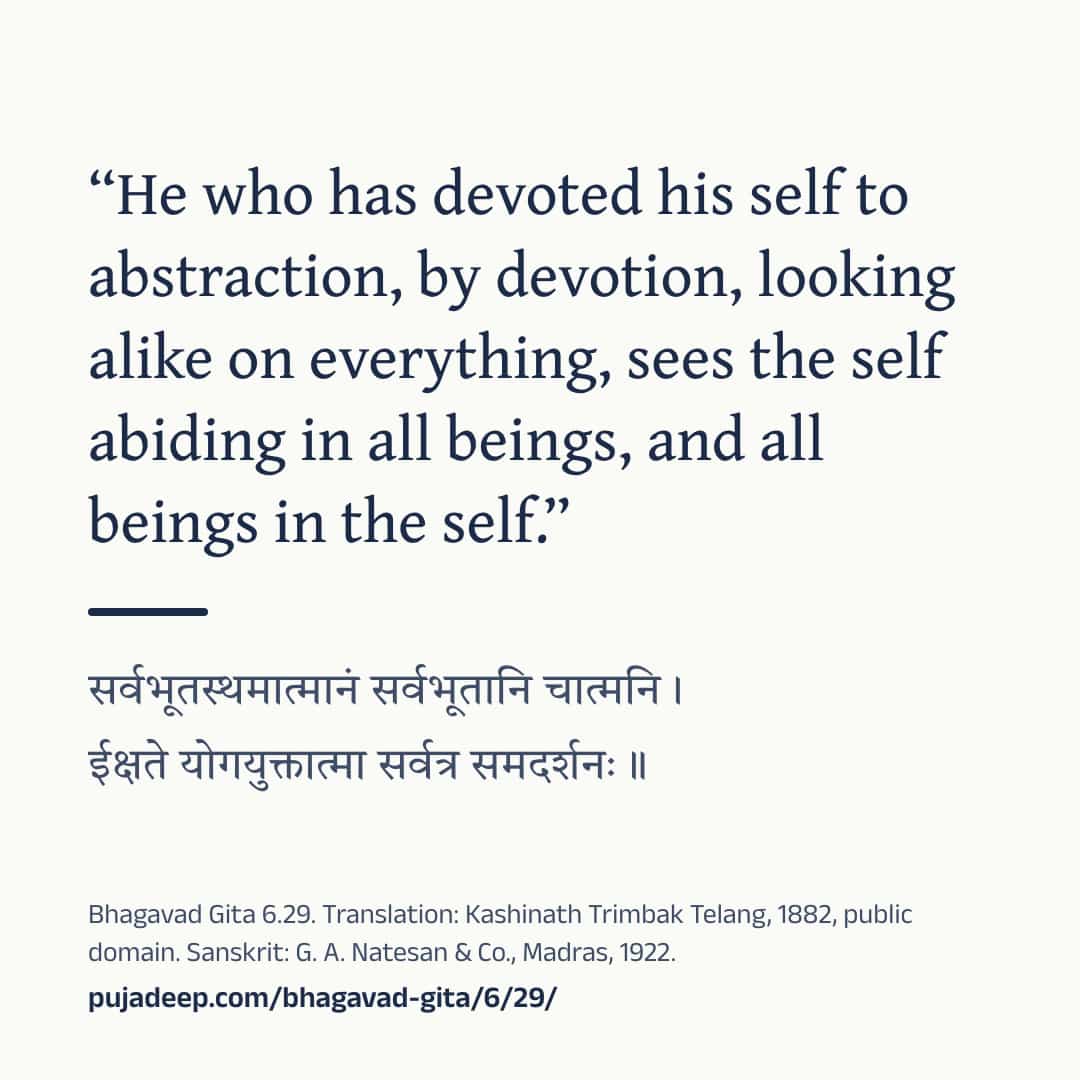
Drawing the picture
See the words
Bhagavad Gita 6.29

सर्वभूतस्थमात्मानं सर्वभूतानि चात्मनि ।
ईक्षते योगयुक्तात्मा सर्वत्र समदर्शनः ॥

“He who has devoted his self to abstraction, by devotion, looking alike on everything, sees the self abiding in all beings, and all beings in the self.”
(K. T. Telang, The Bhagavadgîtâ (The Sacred Books of the East, vol. VIII, Oxford: Clarendon Press, 1882), pp. 70–71, public domain)

“The self, harmonised by Yoga, seeth the SELF abiding in all beings, all beings in the SELF; everywhere he seeth the same.”
(Annie Besant, The Bhagavad Gîtâ, or The Lord's Song (London: Theosophical Publishing Society, 1895), p. 70, public domain)

“With the heart concentrated by Yoga, with the eye of even-ness for all things, he beholds the Self in all beings and all beings in the Self.”
(Swami Swarupananda, Srimad-Bhagavad-Gita (Mayavati: Prabuddha Bharata Press, 1909; first printed in Prabuddha Bharata, 1907–1909), p. 134, public domain)

Sanskrit: G. A. Natesan & Co., Madras, 1922.
https://pujadeep.com/bhagavad-gita/6/29/ Nothing is sent from this site. Your own app sends it, to the chat you choose. The picture quotes the translation you chose on this page, with its name and year.
Sanskrit text: The Bhagavad-Gita, or The Lord's Song, with the text in Devanagari and an English translation, 1922. Meanings: written for Pujadeep and checked against the cited edition. Source and changes
Questions families ask
Who speaks Bhagavad Gita 6.29?
Krishna speaks this verse, in chapter 6 (Dhyana Yoga).
Where does the Sanskrit text come from?
Sanskrit text: The Bhagavad-Gita, or The Lord's Song, with the text in Devanagari and an English translation, 1922. Meanings: written for Pujadeep and checked against the cited edition. See the source
Is the meaning on this page a translation?
Explanation written for this site from the sources listed here, and checked against the cited edition. It is not a translation and not the only way to read the text. Free to quote with credit.
Source and licence
- Sanskrit text
- The Bhagavad-Gita, or The Lord's Song, with the text in Devanagari and an English translation (Annie Besant, G. A. Natesan & Co., Madras, 1922). Public domain. The Sanskrit on these pages was read from this printing’s page images.
- Translation
- The Bhagavadgîtâ with the Sanatsugâtîya and the Anugîtâ, translated by Kâshinâth Trimbak Telang (The Sacred Books of the East, vol. VIII, ed. F. Max Müller) (Kashinath Trimbak Telang, F. Max Müller, Clarendon Press, Oxford, 1882). Public domain. Shown verbatim, as printed.
- Translation
- The Bhagavad Gîtâ, or The Lord's Song, translated by Annie Besant (Annie Besant, Theosophical Publishing Society, London, 1895). Public domain. Shown verbatim, as printed.
- Translation
- Srimad-Bhagavad-Gita, with Sanskrit Text; Paraphrase with Word-by-word Literal Translation; English Rendering and Comments, Index, &c., by the Swami Swarupananda (Himalayan Series, No. XX) (Swami Swarupananda, The Editors and Publishers, Advaita Ashrama, Mayavati, Prabuddha Bharata Press, Mayavati, Almora, Himalayas, 1909). Public domain. Shown verbatim, as printed.
- Commentary
- The Bhagavad-Gita, with the commentary of Sri Sankaracharya, translated by A. Mahadeva Sastri (2nd ed., Mysore: G. T. A. Printing Works, 1901) (Public-domain scan, University of California Libraries). Summarised in our own words; none of its text is reproduced.
- Commentary
- Sri Bhagavad-Gita with Sri Ramanujacharya's Visishtadvaita commentary, translated by A. Govindacharya (Madras, 1898) (Scan uploaded to archive.org (folkscanomy collection)). Summarised in our own words; none of its text is reproduced.
- Common wording
- In this text, 32 words follow today's common wording, checked against sanskritdocuments.org; Sanskrit Wikisource; Gita Press, Gorakhpur; GRETIL, Göttingen and Bhaktivedanta Book Trust.
- Our explanation
- Explanation written for this site from the sources listed here, and checked against the cited edition. It is not a translation and not the only way to read the text. Free to quote with credit.
- Checked
- Checked against the cited edition, October 15, 2026.
- Updated
- October 25, 2026