Bhagavad Gita 6.23: meaning and translation
Chapter 6: Dhyana Yoga. Krishna says
Krishna completes the sentence: this cutting off of contact with sorrow should be known as yoga.
Click or tap a word for its meaning and its dictionary page.
Text and layers
Text and layers
These choices stay in this browser.
Bhagavad Gita 6.23
तं विद्याद् दुःखसंयोगवियोगं योगसंज्ञितम् ।स निश्चयेन योक्तव्यो योगोऽनिर्विण्णचेतसा ॥
Tam vidyad duhkhasanyogaviyogam yogasanjnitamSa nishchayena yoktavyo yogonirvinnachetasa
taṃ vidyād duḥkhasaṃyogaviyogaṃ yogasaṃjñitam |sa niścayena yoktavyo yogo’nirviṇṇacetasā ||
Our explanation Krishna completes the sentence: this cutting off of contact with sorrow should be known as yoga. That yoga is to be practised with firm resolve and with a mind that does not lose heart.
हिंदी अर्थ कृष्ण वाक्य पूरा करते हैं: दुःख के संयोग से इस वियोग को ही योग जानना चाहिए। उस योग का अभ्यास दृढ़ निश्चय से और बिना हिम्मत हारे मन से करना चाहिए।
Word by word
Every word, with its dictionary page
Word by word
- तम् tam · that (pronoun (masculine), accusative singular) Dictionary: tad, Monier-Williams 1899, p. 434, col. 1 “m. he, f. she, n. it, that, this”
- विद्यात् vidyāt · one should know (optative, 3rd person singular) Dictionary: 1. vid, Monier-Williams 1899, p. 963, col. 2 “to know, understand, perceive, learn”
- दुःखसंयोगवियोगम् duḥkhasaṃyogaviyogam · the cutting off of contact with sorrow (compound (masculine), accusative singular) Dictionary: 1. duḥkha, Monier-Williams 1899, p. 483, col. 2 “uneasiness, pain, sorrow, trouble, difficulty”; saṃ-yoga, Monier-Williams 1899, p. 1112, col. 2 “conjunction, combination, connection”; vi-yoga, Monier-Williams 1899, p. 981, col. 3 “disjunction, separation”
- योगसंज्ञितम् yogasaṃjñitam · called yoga (compound (masculine), accusative singular) Dictionary: yoga, Monier-Williams 1899, p. 856, col. 2 “the act of yoking, joining, attaching”; saṃ-jñita, Monier-Williams 1899, p. 1133, col. 3 “called, named, termed”
- सः saḥ · that (pronoun (masculine), nominative singular) Dictionary: tad, Monier-Williams 1899, p. 434, col. 1 “m. he, f. she, n. it, that, this”
- निश्चयेन niścayena · with firm resolve (noun (masculine), instrumental singular) Dictionary: niś-caya, Monier-Williams 1899, p. 561, col. 2 “inquiry, ascertainment, fixed opinion, conviction, certainty”
- योक्तव्यः yoktavyaḥ · is to be practised (gerundive (to be done) (masculine), nominative singular) Dictionary: yoktavya, Monier-Williams 1899, p. 854, col. 3 “to be prepared or employed or practised or applied”
- योगः yogaḥ · yoga (noun (masculine), nominative singular) Dictionary: yoga, Monier-Williams 1899, p. 856, col. 2 “the act of yoking, joining, attaching”
- अनिर्विण्णचेतसा anirviṇṇacetasā · with a mind that does not lose heart (compound (neuter), instrumental singular) Dictionary: a-nirviṇṇa, Monier-Williams 1899, p. 30, col. 1 “not downcast”; cetas, Monier-Williams 1899, p. 398, col. 1 “consciousness, intelligence, thinking soul, heart, mind”
Old translations
Kashinath Trimbak Telang, 1882. Public domain.
Telang translates verses 20–23 as one sentence; see 6.20. Read it at 6.20
Compare 3 translations
Kashinath Trimbak Telang, 1882. Public domain.
Telang translates verses 20–23 as one sentence; see 6.20. Read it at 6.20
You are reading this one
Annie Besant, 1895. Public domain. Page 69.
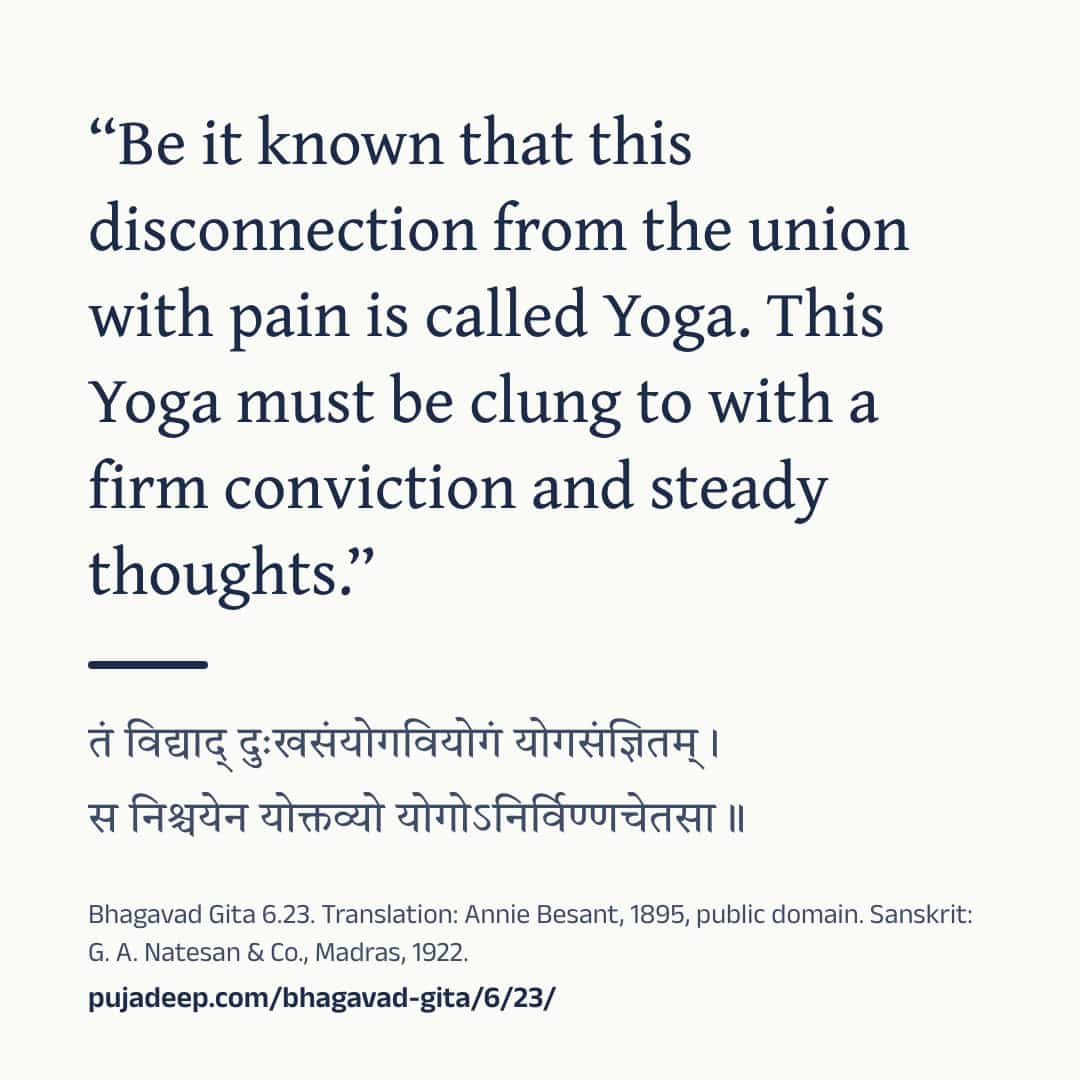
Be it known that this disconnection from the union with pain is called Yoga. This Yoga must be clung to with a firm conviction and steady thoughts.
This sentence begins in 6.20.
You are reading this one
Swami Swarupananda, 1909 (first printed 1907). Public domain.
Swarupananda renders verses 20–23 together; see 6.20. Read it at 6.20
You are reading this one
Cite this verse
The translation: K. T. Telang, The Bhagavadgîtâ (The Sacred Books of the East, vol. VIII, Oxford: Clarendon Press, 1882), pp. 69–70. Bhagavad Gita 6.20–23.
The translation: Annie Besant, The Bhagavad Gîtâ, or The Lord's Song (London: Theosophical Publishing Society, 1895), p. 69. Bhagavad Gita 6.23.
The translation: Swami Swarupananda, Srimad-Bhagavad-Gita (Mayavati: Prabuddha Bharata Press, 1909; first printed in Prabuddha Bharata, 1907–1909), pp. 131–132. Bhagavad Gita 6.20–23.
Our explanation: “Bhagavad Gita 6.23: meaning and translation.” Pujadeep. Updated October 25, 2026. https://pujadeep.com/bhagavad-gita/6/23/
Pujadeep’s explanations are free to quote with credit: name Pujadeep and link to the page. How to credit
Classical readings, by school
No readings by school on this verse yet.
Share
Show the ways to share
Send one picture or the text to one chat. The picture names its source and the address of this page.
Drawing the picture
See the words
Bhagavad Gita 6.23

तं विद्याद् दुःखसंयोगवियोगं योगसंज्ञितम् ।
स निश्चयेन योक्तव्यो योगोऽनिर्विण्णचेतसा ॥

“Be it known that this disconnection from the union with pain is called Yoga. This Yoga must be clung to with a firm conviction and steady thoughts.”
(Annie Besant, The Bhagavad Gîtâ, or The Lord's Song (London: Theosophical Publishing Society, 1895), p. 69, public domain)
This sentence begins in 6.20.

Sanskrit: G. A. Natesan & Co., Madras, 1922.
https://pujadeep.com/bhagavad-gita/6/23/ Nothing is sent from this site. Your own app sends it, to the chat you choose. The picture quotes the translation you chose on this page, with its name and year.
Sanskrit text: The Bhagavad-Gita, or The Lord's Song, with the text in Devanagari and an English translation, 1922. Meanings: written for Pujadeep and checked against the cited edition. Source and changes
Questions families ask
Who speaks Bhagavad Gita 6.23?
Krishna speaks this verse, in chapter 6 (Dhyana Yoga).
Where does the Sanskrit text come from?
Sanskrit text: The Bhagavad-Gita, or The Lord's Song, with the text in Devanagari and an English translation, 1922. Meanings: written for Pujadeep and checked against the cited edition. See the source
Is the meaning on this page a translation?
Explanation written for this site from the sources listed here, and checked against the cited edition. It is not a translation and not the only way to read the text. Free to quote with credit.
Source and licence
- Sanskrit text
- The Bhagavad-Gita, or The Lord's Song, with the text in Devanagari and an English translation (Annie Besant, G. A. Natesan & Co., Madras, 1922). Public domain. The Sanskrit on these pages was read from this printing’s page images.
- Translation
- The Bhagavadgîtâ with the Sanatsugâtîya and the Anugîtâ, translated by Kâshinâth Trimbak Telang (The Sacred Books of the East, vol. VIII, ed. F. Max Müller) (Kashinath Trimbak Telang, F. Max Müller, Clarendon Press, Oxford, 1882). Public domain. Shown verbatim, as printed.
- Translation
- The Bhagavad Gîtâ, or The Lord's Song, translated by Annie Besant (Annie Besant, Theosophical Publishing Society, London, 1895). Public domain. Shown verbatim, as printed.
- Translation
- Srimad-Bhagavad-Gita, with Sanskrit Text; Paraphrase with Word-by-word Literal Translation; English Rendering and Comments, Index, &c., by the Swami Swarupananda (Himalayan Series, No. XX) (Swami Swarupananda, The Editors and Publishers, Advaita Ashrama, Mayavati, Prabuddha Bharata Press, Mayavati, Almora, Himalayas, 1909). Public domain. Shown verbatim, as printed.
- Common wording
- In this text, 32 words follow today's common wording, checked against sanskritdocuments.org; Sanskrit Wikisource; Gita Press, Gorakhpur; GRETIL, Göttingen and Bhaktivedanta Book Trust.
- Our explanation
- Explanation written for this site from the sources listed here, and checked against the cited edition. It is not a translation and not the only way to read the text. Free to quote with credit.
- Checked
- Checked against the cited edition, October 15, 2026.
- Updated
- October 25, 2026