Bhagavad Gita 6.32: meaning and translation
Chapter 6: Dhyana Yoga. Krishna says
The one who, by comparison with himself (ātmaupamya), sees the same everywhere, whether pleasure or pain, is thought to be the highest yogī, Krishna tells Arjuna.
Click or tap a word for its meaning and its dictionary page.
Text and layers
Text and layers
These choices stay in this browser.
Bhagavad Gita 6.32
आत्मौपम्येन सर्वत्र समं पश्यति योऽर्जुन ।सुखं वा यदि वा दुःखं स योगी परमो मतः ॥
Atmaupamyena sarvatra samam pashyati yorjunaSukham va yadi va duhkham sa yogi paramo matah
ātmaupamyena sarvatra samaṃ paśyati yo’rjuna |sukhaṃ vā yadi vā duḥkhaṃ sa yogī paramo mataḥ ||
Our explanation The one who, by comparison with himself (ātmaupamya), sees the same everywhere, whether pleasure or pain, is thought to be the highest yogī, Krishna tells Arjuna. Telang's note puts it as putting oneself in the place of others. The schools explain the comparison in different ways (see the views).
हिंदी अर्थ कृष्ण अर्जुन से कहते हैं कि जो अपनी तुलना से (आत्मौपम्य से) सब जगह सुख हो या दुःख, समान देखता है, वह परम योगी माना जाता है। तेलंग की टिप्पणी इसे स्वयं को दूसरों के स्थान पर रखकर देखना बताती है। परंपराएँ इस तुलना को अलग-अलग ढंग से समझाती हैं।
Word by word
Every word, with its dictionary page
Word by word
- आत्मौपम्येन ātmaupamyena · by comparison with oneself (compound (neuter), instrumental singular) Dictionary: ātmaupamya, Monier-Williams 1899, p. 136, col. 1 “by analogy to one's own self”
- सर्वत्र sarvatra · everywhere (indeclinable) Dictionary: sarvatra, Monier-Williams 1899, p. 1189, col. 2 “everywhere, in every case, always, at all times”
- समम् samam · the same (adjective (neuter), accusative singular) Dictionary: 2. sama, Monier-Williams 1899, p. 1152, col. 1 “same, equal, similar, like, equivalent”
- पश्यति paśyati · sees (present, 3rd person singular) Dictionary: 1. paś, Monier-Williams 1899, p. 611, col. 2 “behold, look at, observe, perceive, notice”
- यः yaḥ · who (pronoun (masculine), nominative singular) Dictionary: yad, Monier-Williams 1899, p. 844, col. 2 “who, which, what, whichever, whatever, that”
- अर्जुन arjuna · O Arjuna (noun (masculine), vocative singular) Dictionary: arjuna, Monier-Williams 1899, p. 90, col. 1
- सुखम् sukham · pleasure (noun (neuter), accusative singular) Dictionary: sukha, Monier-Williams 1899, p. 1221, col. 1 “ease, easiness, comfort, prosperity, pleasure, happiness”
- वा vā · whether (indeclinable) Dictionary: 1. vā, Monier-Williams 1899, p. 934, col. 2 “ind. or”
- यदि yadi · if (indeclinable) Dictionary: yadi, Monier-Williams 1899, p. 844, col. 3 “if, in case that”
- वा vā · or (indeclinable) Dictionary: 1. vā, Monier-Williams 1899, p. 934, col. 2 “ind. or”
- दुःखम् duḥkham · pain (noun (neuter), accusative singular) Dictionary: 1. duḥkha, Monier-Williams 1899, p. 483, col. 2 “uneasiness, pain, sorrow, trouble, difficulty”
- सः saḥ · he (pronoun (masculine), nominative singular) Dictionary: tad, Monier-Williams 1899, p. 434, col. 1 “m. he, f. she, n. it, that, this”
- योगी yogī · yogī (noun (masculine), nominative singular) Dictionary: yogin, Monier-Williams 1899, p. 857, col. 3 “a follower of the Yoga system, a Yogin (usually called Yogī) or contemplative saint”
- परमः paramaḥ · highest (adjective (masculine), nominative singular) Dictionary: parama, Monier-Williams 1899, p. 588, col. 1 “chief, highest, primary, most prominent or conspicuous”
- मतः mataḥ · is thought (past participle (masculine), nominative singular) Dictionary: mata, Monier-Williams 1899, p. 783, col. 1 “thought, believed, imagined, supposed, understood; regarded or considered as”
Old translations
Kashinath Trimbak Telang, 1882. Public domain. Page 71.
That devotee, O Arguna! is deemed to be the best, who looks alike on pleasure or pain, whatever it may be, in all (creatures), comparing all with his own (pleasure or pain)1.
Footnotes (the translator’s own) - Who believes that pleasure and pain are as much liked or disliked by others as by himself, and puts himself in fact in the place of others. ↩
Compare 3 translations
Kashinath Trimbak Telang, 1882. Public domain. Page 71.
That devotee, O Arguna! is deemed to be the best, who looks alike on pleasure or pain, whatever it may be, in all (creatures), comparing all with his own (pleasure or pain)1.
Footnotes (the translator’s own) - Who believes that pleasure and pain are as much liked or disliked by others as by himself, and puts himself in fact in the place of others. ↩
You are reading this one
Annie Besant, 1895. Public domain. Page 71.
He who, through the likeness of the SELF,1 O Arjuna, seeth identity in everything, whether pleasant or painful, he is regarded as a perfected Yogî.
Footnotes (the translator’s own) - The same SELF shining in the heart of each. ↩
You are reading this one
Swami Swarupananda, 1909 (first printed 1907). Public domain. Page 135.
He who judges of pleasure or pain everywhere, by the same standard, as he applies to himself, that Yogi, O Arjuna, is regarded as the highest.
You are reading this one
Cite this verse
The translation: K. T. Telang, The Bhagavadgîtâ (The Sacred Books of the East, vol. VIII, Oxford: Clarendon Press, 1882), p. 71. Bhagavad Gita 6.32.
The translation: Annie Besant, The Bhagavad Gîtâ, or The Lord's Song (London: Theosophical Publishing Society, 1895), p. 71. Bhagavad Gita 6.32.
The translation: Swami Swarupananda, Srimad-Bhagavad-Gita (Mayavati: Prabuddha Bharata Press, 1909; first printed in Prabuddha Bharata, 1907–1909), p. 135. Bhagavad Gita 6.32.
Our explanation: “Bhagavad Gita 6.32: meaning and translation.” Pujadeep. Updated October 25, 2026. https://pujadeep.com/bhagavad-gita/6/32/
Pujadeep’s explanations are free to quote with credit: name Pujadeep and link to the page. How to credit
Classical readings, by school
Each reading is named by its school. None is presented as the only meaning.
What Advaita, Vishishtadvaita and Dvaita teach, in short
Shankara Advaita
Shankara says such a person sees that whatever is pleasant or painful to himself is pleasant or painful to every creature, so he causes pain to no being. Doing no harm and devoted to right knowledge, he is the highest yogī.
Source: The Bhagavad-Gita, with the commentary of Sri Sankaracharya, translated by A. Mahadeva Sastri (2nd ed., Mysore: G. T. A. Printing Works, 1901), commentary on 6.32, pp. 181–182. Summarised in our own words; none of its text is reproduced.
Ramanuja Vishishtadvaita
Ramanuja says the comparison is that every self, including one's own, is pure consciousness and untouched by pleasure and pain. Knowing this, the yogī looks on joy and grief alike, whether they come to him or to others.
Source: Sri Bhagavad-Gita with Sri Ramanujacharya's Visishtadvaita commentary, translated by A. Govindacharya (Madras, 1898), commentary on 6.32, p. 210. Summarised in our own words; none of its text is reproduced.
Share
Show the ways to share
Send one picture or the text to one chat. The picture names its source and the address of this page.
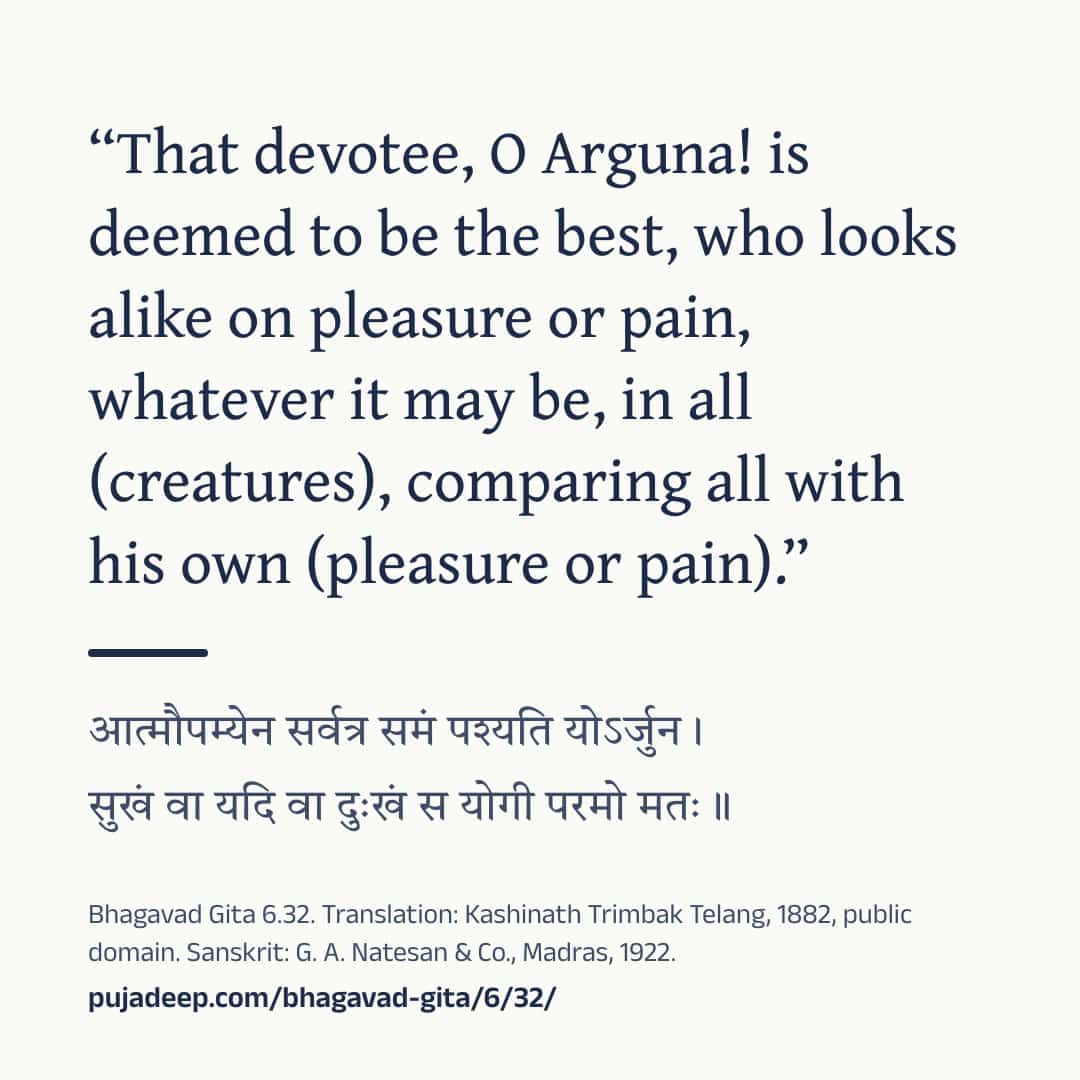
Drawing the picture
See the words
Bhagavad Gita 6.32

आत्मौपम्येन सर्वत्र समं पश्यति योऽर्जुन ।
सुखं वा यदि वा दुःखं स योगी परमो मतः ॥

“That devotee, O Arguna! is deemed to be the best, who looks alike on pleasure or pain, whatever it may be, in all (creatures), comparing all with his own (pleasure or pain).”
(K. T. Telang, The Bhagavadgîtâ (The Sacred Books of the East, vol. VIII, Oxford: Clarendon Press, 1882), p. 71, public domain)

“He who, through the likeness of the SELF, O Arjuna, seeth identity in everything, whether pleasant or painful, he is regarded as a perfected Yogî.”
(Annie Besant, The Bhagavad Gîtâ, or The Lord's Song (London: Theosophical Publishing Society, 1895), p. 71, public domain)

“He who judges of pleasure or pain everywhere, by the same standard, as he applies to himself, that Yogi, O Arjuna, is regarded as the highest.”
(Swami Swarupananda, Srimad-Bhagavad-Gita (Mayavati: Prabuddha Bharata Press, 1909; first printed in Prabuddha Bharata, 1907–1909), p. 135, public domain)

Sanskrit: G. A. Natesan & Co., Madras, 1922.
https://pujadeep.com/bhagavad-gita/6/32/ Nothing is sent from this site. Your own app sends it, to the chat you choose. The picture quotes the translation you chose on this page, with its name and year.
Sanskrit text: The Bhagavad-Gita, or The Lord's Song, with the text in Devanagari and an English translation, 1922. Meanings: written for Pujadeep and checked against the cited edition. Source and changes
Questions families ask
Who speaks Bhagavad Gita 6.32?
Krishna speaks this verse, in chapter 6 (Dhyana Yoga).
Where does the Sanskrit text come from?
Sanskrit text: The Bhagavad-Gita, or The Lord's Song, with the text in Devanagari and an English translation, 1922. Meanings: written for Pujadeep and checked against the cited edition. See the source
Is the meaning on this page a translation?
Explanation written for this site from the sources listed here, and checked against the cited edition. It is not a translation and not the only way to read the text. Free to quote with credit.
Source and licence
- Sanskrit text
- The Bhagavad-Gita, or The Lord's Song, with the text in Devanagari and an English translation (Annie Besant, G. A. Natesan & Co., Madras, 1922). Public domain. The Sanskrit on these pages was read from this printing’s page images.
- Translation
- The Bhagavadgîtâ with the Sanatsugâtîya and the Anugîtâ, translated by Kâshinâth Trimbak Telang (The Sacred Books of the East, vol. VIII, ed. F. Max Müller) (Kashinath Trimbak Telang, F. Max Müller, Clarendon Press, Oxford, 1882). Public domain. Shown verbatim, as printed.
- Translation
- The Bhagavad Gîtâ, or The Lord's Song, translated by Annie Besant (Annie Besant, Theosophical Publishing Society, London, 1895). Public domain. Shown verbatim, as printed.
- Translation
- Srimad-Bhagavad-Gita, with Sanskrit Text; Paraphrase with Word-by-word Literal Translation; English Rendering and Comments, Index, &c., by the Swami Swarupananda (Himalayan Series, No. XX) (Swami Swarupananda, The Editors and Publishers, Advaita Ashrama, Mayavati, Prabuddha Bharata Press, Mayavati, Almora, Himalayas, 1909). Public domain. Shown verbatim, as printed.
- Commentary
- The Bhagavad-Gita, with the commentary of Sri Sankaracharya, translated by A. Mahadeva Sastri (2nd ed., Mysore: G. T. A. Printing Works, 1901) (Public-domain scan, University of California Libraries). Summarised in our own words; none of its text is reproduced.
- Commentary
- Sri Bhagavad-Gita with Sri Ramanujacharya's Visishtadvaita commentary, translated by A. Govindacharya (Madras, 1898) (Scan uploaded to archive.org (folkscanomy collection)). Summarised in our own words; none of its text is reproduced.
- Common wording
- In this text, 32 words follow today's common wording, checked against sanskritdocuments.org; Sanskrit Wikisource; Gita Press, Gorakhpur; GRETIL, Göttingen and Bhaktivedanta Book Trust.
- Our explanation
- Explanation written for this site from the sources listed here, and checked against the cited edition. It is not a translation and not the only way to read the text. Free to quote with credit.
- Checked
- Checked against the cited edition, October 15, 2026.
- Updated
- October 25, 2026