Bhagavad Gita 6.46: meaning and translation
Chapter 6: Dhyana Yoga. Krishna says
Krishna says the yogī is greater than those who practise austerity (tapasvī), greater even than the learned (jñānī), and greater than those who do ritual works (karmī).
Click or tap a word for its meaning and its dictionary page.
Text and layers
Text and layers
These choices stay in this browser.
Bhagavad Gita 6.46
तपस्विभ्योऽधिको योगी ज्ञानिभ्योऽपि मतोऽधिकः ।कर्मिभ्यश्चाधिको योगी तस्माद्योगी भवार्जुन ॥
Tapasvibhyodhiko yogi jnanibhyopi matodhikahKarmibhyashchadhiko yogi tasmadyogi bhavarjuna
tapasvibhyo’dhiko yogī jñānibhyo’pi mato’dhikaḥ |karmibhyaścādhiko yogī tasmādyogī bhavārjuna ||
Our explanation Krishna says the yogī is greater than those who practise austerity (tapasvī), greater even than the learned (jñānī), and greater than those who do ritual works (karmī). So he tells Arjuna to be a yogī.
हिंदी अर्थ कृष्ण कहते हैं कि योगी तपस्वियों से श्रेष्ठ है, ज्ञानियों (विद्वानों) से भी श्रेष्ठ है, और कर्मकांड करने वालों से भी श्रेष्ठ है। इसलिए वे अर्जुन से योगी बनने को कहते हैं।
Word by word
Every word, with its dictionary page
Word by word
- तपस्विभ्यः tapasvibhyaḥ · than ascetics (noun (masculine), ablative plural) Dictionary: tapasvin, Monier-Williams 1899, p. 437, col. 2 “practising austerities, (m.) an ascetic”
- अधिकः adhikaḥ · greater (adjective (masculine), nominative singular) Dictionary: adhika, Monier-Williams 1899, p. 20, col. 2 “surpassing (in number or quantity or quality), superior”
- योगी yogī · the yogī (noun (masculine), nominative singular) Dictionary: yogin, Monier-Williams 1899, p. 857, col. 3 “a follower of the Yoga system, a Yogin (usually called Yogī) or contemplative saint”
- ज्ञानिभ्यः jñānibhyaḥ · than the learned (noun (masculine), ablative plural) Dictionary: jñānin, Monier-Williams 1899, p. 426, col. 2 “knowing, endowed with knowledge or intelligence, wise”
- अपि api · even (indeclinable) Dictionary: api, Monier-Williams 1899, p. 55, col. 1 “in the sense of even, also, very”
- मतः mataḥ · is thought (past participle (masculine), nominative singular) Dictionary: mata, Monier-Williams 1899, p. 783, col. 1 “thought, believed, imagined, supposed, understood; regarded or considered as”
- अधिकः adhikaḥ · greater (adjective (masculine), nominative singular) Dictionary: adhika, Monier-Williams 1899, p. 20, col. 2 “surpassing (in number or quantity or quality), superior”
- कर्मिभ्यः karmibhyaḥ · than doers of rites (noun (masculine), ablative plural) Dictionary: karmin, Monier-Williams 1899, p. 259, col. 3 “performing a religious action”
- च ca · and (indeclinable) Dictionary: 2. ca, Monier-Williams 1899, p. 380, col. 1 “ind. and, both, also, moreover, as well as”
- अधिकः adhikaḥ · greater (adjective (masculine), nominative singular) Dictionary: adhika, Monier-Williams 1899, p. 20, col. 2 “surpassing (in number or quantity or quality), superior”
- योगी yogī · the yogī (noun (masculine), nominative singular) Dictionary: yogin, Monier-Williams 1899, p. 857, col. 3 “a follower of the Yoga system, a Yogin (usually called Yogī) or contemplative saint”
- तस्मात् tasmāt · therefore (indeclinable) Dictionary: tasmāt, Monier-Williams 1899, p. 441, col. 2 “from that, on that account, therefore”
- योगी yogī · a yogī (noun (masculine), nominative singular) Dictionary: yogin, Monier-Williams 1899, p. 857, col. 3 “a follower of the Yoga system, a Yogin (usually called Yogī) or contemplative saint”
- भव bhava · be (imperative, 2nd person singular) Dictionary: 1. bhū, Monier-Williams 1899, p. 760, col. 2 “arise, come into being, exist”
- अर्जुन arjuna · O Arjuna (noun (masculine), vocative singular) Dictionary: arjuna, Monier-Williams 1899, p. 90, col. 1
Old translations
Kashinath Trimbak Telang, 1882. Public domain. Page 73.
The devotee is esteemed higher than the performers of penances, higher even than the men of knowledge, and the devotee is higher than the men of action; therefore, O Arguna! become a devotee.
Compare 3 translations
Kashinath Trimbak Telang, 1882. Public domain. Page 73.
The devotee is esteemed higher than the performers of penances, higher even than the men of knowledge, and the devotee is higher than the men of action; therefore, O Arguna! become a devotee.
You are reading this one
Annie Besant, 1895. Public domain. Page 74.
The Yogî is greater than the ascetics; he is thought to be greater than even the wise; the Yogî is greater than the men of action; therefore become thou a Yog, O Arjuna!
You are reading this one
Swami Swarupananda, 1909 (first printed 1907). Public domain. Page 142.
The Yogi is regarded as superior to those who practise asceticism, also to those who have obtained wisdom (through the Shàstras). He is also superior to the performers of action, (enjoined in the Vedas). Therefore, be thou a Yogi, O Arjuna!
You are reading this one
Cite this verse
The translation: K. T. Telang, The Bhagavadgîtâ (The Sacred Books of the East, vol. VIII, Oxford: Clarendon Press, 1882), p. 73. Bhagavad Gita 6.46.
The translation: Annie Besant, The Bhagavad Gîtâ, or The Lord's Song (London: Theosophical Publishing Society, 1895), p. 74. Bhagavad Gita 6.46.
The translation: Swami Swarupananda, Srimad-Bhagavad-Gita (Mayavati: Prabuddha Bharata Press, 1909; first printed in Prabuddha Bharata, 1907–1909), p. 142. Bhagavad Gita 6.46.
Our explanation: “Bhagavad Gita 6.46: meaning and translation.” Pujadeep. Updated October 25, 2026. https://pujadeep.com/bhagavad-gita/6/46/
Pujadeep’s explanations are free to quote with credit: name Pujadeep and link to the page. How to credit
Classical readings, by school
No readings by school on this verse yet.
Share
Show the ways to share
Send one picture or the text to one chat. The picture names its source and the address of this page.
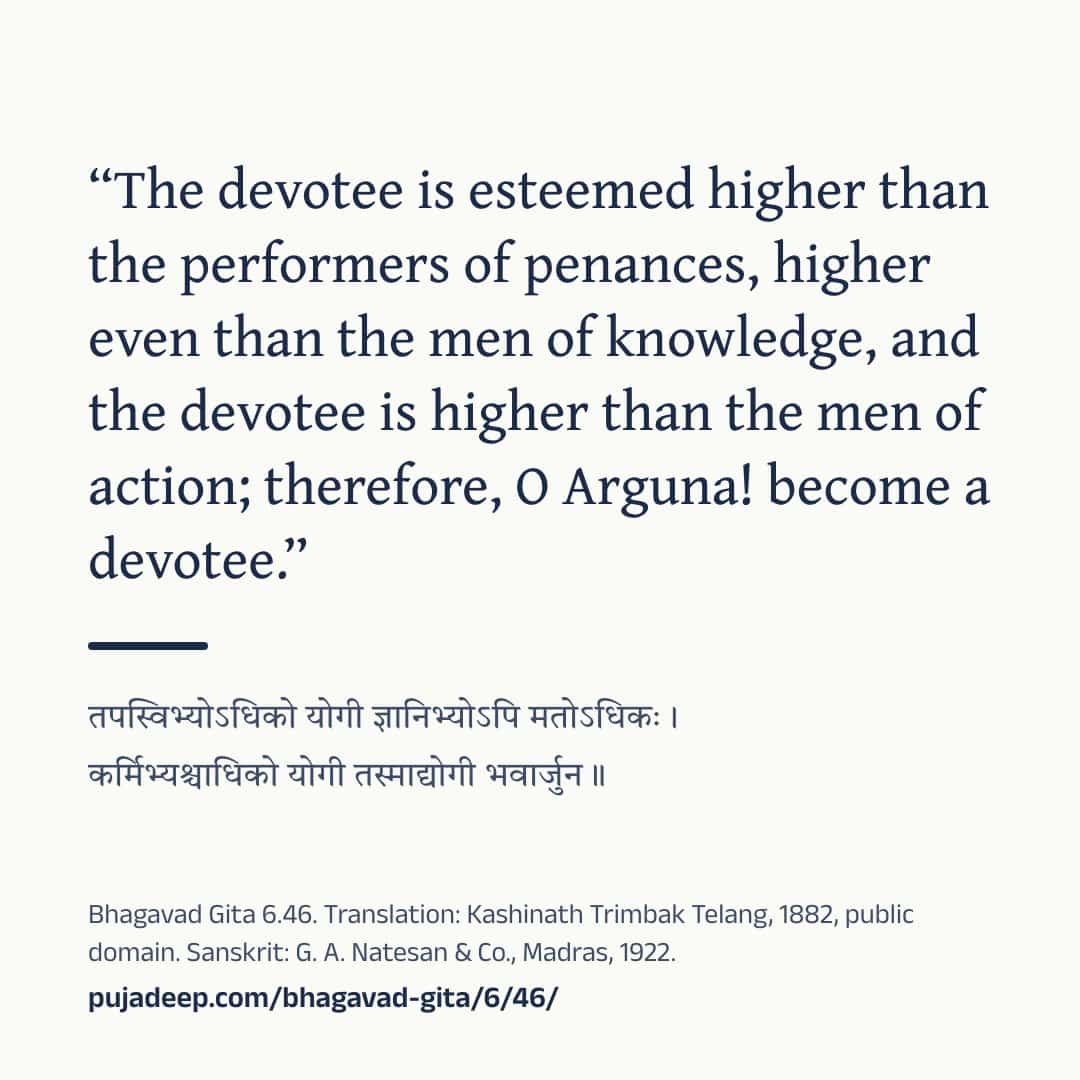
Drawing the picture
See the words
Bhagavad Gita 6.46

तपस्विभ्योऽधिको योगी ज्ञानिभ्योऽपि मतोऽधिकः ।
कर्मिभ्यश्चाधिको योगी तस्माद्योगी भवार्जुन ॥

“The devotee is esteemed higher than the performers of penances, higher even than the men of knowledge, and the devotee is higher than the men of action; therefore, O Arguna! become a devotee.”
(K. T. Telang, The Bhagavadgîtâ (The Sacred Books of the East, vol. VIII, Oxford: Clarendon Press, 1882), p. 73, public domain)

“The Yogî is greater than the ascetics; he is thought to be greater than even the wise; the Yogî is greater than the men of action; therefore become thou a Yog, O Arjuna!”
(Annie Besant, The Bhagavad Gîtâ, or The Lord's Song (London: Theosophical Publishing Society, 1895), p. 74, public domain)

“The Yogi is regarded as superior to those who practise asceticism, also to those who have obtained wisdom (through the Shàstras). He is also superior to the performers of action, (enjoined in the Vedas). Therefore, be thou a Yogi, O Arjuna!”
(Swami Swarupananda, Srimad-Bhagavad-Gita (Mayavati: Prabuddha Bharata Press, 1909; first printed in Prabuddha Bharata, 1907–1909), p. 142, public domain)

Sanskrit: G. A. Natesan & Co., Madras, 1922.
https://pujadeep.com/bhagavad-gita/6/46/ Nothing is sent from this site. Your own app sends it, to the chat you choose. The picture quotes the translation you chose on this page, with its name and year.
Sanskrit text: The Bhagavad-Gita, or The Lord's Song, with the text in Devanagari and an English translation, 1922. Meanings: written for Pujadeep and checked against the cited edition. Source and changes
Questions families ask
Who speaks Bhagavad Gita 6.46?
Krishna speaks this verse, in chapter 6 (Dhyana Yoga).
Where does the Sanskrit text come from?
Sanskrit text: The Bhagavad-Gita, or The Lord's Song, with the text in Devanagari and an English translation, 1922. Meanings: written for Pujadeep and checked against the cited edition. See the source
Is the meaning on this page a translation?
Explanation written for this site from the sources listed here, and checked against the cited edition. It is not a translation and not the only way to read the text. Free to quote with credit.
Source and licence
- Sanskrit text
- The Bhagavad-Gita, or The Lord's Song, with the text in Devanagari and an English translation (Annie Besant, G. A. Natesan & Co., Madras, 1922). Public domain. The Sanskrit on these pages was read from this printing’s page images.
- Translation
- The Bhagavadgîtâ with the Sanatsugâtîya and the Anugîtâ, translated by Kâshinâth Trimbak Telang (The Sacred Books of the East, vol. VIII, ed. F. Max Müller) (Kashinath Trimbak Telang, F. Max Müller, Clarendon Press, Oxford, 1882). Public domain. Shown verbatim, as printed.
- Translation
- The Bhagavad Gîtâ, or The Lord's Song, translated by Annie Besant (Annie Besant, Theosophical Publishing Society, London, 1895). Public domain. Shown verbatim, as printed.
- Translation
- Srimad-Bhagavad-Gita, with Sanskrit Text; Paraphrase with Word-by-word Literal Translation; English Rendering and Comments, Index, &c., by the Swami Swarupananda (Himalayan Series, No. XX) (Swami Swarupananda, The Editors and Publishers, Advaita Ashrama, Mayavati, Prabuddha Bharata Press, Mayavati, Almora, Himalayas, 1909). Public domain. Shown verbatim, as printed.
- Common wording
- In this text, 32 words follow today's common wording, checked against sanskritdocuments.org; Sanskrit Wikisource; Gita Press, Gorakhpur; GRETIL, Göttingen and Bhaktivedanta Book Trust.
- Our explanation
- Explanation written for this site from the sources listed here, and checked against the cited edition. It is not a translation and not the only way to read the text. Free to quote with credit.
- Checked
- Checked against the cited edition, October 15, 2026.
- Updated
- October 25, 2026