Bhagavad Gita 6.47: meaning and translation
Chapter 6: Dhyana Yoga. Krishna says
Krishna closes the chapter.
Click or tap a word for its meaning and its dictionary page.
Text and layers
Text and layers
These choices stay in this browser.
Bhagavad Gita 6.47
योगिनामपि सर्वेषां मद्गतेनान्तरात्मना ।श्रद्धावान्भजते यो मां स मे युक्ततमो मतः ॥
Yoginamapi sarvesham madgatenantaratmanaShraddhavanbhajate yo mam sa me yuktatamo matah
yogināmapi sarveṣāṃ madgatenāntarātmanā |śraddhāvānbhajate yo māṃ sa me yuktatamo mataḥ ||
Our explanation Krishna closes the chapter. Of all yogīs, the one who, full of faith, worships him with the inner self gone to him, is in his view the most joined in yoga (yuktatama). The schools read this verse differently (see the views).
हिंदी अर्थ कृष्ण अध्याय पूरा करते हैं। सब योगियों में भी, जो श्रद्धा से भरकर, अपने अंतरात्मा को उनमें लगाकर, उन्हें भजता है, वह उनके मत में सबसे अधिक युक्त (युक्ततम) है। परंपराएँ इस श्लोक को अलग ढंग से पढ़ती हैं।
Word by word
Every word, with its dictionary page
Word by word
- योगिनाम् yoginām · of yogīs (noun (masculine), genitive plural) Dictionary: yogin, Monier-Williams 1899, p. 857, col. 3 “a follower of the Yoga system, a Yogin (usually called Yogī) or contemplative saint”
- अपि api · even (indeclinable) Dictionary: api, Monier-Williams 1899, p. 55, col. 1 “in the sense of even, also, very”
- सर्वेषाम् sarveṣām · of all (pronoun (masculine), genitive plural) Dictionary: sarva, Monier-Williams 1899, p. 1184, col. 3 “whole, entire, all, every”
- मद्गतेन madgatena · gone to "me" (Krishna) (compound (masculine), instrumental singular) Dictionary: 1. mad, Monier-Williams 1899, p. 777, col. 2 “base of the first pers. pron. in the sg. number (esp. in comp.)”; gata, Monier-Williams 1899, p. 347, col. 1 “gone to any state or condition”
- अन्तरात्मना antarātmanā · with the inner self (compound (masculine), instrumental singular) Dictionary: antar-ātman, Monier-Williams 1899, p. 43, col. 2 “the soul; the internal feelings, the heart or mind”
- श्रद्धावान् śraddhāvān · full of faith (adjective (masculine), nominative singular) Dictionary: śraddhā-vat, Monier-Williams 1899, p. 1095, col. 3
- भजते bhajate · worships (present, 3rd person singular) Dictionary: bhaj, Monier-Williams 1899, p. 743, col. 1 “to serve, honour, revere, love, adore”
- यः yaḥ · who (pronoun (masculine), nominative singular) Dictionary: yad, Monier-Williams 1899, p. 844, col. 2 “who, which, what, whichever, whatever, that”
- माम् mām · "me" (Krishna) (pronoun, accusative singular) Dictionary: 1. mad, Monier-Williams 1899, p. 777, col. 2 “base of the first pers. pron. in the sg. number (esp. in comp.)”
- सः saḥ · he (pronoun (masculine), nominative singular) Dictionary: tad, Monier-Williams 1899, p. 434, col. 1 “m. he, f. she, n. it, that, this”
- मे me · in "my" (Krishna's) view (pronoun, genitive singular) Dictionary: 1. mad, Monier-Williams 1899, p. 777, col. 2 “base of the first pers. pron. in the sg. number (esp. in comp.)”
- युक्ततमः yuktatamaḥ · the most joined in yoga (adjective (masculine), nominative singular) Dictionary: yukta, Monier-Williams 1899, p. 853, col. 2 “yoked or joined or fastened or attached or harnessed”; 2. tama, Monier-Williams 1899, p. 438, col. 2 “an affix forming the superl. degree of adjectives”
- मतः mataḥ · is thought (past participle (masculine), nominative singular) Dictionary: mata, Monier-Williams 1899, p. 783, col. 1 “thought, believed, imagined, supposed, understood; regarded or considered as”
Old translations
Kashinath Trimbak Telang, 1882. Public domain. Page 73.
And even among all devotees, he who, being full of faith, worships me, with his inmost self intent on me, is esteemed by me to be the most devoted.
Compare 3 translations
Kashinath Trimbak Telang, 1882. Public domain. Page 73.
And even among all devotees, he who, being full of faith, worships me, with his inmost self intent on me, is esteemed by me to be the most devoted.
You are reading this one
Annie Besant, 1895. Public domain. Page 74.
And among all Yogîs, he who with the inner SELF abideth in Me, who full of faith, adoreth Me, he is considered by Me to be the most completely harmonised.
You are reading this one
Swami Swarupananda, 1909 (first printed 1907). Public domain. Page 143.
And of all Yogis, he who with the inner self merged in Me, who with Shraddhâ devotes himself to Me, is considered by Me, as the most steadfast.
You are reading this one
Cite this verse
The translation: K. T. Telang, The Bhagavadgîtâ (The Sacred Books of the East, vol. VIII, Oxford: Clarendon Press, 1882), p. 73. Bhagavad Gita 6.47.
The translation: Annie Besant, The Bhagavad Gîtâ, or The Lord's Song (London: Theosophical Publishing Society, 1895), p. 74. Bhagavad Gita 6.47.
The translation: Swami Swarupananda, Srimad-Bhagavad-Gita (Mayavati: Prabuddha Bharata Press, 1909; first printed in Prabuddha Bharata, 1907–1909), p. 143. Bhagavad Gita 6.47.
Our explanation: “Bhagavad Gita 6.47: meaning and translation.” Pujadeep. Updated October 25, 2026. https://pujadeep.com/bhagavad-gita/6/47/
Pujadeep’s explanations are free to quote with credit: name Pujadeep and link to the page. How to credit
Classical readings, by school
Each reading is named by its school. None is presented as the only meaning.
What Advaita, Vishishtadvaita and Dvaita teach, in short
Shankara Advaita
Shankara says the yogīs compared here include those who meditate on gods such as Rudra and Āditya; the one whose inner sense is held steady on Vāsudeva is the most devout of them.
Source: The Bhagavad-Gita, with the commentary of Sri Sankaracharya, translated by A. Mahadeva Sastri (2nd ed., Mysore: G. T. A. Printing Works, 1901), commentary on 6.47, p. 187. Summarised in our own words; none of its text is reproduced.
Ramanuja Vishishtadvaita
Ramanuja reads 'of all yogīs' as 'beyond all yogīs': the loving devotee (bhakta) is not one more kind of yogī but stands above all of them, as a mountain above mustard seeds. He sees this verse as opening the chapters on devotion (7–12).
Source: Sri Bhagavad-Gita with Sri Ramanujacharya's Visishtadvaita commentary, translated by A. Govindacharya (Madras, 1898), commentary on 6.47, pp. 219–221. Summarised in our own words; none of its text is reproduced.
Share
Show the ways to share
Send one picture or the text to one chat. The picture names its source and the address of this page.
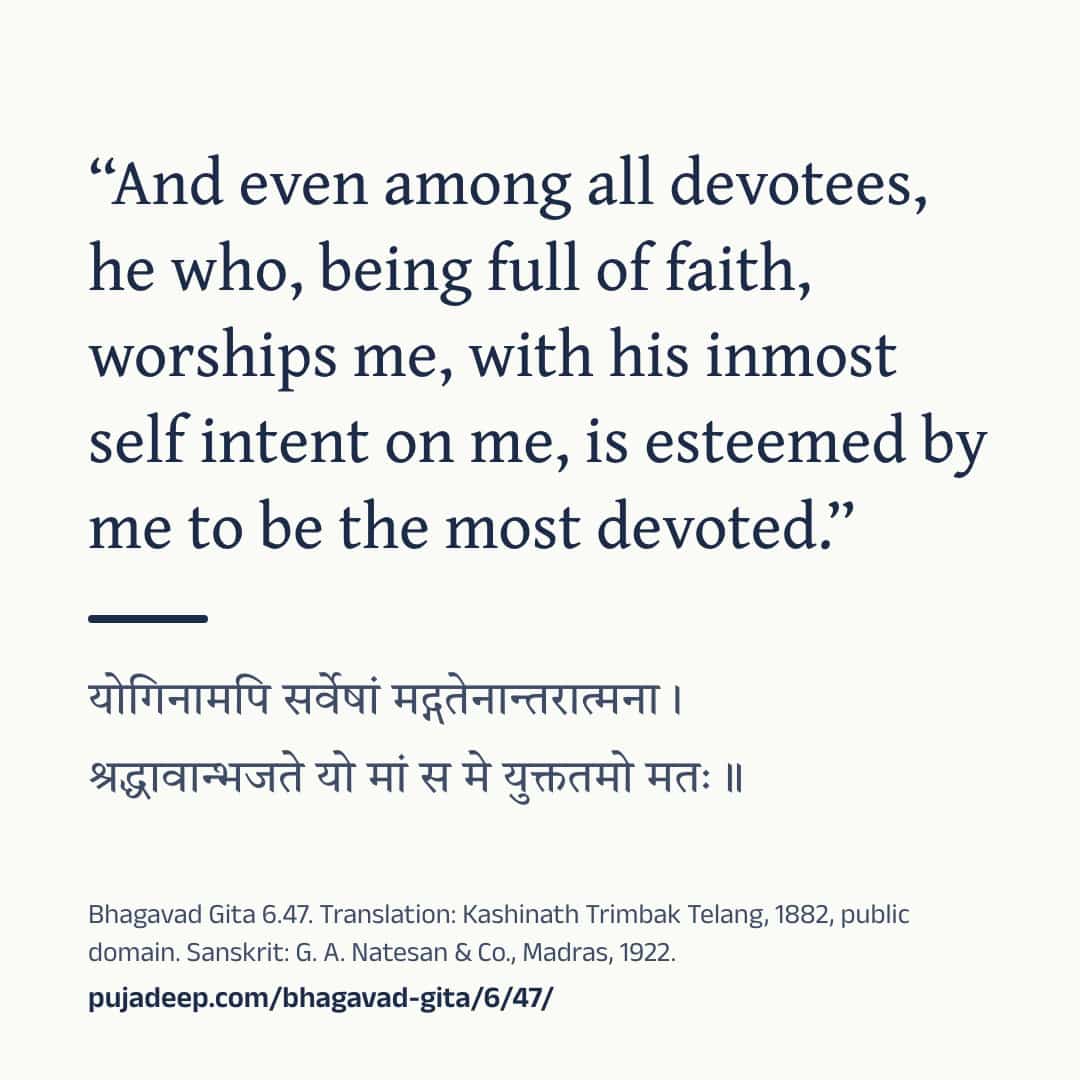
Drawing the picture
See the words
Bhagavad Gita 6.47

योगिनामपि सर्वेषां मद्गतेनान्तरात्मना ।
श्रद्धावान्भजते यो मां स मे युक्ततमो मतः ॥

“And even among all devotees, he who, being full of faith, worships me, with his inmost self intent on me, is esteemed by me to be the most devoted.”
(K. T. Telang, The Bhagavadgîtâ (The Sacred Books of the East, vol. VIII, Oxford: Clarendon Press, 1882), p. 73, public domain)

“And among all Yogîs, he who with the inner SELF abideth in Me, who full of faith, adoreth Me, he is considered by Me to be the most completely harmonised.”
(Annie Besant, The Bhagavad Gîtâ, or The Lord's Song (London: Theosophical Publishing Society, 1895), p. 74, public domain)

“And of all Yogis, he who with the inner self merged in Me, who with Shraddhâ devotes himself to Me, is considered by Me, as the most steadfast.”
(Swami Swarupananda, Srimad-Bhagavad-Gita (Mayavati: Prabuddha Bharata Press, 1909; first printed in Prabuddha Bharata, 1907–1909), p. 143, public domain)

Sanskrit: G. A. Natesan & Co., Madras, 1922.
https://pujadeep.com/bhagavad-gita/6/47/ Nothing is sent from this site. Your own app sends it, to the chat you choose. The picture quotes the translation you chose on this page, with its name and year.
Sanskrit text: The Bhagavad-Gita, or The Lord's Song, with the text in Devanagari and an English translation, 1922. Meanings: written for Pujadeep and checked against the cited edition. Source and changes
Questions families ask
Who speaks Bhagavad Gita 6.47?
Krishna speaks this verse, in chapter 6 (Dhyana Yoga).
Where does the Sanskrit text come from?
Sanskrit text: The Bhagavad-Gita, or The Lord's Song, with the text in Devanagari and an English translation, 1922. Meanings: written for Pujadeep and checked against the cited edition. See the source
Is the meaning on this page a translation?
Explanation written for this site from the sources listed here, and checked against the cited edition. It is not a translation and not the only way to read the text. Free to quote with credit.
Source and licence
- Sanskrit text
- The Bhagavad-Gita, or The Lord's Song, with the text in Devanagari and an English translation (Annie Besant, G. A. Natesan & Co., Madras, 1922). Public domain. The Sanskrit on these pages was read from this printing’s page images.
- Translation
- The Bhagavadgîtâ with the Sanatsugâtîya and the Anugîtâ, translated by Kâshinâth Trimbak Telang (The Sacred Books of the East, vol. VIII, ed. F. Max Müller) (Kashinath Trimbak Telang, F. Max Müller, Clarendon Press, Oxford, 1882). Public domain. Shown verbatim, as printed.
- Translation
- The Bhagavad Gîtâ, or The Lord's Song, translated by Annie Besant (Annie Besant, Theosophical Publishing Society, London, 1895). Public domain. Shown verbatim, as printed.
- Translation
- Srimad-Bhagavad-Gita, with Sanskrit Text; Paraphrase with Word-by-word Literal Translation; English Rendering and Comments, Index, &c., by the Swami Swarupananda (Himalayan Series, No. XX) (Swami Swarupananda, The Editors and Publishers, Advaita Ashrama, Mayavati, Prabuddha Bharata Press, Mayavati, Almora, Himalayas, 1909). Public domain. Shown verbatim, as printed.
- Commentary
- The Bhagavad-Gita, with the commentary of Sri Sankaracharya, translated by A. Mahadeva Sastri (2nd ed., Mysore: G. T. A. Printing Works, 1901) (Public-domain scan, University of California Libraries). Summarised in our own words; none of its text is reproduced.
- Commentary
- Sri Bhagavad-Gita with Sri Ramanujacharya's Visishtadvaita commentary, translated by A. Govindacharya (Madras, 1898) (Scan uploaded to archive.org (folkscanomy collection)). Summarised in our own words; none of its text is reproduced.
- Common wording
- In this text, 32 words follow today's common wording, checked against sanskritdocuments.org; Sanskrit Wikisource; Gita Press, Gorakhpur; GRETIL, Göttingen and Bhaktivedanta Book Trust.
- Our explanation
- Explanation written for this site from the sources listed here, and checked against the cited edition. It is not a translation and not the only way to read the text. Free to quote with credit.
- Checked
- Checked against the cited edition, October 15, 2026.
- Updated
- October 25, 2026