Bhagavad Gita 7.1: meaning and translation
Chapter 7: Jnana Vijnana Yoga. Krishna says
Krishna begins a new teaching.
Click or tap a word for its meaning and its dictionary page.
Text and layers
Text and layers
These choices stay in this browser.
Bhagavad Gita 7.1
श्रीभगवानुवाच ।
मय्यासक्तमनाः पार्थ योगं युञ्जन्मदाश्रयः ।असंशयं समग्रं मां यथा ज्ञास्यसि तच्छृणु ॥
Mayyasaktamanah partha yogam yunjanmadashrayahAsanshayam samagram mam yatha jnasyasi tachchhrinu
mayyāsaktamanāḥ pārtha yogaṃ yuñjanmadāśrayaḥ |asaṃśayaṃ samagraṃ māṃ yathā jñāsyasi tacchṛṇu ||
Our explanation Krishna begins a new teaching. He tells Arjuna (Partha) to listen: with his mind attached to Krishna, practising yoga and taking refuge in him, Arjuna will come to know him fully and without doubt.
हिंदी अर्थ कृष्ण नया उपदेश आरंभ करते हैं। वे अर्जुन (पार्थ) से कहते हैं कि सुनो: कृष्ण में मन लगाकर, योग का अभ्यास करते हुए और उनकी शरण लेकर अर्जुन उन्हें पूरी तरह और बिना किसी संशय के जान लेंगे।
Word by word
Every word, with its dictionary page
Word by word
- मय्यासक्तमनाः mayyāsaktamanāḥ · with mind attached to "me" (Krishna) (compound (masculine), nominative singular) Dictionary: 1. mad, Monier-Williams 1899, p. 777, col. 2 “base of the first pers. pron. in the sg. number (esp. in comp.)”; ā-sakta, Monier-Williams 1899, p. 160, col. 1 “fixed or fastened to; attached to”; manas, Monier-Williams 1899, p. 783, col. 3 “mind (in its widest sense as applied to all the mental powers)”
- पार्थ pārtha · O Partha (son of Pritha) (noun (masculine), vocative singular) Dictionary: 2. pārtha, Monier-Williams 1899, p. 621, col. 3 “metron. of Yudhi-shṭhira or Bhīma-sena or Arjuna”
- योगम् yogam · yoga, discipline (noun (masculine), accusative singular) Dictionary: yoga, Monier-Williams 1899, p. 856, col. 3 “application or concentration of the thoughts, abstract contemplation, meditation”
- युञ्जन् yuñjan · practising (present participle (masculine), nominative singular) Dictionary: 1. yuj, Monier-Williams 1899, p. 853, col. 2 “to yoke or join or fasten or harness”
- मदाश्रयः madāśrayaḥ · taking refuge in "me" (Krishna) (compound (masculine), nominative singular) Dictionary: 1. mad, Monier-Williams 1899, p. 777, col. 2 “base of the first pers. pron. in the sg. number (esp. in comp.)”; ā-śraya, Monier-Williams 1899, p. 158, col. 2 “dwelling, asylum, place of refuge, shelter”
- असंशयम् asaṃśayam · without doubt (adverb) Dictionary: a-saṃśaya, Monier-Williams 1899, p. 117, col. 3 “absence of doubt, certainty”
- समग्रम् samagram · fully, as a whole (adjective (masculine), accusative singular) Dictionary: sam-agra, Monier-Williams 1899, p. 1153, col. 3 “all, entire, whole, complete”
- माम् mām · "me" (Krishna) (pronoun, accusative singular) Dictionary: 1. mad, Monier-Williams 1899, p. 777, col. 2 “base of the first pers. pron. in the sg. number (esp. in comp.)”
- यथा yathā · how (indeclinable) Dictionary: yathā, Monier-Williams 1899, p. 841, col. 2 “in which manner or way, according as, as, like”
- ज्ञास्यसि jñāsyasi · you will know (future, 2nd person singular) Dictionary: 1. jñā, Monier-Williams 1899, p. 425, col. 3 “to know, have knowledge, become acquainted with”
- तत् tat · that (pronoun (neuter), accusative singular) Dictionary: tad, Monier-Williams 1899, p. 434, col. 1 “m. he, f. she, n. it, that, this”
- शृणु śṛṇu · hear, listen (imperative, 2nd person singular) Dictionary: 1. śru, Monier-Williams 1899, p. 1100, col. 3 “to hear, listen or attend to anything”
Old translations
Kashinath Trimbak Telang, 1882. Public domain. Page 73.
The Deity said:
O son of Prithâ! now hear how you can without doubt know me fully, fixing your mind on me, and resting in me, and practising devotion.
Compare 3 translations
Kashinath Trimbak Telang, 1882. Public domain. Page 73.
The Deity said:
O son of Prithâ! now hear how you can without doubt know me fully, fixing your mind on me, and resting in me, and practising devotion.
You are reading this one
Annie Besant, 1895. Public domain. Page 75.
The Blessed Lord said:
With Manas clinging to Me, O Pârtha constant in Yoga, refuged in Me, how thou shalt without doubt know Me to the uttermost, that hear thou.
You are reading this one
Swami Swarupananda, 1909 (first printed 1907). Public domain. Page 144.
The Blessed Lord said:
With the mind intent on Me, O son of Prithâ, taking refuge in Me, and practising Yoga, how thou shalt without doubt know Me fully, that do thou hear.
You are reading this one
Cite this verse
The translation: K. T. Telang, The Bhagavadgîtâ (The Sacred Books of the East, vol. VIII, Oxford: Clarendon Press, 1882), p. 73. Bhagavad Gita 7.1.
The translation: Annie Besant, The Bhagavad Gîtâ, or The Lord's Song (London: Theosophical Publishing Society, 1895), p. 75. Bhagavad Gita 7.1.
The translation: Swami Swarupananda, Srimad-Bhagavad-Gita (Mayavati: Prabuddha Bharata Press, 1909; first printed in Prabuddha Bharata, 1907–1909), p. 144. Bhagavad Gita 7.1.
Our explanation: “Bhagavad Gita 7.1: meaning and translation.” Pujadeep. Updated October 27, 2026. https://pujadeep.com/bhagavad-gita/7/1/
Pujadeep’s explanations are free to quote with credit: name Pujadeep and link to the page. How to credit
Classical readings, by school
No readings by school on this verse yet.
Share
Show the ways to share
Send one picture or the text to one chat. The picture names its source and the address of this page.
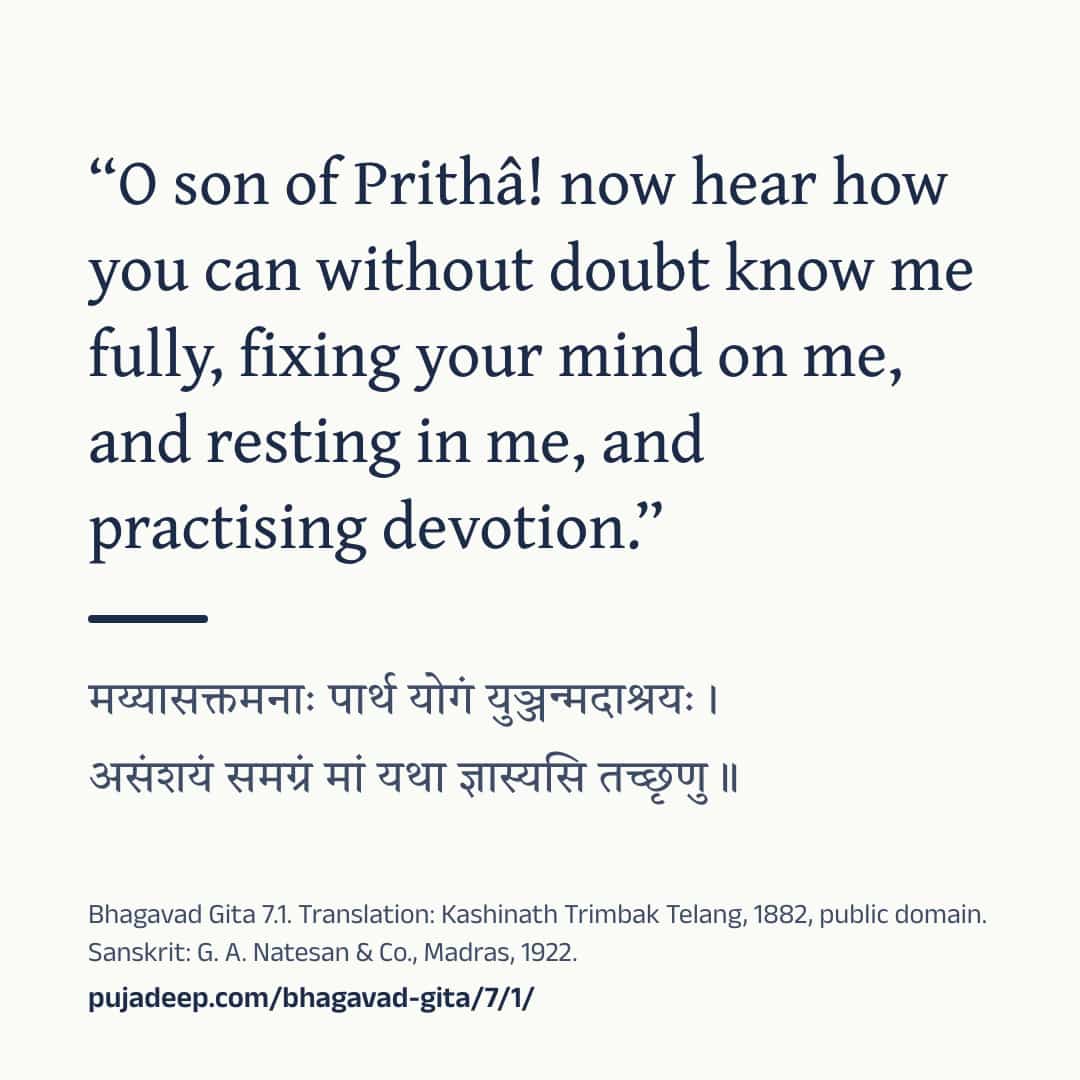
Drawing the picture
See the words
Bhagavad Gita 7.1

मय्यासक्तमनाः पार्थ योगं युञ्जन्मदाश्रयः ।
असंशयं समग्रं मां यथा ज्ञास्यसि तच्छृणु ॥

“O son of Prithâ! now hear how you can without doubt know me fully, fixing your mind on me, and resting in me, and practising devotion.”
(K. T. Telang, The Bhagavadgîtâ (The Sacred Books of the East, vol. VIII, Oxford: Clarendon Press, 1882), p. 73, public domain)

“With Manas clinging to Me, O Pârtha constant in Yoga, refuged in Me, how thou shalt without doubt know Me to the uttermost, that hear thou.”
(Annie Besant, The Bhagavad Gîtâ, or The Lord's Song (London: Theosophical Publishing Society, 1895), p. 75, public domain)

“With the mind intent on Me, O son of Prithâ, taking refuge in Me, and practising Yoga, how thou shalt without doubt know Me fully, that do thou hear.”
(Swami Swarupananda, Srimad-Bhagavad-Gita (Mayavati: Prabuddha Bharata Press, 1909; first printed in Prabuddha Bharata, 1907–1909), p. 144, public domain)

Sanskrit: G. A. Natesan & Co., Madras, 1922.
https://pujadeep.com/bhagavad-gita/7/1/ Nothing is sent from this site. Your own app sends it, to the chat you choose. The picture quotes the translation you chose on this page, with its name and year.
Sanskrit text: The Bhagavad-Gita, or The Lord's Song, with the text in Devanagari and an English translation, 1922. Meanings: written for Pujadeep and checked against the cited edition. Source and changes
Questions families ask
Who speaks Bhagavad Gita 7.1?
Krishna speaks this verse, in chapter 7 (Jnana Vijnana Yoga).
Where does the Sanskrit text come from?
Sanskrit text: The Bhagavad-Gita, or The Lord's Song, with the text in Devanagari and an English translation, 1922. Meanings: written for Pujadeep and checked against the cited edition. See the source
Is the meaning on this page a translation?
Explanation written for this site from the sources listed here, and checked against the cited edition. It is not a translation and not the only way to read the text. Free to quote with credit.
Source and licence
- Sanskrit text
- The Bhagavad-Gita, or The Lord's Song, with the text in Devanagari and an English translation (Annie Besant, G. A. Natesan & Co., Madras, 1922). Public domain. The Sanskrit on these pages was read from this printing’s page images.
- Translation
- The Bhagavadgîtâ with the Sanatsugâtîya and the Anugîtâ, translated by Kâshinâth Trimbak Telang (The Sacred Books of the East, vol. VIII, ed. F. Max Müller) (Kashinath Trimbak Telang, F. Max Müller, Clarendon Press, Oxford, 1882). Public domain. Shown verbatim, as printed.
- Translation
- The Bhagavad Gîtâ, or The Lord's Song, translated by Annie Besant (Annie Besant, Theosophical Publishing Society, London, 1895). Public domain. Shown verbatim, as printed.
- Translation
- Srimad-Bhagavad-Gita, with Sanskrit Text; Paraphrase with Word-by-word Literal Translation; English Rendering and Comments, Index, &c., by the Swami Swarupananda (Himalayan Series, No. XX) (Swami Swarupananda, The Editors and Publishers, Advaita Ashrama, Mayavati, Prabuddha Bharata Press, Mayavati, Almora, Himalayas, 1909). Public domain. Shown verbatim, as printed.
- Common wording
- In this text, 32 words follow today's common wording, checked against sanskritdocuments.org; Sanskrit Wikisource; Gita Press, Gorakhpur; GRETIL, Göttingen and Bhaktivedanta Book Trust.
- Our explanation
- Explanation written for this site from the sources listed here, and checked against the cited edition. It is not a translation and not the only way to read the text. Free to quote with credit.
- Checked
- Checked against the cited edition, October 15, 2026.
- Updated
- October 27, 2026